Nedarim 9b: Talmud study for Daf Yomi
Daf Yomi is the daily study of one Talmud folio. Explore 37 tractates with scans, Hebrew text, Sefaria English and AI-generated French translations where annotated.
Passage selection and English or AI-generated French translation are available where the scan has annotations. Daf Study is independent of Torah-Box and Sefaria.
Browse Nedarim · נדרים · All tractatesNedarim 9b text and translations
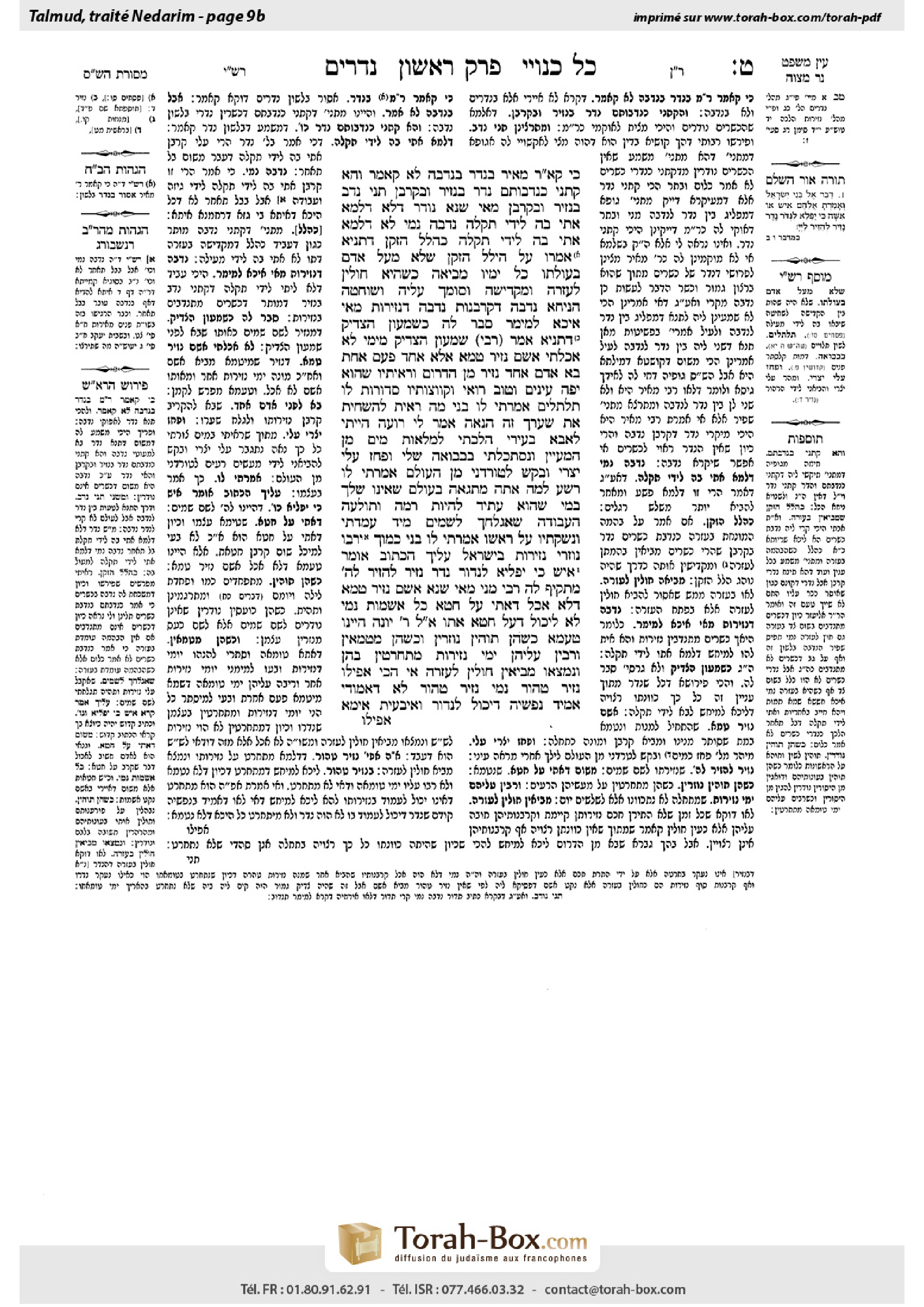
This page of Nedarim includes the Aramaic text, an English translation and an AI-generated French translation, alongside the scan above.
נדרים ט׳ ב · Aramaic and Hebrew text
כִּי קָאָמַר רַבִּי מֵאִיר — בְּנֶדֶר, בִּנְדָבָה לָא קָאָמַר. וְהָא קָתָנֵי: ״כְּנִדְבוֹתָם״ — נָדַר בְּנָזִיר וּבְקׇרְבָּן! תְּנִי: נָדַב בְּנָזִיר וּבְקׇרְבָּן.
מַאי שְׁנָא נוֹדֵר דְּלָא — דִּלְמָא אָתֵי בָּהּ לִידֵי תַקָּלָה? נְדָבָה נָמֵי לָא — דִּלְמָא אָתֵי בָּהּ לִידֵי תַקָּלָה!
כְּהִלֵּל הַזָּקֵן. דְּתַנְיָא: אָמְרוּ עַל הִילֵּל הַזָּקֵן שֶׁלֹּא מָעַל אָדָם בְּעוֹלָתוֹ כׇּל יָמָיו. מְבִיאָהּ כְּשֶׁהִיא חוּלִּין לָעֲזָרָה, וּמַקְדִּישָׁהּ, וְסוֹמֵךְ עָלֶיהָ, וְשׁוֹחֲטָהּ.
הָנִיחָא נְדָבָה דְקׇרְבָּנוֹת. נְדָבָה דִנְזִירוּת מַאי אִיכָּא לְמֵימַר? סָבַר לַהּ כְּשִׁמְעוֹן הַצַּדִּיק.
דְּתַנְיָא, אָמַר (רַבִּי) שִׁמְעוֹן הַצַּדִּיק: מִיָּמַי לֹא אָכַלְתִּי אֲשַׁם נָזִיר טָמֵא אֶלָּא אֶחָד. פַּעַם אַחַת בָּא אָדָם אֶחָד נָזִיר מִן הַדָּרוֹם, וּרְאִיתִיו שֶׁהוּא יְפֵה עֵינַיִם וְטוֹב רוֹאִי וּקְווּצּוֹתָיו סְדוּרוֹת לוֹ תַּלְתַּלִּים. אָמַרְתִּי לוֹ: בְּנִי, מָה רָאִיתָ לְהַשְׁחִית אֶת שְׂעָרְךָ זֶה הַנָּאֶה?
אָמַר לִי: רוֹעֶה הָיִיתִי לְאַבָּא בְּעִירִי, הָלַכְתִּי לְמַלּאוֹת מַיִם מִן הַמַּעְיָין וְנִסְתַּכַּלְתִּי בַּבָּבוּאָה שֶׁלִּי, וּפָחַז עָלַי יִצְרִי וּבִקֵּשׁ לְטוֹרְדֵנִי מִן הָעוֹלָם. אָמַרְתִּי לוֹ: רָשָׁע! לָמָה אַתָּה מִתְגָּאֶה בְּעוֹלָם שֶׁאֵינוֹ שֶׁלְּךָ, בְּמִי שֶׁהוּא עָתִיד לִהְיוֹת רִמָּה וְתוֹלֵעָה? הָעֲבוֹדָה, שֶׁאֲגַלֵּחֲךָ לַשָּׁמַיִם!
מִיָּד עָמַדְתִּי וּנְשַׁקְתִּיו עַל רֹאשׁוֹ, אָמַרְתִּי לוֹ: בְּנִי, כָּמוֹךָ יִרְבּוּ נוֹזְרֵי נְזִירוּת בְּיִשְׂרָאֵל. עָלֶיךָ הַכָּתוּב אוֹמֵר ״אִישׁ כִּי יַפְלִא לִנְדֹּר נֶדֶר נָזִיר לְהַזִּיר לַה׳״.
מַתְקֵיף לַהּ רַבִּי מָנִי: מַאי שְׁנָא אֲשַׁם נָזִיר טָמֵא דְּלָא אֲכַל — דְּאָתֵי עַל חֵטְא? כׇּל אֲשָׁמוֹת נָמֵי לָא לֵיכוֹל, דְּעַל חֵטְא אָתוּ!
אֲמַר לֵיהּ רַבִּי יוֹנָה, הַיְינוּ טַעְמָא: כְּשֶׁהֵן תּוֹהִין נוֹזְרִין. וּכְשֶׁהֵן מִטַּמְּאִין וְרָבִין עֲלֵיהֶן יְמֵי נְזִירוּת, מִתְחָרְטִין בָּהֶן, וְנִמְצְאוּ מְבִיאִין חוּלִּין לָעֲזָרָה.
אִי הָכִי, אֲפִילּוּ נָזִיר טָהוֹר נָמֵי! נָזִיר טָהוֹר לָא, דְּאָמוֹדֵי אָמֵיד נַפְשֵׁיהּ דְּיָכוֹל לִנְדּוֹר.
וְאִיבָּעֵית אֵימָא:
Nedarim 9b · English translation
When Rabbi Meir said that one should abstain from making vows, he was referring only to a vow; he did not say it with regard to a gift offering. The Gemara asks: But it is taught in the mishna that if one said: Like the gift offerings of the virtuous, he has vowed with regard to becoming a nazirite or bringing an offering; this indicates that the virtuous vow to become nazirites and bring offerings. The Gemara answers: Teach the mishna in the following emended formulation: He has volunteered with regard to becoming a nazirite or bringing an offering.
The Gemara asks: What is different about one who vows, i.e., one who says: It is incumbent upon me to bring an offering, which is not proper to do due to the concern that perhaps he will encounter a stumbling block and not bring it promptly, thereby violating the prohibition against delaying? One should also not designate a particular animal as a gift offering due to the concern that perhaps he will encounter a stumbling block with it. Once the animal is consecrated, anyone who unwittingly benefits from it, e.g., by shearing it or working with it, transgresses the prohibition against misusing consecrated property.
The Gemara answers: In the case of a gift offering, he can act like Hillel the Elder. As it is taught in a baraita: They said about Hillel the Elder that no person misused his burnt-offering in his lifetime. How did he ensure this? He was careful not to consecrate the animal in advance; rather, he would bring it when it was unconsecrated to the Temple courtyard and there he would consecrate it, and then immediately he would place his hand on its head and slaughter it. Consequently, there was no opportunity to misuse it.
The Gemara asks: This works out well with regard to voluntary gifts in the context of offerings, but with regard to the voluntary acceptance of naziriteship, what is there to say? There is still room for concern that he will not fulfill the obligations incumbent upon him as a nazirite. The Gemara answers: Rabbi Meir holds in accordance with the opinion of Shimon HaTzaddik.
As it is taught in a baraita that Rabbi Shimon HaTzaddik said: In all my days as a priest, I never ate the guilt-offering of a ritually impure nazirite except for one occasion. One time, a particular man who was a nazirite came from the South and I saw that he had beautiful eyes and was good looking, and the fringes of his hair were arranged in curls. I said to him: My son, what did you see that made you decide to destroy this beautiful hair of yours by becoming a nazirite? A nazirite must shave off his hair at the completion of his term. If he becomes impure before the completion of his term, he shaves off his hair and starts his term of naziriteship again.
He said to me: I was a shepherd for my father in my city, and I went to draw water from the spring, and I looked at my reflection [babavua] in the water and my evil inclination quickly overcame me and sought to expel me from the world. I said to myself: Wicked one! Why do you pride yourself in a world that is not yours? Why are you proud of someone who will eventually be food in the grave for worms and maggots, i.e., your body? I swear by the Temple service that I shall shave you for the sake of Heaven.
Shimon HaTzaddik continues the narrative: I immediately arose and kissed him on his head. I said to him: My son, may there be more who take vows of naziriteship like you among the Jewish people. About you the verse states: “When either a man or a woman shall clearly utter a vow, the vow of a nazirite, to consecrate himself to the Lord” (Numbers 6:2). This is an example of voluntary acceptance of naziriteship, i.e., becoming a nazirite with entirely pure intentions rather than as a rash statement, e.g., while in a fit of anger.
Rabbi Mani strongly objects to the statement of Shimon HaTzaddik. What is different about the guilt-offering of a ritually impure nazirite that Shimon HaTzaddik did not eat, because it came as a result of sin when the individual violated the terms of his naziriteship by becoming impure? Let him also not eat all other guilt-offerings, as they too come as a result of sin.
Rabbi Yona said to him: This is the reason: When they regret their misdeeds they become nazirites, and when they become ritually impure and the days of their naziriteship are increased, as they must become pure and then begin their terms of naziriteship again, they regret having become nazirites. They will then turn out to be bringing non-sacred animals into the Temple courtyard. Since they do not wish to bring the offerings of a nazirite, their offerings are undesirable, and it is as though the animals are non-sacred.
The Gemara asks: If so, then Shimon HaTzaddik should have abstained from eating even the offerings of a ritually pure nazirite as well for the same reason; perhaps he too regretted his decision to become a nazirite. The Gemara answers: In the case of a pure nazirite there is no concern because he assessed himself and realized that he was able to vow and to keep his vow for the term of his naziriteship. However, in the case of a ritually impure nazirite, where the naziriteship was extended for longer than he had estimated due to his contracting impurity, there is concern that he regrets having become a nazirite.
The Gemara suggests a different answer to the question of the identity of the tanna whose opinion is expressed in the mishna. And if you wish, say:
Nedarim 9b · Traduction française (IA)
Lorsque Rabbi Meir a dit qu’il fallait s’abstenir de faire des vœux, il ne faisait référence qu’à un vœu ; il ne parlait pas d’une offrande volontaire. La Guemara demande : Mais la Michna enseigne que si quelqu’un dit : « Comme les offrandes volontaires des hommes vertueux », il a fait vœu de devenir nazir ou d’apporter une offrande. Cela indique que les hommes vertueux font vœu de devenir nazir et d’apporter des offrandes. La Guemara répond : Il faut enseigner la Michna selon la formulation corrigée suivante : il s’est porté volontaire pour devenir nazir ou apporter une offrande.
La Guemara demande : En quoi celui qui fait un vœu — c’est-à-dire qui dit : « Je suis tenu d’apporter une offrande » — est-il différent ? Il n’est pas convenable d’agir ainsi, de crainte qu’il ne rencontre un obstacle et ne l’apporte pas rapidement, transgressant ainsi l’interdiction de tarder. Il ne faudrait pas non plus désigner un animal particulier comme offrande volontaire, de crainte qu’il ne rencontre un obstacle à son sujet. Une fois l’animal consacré, quiconque en tire involontairement profit, par exemple en le tondant ou en l’utilisant pour travailler, transgresse l’interdiction de faire un usage profane d’un bien consacré.
La Guemara répond : Dans le cas d’une offrande volontaire, il peut agir comme Hillel l’Ancien. En effet, une baraïta enseigne qu’on a dit au sujet de Hillel l’Ancien que personne n’a fait un usage profane de son holocauste de son vivant. Comment s’y prenait-il ? Il veillait à ne pas consacrer l’animal à l’avance ; il l’amenait non consacré dans la cour du Temple, le consacrait là, puis posait aussitôt la main sur sa tête et l’égorgeait. Il n’y avait donc pas la possibilité d’en faire un usage profane.
La Guemara demande : Cela s’explique bien pour les offrandes volontaires, mais que dire de l’acceptation volontaire du naziréat ? Il reste à craindre que la personne n’accomplisse pas les obligations qui lui incombent en tant que nazir. La Guemara répond : Rabbi Meir suit l’opinion de Shimon HaTzaddik.
En effet, une baraïta enseigne que Rabbi Shimon HaTzaddik a dit : De toute ma vie de prêtre, je n’ai jamais mangé le sacrifice de culpabilité d’un nazir rituellement impur, sauf une seule fois. Un jour, un certain homme, qui était nazir, vint du Sud. Je vis qu’il avait de beaux yeux, qu’il était beau et que les mèches de ses cheveux retombaient en boucles. Je lui dis : « Mon fils, qu’as-tu vu qui t’a décidé à détruire tes beaux cheveux en devenant nazir ? » Un nazir doit se raser les cheveux à la fin de son terme. S’il devient rituellement impur avant la fin de son terme, il se rase les cheveux et recommence son terme de naziréat.
Il me dit : « J’étais berger pour mon père dans ma ville. Un jour, j’allai puiser de l’eau à la source et je regardai mon reflet [babavua] dans l’eau. Mon mauvais penchant me domina rapidement et chercha à me faire quitter ce monde. Je me dis : “Mécréant ! Pourquoi tires-tu orgueil d’un monde qui ne t’appartient pas ? Pourquoi es-tu fier de quelqu’un qui finira par servir de nourriture aux vers et aux asticots dans la tombe, c’est-à-dire ton corps ? Je jure par le service du Temple que je te raserai pour l’amour du Ciel.” »
Shimon HaTzaddik poursuit son récit : Je me levai aussitôt et l’embrassai sur la tête. Je lui dis : « Mon fils, puisse-t-il y avoir beaucoup de gens comme toi, parmi le peuple juif, qui font vœu de naziréat. » C’est à ton sujet que le verset dit : « Lorsqu’un homme ou une femme prononcera clairement un vœu, le vœu d’un nazir, pour se consacrer à l’Éternel » (Nombres 6:2). Voilà un exemple d’acceptation volontaire du naziréat, c’est-à-dire de quelqu’un qui devient nazir avec des intentions entièrement pures, et non à la suite d’une parole irréfléchie, par exemple sous le coup de la colère.
Rabbi Mani s’oppose vivement à la déclaration de Shimon HaTzaddik. En quoi le sacrifice de culpabilité d’un nazir rituellement impur, que Shimon HaTzaddik ne mangeait pas parce qu’il résultait d’une faute — l’individu ayant enfreint les règles de son naziréat en devenant rituellement impur — est-il différent ? Qu’il ne mange pas non plus les autres sacrifices de culpabilité, puisqu’ils résultent eux aussi d’une faute.
Rabbi Yona lui dit : « Voici la raison : lorsqu’ils regrettent leurs méfaits, ils deviennent nazir. Mais lorsqu’ils deviennent rituellement impurs et que la durée de leur naziréat s’allonge — puisqu’ils doivent retrouver leur pureté puis recommencer leur terme de naziréat —, ils regrettent d’être devenus nazir. Il s’ensuit qu’ils font entrer des animaux non consacrés dans la cour du Temple. Puisqu’ils ne souhaitent pas apporter les offrandes d’un nazir, leurs offrandes ne sont pas désirées, et c’est comme si les animaux n’étaient pas consacrés. »
La Guemara demande : Si tel est le cas, Shimon HaTzaddik aurait également dû s’abstenir de manger les offrandes d’un nazir rituellement pur, pour la même raison : peut-être celui-ci aussi regrettait-il d’être devenu nazir. La Guemara répond : Dans le cas d’un nazir rituellement pur, il n’y a pas lieu de s’inquiéter, car il s’était évalué et avait compris qu’il était capable de faire un vœu et de le respecter pendant toute la durée de son naziréat. En revanche, dans le cas d’un nazir rituellement impur, dont le naziréat a duré plus longtemps que prévu parce qu’il a contracté une impureté, on peut craindre qu’il regrette d’être devenu nazir.
La Guemara propose une autre réponse à la question de savoir quel est le tanna dont l’opinion est exprimée dans la Michna. Et si tu veux, dis :
Traduction française générée par IA à partir de l’édition anglaise de Sefaria. Vérifie toujours un passage avec le texte source.
Text from Sefaria: William Davidson Edition - Vocalized Aramaic (CC BY NC); William Davidson Edition - English (CC BY NC).