Nedarim 9a: Talmud study for Daf Yomi
Daf Yomi is the daily study of one Talmud folio. Explore 37 tractates with scans, Hebrew text, Sefaria English and AI-generated French translations where annotated.
Passage selection and English or AI-generated French translation are available where the scan has annotations. Daf Study is independent of Torah-Box and Sefaria.
Browse Nedarim · נדרים · All tractatesNedarim 9a text and translations
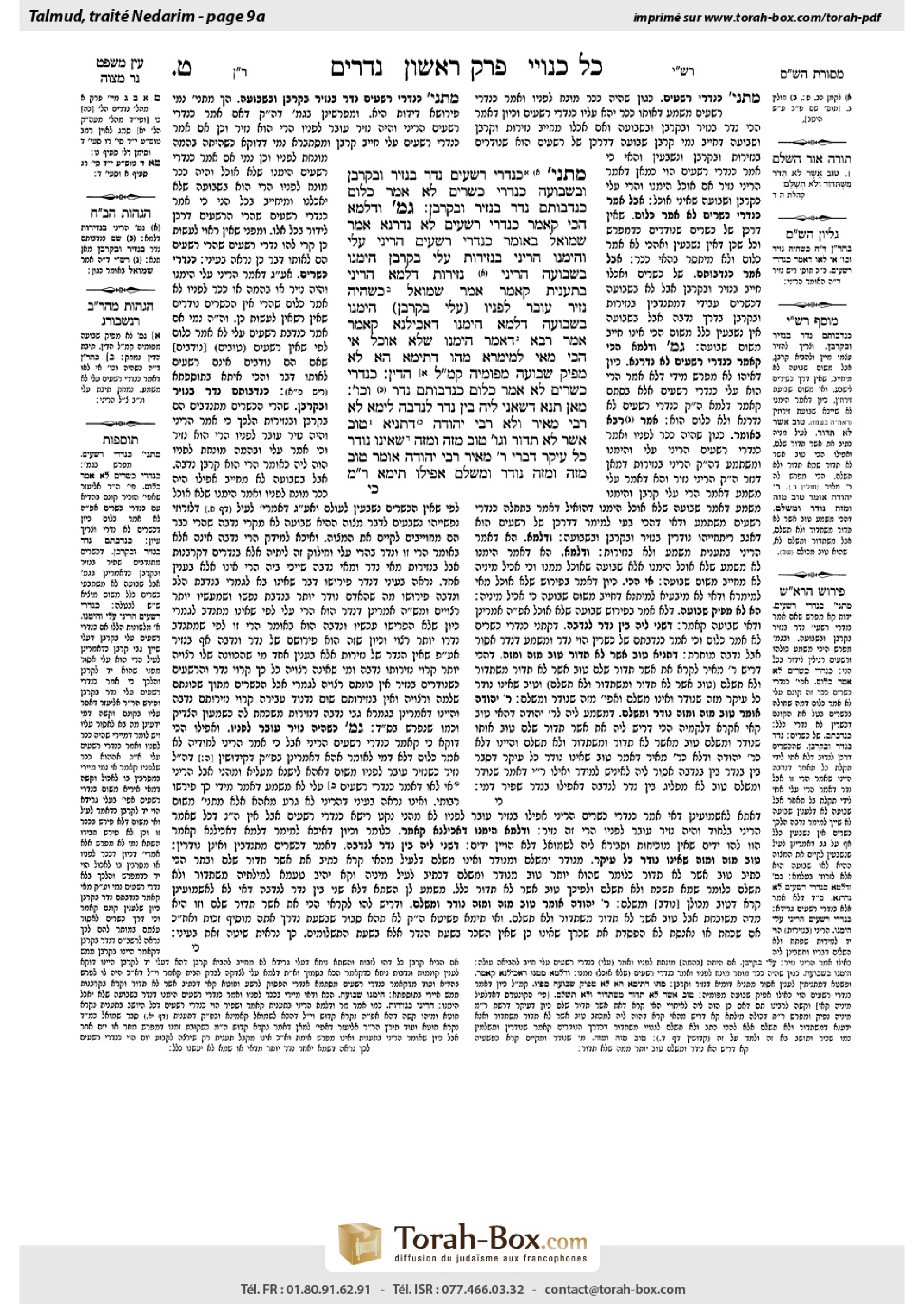
This page of Nedarim includes the Aramaic text, an English translation and an AI-generated French translation, alongside the scan above.
נדרים ט׳ א · Aramaic and Hebrew text
מַתְנִי׳ ״כְּנִדְרֵי רְשָׁעִים״ — נָדַר בְּנָזִיר וּבְקׇרְבָּן וּבִשְׁבוּעָה. ״כְּנִדְרֵי כְשֵׁרִים״ — לֹא אָמַר כְּלוּם. ״כְּנִדְבוֹתָם״ — נָדַר בְּנָזִיר וּבְקׇרְבָּן.
גְּמָ׳ וְדִלְמָא הָכִי קָאָמַר: כְּנִדְרֵי רְשָׁעִים לָא נָדַרְנָא? אָמַר שְׁמוּאֵל: בְּאוֹמֵר ״כְּנִדְרֵי רְשָׁעִים הֲרֵינִי עָלַי וְהֵימֶנּוּ״, ״הֲרֵינִי״ — בִּנְזִירוּת, ״עָלַי״ — בְּקׇרְבָּן, ״הֵימֶנּוּ״ — בִּשְׁבוּעָה.
״הֲרֵינִי״ נְזִירוּת. דִּלְמָא הֲרֵינִי בְּתַעֲנִית קָאָמַר? אָמַר שְׁמוּאֵל: כְּשֶׁהָיָה נָזִיר עוֹבֵר לְפָנָיו.
(״עָלַי״ — בְּקׇרְבָּן) ״הֵימֶנּוּ״ — בִּשְׁבוּעָה. דִּלְמָא: ״הֵימֶנּוּ״ — דְּאָכֵילְנָא קָאָמַר! אָמַר רָבָא: דְּאָמַר ״הֵימֶנּוּ שֶׁלֹּא אוֹכַל״.
אִי הָכִי מַאי לְמֵימְרָא? מַהוּ דְּתֵימָא: הָא לָא מַפֵּיק שְׁבוּעָה מִפּוּמֵּיהּ, קָא מַשְׁמַע לַן הָדֵין.
״כְּנִדְרֵי כְשֵׁרִים״ — לֹא אָמַר כְּלוּם, ״כְּנִדְבוֹתָם״ — נָדַר וְכוּ׳. מַאן תַּנָּא דְּשָׁאנֵי לֵיהּ בֵּין נֶדֶר לִנְדָבָה? לֵימָא לָא רַבִּי מֵאִיר וְלָא רַבִּי יְהוּדָה!
דְּתַנְיָא: ״טוֹב אֲשֶׁר לֹא תִדֹּר וְגוֹ׳״, טוֹב מִזֶּה וּמִזֶּה — שֶׁאֵינוֹ נוֹדֵר כׇּל עִיקָּר, דִּבְרֵי רַבִּי מֵאִיר. רַבִּי יְהוּדָה אוֹמֵר: טוֹב מִזֶּה וּמִזֶּה נוֹדֵר וּמְשַׁלֵּם.
אֲפִילּוּ תֵּימָא רַבִּי מֵאִיר,
Nedarim 9a · English translation
MISHNA: The mishna continues to explain the rules of intimations of vows. If an individual states that he accepts an obligation upon himself like the vows of the wicked, he has vowed with regard to becoming a nazirite, or bringing an offering, or taking an oath. This is considered a real formulation of a vow, just as the wicked customarily take vows. If he says: Like the vows of the virtuous, he has not said anything, because virtuous people do not generally take vows. If he says: Like their gift offerings, he has vowed with regard to becoming a nazirite or bringing an offering.
GEMARA: The Gemara asks a question with regard to the first clause of the mishna. And perhaps this is what he is saying: I am not making a vow like the vows of the wicked, in which case he does not intend to take a vow. Shmuel said: It is referring to one who said: Like the vows of the wicked I am hereby, or: I accept upon myself, or: From it. If he says: I am hereby, he is referring to his acceptance of naziriteship. If he says: I accept upon myself, he is referring to an offering. If he says: From it, he means to restrict himself from a particular activity through an oath.
The Gemara challenges this explanation: If he says: I am hereby, does he necessarily intend to accept naziriteship? Perhaps he is saying: I am hereby accepting upon myself to fast. Shmuel said: This is not a case where he simply said: I am hereby like the vows of the wicked; rather, it is a case where a nazirite was passing in front of him, and the meaning of his statement is understood based on that context.
Shmuel had also stated that if he says: I accept upon myself, he is referring to an offering, and if he says: From it, he means to restrict himself by means of an oath. The Gemara asks: If he says: From it, does he necessarily mean to restrict himself through an oath? Perhaps he is saying: I will eat from this loaf, rather than: I will not eat from it. Rava said: The case is where he said: I will not eat from it.
The Gemara asks: If so, he has explicitly clarified his intent, so what is the purpose of stating that this statement constitutes an oath? The Gemara answers: Lest you say that since he did not utter the term oath from his mouth the oath does not take effect, this teaches us that this is nevertheless considered a valid intimation of an oath.
§ It was taught in the mishna that if one states that he accepts an obligation upon himself like the vows of the virtuous, he has not said anything. However, if he says: Like their gift offerings, he has vowed with regard to becoming a nazirite and bringing an offering. The Gemara asks: Who is the tanna according to whom there is a difference between a vow and a gift offering? Shall we say that this is not the opinion of Rabbi Meir and not the opinion of Rabbi Yehuda either?
This is as it is taught in a baraita with regard to the verse “Better that you should not vow, than that you should vow and not pay” (Ecclesiastes 5:4), that better than both this and that is one who does not take a vow at all. This is the statement of Rabbi Meir. Rabbi Yehuda says: Better than both this and that is one who vows and pays. Consequently, Rabbi Meir advocates abstaining from all vows and Rabbi Yehuda advocates making vows and fulfilling them, but neither of them distinguishes between vows and gift offerings. The mishna, however, indicates that virtuous people do not make vows but do bring gift offerings.
The Gemara answers: You can even say that it is in accordance with the opinion of Rabbi Meir.
Nedarim 9a · Traduction française (IA)
MICHNA : La Michna poursuit l’explication des règles relatives aux formulations implicites de vœux. Si quelqu’un déclare qu’il prend sur lui une obligation comme les vœux des méchants, il a fait vœu de devenir nazir, d’apporter une offrande ou de prêter serment. Cette déclaration constitue une véritable formulation de vœu, puisque les méchants ont coutume de faire des vœux. S’il dit : « Comme les vœux des vertueux », il n’a rien dit, car les vertueux n’ont généralement pas coutume de faire des vœux. S’il dit : « Comme leurs offrandes volontaires », il a fait vœu de devenir nazir ou d’apporter une offrande.
GUEMARA : À propos de la première partie de la Michna, la Guemara pose la question suivante : peut-être veut-il dire : « Je ne fais pas de vœu comme les vœux des méchants », auquel cas il n’a pas l’intention de faire un vœu. Chmouel a dit : Il s’agit de quelqu’un qui a dit : « Comme les vœux des méchants, je suis dès à présent », ou : « Je prends sur moi », ou : « De cela ». S’il dit : « Je suis dès à présent », il fait référence à son acceptation du naziréat. S’il dit : « Je prends sur moi », il fait référence à une offrande. S’il dit : « De cela », il entend s’interdire une activité particulière par un serment.
La Guemara conteste cette explication : s’il dit : « Je suis dès à présent », entend-il nécessairement accepter le naziréat ? Peut-être dit-il : « Je prends dès à présent sur moi de jeûner. » Chmouel a dit : Il ne s’agit pas d’un cas où il a simplement dit : « Je suis dès à présent comme les vœux des méchants », mais d’un cas où un nazir passait devant lui ; le sens de sa déclaration se comprend alors à la lumière de ce contexte.
Chmouel avait également déclaré que, s’il dit : « Je prends sur moi », il fait référence à une offrande, et que, s’il dit : « De cela », il entend s’interdire quelque chose par un serment. La Guemara demande : s’il dit : « De cela », entend-il nécessairement s’interdire quelque chose par un serment ? Peut-être dit-il : « Je mangerai de cette miche », et non : « Je n’en mangerai pas. » Rava a dit : Il s’agit du cas où il a dit : « Je n’en mangerai pas. »
La Guemara demande : dans ce cas, il a explicitement précisé son intention ; à quoi sert-il donc d’indiquer que cette déclaration constitue un serment ? La Guemara répond : de peur que tu ne dises que, puisqu’il n’a pas prononcé le mot « serment », celui-ci ne prend pas effet, cela nous enseigne que cette formulation constitue néanmoins une allusion valable à un serment.
§ La Michna enseigne que si quelqu’un déclare qu’il prend sur lui une obligation comme les vœux des vertueux, il n’a rien dit. Cependant, s’il dit : « Comme leurs offrandes volontaires », il a fait vœu de devenir nazir et d’apporter une offrande. La Guemara demande : De quel tanna s’agit-il, selon lequel il y a une différence entre un vœu et une offrande volontaire ? Faudrait-il dire qu’il ne s’agit ni de l’opinion de Rabbi Meïr ni de celle de Rabbi Yehouda ?
C’est ce qui est enseigné dans une baraïta à propos du verset : « Mieux vaut ne pas faire de vœu que d’en faire un et de ne pas l’accomplir » (Ecclésiaste 5, 4) : mieux que l’une et l’autre de ces attitudes est celle de ne faire aucun vœu. Telle est l’opinion de Rabbi Meïr. Rabbi Yehouda dit : mieux que l’une et l’autre de ces attitudes est celle de faire un vœu et de l’accomplir. Par conséquent, Rabbi Meïr préconise de s’abstenir de tout vœu, tandis que Rabbi Yehouda préconise de faire des vœux et de les accomplir ; mais ni l’un ni l’autre ne fait de distinction entre les vœux et les offrandes volontaires. Or, la Michna indique que les vertueux ne font pas de vœux, mais apportent des offrandes volontaires.
La Guemara répond : Tu peux même dire que cela est conforme à l’opinion de Rabbi Meïr.
Traduction française générée par IA à partir de l’édition anglaise de Sefaria. Vérifie toujours un passage avec le texte source.
Text from Sefaria: William Davidson Edition - Vocalized Aramaic (CC BY NC); William Davidson Edition - English (CC BY NC).