Nedarim 10b: Talmud study for Daf Yomi
Daf Yomi is the daily study of one Talmud folio. Explore 37 tractates with scans, Hebrew text, Sefaria English and AI-generated French translations where annotated.
Passage selection and English or AI-generated French translation are available where the scan has annotations. Daf Study is independent of Torah-Box and Sefaria.
Browse Nedarim · נדרים · All tractatesNedarim 10b text and translations
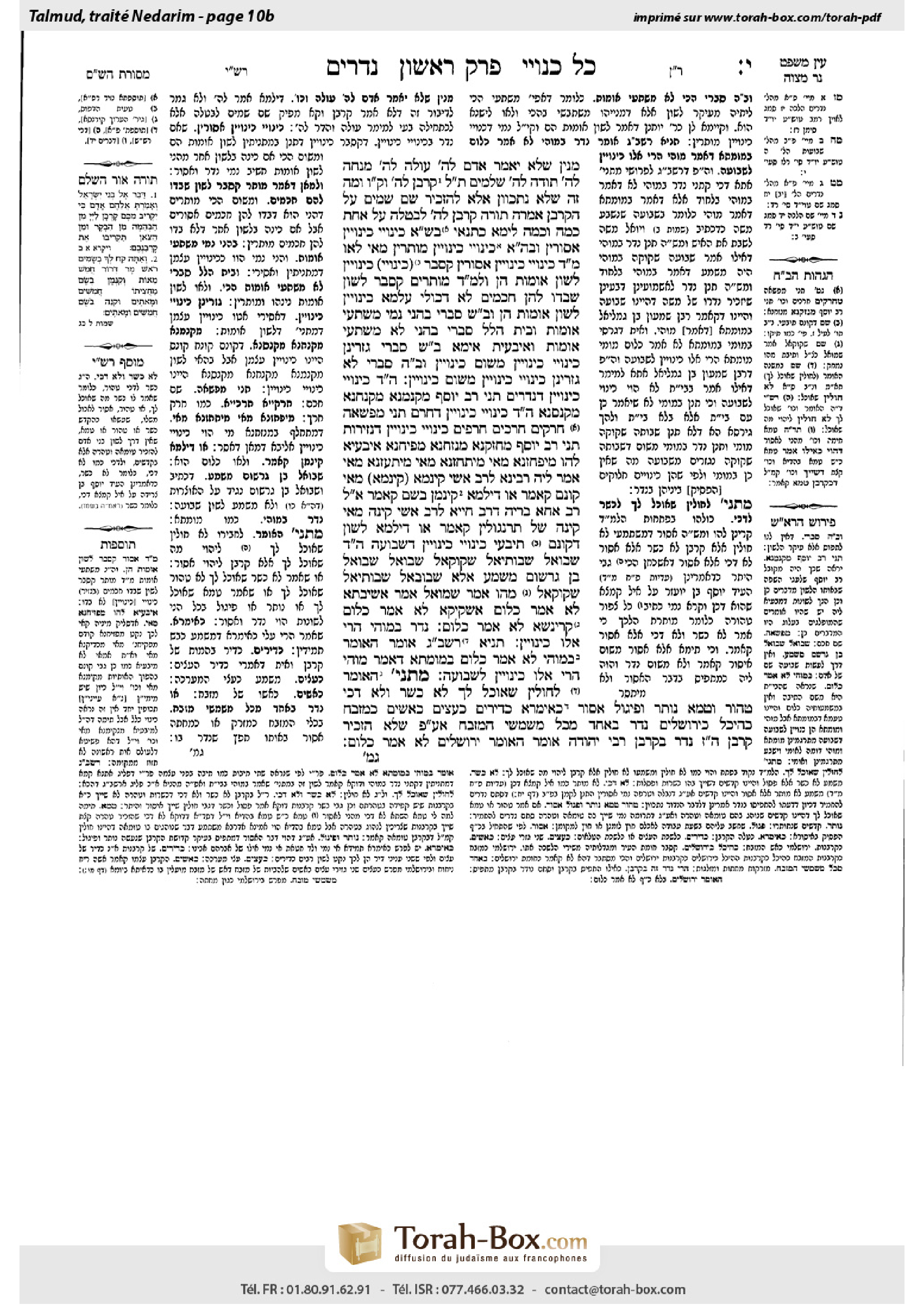
This page of Nedarim includes the Aramaic text, an English translation and an AI-generated French translation, alongside the scan above.
נדרים י׳ ב · Aramaic and Hebrew text
מִנַּיִן שֶׁלֹּא יֹאמַר אָדָם ״לַה׳ עוֹלָה״, ״לַה׳ מִנְחָה״, ״לַה׳ תּוֹדָה״, ״לַה׳ שְׁלָמִים״ — תַּלְמוּד לוֹמַר: ״קׇרְבָּן לַה׳״.
וְקַל וָחוֹמֶר: וּמָה זֶה שֶׁלֹּא נִתְכַּוֵּון אֶלָּא לְהַזְכִּיר שֵׁם שָׁמַיִם עַל הַקׇּרְבָּן — אָמְרָה תּוֹרָה ״קׇרְבָּן לַה׳״, לְבַטָּלָה — עַל אַחַת כַּמָּה וְכַמָּה.
לֵימָא כְּתַנָּאֵי, בֵּית שַׁמַּאי אוֹמְרִים: כִּינּוּיֵי כִינּוּיִין — אֲסוּרִין. וּבֵית הִלֵּל אוֹמְרִים: כִּינּוּיֵי כִינּוּיִין — מוּתָּרִין.
מַאי לָאו: מַאן דְּאָמַר כִּינּוּיֵי כִינּוּיִין אֲסוּרִין, קָסָבַר (כִּינּוּיֵי) כִינּוּיִין לְשׁוֹן אוּמּוֹת הֵן. וּלְמַאן דְּאָמַר מוּתָּרִים, קָסָבַר לָשׁוֹן שֶׁבָּדוּ לָהֶן חֲכָמִים?
לָא, דְּכוּלֵּי עָלְמָא כִּינּוּיִין לְשׁוֹן אוּמּוֹת הֵן, וּבֵית שַׁמַּאי סָבְרִי: בְּהָנֵי נָמֵי מִשְׁתַּעִי אוּמּוֹת, וּבֵית הִלֵּל סָבְרִי: בְּהָנֵי לָא מִשְׁתַּעִי אוּמּוֹת.
וְאִיבָּעֵית אֵימָא, בֵּית שַׁמַּאי סָבְרִי: גָּזְרִינַן כִּינּוּיֵי כִינּוּיִין מִשּׁוּם כִּינּוּיִין, וּבֵית הִלֵּל סָבְרִי: לָא גָּזְרִינַן כִּינּוּיֵי כִינּוּיִין מִשּׁוּם כִּינּוּיִין.
הֵיכִי דָּמֵי כִּינּוּיֵי כִינּוּיִין דִּנְדָרִים? תָּנֵי רַב יוֹסֵף: ״מַקְנֵמְנָא״ ״מַקְנַחְנָא״ ״מַקְנֵסְנָא״. הֵיכִי דָּמֵי כִּינּוּיֵי כִינּוּיִין דְּחֵרֶם? תָּנֵי מַפְשָׁאָה: ״חֲרָקִים״ ״חֲרָכִים״ ״חֲרָפִים״. כִּינּוּיֵי כִינּוּיִין דִּנְזִירוּת? תָּנֵי רַב יוֹסֵף: ״מַחְזֵקְנָא״ ״מַנְזַחְנָא״ ״מַפִּיחְנָא״.
אִיבַּעְיָא לְהוּ: ״מִיפְּחַזְנָא״ מַאי? ״מִיתְּחַזְנָא״ מַאי? ״מִיתְּעַזְנָא״ מַאי? אֲמַר לֵיהּ רָבִינָא לְרַב אָשֵׁי: ״קִינְּמָא״ (קינמא) מַאי? ״קֻוֽנָּם״ קָאָמַר, אוֹ דִלְמָא ״קִנְּמָן בֶּשֶׂם״ קָאָמַר?
אֲמַר לֵיהּ רַב אַחָא בְּרֵיהּ דְּרַב חִיָּיא לְרַב אָשֵׁי: ״קִינָּה״ מַאי? קִינָּה שֶׁל תַּרְנְגוֹלִין קָאָמַר, אוֹ דִילְמָא לָשׁוֹן דְּקֻוֽנָּם? תִּיבְּעֵי.
כִּינּוּיֵי כִינּוּיִין דִּשְׁבוּעָה הֵיכִי דָּמֵי? ״שְׁבוּאֵל״ ״שְׁבוּתִיאֵל״ ״שְׁקוּקָאֵל״. שְׁבוּאֵל? שְׁבוּאֵל בֶּן גֵּרְשׁוֹם מַשְׁמַע! אֶלָּא: ״שְׁבוּבָאֵל״ ״שְׁבוּתִיאֵל״ ״שְׁקוּקָאֵל״ מַהוּ? אָמַר שְׁמוּאֵל: אָמַר ״אַשִּׁיבְתָּא״ — לֹא אָמַר כְּלוּם, ״אַשְׁקִיקָא״ — לֹא אָמַר כְּלוּם, ״קָרִינְשָׂא״ — לֹא אָמַר כְּלוּם.
״נָדַר בְּמוֹהִי הֲרֵי אֵלּוּ כִינּוּיִין״. תַּנְיָא, רַבָּן שִׁמְעוֹן בֶּן גַּמְלִיאֵל אוֹמֵר: הָאוֹמֵר ״בְּמוֹהִי״ — לֹא אָמַר כְּלוּם, ״בְּמוֹמָתָא דַּאֲמַר מוֹהִי״ — הֲרֵי אֵלּוּ כִּינּוּיִין לַשְּׁבוּעָה.
מַתְנִי׳ הָאוֹמֵר ״לַחוּלִּין שֶׁאוֹכַל לָךְ״, ״לָא כָּשַׁר״ וְ״לָא דְּכֵי״, ״טָהוֹר״ וְ״טָמֵא״, ״נוֹתָר״ וּ״פִיגּוּל״ — אָסוּר.
כְּאִימְּרָא, כְּדִירִים, כָּעֵצִים, כָּאִשִּׁים, כַּמִּזְבֵּחַ, כַּהֵיכָל, כִּירוּשָׁלַיִם. נָדַר בְּאֶחָד מִכׇּל מְשַׁמְּשֵׁי הַמִּזְבֵּחַ, אַף עַל פִּי שֶׁלֹּא הִזְכִּיר קׇרְבָּן — הֲרֵי זֶה נָדַר בְּקׇרְבָּן. רַבִּי יְהוּדָה אוֹמֵר: הָאוֹמֵר ״יְרוּשָׁלַיִם״ — לֹא אָמַר כְּלוּם.
Nedarim 10b · English translation
From where is it derived that a person should not say: To the Lord a burnt-offering, or: To the Lord a meal-offering, or: To the Lord a thanks-offering, or: To the Lord a peace-offering, but should mention the offering first and then state that it is for the Lord? The verse states: “An offering to the Lord” (Leviticus 1:2). The reason for this is that if one first says: To the Lord, perhaps he will change his mind and not complete the sentence in order to avoid consecrating the offering, and he will have uttered the name of God in vain.
And it is an a fortiori inference: Just as with regard to this individual discussed in the baraita, who intended to mention the name of Heaven only upon an offering, the Torah said that he should say: An offering to the Lord, in order to avoid possibly mentioning the name of God in vain, with regard to one who actually mentions the Divine Name in vain, all the more so it is clear that he has committed a severe transgression.
The Gemara suggests: Let us say that this dispute between Rabbi Yoḥanan and Rabbi Shimon ben Lakish is parallel to a dispute between tanna’im, as it was taught in a baraita that Beit Shammai say: If one expresses a vow with substitutes for the substitute terms mentioned in the mishna, the vow takes effect and the items are forbidden. And Beit Hillel say: If one expresses a vow with substitutes for the substitute terms mentioned in the mishna, the vow does not take effect and the items are permitted.
What, is it not correct that the one who says that a vow expressed with substitutes for the substitute terms mentioned in the mishna takes effect and that the item is consequently forbidden likewise holds that substitutes for the language of vows are terms from the language of other nations, and therefore substitutes for those terms, which are also from foreign languages, should be equally acceptable? And similarly, according to the one who says that the vow does not take effect and the item is permitted, it must be that he holds that these terms are language that the Sages devised. Consequently, substitutes for those terms, which the Sages did not declare to be acceptable terms for expressing a vow, do not cause a vow to take effect.
The Gemara responds: No, it is possible that everyone holds that substitutes for the language of vows are terms from the language of other nations, and Beit Shammai hold that the nations speak using these substitutes for the terms mentioned in the mishna also, and Beit Hillel hold that the nations do not speak using these terms.
And if you wish, say an alternate response: Substitute terms themselves are terms from a foreign language. Beit Shammai hold that we issue a decree with regard to substitutes for the substitute terms mentioned in the mishna, despite the fact that these terms themselves are not valid terms even in a foreign language, due to a concern that if they are not considered to express a vow, one will come to act leniently with regard to a vow expressed with the substitute terms mentioned in the mishna. And Beit Hillel hold: We do not issue a decree with regard to substitutes for the substitute terms mentioned in the mishna due to a concern that one will come to act leniently with regard to a vow expressed with the substitute terms themselves.
The Gemara asks: What are the circumstances of substitutes for substitute terms for vows? Rav Yosef teaches that they include the following terms: Mekanamna, mekanaḥna, and mekanasna. These are verb forms of the terms konam, konaḥ, and konas respectively, mentioned in the mishna. The Gemara asks: What are the circumstances of substitutes for substitute terms for dedication [ḥerem]? The Sage Mafsha’a teaches: Ḥarakim, ḥarakhim, and ḥarafim. The Gemara continues: What are the substitutes for substitute terms for naziriteship [nezirut]? Rav Yosef teaches: Meḥazakna, menazaḥna, and mafiḥna.
A dilemma was raised before the Sages: If one uses the term mifḥazna, what is the halakha? If one uses the term mitḥazna, what is the halakha? If one uses the term mitazna, what is the halakha? Ravina said to Rav Ashi: If one uses the term kinma, what is the halakha? Is he saying that the item should be like a konam, in which case the vow takes effect, or perhaps he is saying sweet cinnamon [kineman besem] (see Exodus 30:23) and does not intend to express a vow with the word konam?
Rav Aḥa, son of Rav Ḥiyya, said to Rav Ashi: If one uses the term kina, what is the halakha? Is he saying this term in reference to a chicken coop, which is also called a kina, or perhaps it is a term for konam and expresses a vow? With regard to these cases, the Gemara says: The dilemma remains unresolved.
The Gemara asks: What are the circumstances of substitutes for substitute terms of oaths [shevua]? The Gemara answers that this category includes the terms shevuel, shevutiel, and shekukael. The Gemara asks: Why is the term shevuel included? This word indicates Shevuel, son of Gershom, the proper name of an individual (see I Chronicles 26:24), and therefore it should not be considered a substitute term for an oath. Rather, the list of terms includes shevuvael, shevutiel, and shekukael. What is the halakha? Shmuel said: If he said ashivta he has not said anything, despite the fact that there is some similarity between this term and the word oath [shevua]. Similarly, if he said ashkika he has not said anything. If he said karinsha he has not said anything, although it is somewhat similar to konam.
§ It is taught in the mishna: If one used the terms shevuta or shekuka, or took a vow with the term mohi, these are substitute terms for an oath. It is taught in a baraita that Rabban Shimon ben Gamliel says: One who says that he is taking an oath by mohi has not said anything. However, if he says: By an oath [bemomata] that Mohi said, these are valid substitute terms for an oath.
MISHNA: If one says to another: That which I eat of yours shall be considered laḥullin, it is interpreted as though he said: La ḥullin, not non-sacred, and the food is thereby forbidden to him. Similarly, if he said that food shall be considered not valid or not dekhi, i.e., not ritually pure, or if he said the food shall be considered an offering that has become ritually impure, left over [notar], or piggul, i.e., an offering that was sacrificed with the intent to consume it after its appointed time, it is forbidden.
If one says that food shall be considered like the lamb of the daily offering, like the animals designated as offerings and kept in special enclosures, like the wood of the altar, like the fires on the altar, like the altar, like the Sanctuary, or like Jerusalem, or if he took a vow with any of the accessories of the altar, although he did not explicitly mention that the food should be like an offering, it is considered a vow that associates a different item with an offering. Rabbi Yehuda says: One who says that an item shall be considered Jerusalem, instead of saying that it shall be considered like Jerusalem, has not said anything.
Nedarim 10b · Traduction française (IA)
D’où apprend-on qu’une personne ne doit pas dire : « Pour le Seigneur, un holocauste », ou : « Pour le Seigneur, une offrande végétale », ou : « Pour le Seigneur, un sacrifice de reconnaissance », ou : « Pour le Seigneur, un sacrifice de paix », mais doit d’abord mentionner l’offrande, puis préciser qu’elle est destinée au Seigneur ? Le verset dit : « Une offrande au Seigneur » (Lévitique 1, 2). En effet, si l’on dit d’abord : « Pour le Seigneur », on pourrait changer d’avis et ne pas achever la phrase afin d’éviter de consacrer l’offrande ; on aurait alors prononcé le nom de Dieu en vain.
C’est un raisonnement a fortiori : si, au sujet de cet individu dont parle la baraïta, qui avait l’intention de mentionner le nom du Ciel uniquement à propos d’une offrande, la Torah a dit qu’il devait dire : « Une offrande au Seigneur », afin d’éviter qu’il ne mentionne éventuellement le nom de Dieu en vain, à plus forte raison est-il évident que celui qui prononce effectivement le Nom divin en vain commet une grave transgression.
La Guemara propose : Disons que la controverse entre Rabbi Yoḥanan et Rabbi Shimon ben Lakish correspond à une controverse entre tannaïm, car il a été enseigné dans une baraïta que Beit Shammaï disent : si quelqu’un formule un vœu au moyen de substituts des termes de substitution mentionnés dans la Michna, le vœu prend effet et les objets sont interdits. Beit Hillel disent : si quelqu’un formule un vœu au moyen de substituts des termes de substitution mentionnés dans la Michna, le vœu ne prend pas effet et les objets sont permis.
N’est-il pas exact que celui qui affirme qu’un vœu formulé au moyen de substituts des termes de substitution mentionnés dans la Michna prend effet, et que l’objet est donc interdit, soutient également que les substituts du langage des vœux sont des termes issus des langues des autres nations ? Par conséquent, les substituts de ces termes, qui proviennent eux aussi de langues étrangères, devraient également être valables. De même, selon celui qui affirme que le vœu ne prend pas effet et que l’objet est permis, il faut qu’il considère que ces termes sont un langage forgé par les Sages. Par conséquent, les substituts de ces termes, que les Sages n’ont pas déclarés valables pour formuler un vœu, ne font pas prendre effet au vœu.
La Guemara répond : Non. Il est possible que tous soutiennent que les substituts du langage des vœux sont des termes issus des langues des autres nations, et que Beit Shammaï considèrent que les nations emploient également ces substituts des termes mentionnés dans la Michna, tandis que Beit Hillel considèrent que les nations n’emploient pas ces termes.
Et si tu le souhaites, voici une autre réponse : les termes de substitution eux-mêmes sont des termes d’une langue étrangère. Beit Shammaï considèrent que l’on décrète que les substituts des termes de substitution mentionnés dans la Michna font prendre effet au vœu, bien que ces termes eux-mêmes ne soient pas valables, même dans une langue étrangère, par crainte que, si on ne les considère pas comme exprimant un vœu, on en vienne à traiter avec légèreté un vœu formulé au moyen des termes de substitution mentionnés dans la Michna. Beit Hillel considèrent que l’on ne décrète pas que les substituts des termes de substitution mentionnés dans la Michna font prendre effet au vœu, par crainte que l’on en vienne à traiter avec légèreté un vœu formulé au moyen des termes de substitution eux-mêmes.
La Guemara demande : Que sont les substituts des termes de substitution des vœux ? Rav Yosef enseigne qu’ils comprennent les termes suivants : Mekanamna, mekanaḥna et mekanasna. Ce sont des formes verbales des termes konam, konaḥ et konas, respectivement, mentionnés dans la Michna. La Guemara demande : Que sont les substituts des termes de substitution de la consécration [ḥerem] ? Le Sage Mafsha’a enseigne : Ḥarakim, ḥarakhim et ḥarafim. La Guemara poursuit : Quels sont les substituts des termes de substitution du naziréat [nezirut] ? Rav Yosef enseigne : Meḥazakna, menazaḥna et mafiḥna.
Une question fut posée aux Sages : quelle est la halakha si quelqu’un emploie le terme mifḥazna ? Quelle est la halakha s’il emploie le terme mitḥazna ? Quelle est la halakha s’il emploie le terme mitazna ? Ravina dit à Rav Ashi : quelle est la halakha si quelqu’un emploie le terme kinma ? Veut-il dire que l’objet sera comme un konam, auquel cas le vœu prend effet, ou bien veut-il dire « cannelle odorante » [kineman besem] (voir Exode 30, 23), sans avoir l’intention de formuler un vœu au moyen du mot konam ?
Rav Aḥa, fils de Rav Ḥiyya, dit à Rav Ashi : quelle est la halakha si quelqu’un emploie le terme kina ? Veut-il désigner un poulailler, que l’on appelle également kina, ou bien s’agit-il d’un terme pour konam qui exprime un vœu ? À propos de ces cas, la Guemara dit que la question reste sans réponse.
La Guemara demande : Que sont les substituts des termes de substitution des serments [shevua] ? La Guemara répond que cette catégorie comprend les termes shevuel, shevutiel et shekukael. La Guemara demande : Pourquoi le terme shevuel est-il inclus ? Ce mot désigne Shevuel, fils de Gershom, nom propre d’un individu (voir I Chroniques 26, 24), et ne devrait donc pas être considéré comme un terme de substitution d’un serment. La liste comprend plutôt shevuvael, shevutiel et shekukael. Quelle est la halakha ? Shmuel dit : s’il a dit ashivta, il n’a rien dit, bien que ce terme présente une certaine ressemblance avec le mot « serment » [shevua]. De même, s’il a dit ashkika, il n’a rien dit. S’il a dit karinsha, il n’a rien dit, bien que ce terme ressemble quelque peu à konam.
§ Il est enseigné dans la Michna : si quelqu’un emploie les termes shevuta ou shekuka, ou formule un vœu avec le terme mohi, ce sont des termes de substitution d’un serment. Une baraïta enseigne que Rabban Shimon ben Gamliel dit : celui qui dit qu’il jure par mohi n’a rien dit. Toutefois, s’il dit : « Par le serment [bemomata] que Mohi a prononcé », ces termes constituent des substituts valables d’un serment.
MICHNA : Si quelqu’un dit à un autre : « Ce que je mangerai de ce qui t’appartient sera considéré comme laḥullin », cela s’interprète comme s’il avait dit : « La ḥullin », c’est-à-dire « pas profane », et la nourriture lui est ainsi interdite. De même, s’il dit que la nourriture sera considérée comme invalide ou comme non dekhi, c’est-à-dire non rituellement pure, ou comme une offrande devenue rituellement impure, comme un reste [notar] ou comme du piggul, c’est-à-dire une offrande sacrifiée avec l’intention d’en consommer après le délai fixé, elle lui est interdite.
Si quelqu’un dit que la nourriture sera considérée comme l’agneau de l’offrande quotidienne, comme les animaux désignés comme offrandes et gardés dans des enclos spéciaux, comme le bois de l’autel, comme les feux de l’autel, comme l’autel, comme le Sanctuaire ou comme Jérusalem, ou s’il formule un vœu en mentionnant l’un quelconque des accessoires de l’autel, bien qu’il n’ait pas explicitement dit que la nourriture devait être comme une offrande, cela est considéré comme un vœu associant un autre objet à une offrande. Rabbi Yehuda dit : celui qui dit qu’un objet sera Jérusalem, au lieu de dire qu’il sera comme Jérusalem, n’a rien dit.
Traduction française générée par IA à partir de l’édition anglaise de Sefaria. Vérifie toujours un passage avec le texte source.
Text from Sefaria: William Davidson Edition - Vocalized Aramaic (CC BY NC); William Davidson Edition - English (CC BY NC).