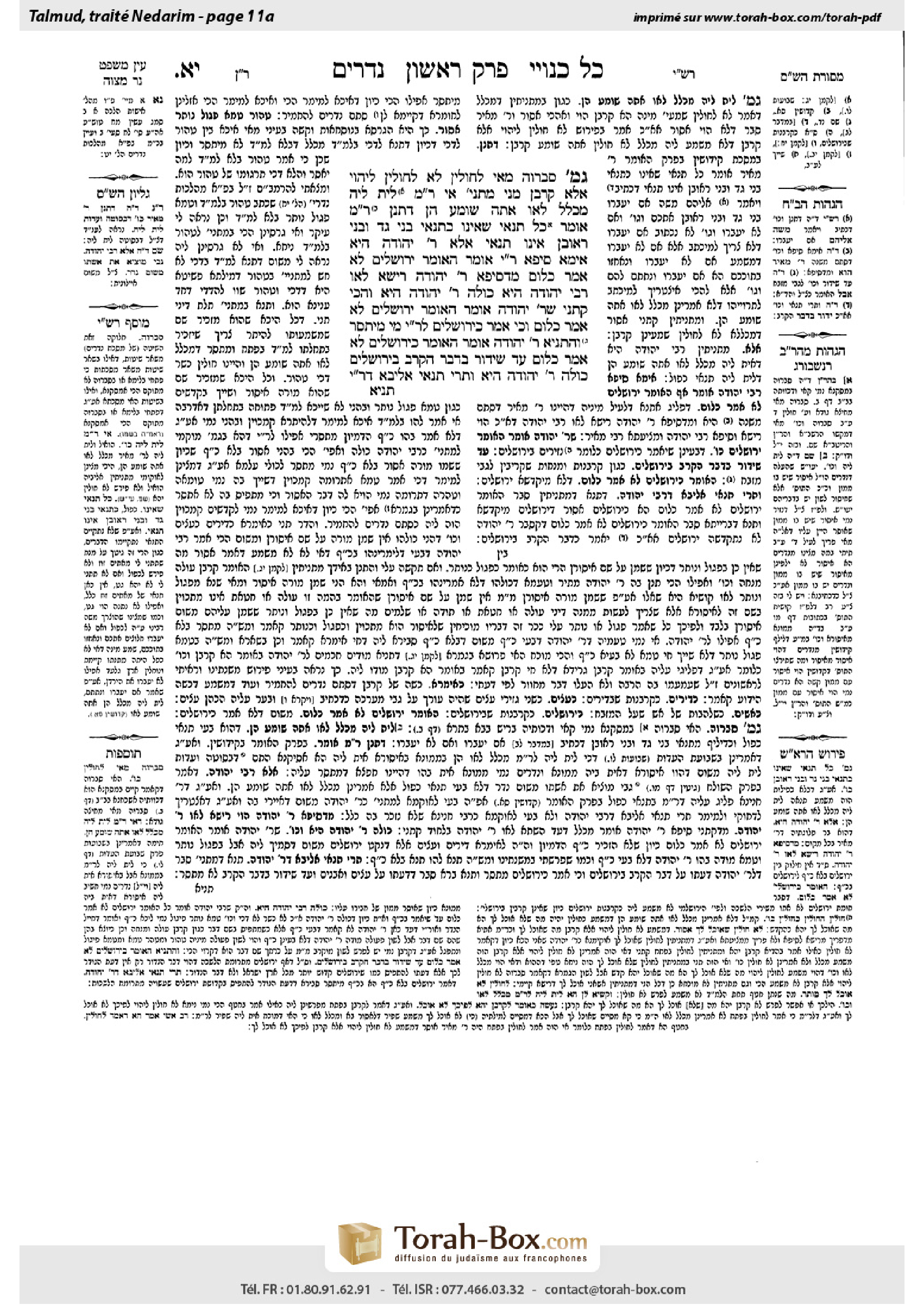
Nedarim 11a: Talmud study for Daf Yomi
Daf Yomi is the daily study of one Talmud folio. Explore 37 tractates with scans, Hebrew text, Sefaria English and AI-generated French translations where annotated.
Passage selection and English or AI-generated French translation are available where the scan has annotations. Daf Study is independent of Torah-Box and Sefaria.
Browse Nedarim · נדרים · All tractatesNedarim 11a text and translations
This page of Nedarim includes the Aramaic text, an English translation and an AI-generated French translation, alongside the scan above.
נדרים י״א א · Aramaic and Hebrew text
גְּמָ׳ סַבְרוּהָ: מַאי ״לַחוּלִּין״ — לָא לְחוּלִּין לֶיהֱוֵי, אֶלָּא קׇרְבָּן.
מַנִּי מַתְנִיתִין? אִי רַבִּי מֵאִיר — לֵית לֵיהּ מִכְּלָל לָאו אַתָּה שׁוֹמֵעַ הֵן. דִּתְנַן, רַבִּי מֵאִיר אוֹמֵר: כׇּל תְּנַאי שֶׁאֵינוֹ כִּתְנַאי בְּנֵי גָד וּבְנֵי רְאוּבֵן — אֵינוֹ תְּנַאי.
אֶלָּא רַבִּי יְהוּדָה הִיא. אֵימָא סֵיפָא, רַבִּי יְהוּדָה אוֹמֵר: הָאוֹמֵר ״יְרוּשָׁלַיִם״ — לֹא אָמַר כְּלוּם. מִדְּסֵיפָא רַבִּי יְהוּדָה — רֵישָׁא לָאו רַבִּי יְהוּדָה הִיא!
כּוּלֵּהּ רַבִּי יְהוּדָה הִיא, וְהָכִי קָתָנֵי: שֶׁרַבִּי יְהוּדָה אוֹמֵר: הָאוֹמֵר ״יְרוּשָׁלַיִם״ — לֹא אָמַר כְּלוּם.
וְכִי אָמַר ״כִּירוּשָׁלַיִם״, לְרַבִּי יְהוּדָה מִי מִיתְּסַר? וְהָתַנְיָא, רַבִּי יְהוּדָה אוֹמֵר: הָאוֹמֵר ״כִּירוּשָׁלַיִם״ — לֹא אָמַר כְּלוּם, עַד שֶׁיִּדּוֹר בְּדָבָר הַקָּרֵב בִּירוּשָׁלַיִם!
כּוּלַּהּ רַבִּי יְהוּדָה הִיא, וּתְרֵי תַּנָּאֵי אַלִּיבָּא דְּרַבִּי יְהוּדָה.
Nedarim 11a · English translation
GEMARA: They assumed: What is the meaning of the term laḥullin? The individual is saying: It shall not [la] be non-sacred [ḥullin] but rather it should have the status of an offering.
The Gemara says: Whose opinion is expressed in the mishna? If you say it is that of Rabbi Meir, he does not hold that from a negative statement you can infer a positive statement. As we learned in a mishna: Rabbi Meir says that any condition that is not like the condition of the sons of the tribe of Gad and the sons of the tribe of Reuben, when Moses gave them land on the eastern bank of the Jordan River (see Numbers 32:29–30), is not a valid condition. Moses phrased the agreement as a double condition, stating that if they would join the other tribes in battle they would receive their inheritance on the eastern bank of the Jordan River, and if not, they would not receive that territory. Because Rabbi Meir holds that only a condition expressed in this manner is valid, it is clear that he holds that one may not infer a negative statement from a positive one or vice versa.
Rather, the mishna is in accordance with the opinion of Rabbi Yehuda. The Gemara challenges this statement: Say the latter clause of the mishna: Rabbi Yehuda says: One who says that an item shall be considered Jerusalem has not said anything. From the fact that the latter clause is stated by Rabbi Yehuda, it is clear that the first clause is not in accordance with the opinion of Rabbi Yehuda.
The Gemara responds: The entire mishna is in accordance with the opinion of Rabbi Yehuda, and this is what it is teaching: Although one who declares an item to be like Jerusalem has taken a vow rendering it forbidden, one who says that an item shall be considered Jerusalem has not taken a vow. This is as Rabbi Yehuda says, that one who says that an item shall be considered Jerusalem has not said anything, since this expression has no meaning.
The Gemara asks: When one says that an item should be like Jerusalem, is it prohibited according to Rabbi Yehuda? Isn’t it taught in a baraita that Rabbi Yehuda says: One who says that an item shall be considered like Jerusalem has not said anything unless he vows by means of an item that is sacrificed in Jerusalem. Consequently, the first clause of the mishna, which states that one has vowed if he declares an item to be like Jerusalem, cannot be in accordance with the opinion of Rabbi Yehuda.
The Gemara responds: The entire mishna is in accordance with the opinion of Rabbi Yehuda, and the mishna and baraita express the opinions of two tanna’im in accordance with the opinion of Rabbi Yehuda.
Nedarim 11a · Traduction française (IA)
GUEMARA : Ils ont supposé : Que signifie le terme laḥullin ? L’individu dit : « Que cela ne soit pas [la] profane [ḥullin], mais qu’il ait plutôt le statut d’une offrande. »
La Guemara dit : Quelle opinion la Michna exprime-t-elle ? Si tu dis qu’il s’agit de celle de Rabbi Meir, celui-ci ne considère pas qu’on puisse déduire une affirmation positive d’une affirmation négative. En effet, nous avons appris dans une Michna : Rabbi Meir dit que toute condition qui n’est pas formulée comme celle des fils de la tribu de Gad et des fils de la tribu de Ruben, lorsque Moïse leur attribua des terres sur la rive orientale du Jourdain (voir Nombres 32, 29-30), n’est pas une condition valable. Moïse formula l’accord sous la forme d’une condition double : il déclara que s’ils se joignaient aux autres tribus pour combattre, ils recevraient leur héritage sur la rive orientale du Jourdain, et que, sinon, ils ne recevraient pas ce territoire. Puisque Rabbi Meir considère que seule une condition formulée de cette manière est valable, il est clair qu’il pense qu’on ne peut déduire une affirmation négative d’une affirmation positive, ni inversement.
La Michna est plutôt conforme à l’opinion de Rabbi Yehouda. La Guemara objecte : Considère la dernière partie de la Michna : Rabbi Yehouda dit : « Celui qui dit qu’un objet doit être considéré comme Jérusalem n’a rien dit. » Puisque cette dernière partie est attribuée à Rabbi Yehouda, il est clair que la première partie n’est pas conforme à son opinion.
La Guemara répond : Toute la Michna est conforme à l’opinion de Rabbi Yehouda, et voici ce qu’elle enseigne : bien que celui qui déclare qu’un objet est comme Jérusalem ait prononcé un vœu qui le rend interdit, celui qui dit qu’un objet doit être considéré comme Jérusalem n’a pas prononcé de vœu. C’est ce que dit Rabbi Yehouda : celui qui dit qu’un objet doit être considéré comme Jérusalem n’a rien dit, car cette expression n’a pas de sens.
La Guemara demande : Selon Rabbi Yehouda, un objet déclaré comme étant Jérusalem est-il interdit ? N’est-il pas enseigné dans une baraïta que Rabbi Yehouda dit : « Celui qui dit qu’un objet doit être considéré comme Jérusalem n’a rien dit, à moins qu’il ne prononce un vœu en faisant référence à un objet offert en sacrifice à Jérusalem » ? Par conséquent, la première partie de la Michna, qui affirme qu’on a prononcé un vœu si l’on déclare qu’un objet est comme Jérusalem, ne peut pas être conforme à l’opinion de Rabbi Yehouda.
La Guemara répond : Toute la Michna est conforme à l’opinion de Rabbi Yehouda, et la Michna comme la baraïta expriment les opinions de deux tannaïm qui suivent l’opinion de Rabbi Yehouda.
Traduction française générée par IA à partir de l’édition anglaise de Sefaria. Vérifie toujours un passage avec le texte source.
Text from Sefaria: William Davidson Edition - Vocalized Aramaic (CC BY NC); William Davidson Edition - English (CC BY NC).