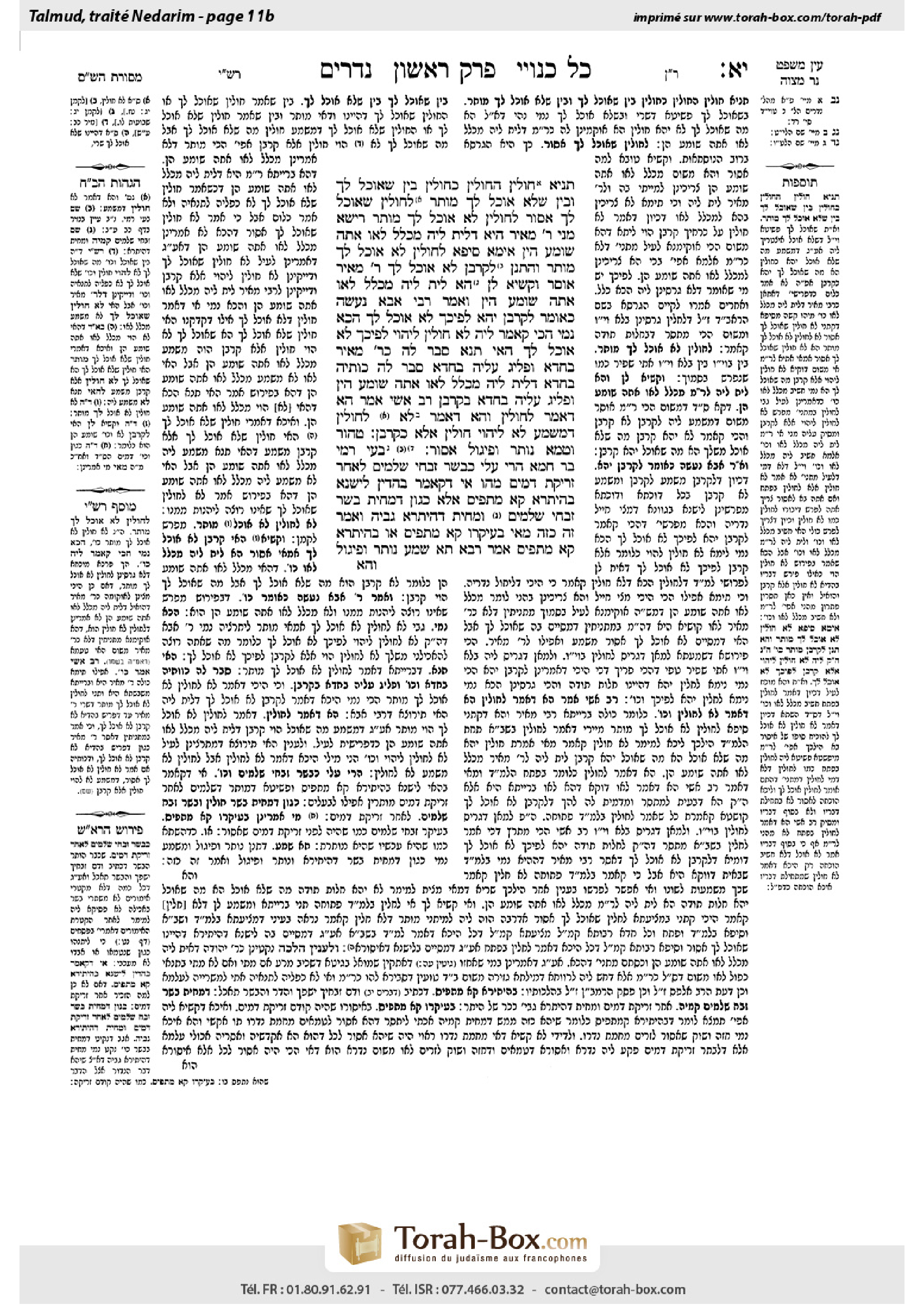
Nedarim 11b: Talmud study for Daf Yomi
Daf Yomi is the daily study of one Talmud folio. Explore 37 tractates with scans, Hebrew text, Sefaria English and AI-generated French translations where annotated.
Passage selection and English or AI-generated French translation are available where the scan has annotations. Daf Study is independent of Torah-Box and Sefaria.
Browse Nedarim · נדרים · All tractatesNedarim 11b text and translations
This page of Nedarim includes the Aramaic text, an English translation and an AI-generated French translation, alongside the scan above.
נדרים י״א ב · Aramaic and Hebrew text
תַּנְיָא: ״חוּלִּין״ ״הַחוּלִּין״ ״כְּחוּלִּין״, בֵּין ״שֶׁאוֹכַל לָךְ״ וּבֵין ״שֶׁלֹּא אוֹכַל לָךְ״, — מוּתָּר. ״לַחוּלִּין שֶׁאוֹכַל לָךְ״ — אָסוּר. ״לַחוּלִּין לֹא אוֹכַל לָךְ״ — מוּתָּר.
רֵישָׁא מַנִּי — רַבִּי מֵאִיר הִיא, דְּלֵית לֵיהּ מִכְּלָל לָאו אַתָּה שׁוֹמֵעַ הֵין.
אֵימָא סֵיפָא: ״לַחוּלִּין לֹא אוֹכַל לָךְ״ — מוּתָּר. וְהָתְנַן: ״לַקׇּרְבָּן לֹא אוֹכַל לָךְ״ — רַבִּי מֵאִיר אוֹסֵר. וְקַשְׁיָא לַן: הָא לֵית לֵיהּ מִכְּלָל לָאו אַתָּה שׁוֹמֵעַ הֵין?
וְאָמַר רַבִּי אַבָּא, נַעֲשָׂה כְּאוֹמֵר: לְקׇרְבָּן יְהֵא, לְפִיכָךְ לֹא אוֹכַל לָךְ. הָכָא נָמֵי הָכִי קָאָמַר לֵיהּ: לָא חוּלִּין לֶיהֱוֵי, לְפִיכָךְ לֹא אוֹכַל לָךְ!
הַאי תַּנָּא סָבַר לַהּ כְּרַבִּי מֵאִיר בַּחֲדָא וּפְלִיג עֲלֵיהּ בַּחֲדָא? סָבַר לַהּ כְּוָתֵיהּ בַּחֲדָא — דְּלֵית לֵיהּ מִכְּלָל לָאו אַתָּה שׁוֹמֵעַ הֵין, וּפְלִיג עֲלֵיהּ בַּחֲדָא — בְּקׇרְבָּן.
רַב אָשֵׁי אָמַר: הָא דְאָמַר ״לַחוּלִּין״, וְהָא דְּאָמַר ״לָא לְחוּלִּין״, דְּמַשְׁמַע: לָא לֶיהֱוֵי חוּלִּין אֶלָּא כְּקׇרְבָּן.
״טָהוֹר״ וְ״טָמֵא״, ״נוֹתָר״ וּ״פִיגּוּל״ — אָסוּר. בָּעֵי רָמֵי בַּר חָמָא: ״הֲרֵי עָלַי כִּבְשַׂר זִבְחֵי שְׁלָמִים לְאַחַר זְרִיקַת דָּמִים״, מַהוּ?
אִי דְּקָאָמַר בְּהָדֵין לִישָּׁנָא — בְּהֶיתֵּרָא קָא מַתְפֵּיס! אֶלָּא: כְּגוֹן דְּמַחֵית בְּשַׂר זִבְחֵי שְׁלָמִים, וּמַחֵית דְּהֶיתֵּרָא גַּבֵּיהּ, וְאָמַר: ״זֶה כָּזֶה״, מַאי: בְּעִיקָּרוֹ קָא מַתְפֵּיס, אוֹ בְּהֶיתֵּרָא קָא מַתְפֵּיס?
אָמַר רָבָא, תָּא שְׁמַע: נוֹתָר וּפִיגּוּל.
Nedarim 11b · English translation
It is taught in a baraita: If one declares food: Non-sacred, or: The non-sacred, or: Like the non-sacred, then whether he combines that expression with the phrase: That which I eat of yours, or: That which I do not eat of yours, he has not expressed a vow and the food remains permitted. However, if he says: That which I eat of yours shall be considered laḥullin, i.e., not non-sacred, but rather consecrated, the food is forbidden. If he says: That which I do not eat of yours shall be considered laḥullin, the other individual’s food remains permitted to him.
The Gemara analyzes this baraita: Who is the author of the first clause of the baraita? It is Rabbi Meir, who does not hold that from a negative statement you can infer a positive statement. Consequently, even if one said: That which I do not eat of yours shall be considered non-sacred, that does not indicate that what he does eat shall be considered consecrated.
However, say the latter clause of that baraita: If one says: That which I will not eat of yours shall be considered laḥullin, the other individual’s food remains permitted to him. But didn’t we learn in a mishna (13a) that if one says: That which I will not eat of yours shall be considered lakorban, Rabbi Meir prohibits him from eating food belonging to the other individual? Lakorban apparently means la korban, it is not an offering. The reason for this opinion is that his statement indicates that what he does not eat is not an offering, but what he does eat shall be considered an offering. This poses a difficulty for us because Rabbi Meir does not hold that from a negative statement you can infer a positive statement.
And to answer this difficulty, Rabbi Abba said: It is as though he said: It shall be for an offering [lekorban], and therefore I will not eat that which is yours. Here too, when he said: That which I will not eat of yours shall be considered laḥullin, this is what he said to him: It shall not be non-sacred, and therefore I will not eat that which is yours. Consequently, the vow should take effect even according to Rabbi Meir; why does the baraita rule that the vow does not take effect and the food remains permitted?
The Gemara answers: This tanna of the baraita holds in accordance with the opinion of Rabbi Meir in one case and disagrees with his opinion in another. He holds in accordance with his opinion in one case, in that he does not hold that from a negative statement you can infer a positive statement. And he disagrees with his opinion in another case, i.e., in the case of an offering. This tanna holds that if one says: That which I will not eat of yours shall be considered lakorban, he does not mean: It is to be considered an offering and therefore I will not eat from that which is yours. Similarly, in the case in the baraita, the tanna does not hold that the individual means to say: It shall not be non-sacred and therefore I will not eat that which is yours. In order to effect a vow, one must express it clearly.
Rav Ashi said: The apparent contradiction between the baraita and the mishna can be resolved in a different manner. This case in the baraita is where he said: That which I will not eat of yours shall be considered as non-sacred, and that case, where it is forbidden, in accordance with Rabbi Meir’s ruling in the mishna, is where he said: That which I will not eat of yours should not be considered as non-sacred, which indicates: It shall not be considered non-sacred but rather like an offering, and therefore I will not eat it.
§ It is stated in the mishna that if one says that a food item shall be considered not ritually pure, or if he said the food shall be considered an offering that has become ritually impure, left over [notar], or piggul, i.e., an offering that was sacrificed with the intent to consume it after its appointed time, it is forbidden. Rami bar Ḥama raises a dilemma: If one said with regard to a particular item: This is prohibited to me like the meat of peace-offerings after the sprinkling of their blood, what is the halakha? Is this an effective vow, which prohibits the item?
The Gemara responds: If he said it with this formulation, he is associating the object of his vow with a permitted item, as the meat of peace-offerings is permitted to be eaten after the blood is sprinkled on the altar. Consequently, the declaration does not express a vow. Rather, it is a case where he places the meat of peace-offerings following the sprinkling of the blood in one place, and he places an item that is permitted next to it. And he says: This is like that. In this case, what is the halakha? Is he associating the object of his vow with the original forbidden status of the peace-offering before the blood is sprinkled, or is he associating the object of his vow with the current permitted status of the peace-offering?
To resolve this question, Rava said: Come and hear a proof from the mishna: If he said the food shall be considered an offering that has become notar or piggul, i.e. an offering that was sacrificed with the intent to consume it after its appointed time, it is forbidden.
Nedarim 11b · Traduction française (IA)
Il est enseigné dans une baraïta : Si quelqu’un déclare au sujet d’un aliment : « Non consacré », ou : « Le non-consacré », ou : « Comme le non-consacré », qu’il associe ou non cette expression aux mots : « Ce que je mange de chez toi » ou : « Ce que je ne mange pas de chez toi », il n’a pas formulé de vœu et l’aliment reste permis. En revanche, s’il dit : « Ce que je mange de chez toi sera considéré comme laḥullin », c’est-à-dire non pas comme non consacré, mais comme consacré, l’aliment est interdit. S’il dit : « Ce que je ne mange pas de chez toi sera considéré comme laḥullin », la nourriture de l’autre personne lui reste permise.
La Guemara analyse cette baraïta : Qui est l’auteur de sa première clause ? C’est Rabbi Meïr, qui ne considère pas qu’on puisse déduire une affirmation positive d’une formulation négative. Par conséquent, même s’il a dit : « Ce que je ne mange pas de chez toi sera considéré comme non consacré », cela n’indique pas que ce qu’il mange sera considéré comme consacré.
Cependant, examinons la dernière clause de cette baraïta : si quelqu’un dit : « Ce que je ne mangerai pas de chez toi sera considéré comme laḥullin », la nourriture de l’autre personne lui reste permise. Mais n’avons-nous pas appris dans une Michna (13a) que si quelqu’un dit : « Ce que je ne mangerai pas de chez toi sera considéré comme lakorban », Rabbi Meïr lui interdit de manger la nourriture de l’autre personne ? Lakorban signifie apparemment la korban, c’est-à-dire « ce n’est pas un sacrifice ». La raison de cet avis est que sa déclaration indique que ce qu’il ne mange pas n’est pas un sacrifice, mais que ce qu’il mange sera considéré comme un sacrifice. Cela nous pose une difficulté, car Rabbi Meïr ne considère pas qu’on puisse déduire une affirmation positive d’une formulation négative.
Pour résoudre cette difficulté, Rabbi Abba a dit : C’est comme s’il avait dit : « Ce sera un sacrifice [lekorban], et c’est pourquoi je ne mangerai pas ce qui est à toi. » Ici aussi, quand il a dit : « Ce que je ne mangerai pas de chez toi sera considéré comme laḥullin », voici ce qu’il lui a dit : « Ce ne sera pas non consacré, et c’est pourquoi je ne mangerai pas ce qui est à toi. » Par conséquent, le vœu devrait prendre effet même selon Rabbi Meïr ; pourquoi la baraïta statue-t-elle qu’il ne prend pas effet et que l’aliment reste permis ?
La Guemara répond : Ce tanna de la baraïta suit l’opinion de Rabbi Meïr dans un cas, mais s’en écarte dans un autre. Il la suit en ce qu’il ne considère pas qu’on puisse déduire une affirmation positive d’une formulation négative. Mais il s’en écarte dans un autre cas, celui d’un sacrifice. Ce tanna considère que si quelqu’un dit : « Ce que je ne mangerai pas de chez toi sera considéré comme lakorban », il ne veut pas dire : « Cela doit être considéré comme un sacrifice et c’est pourquoi je ne mangerai pas ce qui est à toi. » De même, dans le cas de la baraïta, le tanna ne considère pas que la personne veuille dire : « Ce ne sera pas non consacré et c’est pourquoi je ne mangerai pas ce qui est à toi. » Pour qu’un vœu prenne effet, il faut l’exprimer clairement.
Rav Ashi a dit : La contradiction apparente entre la baraïta et la Michna peut être résolue autrement. Le cas de la baraïta est celui où il a dit : « Ce que je ne mangerai pas de chez toi sera considéré comme non consacré » ; le cas où cela est interdit, conformément à la décision de Rabbi Meïr dans la Michna, est celui où il a dit : « Ce que je ne mangerai pas de chez toi ne sera pas considéré comme non consacré », ce qui indique : « Cela ne sera pas considéré comme non consacré, mais plutôt comme un sacrifice, et c’est pourquoi je ne le mangerai pas. »
§ La Michna enseigne que si quelqu’un dit qu’un aliment sera considéré comme rituellement impur, ou s’il dit qu’il sera considéré comme un sacrifice rituellement impur, comme un reste [notar] ou comme piggul — c’est-à-dire un sacrifice offert avec l’intention d’en consommer la viande après le délai prescrit —, l’aliment est interdit. Rami bar Ḥama soulève un dilemme : si quelqu’un dit au sujet d’un objet particulier : « Ceci m’est interdit comme la viande des sacrifices de paix après l’aspersion de leur sang », quelle est la halakha ? S’agit-il d’un vœu valable, qui interdit l’objet ?
La Guemara répond : S’il l’a formulé ainsi, il associe l’objet de son vœu à un élément permis, car la viande des sacrifices de paix peut être consommée après que le sang a été aspergé sur l’autel. Par conséquent, sa déclaration ne formule pas un vœu. Le cas envisagé est plutôt celui où il place à un endroit la viande des sacrifices de paix après l’aspersion du sang, et à côté un objet permis. Puis il dit : « Ceci est comme cela. » Dans ce cas, quelle est la halakha ? Associe-t-il l’objet de son vœu au statut initialement interdit du sacrifice de paix, avant l’aspersion du sang, ou à son statut actuel, qui permet sa consommation ?
Pour résoudre cette question, Rava a dit : Viens entendre une preuve tirée de la Michna : si quelqu’un dit que l’aliment sera considéré comme un sacrifice devenu notar ou piggul, c’est-à-dire un sacrifice offert avec l’intention d’en consommer la viande après le délai prescrit, l’aliment est interdit.
Traduction française générée par IA à partir de l’édition anglaise de Sefaria. Vérifie toujours un passage avec le texte source.
Text from Sefaria: William Davidson Edition - Vocalized Aramaic (CC BY NC); William Davidson Edition - English (CC BY NC).