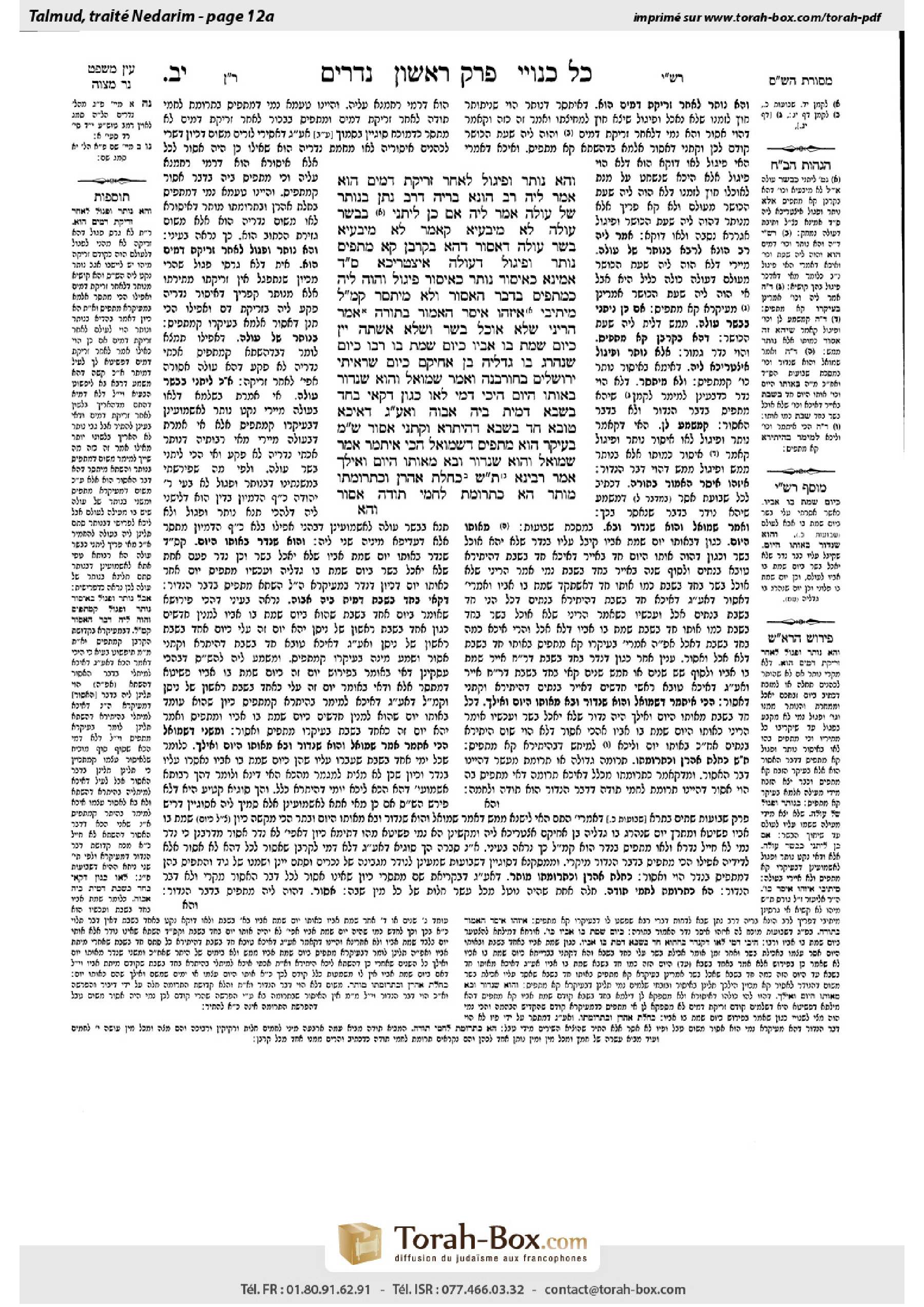
Nedarim 12a: Talmud study for Daf Yomi
Daf Yomi is the daily study of one Talmud folio. Explore 37 tractates with scans, Hebrew text, Sefaria English and AI-generated French translations where annotated.
Passage selection and English or AI-generated French translation are available where the scan has annotations. Daf Study is independent of Torah-Box and Sefaria.
Browse Nedarim · נדרים · All tractatesNedarim 12a text and translations
This page of Nedarim includes the Aramaic text, an English translation and an AI-generated French translation, alongside the scan above.
נדרים י״ב א · Aramaic and Hebrew text
וְהָא נוֹתָר וּפִיגּוּל לְאַחַר זְרִיקַת דָּמִים הוּא.
אֲמַר לֵיהּ רַב הוּנָא בְּרֵיהּ דְּרַב נָתָן: בְּנוֹתָר שֶׁל עוֹלָה. אֲמַר לֵיהּ: אִם כֵּן, לִיתְנֵי בִּבְשַׂר עוֹלָה!
לָא מִיבַּעְיָא קָאָמַר: לָא מִיבַּעְיָא ״בְּשַׂר עוֹלָה״ דְּאָסוּר, דְּהָא בְּקׇרְבָּן קָא מַתְפֵּיס, נוֹתָר וּפִיגּוּל דְּעוֹלָה אִיצְטְרִיכָא,
סָלְקָא דַּעְתָּךְ אָמֵינָא כְּאִיסּוּר נוֹתָר, כְּאִיסּוּר פִּיגּוּל, וְהָוֵה לֵיהּ כְּמַתְפֵּיס בְּדָבָר הָאָסוּר, וְלָא מִיתְּסַר, קָא מַשְׁמַע לַן.
מֵיתִיבִי: אֵיזֶהוּ אִיסָּר הָאָמוּר בְּתוֹרָה? אָמַר: ״הֲרֵינִי שֶׁלֹּא אוֹכַל בָּשָׂר וְשֶׁלֹּא אֶשְׁתֶּה יַיִן כַּיּוֹם שֶׁמֵּת בּוֹ אָבִיו״, ״כַּיּוֹם שֶׁמֵּת בּוֹ רַבּוֹ״, ״כַּיּוֹם שֶׁנֶּהֱרַג בּוֹ גְּדַלְיָה בֶּן אֲחִיקָם״, ״כַּיּוֹם שֶׁרָאִיתִי יְרוּשָׁלַיִם בְּחוּרְבָּנָהּ״, וְאָמַר שְׁמוּאֵל: וְהוּא שֶׁנָּדוּר בְּאוֹתוֹ הַיּוֹם.
הֵיכִי דָּמֵי? לָאו כְּגוֹן דְּקָאֵי בְּחַד בְּשַׁבָּא דְּמִית בֵּיהּ אֲבוּהּ, וְאַף עַל גַּב דְּאִיכָּא טוּבָא חַד בְּשַׁבָּא דְּהֶיתֵּרָא, וְקָתָנֵי אָסוּר. שְׁמַע מִינַּהּ בְּעִיקָּר הוּא מַתְפֵּיס.
דִּשְׁמוּאֵל, הָכִי אִיתְּמַר, אָמַר שְׁמוּאֵל: וְהוּא שֶׁנָּדוּר וּבָא מֵאוֹתוֹ הַיּוֹם וְאֵילָךְ.
אָמַר רָבִינָא, תָּא שְׁמַע: ״כְּחַלַּת אַהֲרֹן״, ״וְכִתְרוּמָתוֹ״ — מוּתָּר. הָא ״כִּתְרוּמַת לַחְמֵי תוֹדָה״ — אָסוּר.
Nedarim 12a · English translation
But notar and piggul are conditions that apply after the sprinkling of the blood, when the prohibition against misusing consecrated property, which the individual is attempting to extend to a permitted item, no longer applies. Since the vow takes effect, this proves that the individual is associating the object of his vow with the original forbidden status of the offering.
Rav Huna, son of Rav Natan, said to him: It is possible to say that it is speaking here about notar of a burnt-offering. Since a burnt-offering may not be eaten even after its blood is sprinkled, the original prohibition against misusing consecrated property continues to apply to the meat of this offering. Rava said to Rav Huna, son of Rav Natan: If so, let it teach explicitly that the individual referred to the meat of a burnt-offering.
The Gemara responds: The tanna is speaking utilizing the style of: It is not necessary. It is not necessary to state that if one associates the object of his vow with meat of a burnt-offering, it is forbidden, as he extends the status of an offering to the other item. However, if one extends the status of notar and piggul of a burnt-offering, it is necessary to say that the other item is forbidden.
It could enter your mind to say that the individual intended to declare the item forbidden like the prohibition of notar or like the prohibition of piggul, and this would be like one who associates the object of his vow with an item that is forbidden by the Torah rather than an item forbidden by means of a vow. Consequently, the item is not forbidden, as one can take a vow by associating the object of his vow with a forbidden item only if that item is itself prohibited due to a vow. The mishna therefore teaches us that his intention is to transfer the prohibition of the offering, and the vow takes effect.
The Gemara raises an objection based upon the following baraita: Which is the vow of prohibition [issar] mentioned in the Torah? It is a case where one said: I hereby declare that I will not eat meat and I will not drink wine today like the day his father died, referring to the father of the individual making the vow, as there is a custom to fast on the anniversary of a parent’s death, or: Like the day his teacher died, as one mourns his primary teacher like a father, or: Like the day Gedaliah, son of Ahikam, was killed (see Jeremiah, chapter 41), i.e., the Fast of Gedaliah, or: Like the day I saw Jerusalem in its state of destruction. And Shmuel said: And this is if he was obligated by a previous vow to abstain from meat and wine on that day that he refers to in his declaration.
The Gemara clarifies: What are the circumstances? Is it not a case where, for example, it was Sunday, the same day of the week on which his father died? And although there were many permitted Sundays in the interim, nevertheless, when he said he would not eat meat or drink wine like the day of the week on which his father died, his intention was to the particular Sunday when his father died, when he had vowed to abstain from meat and wine, and therefore the tanna teaches that it is prohibited. Learn from this that he associates the object of his vow with the original halakhic status of the Sunday his father died, and not the status of the intervening Sundays. Similarly, in the case of peace-offerings following the sprinkling of the blood, he is referring to the original status of the meat before the sprinkling of the blood.
The Gemara responds that this is how the comment of Shmuel was stated: Shmuel said: And this is if he was continuously obligated by a vow from that day forward to abstain from meat and wine on the anniversary of his father’s death. Consequently, when he associates another day with the day of his father’s death, he expresses a vow based upon the current status of the day, and there is no proof with regard to the case of the meat of the peace-offering.
The Gemara cites another attempted proof. Ravina said: Come and hear that which was taught in the mishna (13b): If one declares an item to be like the ḥalla of Aaron, i.e., the portion of dough given to the priests, or like his teruma, the portion of agricultural produce given to priests, the item remains permitted. Although these items are prohibited to non-priests as soon as they are designated, they are considered forbidden by the Torah rather than forbidden by a vow. The Gemara infers: But if one declares an item to be like the teruma of the loaves of the thanks-offering, i.e., the four loaves of the thanks-offering that were eaten by the priests, the item is forbidden.
Nedarim 12a · Traduction française (IA)
Mais le notar et le piggul sont des statuts qui s’appliquent après l’aspersion du sang, lorsque l’interdiction de tirer profit des biens consacrés, que l’individu cherche à étendre à un objet permis, ne s’applique plus. Puisque le vœu prend effet, cela prouve que l’individu associe l’objet de son vœu au statut initial d’interdiction de l’offrande.
Rav Houna, fils de Rav Natan, lui dit : « On peut dire qu’il s’agit ici du notar d’un holocauste. Puisqu’un holocauste ne peut pas être consommé même après l’aspersion de son sang, l’interdiction initiale de tirer profit des biens consacrés continue de s’appliquer à la viande de cette offrande. » Rava dit à Rav Houna, fils de Rav Natan : « Dans ce cas, que la Michna enseigne explicitement que l’individu faisait référence à la viande d’un holocauste. »
La Guemara répond : Le tanna s’exprime selon le procédé du « il n’est pas nécessaire ». Il n’est pas nécessaire de préciser que si quelqu’un associe l’objet de son vœu à la viande d’un holocauste, cet objet est interdit, puisqu’il étend à l’autre objet le statut d’une offrande. En revanche, il est nécessaire de préciser que si quelqu’un étend à l’autre objet le statut de notar et de piggul d’un holocauste, cet objet est interdit.
On aurait pu penser que l’individu voulait déclarer l’objet interdit comme le serait un objet frappé par l’interdiction du notar ou celle du piggul. Ce serait alors comme s’il associait l’objet de son vœu à un objet interdit par la Torah, plutôt qu’à un objet interdit par un vœu. Par conséquent, l’objet n’est pas interdit, car on ne peut faire un vœu en associant son objet à un objet interdit que si ce dernier est lui-même interdit en vertu d’un vœu. La Michna nous enseigne donc que son intention est de transférer l’interdiction de l’offrande, et le vœu prend effet.
La Guemara soulève une objection à partir de la baraïta suivante : Quel est le vœu d’interdiction [issar] mentionné dans la Torah ? C’est le cas où quelqu’un dit : « Je déclare par la présente que je ne mangerai pas de viande et ne boirai pas de vin aujourd’hui, comme le jour où son père est mort », c’est-à-dire le père de celui qui prononce le vœu, car il est d’usage de jeûner à l’anniversaire de la mort d’un parent ; ou : « Comme le jour où son maître est mort », car on pleure son maître principal comme un père ; ou : « Comme le jour où Guedalia, fils d’Ahikam, a été tué » (voir Jérémie, chapitre 41), c’est-à-dire le jeûne de Guedalia ; ou : « Comme le jour où j’ai vu Jérusalem dans son état de destruction. » Et Chmouel a dit : Cela n’est le cas que s’il était tenu, en vertu d’un vœu antérieur, de s’abstenir de viande et de vin le jour auquel il fait référence dans sa déclaration.
La Guemara précise : Dans quelles circonstances ? Ne s’agit-il pas, par exemple, d’un dimanche, le même jour de la semaine que celui où son père est mort ? Bien qu’il y ait eu entre-temps de nombreux dimanches où il était permis d’en manger, lorsqu’il a dit qu’il ne mangerait pas de viande et ne boirait pas de vin comme le jour de la semaine où son père est mort, son intention était de désigner le dimanche précis où son père est mort, jour où il avait fait vœu de s’abstenir de viande et de vin ; le tanna enseigne donc que c’est interdit. Apprends-en que l’objet de son vœu est associé au statut halakhique initial du dimanche où son père est mort, et non au statut des dimanches intermédiaires. De même, dans le cas de la viande des sacrifices de paix après l’aspersion du sang, il fait référence à son statut initial, avant l’aspersion du sang.
La Guemara répond que la déclaration de Chmouel a été formulée ainsi : Chmouel a dit : Cela n’est le cas que s’il était continuellement tenu, à partir de ce jour, par un vœu de s’abstenir de viande et de vin à l’anniversaire de la mort de son père. Par conséquent, lorsqu’il associe un autre jour au jour de la mort de son père, il formule un vœu fondé sur le statut actuel de ce jour ; il n’y a donc là aucune preuve concernant le cas de la viande du sacrifice de paix.
La Guemara cite une autre tentative de preuve. Ravina dit : « Viens et entends ce qui a été enseigné dans la Michna (13b) : Si quelqu’un déclare qu’un objet est comme la hallah d’Aaron, c’est-à-dire la portion de pâte donnée aux prêtres, ou comme sa terouma, la portion des produits agricoles donnée aux prêtres, l’objet reste permis. Bien que ces portions soient interdites aux non-prêtres dès qu’elles sont désignées, elles sont considérées comme interdites par la Torah plutôt que par un vœu. » La Guemara en déduit : « Mais si quelqu’un déclare qu’un objet est comme la terouma des pains du sacrifice de reconnaissance, c’est-à-dire les quatre pains de ce sacrifice consommés par les prêtres, l’objet est interdit. »
Traduction française générée par IA à partir de l’édition anglaise de Sefaria. Vérifie toujours un passage avec le texte source.
Text from Sefaria: William Davidson Edition - Vocalized Aramaic (CC BY NC); William Davidson Edition - English (CC BY NC).