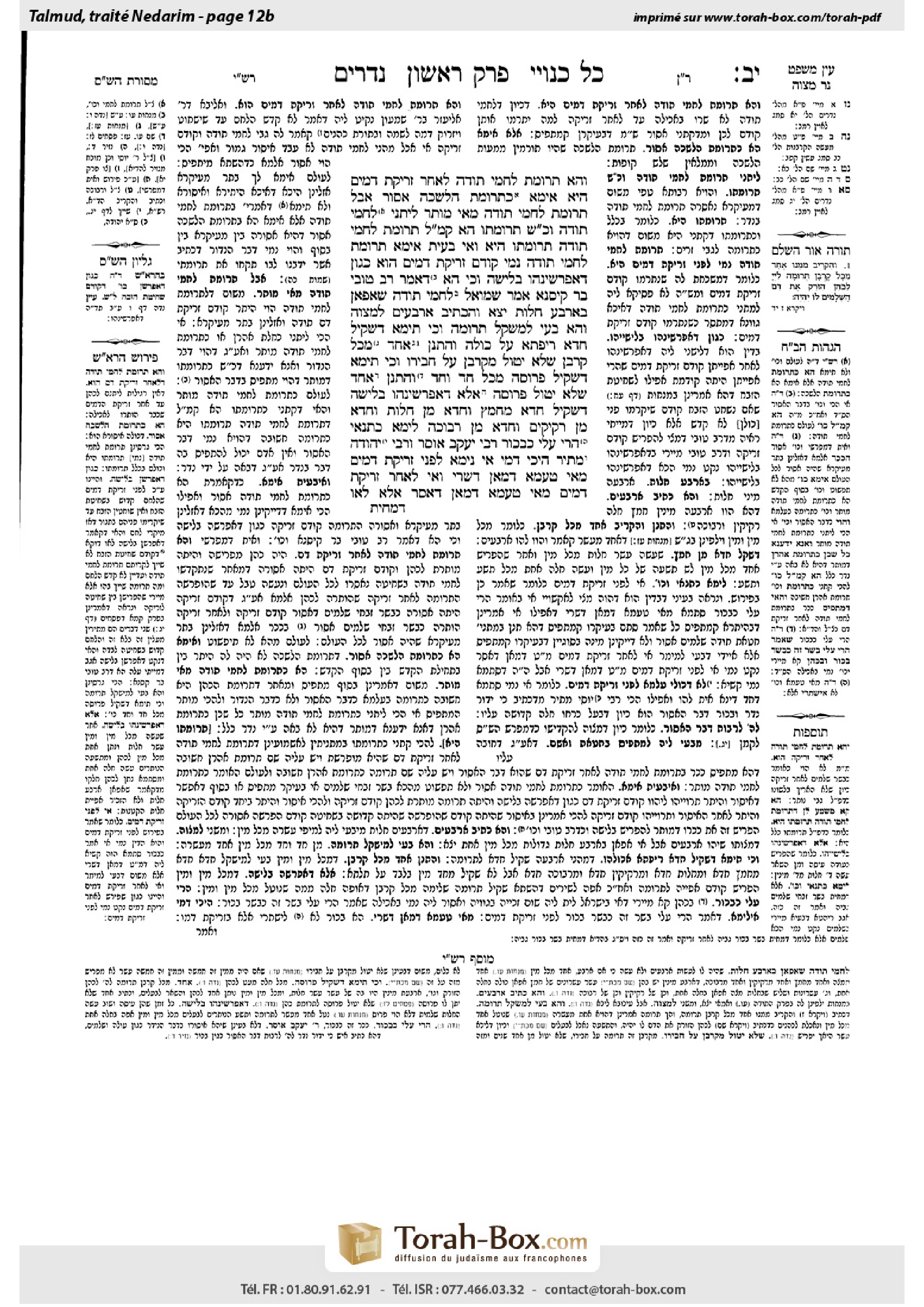
Nedarim 12b: Talmud study for Daf Yomi
Daf Yomi is the daily study of one Talmud folio. Explore 37 tractates with scans, Hebrew text, Sefaria English and AI-generated French translations where annotated.
Passage selection and English or AI-generated French translation are available where the scan has annotations. Daf Study is independent of Torah-Box and Sefaria.
Browse Nedarim · נדרים · All tractatesNedarim 12b text and translations
This page of Nedarim includes the Aramaic text, an English translation and an AI-generated French translation, alongside the scan above.
נדרים י״ב ב · Aramaic and Hebrew text
וְהָא תְּרוּמַת לַחְמֵי תוֹדָה — לְאַחַר זְרִיקַת דָּמִים הִיא.
אֵימָא: ״כִּתְרוּמַת הַלִּשְׁכָּה״ — אָסוּר.
אֲבָל תְּרוּמַת לַחְמֵי תוֹדָה מַאי — מוּתָּר? לִיתְנֵי לַחְמֵי תוֹדָה, וְכׇל שֶׁכֵּן תְּרוּמָתוֹ! הָא קָא מַשְׁמַע לַן תְּרוּמַת לַחְמֵי תוֹדָה — תְּרוּמָתוֹ הִיא.
וְאִי בָּעֵית אֵימָא: תְּרוּמַת לַחְמֵי תוֹדָה נָמֵי קוֹדֶם זְרִיקַת דָּמִים הוּא. כְּגוֹן דְּאַפְרְשִׁינְהוּ בְּלֵישָׁה.
וְכִי הָא דְּאָמַר רַב טוֹבִי בַּר קִיסְנָא אָמַר שְׁמוּאֵל: לַחְמֵי תוֹדָה שֶׁאֲפָאָן בְּאַרְבַּע חַלּוֹת — יָצָא. וְהָכְתִיב אַרְבָּעִים! לְמִצְוָה.
וְהָא בָּעֵי לְמִשְׁקַל תְּרוּמָה! וְכִי תֵּימָא דְּשָׁקֵיל חֲדָא רִיפְתָּא עַל כּוּלַּהּ — וְהָתְנַן: אֶחָד מִכׇּל קׇרְבָּן. שֶׁלֹּא יִטּוֹל מִקׇּרְבָּן עַל חֲבֵירוֹ! וְכִי תֵּימָא דְּשָׁקֵיל פְּרוּסָה מִכׇּל חַד וְחַד, וְהָתְנַן: ״אֶחָד״, שֶׁלֹּא יִטּוֹל פְּרוּסָה!
אֶלָּא דְּאַפְרְשִׁינְהוּ בְּלֵישָׁה. דְּשָׁקֵיל חֲדָא מֵחָמֵץ, וַחֲדָא מִן חַלּוֹת, וַחֲדָא מִן רְקִיקִים, וַחֲדָא מִן רְבוּכָה.
לֵימָא כְּתַנָּאֵי: ״הֲרֵי עָלַי כִּבְכוֹר״, רַבִּי יַעֲקֹב אוֹסֵר, וְרַבִּי יְהוּדָה מַתִּיר.
הֵיכִי דָמֵי? אִי נֵימָא לִפְנֵי זְרִיקַת דָּמִים, מַאי טַעְמָא דְמַאן דְּשָׁרֵי. וְאִי לְאַחַר זְרִיקַת דָּמִים, מַאי טַעְמָא דְּמַאן דְּאָסַר? אֶלָּא לָאו,
Nedarim 12b · English translation
Having made this inference, Ravina comments: But the teruma of the loaves of the thanks-offering is designated only after the sprinkling of the blood. Consequently, the individual must have made his vow after the sprinkling of the blood, when these loaves are permitted to priests. If the vow nevertheless takes effect, it must be because the individual is referring to the original forbidden status of the loaves before the sprinkling of the blood. This indicates that one has in mind the original status of the item rather than its current status.
The Gemara refutes this: Say that when the mishna specifies that if one said the food should be like the teruma of Aaron it remains permitted it thereby indicates that if he said it should be like the collection of the Temple treasury chamber, which is also called a teruma and is always forbidden, the food becomes forbidden. However, one cannot infer from the mishna that if one declares the food to be like the teruma of the loaves of the thanks-offering the food becomes forbidden.
The Gemara asks: But according to this, if one said the food should be like the teruma of the loaves of the thanks-offering, what, does the food remain permitted? If so, let it teach in the mishna that if one said the food should be like the teruma of the loaves of the thanks-offering it remains permitted even though the thanks-offering is forbidden by means of a vow, and one would know on his own that if he says the food should be like the teruma of Aaron, all the more so the food remains permitted. The Gemara responds: It teaches us this: Teruma of the loaves of the thanks-offering is also referred to as his teruma and is therefore included in the mishna.
The Gemara offers an alternative response to Ravina’s attempted proof from the case of the teruma of the loaves of the thanks-offering, that one has in mind the original status of an item when one expresses a vow. And if you wish, say that the teruma of the loaves of the thanks-offering can also be designated before the sprinkling of the blood, for example, when he separated the teruma during the kneading of the dough. Consequently, the case may be where one makes the vow before the sprinkling of the blood, when the loaves are forbidden to all, and that is the reason the vow takes effect.
And this is in accordance with that which Rav Tovi bar Kisna said that Shmuel said: If one baked the loaves of the thanks-offering as four loaves rather than the forty loaves that should ideally be baked, he has fulfilled his obligation. The Gemara asks: Isn’t it written that forty loaves must be brought with the thanks-offering, ten loaves of each of the four different types? The Gemara answers: One must bake forty loaves in order to fulfill the mitzva in the optimal fashion, but he has nevertheless fulfilled his obligation with four loaves, one of each type.
The Gemara asks: But he is required to take teruma, i.e., designate one loaf of each type to be given to the priests. And if you would say that he takes one loaf of bread of the four as teruma for all the others, but didn’t we learn in a mishna (Menaḥot 77b) with regard to the verse “And of it he shall present one out of each offering for a gift to the Lord; it shall be the priest’s” (Leviticus 7:14), that it indicates that he should not take from one offering, i.e., one type of loaf, for another? And if you would say that he takes a slice from each one of the four loaves and gives them to the priest, but didn’t we learn in that mishna that the word one in the verse indicates that he may not take a slice but rather a complete loaf?
Rather, it must be that he separated the teruma during the time of kneading. He took one piece of dough from the leavened bread, one from the loaves, one from the wafers, and one from the flour mixed with water and oil. After separating one tenth of each type of dough for the priest, he then baked the remainder into four loaves. Since it is possible to separate the teruma at the time of the kneading, before the sprinkling of the blood of the offering, it is possible that the case is one where he expressed the vow at this time. Consequently, there is no proof that one has in mind the original status of an offering rather than its current status when one expresses a vow after the sprinkling of the blood.
The Gemara suggests: Let us say that this question, whether one intends to extend the original or current status of an offering, is parallel to a dispute between tanna’im. If one says: This meat is prohibited to me like the meat of a firstborn, Rabbi Ya’akov renders the meat forbidden and Rabbi Yehuda renders it permitted.
The Gemara clarifies: What are the circumstances of this case? If we say that he associates the object of his vow with the status of a firstborn animal before the sprinkling of the blood, when it is forbidden as a consecrated item, what is the rationale of the one who renders it permitted? And if he associates the object of his vow with the status of a firstborn animal after the sprinkling of the blood, when it belongs to the priest and is permitted to be eaten, what is the rationale of the one who renders it forbidden? Rather, is it not
Nedarim 12b · Traduction française (IA)
Après avoir tiré cette déduction, Ravina fait remarquer : Mais la terouma des pains de l’offrande de remerciement n’est désignée qu’après l’aspersion du sang. Par conséquent, l’individu a dû prononcer son vœu après l’aspersion du sang, lorsque ces pains sont permis aux prêtres. Si le vœu prend néanmoins effet, c’est nécessairement parce que l’individu se réfère au statut initial des pains, avant l’aspersion du sang. Cela indique que l’on a à l’esprit le statut initial de l’objet plutôt que son statut actuel.
La Guemara réfute cette déduction : Disons que, lorsque la Michna précise que si quelqu’un dit que la nourriture soit comme la terouma d’Aaron, elle reste permise, cela indique par là que s’il dit qu’elle soit comme le prélèvement de la chambre du Trésor du Temple, qui est également appelé terouma et est toujours interdit, la nourriture devient interdite. Cependant, on ne peut pas déduire de la Michna que si quelqu’un déclare que la nourriture soit comme la terouma des pains de l’offrande de remerciement, elle devient interdite.
La Guemara demande : Mais, selon cela, si quelqu’un disait que la nourriture soit comme la terouma des pains de l’offrande de remerciement, la nourriture resterait-elle permise ? Si tel est le cas, que la Michna enseigne que si quelqu’un dit que la nourriture soit comme la terouma des pains de l’offrande de remerciement, elle reste permise, même si l’offrande de remerciement est interdite par un vœu ; on saurait alors de soi-même que si quelqu’un dit que la nourriture soit comme la terouma d’Aaron, à plus forte raison reste-t-elle permise. La Guemara répond : Cela nous apprend que la terouma des pains de l’offrande de remerciement est elle aussi appelée sa terouma et qu’elle est donc incluse dans la Michna.
La Guemara propose une autre réponse à la preuve que Ravina a tenté de tirer du cas de la terouma des pains de l’offrande de remerciement, selon laquelle, lorsqu’on prononce un vœu, on a à l’esprit le statut initial d’un objet. Et si tu le souhaites, dis que la terouma des pains de l’offrande de remerciement peut également être désignée avant l’aspersion du sang, par exemple lorsqu’il a séparé la terouma pendant le pétrissage de la pâte. Par conséquent, il se peut que le vœu ait été prononcé avant l’aspersion du sang, lorsque les pains sont interdits à tous ; c’est pourquoi le vœu prend effet.
Et cela concorde avec ce que Rav Tovi bar Kisna a dit au nom de Shmuel : Si quelqu’un a cuit les pains de l’offrande de remerciement en quatre pains, au lieu des quarante pains qui auraient dû idéalement être cuits, il s’est acquitté de son obligation. La Guemara demande : N’est-il pas écrit que quarante pains doivent être apportés avec l’offrande de remerciement, dix pains de chacun des quatre types ? La Guemara répond : Il faut cuire quarante pains pour accomplir la mitsva de la manière optimale, mais il s’est néanmoins acquitté de son obligation avec quatre pains, un de chaque type.
La Guemara demande : Mais il doit prélever la terouma, c’est-à-dire désigner un pain de chaque type pour le donner aux prêtres. Et si tu dis qu’il prélève un pain parmi les quatre comme terouma pour tous les autres, n’avons-nous pas appris dans une Michna (Menaḥot 77b), à propos du verset : « Et de chacune de ces offrandes, il présentera une part en prélèvement pour le Seigneur ; elle appartiendra au prêtre » (Lévitique 7:14), que cela indique qu’il ne doit pas prélever sur une offrande, c’est-à-dire sur un type de pain, pour une autre ? Et si tu dis qu’il prélève une tranche de chacun des quatre pains et la donne au prêtre, n’avons-nous pas appris dans cette Michna que le mot « une » dans le verset indique qu’il ne peut pas prélever une tranche, mais doit donner un pain entier ?
Il faut plutôt dire qu’il a séparé la terouma pendant le pétrissage. Il a pris un morceau de pâte du pain levé, un des pains, un des gâteaux et un de la pâte faite avec de la farine, de l’eau et de l’huile. Après avoir prélevé un dixième de chaque type de pâte pour le prêtre, il a cuit le reste en quatre pains. Puisqu’il est possible de séparer la terouma au moment du pétrissage, avant l’aspersion du sang de l’offrande, il se peut qu’il ait prononcé son vœu à ce moment-là. Par conséquent, cela ne prouve pas que, lorsqu’on prononce un vœu après l’aspersion du sang, on a à l’esprit le statut initial de l’offrande plutôt que son statut actuel.
La Guemara suggère : Disons que cette question — à savoir si l’on entend étendre le statut initial ou le statut actuel d’une offrande — correspond à un désaccord entre des tannaïm. Si quelqu’un dit : « Cette viande m’est interdite comme la viande d’un premier-né », Rabbi Ya’akov rend la viande interdite, tandis que Rabbi Yehuda la rend permise.
La Guemara précise : Dans quelles circonstances ce cas se présente-t-il ? Si nous disons qu’il associe l’objet de son vœu au statut d’un animal premier-né avant l’aspersion du sang, alors qu’il est interdit en tant qu’objet consacré, quelle est la raison de celui qui le rend permis ? Et s’il associe l’objet de son vœu au statut d’un animal premier-né après l’aspersion du sang, lorsqu’il appartient au prêtre et qu’il est permis à la consommation, quelle est la raison de celui qui le rend interdit ? N’est-ce pas plutôt
Traduction française générée par IA à partir de l’édition anglaise de Sefaria. Vérifie toujours un passage avec le texte source.
Text from Sefaria: William Davidson Edition - Vocalized Aramaic (CC BY NC); William Davidson Edition - English (CC BY NC).