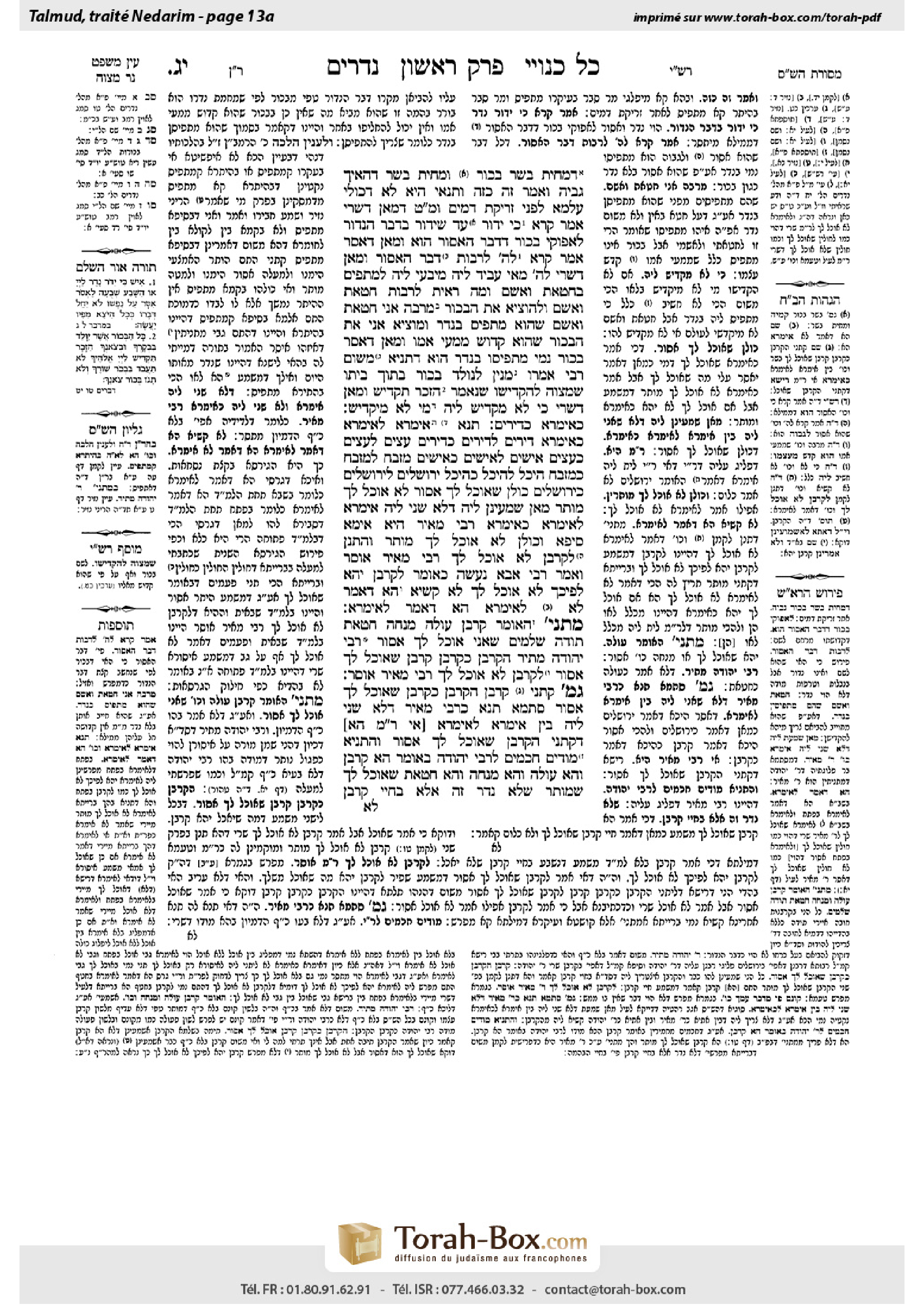
Nedarim 13a: Talmud study for Daf Yomi
Daf Yomi is the daily study of one Talmud folio. Explore 37 tractates with scans, Hebrew text, Sefaria English and AI-generated French translations where annotated.
Passage selection and English or AI-generated French translation are available where the scan has annotations. Daf Study is independent of Torah-Box and Sefaria.
Browse Nedarim · נדרים · All tractatesNedarim 13a text and translations
This page of Nedarim includes the Aramaic text, an English translation and an AI-generated French translation, alongside the scan above.
נדרים י״ג א · Aramaic and Hebrew text
דְּמַחֵית בְּשַׂר בְּכוֹר וּמַחֵית בָּשָׂר דְּהַאיְךְ גַּבֵּיהּ, וְאָמַר ״זֶה כָּזֶה״. וְתַנָּאֵי הִיא.
לָא, דְּכוּלֵּי עָלְמָא לִפְנֵי זְרִיקַת דָּמִים, וּמַאי טַעְמָא דְמַאן דְּשָׁרֵי — אָמַר קְרָא: ״כִּי יִדֹּר״, עַד שֶׁיִּדּוֹר בְּדָבָר הַנָּדוּר, לְאַפּוֹקֵי בְּכוֹר, דְּדָבָר הָאָסוּר הוּא.
וּמַאן דְּאָסַר, אָמַר קְרָא: ״לַה׳״, לְרַבּוֹת דָּבָר הָאָסוּר.
וּמַאן דְּשָׁרֵי, ״לַה׳״ מַאי עָבֵיד לֵיהּ? מִיבְּעֵי לֵיהּ לְמַתְפִּיס בְּחַטָּאת וְאָשָׁם.
וּמָה רָאִיתָ לְרַבּוֹת חַטָּאת וְאָשָׁם וּלְהוֹצִיא אֶת הַבְּכוֹר? מְרַבֶּה אֲנִי חַטָּאת וְאָשָׁם שֶׁהוּא מַתְפִּיס בְּנֶדֶר, וּמוֹצִיא אֲנִי אֶת הַבְּכוֹר שֶׁהוּא קָדוֹשׁ מִמְּעֵי אִמּוֹ.
וּמַאן דְּאָסַר, בְּכוֹר נָמֵי מַתְפִּיסוֹ בְּנֶדֶר הוּא. דְּתַנְיָא, מִשּׁוּם רַבִּי אָמְרוּ: מִנַּיִן לְנוֹלַד בְּכוֹר בְּתוֹךְ בֵּיתוֹ, שֶׁמִּצְוָה לְהַקְדִּישׁוֹ, שֶׁנֶּאֱמַר: ״הַזָּכָר תַּקְדִּישׁ״.
וּמַאן דְּשָׁרֵי, כִּי לָא מַקְדֵּישׁ לֵיהּ מִי לָא מִיקַּדֵּישׁ?
״כְּאִימְּרָא״, ״כַּדִּירִים״.
תָּנָא: ״אִימְּרָא״, ״לְאִימְּרָא״, ״כְּאִימְּרָא״, ״דִּירִים״, ״לַדִּירִים״ ״כַּדִּירִים״, ״עֵצִים״, ״לָעֵצִים״, ״כָּעֵצִים״, ״אִישִּׁים״, ״לָאִישִּׁים״, ״כָּאִישִּׁים״, ״מִזְבֵּחַ״, ״לַמִּזְבֵּחַ״, ״כַּמִּזְבֵּחַ״, ״הֵיכָל״, ״לַהֵיכָל״, ״כַּהֵיכָל״, ״יְרוּשָׁלַיִם״, ״לִירוּשָׁלַיִם״, ״כִּירוּשָׁלַיִם״, כּוּלָּן: ״שֶׁאוֹכַל לָךְ״ — אָסוּר. ״לֹא אוֹכַל לָךְ״ — מוּתָּר.
מַאן שָׁמְעִינַן לֵיהּ דְּלָא שָׁנֵי לֵיהּ ״אִימְּרָא״ ״לְאִימְּרָא״ ״כְּאִימְּרָא״ — רַבִּי מֵאִיר הִיא.
אֵימָא סֵיפָא: וְכוּלָּן ״לֹא אוֹכַל לָךְ״ — מוּתָּר. וְהָתְנַן: ״לַקָּרְבָּן לֹא אוֹכַל לָךְ״ — רַבִּי מֵאִיר אוֹסֵר, וְאָמַר רַבִּי אַבָּא: נַעֲשָׂה כְּאוֹמֵר ״לְקָרְבָּן יְהֵא, לְפִיכָךְ לֹא אוֹכַל לָךְ״.
לָא קַשְׁיָא: הָא דְּאָמַר ״לָא לְאִימְּרָא״, הָא דְּאָמַר ״לְאִימְּרָא״.
מַתְנִי׳ הָאוֹמֵר ״קׇרְבָּן״, ״עוֹלָה״, ״מִנְחָה״, ״חַטָּאת״, ״תּוֹדָה״, ״שְׁלָמִים״, ״שֶׁאֲנִי אוֹכֵל לָךְ״ — אָסוּר. רַבִּי יְהוּדָה מַתִּיר. ״הַקׇּרְבָּן״, ״כַּקׇּרְבָּן״, ״קׇרְבָּן שֶׁאוֹכַל לָךְ״ — אָסוּר. ״לַקׇּרְבָּן לֹא אוֹכַל לָךְ״ — רַבִּי מֵאִיר אוֹסֵר.
גְּמָ׳ קָתָנֵי ״קׇרְבָּן״, ״הַקׇּרְבָּן״, ״כַּקׇּרְבָּן שֶׁאוֹכַל לָךְ״ — אָסוּר. סְתָמָא תְּנָא כְּרַבִּי מֵאִיר, דְּלָא שָׁנֵי לֵיהּ בֵּין ״אִימְּרָא״ ״לְאִימְּרָא״.
[אִי רַבִּי מֵאִיר — הָא] דְּקָתָנֵי: ״הַקׇּרְבָּן שֶׁאוֹכַל לָךְ״ — אָסוּר, וְהָתַנְיָא: מוֹדִים חֲכָמִים לְרַבִּי יְהוּדָה בְּאוֹמֵר ״הָא קׇרְבָּן״, וְ״הָא עוֹלָה״ וְ״הָא מִנְחָה״ וְ״הָא חַטָּאת שֶׁאוֹכַל לָךְ״ — שֶׁמּוּתָּר? שֶׁלֹּא נָדַר זֶה אֶלָּא בְּחַיֵּי קׇרְבָּן!
Nedarim 13a · English translation
that he places the meat of a firstborn animal in one place and he places another piece of meat next to it, and he said: This second piece of meat is hereby like that meat of the firstborn animal, and it is a dispute between tanna’im about whether he is referring to the original forbidden status of the firstborn animal or its current permitted status?
The Gemara responds: No, everyone agrees that he is referring to the status of the animal before the sprinkling of the blood, and what is the reason of the one who renders it permitted? The verse states: “When a man takes a vow” (Numbers 30:3), which indicates that he has not done so until he takes a vow with an item forbidden by means of a vow, i.e., by extending the status of an item that itself was forbidden by a means of a vow. This comes to exclude a firstborn, which is an item that is forbidden by the Torah rather than by means of a vow; a firstborn animal is sacred simply because it is born first.
And the one who renders it forbidden holds that it is because the verse states: “To the Lord” (Numbers 30:3), which comes to include one who takes a vow by associating an object with an item that is forbidden by the Torah.
The Gemara asks: And the one who renders it permitted based on the principle that one cannot take a vow by associating the item with an item that is forbidden by the Torah, what does he do with the expression “to the Lord”? The Gemara answers: He requires this expression to include the case of one who associates the object of his vow with a sin-offering and a guilt-offering. Although these offerings are obligatory rather than voluntary, and in that regard they are dissimilar to items forbidden by means of a vow, one can render another item forbidden by associating it with these offerings.
The Gemara asks: And what did you see that led you to include a sin-offering and a guilt-offering and to exclude the firstborn? The Gemara answers: I include the sin-offering and guilt-offering due to the fact that he associates the object of his vow with an animal forbidden by means of a vow, as it is the individual who designates a particular animal for one of these offerings. And I remove the firstborn, because it is sacred from its mother’s womb.
And the one who renders it forbidden is of the opinion that one who says that a piece of meat shall be considered for him like the meat of a firstborn also associates the object of his vow with an item forbidden by a vow, as it is taught in a baraita: They said in the name of Rabbi Yehuda HaNasi: From where is it derived that if one has a firstborn animal born in his home it is still a mitzva to consecrate it? As it is stated: “The males you shall consecrate” (Deuteronomy 15:19). Although a firstborn animal is considered consecrated from birth, its owner is still commanded to declare it consecrated, and it is therefore considered an item forbidden by means of a vow.
And the one who renders it permitted in this case argues that although the owner is required to declare it consecrated, if he does not consecrate it, is it not consecrated? Since it is consecrated in any event, it is considered to have been rendered forbidden by the Torah rather than through a vow.
§ It is taught in the mishna that if one says that food shall be considered like the lamb [imra] of the daily offering, or like the animals designated as offerings and kept in special enclosures, the vow takes effect.
It was taught in a baraita: If one says that food shall be considered a lamb, for a lamb, like a lamb; enclosures, for enclosures, like enclosures; wood, for wood, like wood; fires, for fires, like fires; the altar, for the altar, like the altar; the Sanctuary, for the Sanctuary, like the Sanctuary; Jerusalem, for Jerusalem, like Jerusalem; with regard to all of them, if he adds: That which I will eat of yours, it is forbidden. This is because his intent is that whatever he eats that belongs to the other individual should be forbidden to him like one of these consecrated items. However, if he adds: That which I will not eat of yours, the food is permitted, since the only implication of his statement is that whatever he does not eat shall be forbidden.
The Gemara asks: Who is the Sage of whom we have heard, for whom there is no difference whether one said a lamb, for a lamb, or like a lamb, that I eat of yours? It is Rabbi Meir. Conversely, Rabbi Yehuda holds that the vow takes effect only if one says: Like a lamb.
However, say the latter clause of the baraita: With regard to all of them, if he adds: That which I will not eat of yours, the food remains permitted. But didn’t we learn in the next mishna that if one says: That which I will not eat of yours shall be for an offering [lekorban], Rabbi Meir prohibits him from eating food belonging to the other individual? And Rabbi Abba said in explanation of this ruling that it is as though he said: It shall be for an offering [lekorban], and therefore I will not eat that which is yours. Apparently, according to Rabbi Meir the food is forbidden even if he said: That which I will not eat of yours.
The Gemara responds: This is not difficult: This baraita is referring to a case where one said: That which I do not eat from you shall not [la] be for a lamb [le’imra]. Although this statement implies that what he does eat shall be considered like the lamb of the daily offering, Rabbi Meir holds that one cannot infer a positive statement from a negative statement. Conversely, that mishna is referring to a case where he said: For a lamb [le’imra]. In that case, his statement is interpreted as though he said: It shall be considered the lamb used for the daily offering, and therefore I will not eat it.
MISHNA: With regard to one who says: An offering, a burnt-offering, a meal-offering, a sin-offering, a thanks-offering, or a peace-offering, and adds: That which I eat of yours, the vow takes effect and the food is forbidden. Rabbi Yehuda renders the food permitted in all these cases. If one says: The offering, like an offering, or an offering, and adds: That which I will eat of yours, the food is forbidden. If he says: That which I will not eat of yours shall be for an offering, Rabbi Meir renders the food forbidden.
GEMARA: It teaches in the mishna that if one says: An offering, the offering, or like an offering, and then adds: That which I will eat of yours, it is forbidden. This indicates that this unattributed opinion in the mishna was taught in accordance with the opinion of Rabbi Meir, for whom there is no difference whether one says a lamb [imra] or as a lamb [le’imra].
The Gemara asks: However, if it is in accordance with the opinion of Rabbi Meir, that which it teaches is difficult. It teaches that if one says: The offering [hakorban], and adds: That which I will eat of yours, the food is forbidden. But isn’t it taught in a baraita that the Rabbis concede to Rabbi Yehuda that with regard to one who says: This offering [ha korban], or this burnt-offering [ha ola], or this meal-offering [ha minḥa], or this sin-offering [ha ḥatat], and then adds: That I will eat of yours, the vow does not take effect and the food is permitted? The reason for this is that the individual did not take a vow that the item should be associated with an offering; rather, he took a vow by the life of the offering, which is not a valid expression of a vow.
Nedarim 13a · Traduction française (IA)
qu’il place la viande d’un animal premier-né en un endroit, puis une autre pièce de viande à côté, et qu’il dise : « Cette seconde pièce de viande est désormais comme la viande de cet animal premier-né » ; s’agit-il d’une controverse entre les tannaïm sur le point de savoir s’il se réfère au statut initial d’interdiction de l’animal premier-né ou à son statut actuel, qui est permis ?
La Guemara répond : Non, tous s’accordent à dire qu’il se réfère au statut de l’animal avant l’aspersion du sang. Quelle est donc la raison de celui qui le rend permis ? Le verset dit : « Lorsqu’un homme prononce un vœu » (Nombres 30, 3), ce qui indique qu’il n’a pas prononcé de vœu tant qu’il n’a pas fait un vœu portant sur un objet interdit par un vœu, c’est-à-dire en étendant le statut d’un objet lui-même interdit par un vœu. Cela vient exclure un animal premier-né, qui est interdit par la Torah et non par un vœu : un animal premier-né est sacré simplement parce qu’il est né le premier.
Et celui qui le rend interdit estime que c’est parce que le verset dit : « Pour le Seigneur » (Nombres 30, 3), ce qui vient inclure celui qui prononce un vœu en associant un objet à un objet interdit par la Torah.
La Guemara demande : Et celui qui le rend permis en se fondant sur le principe qu’on ne peut pas prononcer un vœu en associant un objet à un objet interdit par la Torah, que fait-il de l’expression « pour le Seigneur » ? La Guemara répond : Il a besoin de cette expression pour inclure le cas de celui qui associe l’objet de son vœu à un sacrifice expiatoire ou à un sacrifice de culpabilité. Bien que ces sacrifices soient obligatoires et non volontaires, et qu’à cet égard ils diffèrent des objets interdits par un vœu, on peut rendre un autre objet interdit en l’associant à ces sacrifices.
La Guemara demande : Qu’as-tu vu qui t’a amené à inclure le sacrifice expiatoire et le sacrifice de culpabilité, et à exclure l’animal premier-né ? La Guemara répond : J’inclus le sacrifice expiatoire et le sacrifice de culpabilité, car il associe l’objet de son vœu à un animal interdit par un vœu, puisque c’est l’individu qui désigne un animal particulier pour l’un de ces sacrifices. Et j’exclus l’animal premier-né, car il est sacré dès le ventre de sa mère.
Et celui qui le rend interdit estime que celui qui dit qu’une pièce de viande sera pour lui comme la viande d’un animal premier-né associe également l’objet de son vœu à un objet interdit par un vœu, comme l’enseigne une baraïta : On a dit au nom de Rabbi Yehouda HaNassi : D’où apprend-on que si un animal premier-né naît dans sa maison, il reste une mitsva de le consacrer ? Car il est dit : « Les mâles, tu les consacreras » (Deutéronome 15, 19). Bien qu’un animal premier-né soit considéré comme consacré dès sa naissance, son propriétaire a tout de même l’obligation de le déclarer consacré ; il est donc considéré comme un objet interdit par un vœu.
Et celui qui le rend permis dans ce cas soutient que, bien que le propriétaire soit tenu de le déclarer consacré, s’il ne le consacre pas, n’est-il pas malgré tout consacré ? Puisqu’il est consacré dans tous les cas, il est considéré comme ayant été interdit par la Torah, et non par un vœu.
§ Il est enseigné dans la Michna que si quelqu’un dit qu’un aliment sera comme l’agneau [imra] de l’offrande quotidienne, ou comme les animaux désignés comme offrandes et gardés dans des enclos spéciaux, le vœu prend effet.
Il a été enseigné dans une baraïta : Si quelqu’un dit qu’un aliment sera un agneau, pour un agneau, comme un agneau ; des enclos, pour des enclos, comme des enclos ; du bois, pour du bois, comme du bois ; des feux, pour des feux, comme des feux ; l’autel, pour l’autel, comme l’autel ; le Sanctuaire, pour le Sanctuaire, comme le Sanctuaire ; Jérusalem, pour Jérusalem, comme Jérusalem ; dans tous ces cas, s’il ajoute : « Ce que je mangerai de ce qui t’appartient », c’est interdit. En effet, il entend que tout ce qu’il mangera et qui appartient à l’autre personne lui soit interdit comme l’un de ces objets consacrés. En revanche, s’il ajoute : « Ce que je ne mangerai pas de ce qui t’appartient », l’aliment est permis, puisque sa déclaration implique seulement que tout ce qu’il ne mangera pas sera interdit.
La Guemara demande : Quel est le Sage dont nous avons appris qu’à ses yeux, cela ne fait aucune différence qu’on dise « un agneau », « pour un agneau » ou « comme un agneau », à propos de ce que je mangerai de ce qui t’appartient ? C’est Rabbi Meïr. À l’inverse, Rabbi Yehouda soutient que le vœu ne prend effet que si l’on dit : « Comme un agneau ».
Toutefois, considérons la dernière clause de la baraïta : dans tous ces cas, s’il ajoute : « Ce que je ne mangerai pas de ce qui t’appartient », l’aliment reste permis. Mais n’avons-nous pas appris dans la Michna suivante que si quelqu’un dit : « Ce que je ne mangerai pas de ce qui t’appartient sera une offrande [lekorban] », Rabbi Meïr lui interdit de manger des aliments appartenant à l’autre personne ? Et Rabbi Abba a expliqué cette décision en disant que c’est comme s’il avait dit : « Que cela soit une offrande [lekorban] », et donc je ne mangerai pas ce qui t’appartient. Il apparaît donc que, selon Rabbi Meïr, l’aliment est interdit même s’il a dit : « Ce que je ne mangerai pas de ce qui t’appartient ».
La Guemara répond : Il n’y a pas de difficulté : cette baraïta parle du cas où quelqu’un a dit : « Ce que je ne mangerai pas de chez toi ne [la] sera pas pour un agneau [le’imra]. » Bien que cette déclaration implique que ce qu’il mangera sera considéré comme l’agneau de l’offrande quotidienne, Rabbi Meïr soutient qu’on ne peut pas déduire une affirmation positive d’une affirmation négative. À l’inverse, cette Michna parle du cas où il a dit : « Pour un agneau [le’imra]. » Dans ce cas, sa déclaration est interprétée comme s’il avait dit : « Cela sera considéré comme l’agneau utilisé pour l’offrande quotidienne », et donc je ne le mangerai pas.
MICHNA : Si quelqu’un dit : « Une offrande », « un holocauste », « une offrande végétale », « un sacrifice expiatoire », « un sacrifice de reconnaissance » ou « un sacrifice de paix », et ajoute : « Ce que je mangerai de ce qui t’appartient », le vœu prend effet et l’aliment est interdit. Rabbi Yehouda permet l’aliment dans tous ces cas. Si quelqu’un dit : « L’offrande », « comme une offrande » ou « une offrande », et ajoute : « Ce que je mangerai de ce qui t’appartient », l’aliment est interdit. S’il dit : « Ce que je ne mangerai pas de ce qui t’appartient sera une offrande », Rabbi Meïr rend l’aliment interdit.
GUEMARA : La Michna enseigne que si quelqu’un dit : « Une offrande », « l’offrande » ou « comme une offrande », puis ajoute : « Ce que je mangerai de ce qui t’appartient », c’est interdit. Cela indique que cette opinion anonyme de la Michna suit l’avis de Rabbi Meïr, pour qui cela ne fait aucune différence qu’on dise « un agneau » [imra] ou « comme un agneau » [le’imra].
La Guemara demande : Toutefois, si la Michna suit l’avis de Rabbi Meïr, ce qu’elle enseigne pose une difficulté. Elle enseigne que si quelqu’un dit : « L’offrande » [hakorban], et ajoute : « Ce que je mangerai de ce qui t’appartient », l’aliment est interdit. Mais n’est-il pas enseigné dans une baraïta que les Sages reconnaissent à Rabbi Yehouda que, dans le cas de celui qui dit : « Cette offrande » [ha korban], « cet holocauste » [ha ola], « cette offrande végétale » [ha minḥa] ou « ce sacrifice expiatoire » [ha ḥatat], puis ajoute : « Ce que je mangerai de ce qui t’appartient », le vœu ne prend pas effet et l’aliment est permis ? La raison en est que l’individu n’a pas prononcé de vœu pour associer l’objet à une offrande ; il a plutôt fait un vœu par la vie de l’offrande, ce qui ne constitue pas une formulation valide de vœu.
Traduction française générée par IA à partir de l’édition anglaise de Sefaria. Vérifie toujours un passage avec le texte source.
Text from Sefaria: William Davidson Edition - Vocalized Aramaic (CC BY NC); William Davidson Edition - English (CC BY NC).