Nedarim 13b: Talmud study for Daf Yomi
Daf Yomi is the daily study of one Talmud folio. Explore 37 tractates with scans, Hebrew text, Sefaria English and AI-generated French translations where annotated.
Passage selection and English or AI-generated French translation are available where the scan has annotations. Daf Study is independent of Torah-Box and Sefaria.
Browse Nedarim · נדרים · All tractatesNedarim 13b text and translations
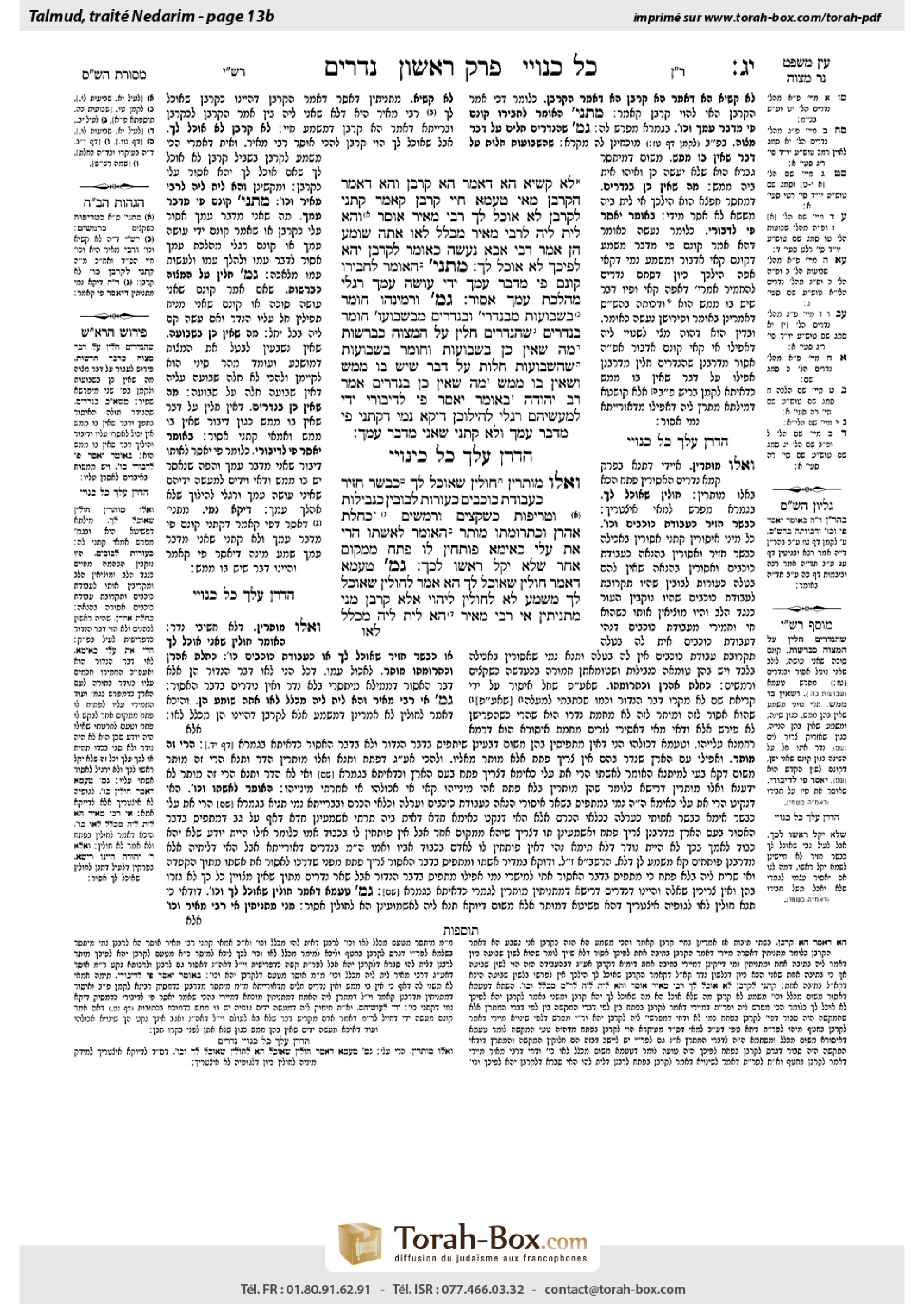
This page of Nedarim includes the Aramaic text, an English translation and an AI-generated French translation, alongside the scan above.
נדרים י״ג ב · Aramaic and Hebrew text
לָא קַשְׁיָא: הָא דְּאָמַר ״הָא קׇרְבָּן״, וְהָא דְּאָמַר ״הַקׇּרְבָּן״. מַאי טַעְמָא? חַיֵּי קׇרְבָּן קָאָמַר.
קָתָנֵי: ״לַקׇּרְבָּן לֹא אוֹכַל לָךְ״, רַבִּי מֵאִיר אוֹסֵר. וְהָא לֵית לֵיהּ לְרַבִּי מֵאִיר מִכְּלָל לָאו אַתָּה שׁוֹמֵעַ הֵן! אָמַר רַבִּי אַבָּא: נַעֲשָׂה כְּאוֹמֵר: לְקׇרְבָּן יְהֵא, לְפִיכָךְ לֹא אוֹכַל לָךְ.
מַתְנִי׳ הָאוֹמֵר לַחֲבֵירוֹ ״קֻוֽנָּם פִּי מְדַבֵּר עִמָּךְ״, ״יָדִי עוֹשָׂה עִמָּךְ״, ״רַגְלִי מְהַלֶּכֶת עִמָּךְ״ — אָסוּר.
גְּמָ׳ וּרְמִינְהוּ: חוֹמֶר בַּשְּׁבוּעוֹת מִבַּנְּדָרִים וּבַנְּדָרִים מִבַּשְּׁבוּעוֹת. חוֹמֶר בַּנְּדָרִים, שֶׁהַנְּדָרִים חָלִים עַל הַמִּצְוָה כְּבָרְשׁוּת, מַה שֶּׁאֵין כֵּן בַּשְּׁבוּעוֹת. וְחוֹמֶר בַּשְּׁבוּעוֹת, שֶׁהַשְּׁבוּעוֹת חָלוֹת עַל דָּבָר שֶׁיֵּשׁ בּוֹ מַמָּשׁ וְשֶׁאֵין בּוֹ מַמָּשׁ, מַה שֶּׁאֵין כֵּן בַּנְּדָרִים.
אָמַר רַב יְהוּדָה: בְּאוֹמֵר ״יֵאָסֵר פִּי לְדִיבּוּרִי״, ״יָדַי לְמַעֲשֵׂיהֶם״, ״רַגְלַי לְהִילּוּכָן״. דַּיְקָא נָמֵי, דְּקָתָנֵי ״פִּי מְדַבֵּר עִמָּךְ״, וְלָא קָתָנֵי ״שֶׁאֲנִי מְדַבֵּר עִמָּךְ״.
הַדְרָן עֲלָךְ כׇּל כִּנּוּיֵי
מַתְנִי׳ וְאֵלּוּ מוּתָּרִין: ״חוּלִּין שֶׁאוֹכַל לָךְ״, ״כִּבְשַׂר חֲזִיר״, ״כַּעֲבוֹדָה זָרָה״, ״כְּעוֹרוֹת לְבוּבִין״, ״כִּנְבֵילוֹת וּטְרֵיפוֹת״, ״כִּשְׁקָצִים וּרְמָשִׂים״, ״כְּחַלַּת אַהֲרֹן וְכִתְרוּמָתוֹ״ — מוּתָּר.
הָאוֹמֵר לְאִשְׁתּוֹ ״הֲרֵי אַתְּ עָלַי כְּאִימָּא״ — פּוֹתְחִין לוֹ פֶּתַח מִמָּקוֹם אַחֵר. שֶׁלֹּא יָקֵל רֹאשׁוֹ לְכָךְ.
גְּמָ׳ טַעְמָא דְּאָמַר ״חוּלִּין שֶׁאוֹכַל לָךְ״ הָא אָמַר ״לַחוּלִּין שֶׁאוֹכַל לָךְ״, מַשְׁמַע: לָא לְחוּלִּין לֶיהֱוֵי אֶלָּא קׇרְבָּן.
מַנִּי מַתְנִיתִין? אִי רַבִּי מֵאִיר — הָא לֵית לֵיהּ מִכְּלָל
Nedarim 13b · English translation
The Gemara answers: This is not difficult. This case, where the vow does not take effect, is where one said: This offering [ha korban], and that case, where the vow does take effect, is where one said: The offering [hakorban]. What is the reason that the vow does not take effect when he says this offering [ha korban]? It is because he is saying that he is taking a vow by the life of this offering, which is not a valid way to express a vow.
The mishna teaches that if one says: That which I will not eat of yours is lakorban, which indicates la korban, it is not an offering, Rabbi Meir prohibits him from eating food belonging to the other individual. This is because his statement indicates that what he does eat shall be considered an offering. The Gemara asks: Isn’t it true that Rabbi Meir does not hold that from a negative statement you can infer a positive statement? The Gemara answers that Rabbi Abba said: It is as though he said: It shall be for an offering [lekorban], and therefore I will not eat that which is yours.
MISHNA: One who says to another: It is konam for me for my mouth to speak with you, or: It is konam for me for my hand to work with you, or: It is konam for me for my foot to walk with you, it is prohibited for him to speak with, work with, or walk with the other individual.
GEMARA: The Gemara raises a contradiction from the following baraita: There is a stricture that applies to oaths beyond the strictures that apply to vows, and there is a stricture that applies to vows beyond the strictures that apply to oaths. The stricture that applies to vows is that vows take effect with regard to a mitzva as they do with regard to optional activities, which is not the case with regard to oaths, as one cannot take an oath to neglect a mitzva. And the stricture that applies to oaths is that oaths take effect upon a matter that has substance and a matter that does not have substance, which is not the case with regard to vows, which take effect only upon a matter that has substance. This contradicts the mishna, which states that a vow can apply to speech or actions, which are not physical items that have concrete substance.
Rav Yehuda said: The mishna is referring to one who says: My mouth shall be forbidden with regard to my speech, or: My hands shall be forbidden with regard to their work, or: My feet should be forbidden with regard to their walking. In these cases the vow applies to a limb, which is a concrete item, and therefore it takes effect. The Gemara comments: The language of the mishna is also precise according to this interpretation, as it teaches: For my mouth to speak with you, and it does not teach: That which I speak with you. This indicates that he imposed the vow upon his mouth and not upon the act of speaking.
MISHNA: And these are the vows in which the one who takes the vow attempts to create a prohibition on an item by associating it with an item in an ineffective manner, rendering the vow void and leaving the item permitted: If one says: That which I will eat of yours will be non-sacred [ḥullin]; or: That which I will eat of yours will be like pig meat; or: Like an object of idol worship; or: Like the hides of animal offerings whose hearts were removed as a form of idol worship, and it is therefore prohibited to derive benefit from those animals; or: Like animal carcasses and animals with a wound that will cause them to die within twelve months [tereifot]; or: Like non-kosher repugnant creatures and non-kosher creeping animals; or: Like the ḥalla of Aaron, the first priest, or like his teruma; in all these cases, the food is permitted. Although none of these items may be eaten, they are forbidden by Torah law, not by means of a vow. Therefore, it is impossible to extend their prohibition to other items by means of a vow that associates them with those items.
With regard to a man who says to his wife: You are hereby to me like my mother, i.e., deriving benefit from you should be forbidden to me like engaging in sexual intercourse with my mother, dissolution is broached with him by suggesting a different extenuation, i.e., a halakhic authority suggests other, extenuating circumstances that enable the dissolution of the vow. Although this vow does not take effect either, as engaging in sexual intercourse with one’s mother is prohibited by Torah law, by rabbinic law this is treated like an actual vow and requires dissolution by a halakhic authority, so that he will not take genuine vows lightly.
GEMARA: It may be inferred from the first case in the mishna that the reason the vow does not take effect is that he said: That which I will eat of yours will be ḥullin; but if he said: That which I will eat of yours will be laḥullin, that indicates that he is saying: It will not [la] be non-sacred [ḥullin], but rather like an offering, which is a vow that takes effect.
Whose opinion is expressed in the mishna? If it is the opinion of Rabbi Meir, isn’t he of the opinion that one does not say: From
Nedarim 13b · Traduction française (IA)
La Guemara répond : Cela ne pose pas de difficulté. Le cas où le vœu n'a pas d'effet est celui où l'on a dit : « Ce sacrifice [ha korban] » ; et le cas où le vœu a un effet est celui où l'on a dit : « Le sacrifice [hakorban] ». Quelle est la raison pour laquelle le vœu n'a pas d'effet lorsqu'il dit « ce sacrifice [ha korban] » ? C'est parce qu'il dit qu'il fait un vœu par la vie de ce sacrifice, ce qui n'est pas une manière valide d'exprimer un vœu.
La Michna enseigne que si l'on dit : « Ce que je ne mangerai pas de ce qui vous appartient est lakorban », ce qui indique la korban, ce n'est pas un sacrifice, et Rabbi Meir lui interdit de manger des aliments appartenant à l'autre individu. C'est parce que sa déclaration indique que ce qu'il mangera sera considéré comme un sacrifice. La Guemara demande : N'est-il pas vrai que Rabbi Meir ne soutient pas qu'on peut inférer une affirmation positive d'une déclaration négative ? La Guemara répond que Rabbi Abba a dit : C'est comme s'il avait dit : « Ce sera pour un sacrifice [lekorban] », et par conséquent je ne mangerai pas ce qui vous appartient.
MICHNA : Celui qui dit à un autre : « Il est konam pour moi que ma bouche parle avec toi », ou : « Il est konam pour moi que ma main travaille avec toi », ou : « Il est konam pour moi que mon pied marche avec toi », il lui est interdit de parler avec, de travailler avec, ou de marcher avec l'autre individu.
GUEMARA : La Guemara soulève une contradiction à partir de la baraïta suivante : Il existe une rigueur qui s'applique aux serments au-delà des rigueurs qui s'appliquent aux vœux, et il existe une rigueur qui s'applique aux vœux au-delà des rigueurs qui s'appliquent aux serments. La rigueur qui s'applique aux vœux est que ceux-ci prennent effet par rapport à une mitsva de la même manière que par rapport à des activités facultatives, ce qui n'est pas le cas des serments, car on ne peut pas faire un serment pour négliger une mitsva. Et la rigueur qui s'applique aux serments est que ceux-ci prennent effet sur une chose qui a une substance et sur une chose qui n'en a pas, ce qui n'est pas le cas des vœux, qui ne prennent effet que sur une chose qui a une substance. Cela contredit la Michna, qui énonce qu'un vœu peut s'appliquer à la parole ou aux actions, qui ne sont pas des objets physiques ayant une substance concrète.
Rav Yehuda a dit : La Michna fait référence à celui qui dit : « Ma bouche sera interdite par rapport à ma parole », ou : « Mes mains seront interdites par rapport à leur travail », ou : « Mes pieds seront interdits par rapport à leur marche ». Dans ces cas, le vœu s'applique à un membre, qui est un objet concret, et par conséquent il prend effet. La Guemara commente : Le langage de la Michna est également précis selon cette interprétation, car elle enseigne : « Que ma bouche parle avec toi », et elle n'enseigne pas : « Ce que je parle avec toi ». Cela indique qu'il a imposé le vœu sur sa bouche et non sur l'acte de parler.
Michna : Voici les vœux dans lesquels celui qui fait le vœu tente de créer une interdiction sur un objet en l'associant à un objet d'une manière inefficace, ce qui rend le vœu nul et laisse l'objet permis : Si l'on dit : « Ce que je mangerai de ce qui vous appartient sera non sacré [ḥullin] » ; ou : « Ce que je mangerai de ce qui vous appartient sera comme de la viande de porc » ; ou : « Comme un objet de culte idolâtre » ; ou : « Comme les peaux des sacrifices d'animaux dont les cœurs ont été retirés comme forme de culte idolâtre, et il est donc interdit de tirer un profit de ces animaux » ; ou : « Comme des carcasses d'animaux et des animaux ayant une blessure qui les fera mourir dans les douze mois [tereifot] » ; ou : « Comme des créatures répugnantes non casheres et des animaux rampants non casheres » ; ou : « Comme la ḥalla d'Aaron, le premier prêtre, ou comme sa terouma » ; dans tous ces cas, la nourriture est permise. Bien qu'aucun de ces objets ne puisse être mangé, ils sont interdits par la loi de la Torah, et non par le moyen d'un vœu. Par conséquent, il est impossible d'étendre leur interdiction à d'autres objets par le moyen d'un vœu qui les associe à ces objets.
Concernant un homme qui dit à sa femme : « Tu es désormais pour moi comme ma mère », c'est-à-dire que tirer un profit de toi doit m'être interdit comme l'union sexuelle avec ma mère, la dissolution est abordée avec lui en suggérant une autre atténuation, c'est-à-dire qu'une autorité halakhique suggère d'autres circonstances atténuantes qui permettent la dissolution du vœu. Bien que ce vœu n'ait pas d'effet non plus, car l'union sexuelle avec sa mère est interdite par la loi de la Torah, selon la loi rabbinique, cela est traité comme un vœu réel et nécessite une dissolution par une autorité halakhique, afin qu'il ne prenne pas à la légère les vœux authentiques.
Guemara : On peut en déduire du premier cas de la Michna que la raison pour laquelle le vœu n'a pas d'effet est qu'il a dit : « Ce que je mangerai de ce qui vous appartient sera ḥullin » ; mais s'il a dit : « Ce que je mangerai de ce qui vous appartient sera laḥullin », cela indique qu'il dit : Ce ne sera pas [la] non sacré [ḥullin], mais plutôt comme une offrande, ce qui est un vœu qui prend effet.
De qui est l'opinion exprimée dans la Michna ? S'il s'agit de l'opinion de Rabbi Meir, n'est-il pas de l'avis que l'on ne dit pas : À partir de
Traduction française générée par IA à partir de l’édition anglaise de Sefaria. Vérifie toujours un passage avec le texte source.
Text from Sefaria: William Davidson Edition - Vocalized Aramaic (CC BY NC); William Davidson Edition - English (CC BY NC).