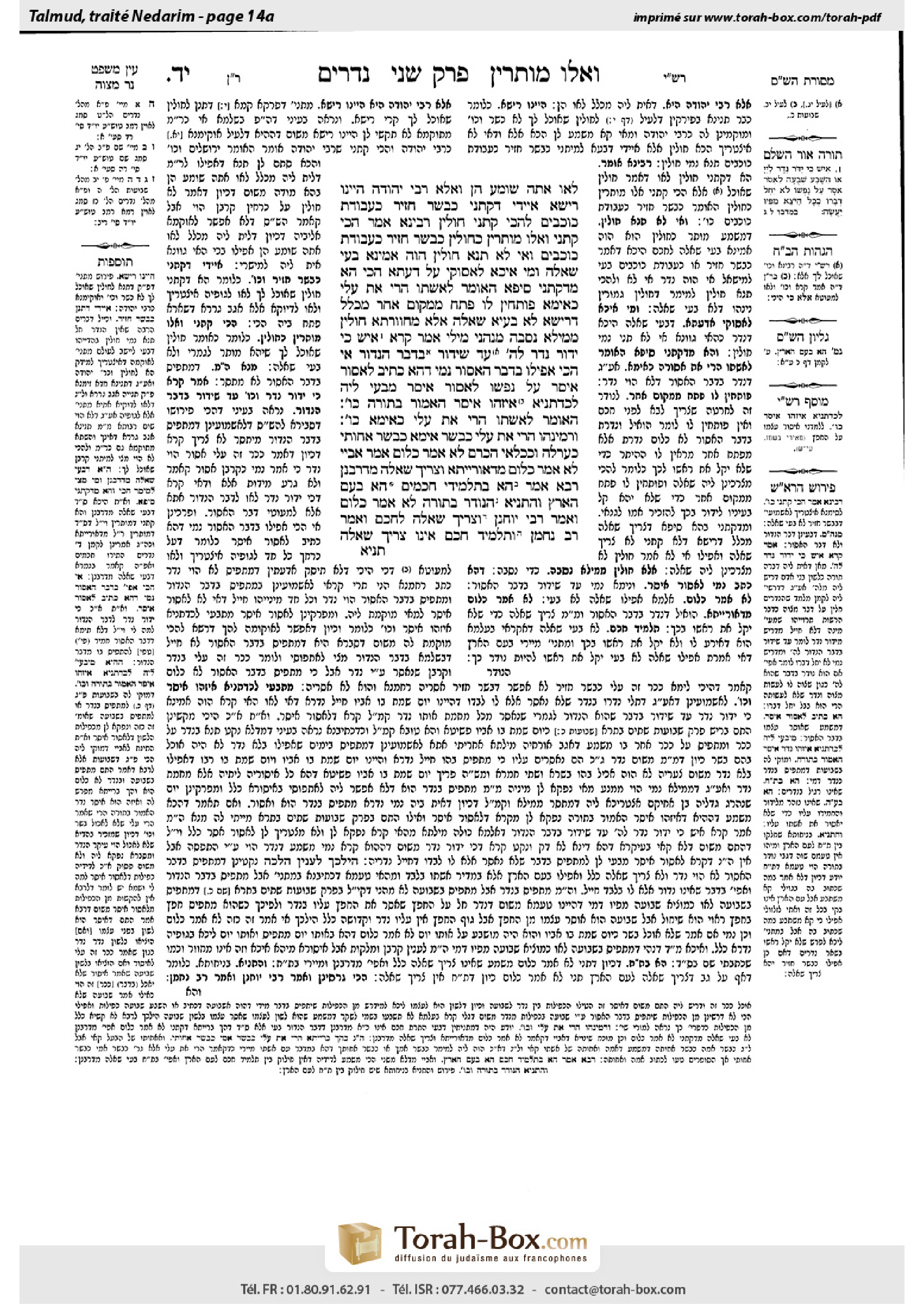
Nedarim 14a: Talmud study for Daf Yomi
Daf Yomi is the daily study of one Talmud folio. Explore 37 tractates with scans, Hebrew text, Sefaria English and AI-generated French translations where annotated.
Passage selection and English or AI-generated French translation are available where the scan has annotations. Daf Study is independent of Torah-Box and Sefaria.
Browse Nedarim · נדרים · All tractatesNedarim 14a text and translations
This page of Nedarim includes the Aramaic text, an English translation and an AI-generated French translation, alongside the scan above.
נדרים י״ד א · Aramaic and Hebrew text
לָאו אַתָּה שׁוֹמֵעַ הֵן! וְאֶלָּא רַבִּי יְהוּדָה, הַיְינוּ רֵישָׁא!
אַיְּידֵי דְּקָתָנֵי ״כִּבְשַׂר חֲזִיר״, ״כַּעֲבוֹדָה זָרָה״, לְהָכִי קָתָנֵי ״חוּלִּין״.
רָבִינָא אָמַר: הָכִי קָתָנֵי, וְאֵלּוּ מוּתָּרִין: ״כְּחוּלִּין״, ״כִּבְשַׂר חֲזִיר״, ״כַּעֲבוֹדָה זָרָה״. וְאִי לָא תְּנָא חוּלִּין, הֲוָה אָמֵינָא בָּעֵי שְׁאֵלָה.
וּמִי אִיכָּא לְאַסּוֹקֵי עַל דַּעְתָּא הָכִי? הָא מִדְּקָתָנֵי סֵיפָא: הָאוֹמֵר לְאִשְׁתּוֹ ״הֲרֵי אַתְּ עָלַי כְּאִימָּא״ — פּוֹתְחִין לוֹ פֶּתַח מִמָּקוֹם אַחֵר, מִכְּלָל דְּרֵישָׁא לָא בָּעֲיָא שְׁאֵלָה! אֶלָּא מְחַוַּורְתָּא, חוּלִּין מִמֵּילָא נַסְבַהּ.
מְנָהָנֵי מִילֵּי? אָמַר קְרָא: ״אִישׁ כִּי יִדֹּר נֶדֶר לַה׳״ — עַד שֶׁיִּדּוֹר בְּדָבָר הַנָּדוּר.
אִי הָכִי, אֲפִילּוּ בְּדָבָר הָאָסוּר נָמֵי, דְּהָא כְּתִיב ״לֶאְסֹר אִסָּר עַל נַפְשׁוֹ״! ״לֶאְסֹר אִסָּר״ מִבְּעֵי לֵיהּ לְכִדְתַנְיָא: אֵיזֶהוּ אִיסָּר הָאָמוּר בַּתּוֹרָה כּוּ׳.
הָאוֹמֵר לְאִשְׁתּוֹ הֲרֵי אַתְּ כְּאִימָּא כּוּ׳. וּרְמִינְהוּ: הֲרֵי אַתְּ עָלַי כִּבְשַׂר אִימָּא, כִּבְשַׂר אֲחוֹתִי, כְּעׇרְלָה, וּכְכִלְאֵי הַכֶּרֶם — לֹא אָמַר כְּלוּם!
אָמַר אַבָּיֵי: לֹא אָמַר כְּלוּם מִדְּאוֹרָיְיתָא, וְצָרִיךְ שְׁאֵלָה מִדְּרַבָּנַן. רָבָא אָמַר: הָא בְּתַלְמִידֵי חֲכָמִים, הָא בְּעַם הָאָרֶץ.
וְהָתַנְיָא: הַנּוֹדֵר בַּתּוֹרָה — לֹא אָמַר כְּלוּם. וְאָמַר רַבִּי יוֹחָנָן: וְצָרִיךְ שְׁאֵלָה לְחָכָם. וְאָמַר רַב נַחְמָן: וְתַלְמִיד חָכָם אֵינוֹ צָרִיךְ שְׁאֵלָה.
Nedarim 14a · English translation
a negative statement you can infer a positive statement? How then can it be inferred that it should be like an offering? And if it is rather the opinion of Rabbi Yehuda, who disagrees with Rabbi Meir in this matter, the ruling of the mishna is superfluous, as this is identical to the ruling of the mishna in the first clause. The mishna above (10b) already established that a vow that uses the term laḥullin takes effect.
The Gemara answers: The ruling is superfluous. However, since the mishna teaches that the vow does not take effect when he says that the food will be like pig meat or like an object of idol worship, it therefore teaches incidentally that this ruling also applies when he says that it will be non-sacred.
Ravina said that this is what the mishna is teaching: And these are the vows that do not take effect at all and therefore the item mentioned in the vow remains permitted: One who said that a certain item will be like non-sacred food, or like pig meat, or like an object of idol worship. And if it did not teach the case of non-sacred food, I would say that although the vow does not take effect, it still requires, by rabbinic law, a request to a halakhic authority for its dissolution.
The Gemara asks: But is there any reason to consider this interpretation? But from the fact that the latter clause teaches with regard to a man who says to his wife: You are hereby to me like my mother, that dissolution is broached with him by suggesting a different extenuation, it may be inferred that the vow in the first clause does not necessitate a request to a halakhic authority. Rather, the interpretation of Ravina must be rejected, and it is clear that the case of non-sacred food was cited tangentially to the other cases in the mishna.
§ With regard to the principle that a prohibition cannot be created by associating a permitted item with one forbidden by Torah law, the Gemara asks: From where is this matter derived? The Gemara answers that the verse states: “When a man takes a vow to the Lord” (Numbers 30:3), which indicates that a vow does not take effect until one takes a vow by associating the status of an item that is forbidden by means of a vow with another item. If the item one is using to create the prohibition is forbidden by Torah law, the vow does not take effect.
The Gemara asks: If so, then even if the item in the vow is associated with an item forbidden by Torah law, the vow should also take effect, as following that phrase in the verse it is written: “To bind his soul with a bond [issar],” which indicates that the association can be with an item forbidden [asur] by Torah law. The Gemara answers: The phrase “To bind his soul with a bond” is necessary for that which is taught in a baraita (12a): What is the bond mentioned in the Torah. The baraita derives from this phrase that a vow that associates the relevant item with an item whose prohibition was created by a pre-existing vow takes effect, but one whose prohibition is by Torah law does not take effect.
§ It is stated in the mishna that with regard to a man who says to his wife: You are hereby to me like my mother, dissolution is broached with him suggesting a different extenuation, i.e., by rabbinic law it is treated like an actual vow and it requires dissolution by a halakhic authority. The Gemara raises a contradiction from a baraita that states that if a man says to his wife: You are hereby to me like the flesh of my mother, or like the flesh of my sister, or like the fruit of a tree during the first three years after its planting [orla], or like forbidden mixtures of diverse kinds planted in a vineyard, all forbidden items, he has said nothing. This indicates that he does not even have to make a request to a halakhic authority.
Abaye said: He has said nothing by Torah law, as the vow does not take effect. However, he needs to make a request to a halakhic authority by rabbinic law. Rava said: That baraita is referring to Torah scholars, who are aware that this vow does not take effect. This mishna, on the other hand, is referring to an ignoramus, with regard to whom a rabbinic ordinance is necessary lest they take vows lightly.
The Gemara comments: And it is taught in a baraita: One who takes a vow by associating an item with a Torah scroll has not said anything, i.e., the vow does not take effect. And Rabbi Yoḥanan said: But nevertheless, he needs to make a request to a halakhic authority for dissolution of the vow. And Rav Naḥman said: And if he is a Torah scholar he does not need to make a request. The postulation of Rava, which states that with regard to some vows that do not take effect it is necessary to make a request to a halakhic authority only if they are taken by an ignoramus, can be seen from here.
Nedarim 14a · Traduction française (IA)
Peut-on inférer une affirmation positive d’une formulation négative ? Comment peut-on alors en déduire que cela doit être comme une offrande ? Et si l’on attribue plutôt cette opinion à Rabbi Yehouda, qui s’oppose à Rabbi Meïr sur ce point, la décision de la Michna est superflue, puisqu’elle est identique à celle de la première partie de la Michna. La Michna ci-dessus (10b) a déjà établi qu’un vœu formulé avec le terme laḥullin prend effet.
La Guemara répond : Cette décision est superflue. Toutefois, puisque la Michna enseigne que le vœu ne prend pas effet lorsqu’il dit que l’aliment sera comme de la viande de porc ou comme un objet d’idolâtrie, elle enseigne incidemment que cette décision s’applique également lorsqu’il dit qu’il sera profane.
Ravina a dit que voici ce qu’enseigne la Michna : voici les vœux qui ne prennent pas effet du tout et laissent donc permis l’objet mentionné dans le vœu : le vœu de celui qui dit qu’un objet donné sera comme un aliment profane, comme de la viande de porc ou comme un objet d’idolâtrie. Et si elle n’avait pas enseigné le cas de l’aliment profane, j’aurais dit que, bien que le vœu ne prenne pas effet, il faut néanmoins, en vertu du droit rabbinique, demander à une autorité halakhique de le délier.
La Guemara demande : Mais y a-t-il lieu d’envisager cette interprétation ? En effet, du fait que la dernière partie enseigne, au sujet d’un homme qui dit à sa femme : « Tu es pour moi comme ma mère », que la dissolution du vœu est amorcée en lui suggérant une autre raison de le délier, on peut déduire que le vœu de la première partie ne nécessite pas de demande auprès d’une autorité halakhique. Il faut donc rejeter l’interprétation de Ravina : il est clair que le cas de l’aliment profane a été cité accessoirement, avec les autres cas de la Michna.
§ À propos du principe selon lequel on ne peut créer une interdiction en assimilant un objet permis à un objet interdit par la Torah, la Guemara demande : De quelle source déduit-on cette règle ? La Guemara répond que le verset dit : « Lorsqu’un homme fait un vœu envers le Seigneur » (Nombres 30:3), ce qui indique qu’un vœu ne prend effet que si l’on formule un vœu en assimilant le statut d’un objet interdit par un vœu à celui d’un autre objet. Si l’objet auquel on l’assimile pour créer l’interdiction est interdit par la Torah, le vœu ne prend pas effet.
La Guemara demande : Dans ce cas, même si l’objet visé par le vœu est assimilé à un objet interdit par la Torah, le vœu devrait également prendre effet, car, à la suite de cette expression dans le verset, il est écrit : « Pour lier son âme par un lien [issar] », ce qui indique que l’assimilation peut se faire à un objet interdit [asur] par la Torah. La Guemara répond : L’expression « Pour lier son âme par un lien » est nécessaire pour la règle enseignée dans une baraïta (12a) : Quel est le lien mentionné dans la Torah ? La baraïta déduit de cette expression qu’un vœu qui assimile l’objet concerné à un objet dont l’interdiction résulte d’un vœu antérieur prend effet, tandis qu’un vœu qui l’assimile à un objet interdit par la Torah ne prend pas effet.
§ La Michna enseigne que, lorsqu’un homme dit à sa femme : « Tu es pour moi comme ma mère », la dissolution du vœu est amorcée en lui suggérant une autre raison de le délier ; autrement dit, en vertu du droit rabbinique, on traite cela comme un véritable vœu, qui doit être dissous par une autorité halakhique. La Guemara soulève une contradiction à partir d’une baraïta, qui enseigne que si un homme dit à sa femme : « Tu es pour moi comme la chair de ma mère », ou « comme la chair de ma sœur », ou « comme le fruit d’un arbre durant les trois premières années après sa plantation [orla] », ou « comme les mélanges interdits d’espèces différentes plantées dans une vigne », tous étant des objets interdits, il n’a rien dit. Cela indique qu’il n’a même pas à demander à une autorité halakhique de dissoudre le vœu.
Abayé a dit : Selon la Torah, il n’a rien dit, car le vœu ne prend pas effet. Toutefois, en vertu du droit rabbinique, il doit demander à une autorité halakhique de le délier. Rava a dit : Cette baraïta concerne des érudits en Torah, qui savent que ce vœu ne prend pas effet. La Michna, en revanche, concerne un ignorant, à propos duquel une ordonnance rabbinique est nécessaire, de peur qu’il ne prenne les vœux à la légère.
La Guemara fait remarquer : Et il est enseigné dans une baraïta qu’une personne qui formule un vœu en assimilant un objet à un rouleau de la Torah n’a rien dit, c’est-à-dire que le vœu ne prend pas effet. Rabbi Yoḥanan a dit : Néanmoins, elle doit demander à une autorité halakhique de dissoudre le vœu. Rav Naḥman a dit : Si elle est un érudit en Torah, elle n’a pas besoin de le demander. On peut voir ici la justesse de l’hypothèse de Rava, selon laquelle, pour certains vœux qui ne prennent pas effet, il n’est nécessaire de demander à une autorité halakhique de les délier que lorsqu’ils ont été formulés par un ignorant.
Traduction française générée par IA à partir de l’édition anglaise de Sefaria. Vérifie toujours un passage avec le texte source.
Text from Sefaria: William Davidson Edition - Vocalized Aramaic (CC BY NC); William Davidson Edition - English (CC BY NC).