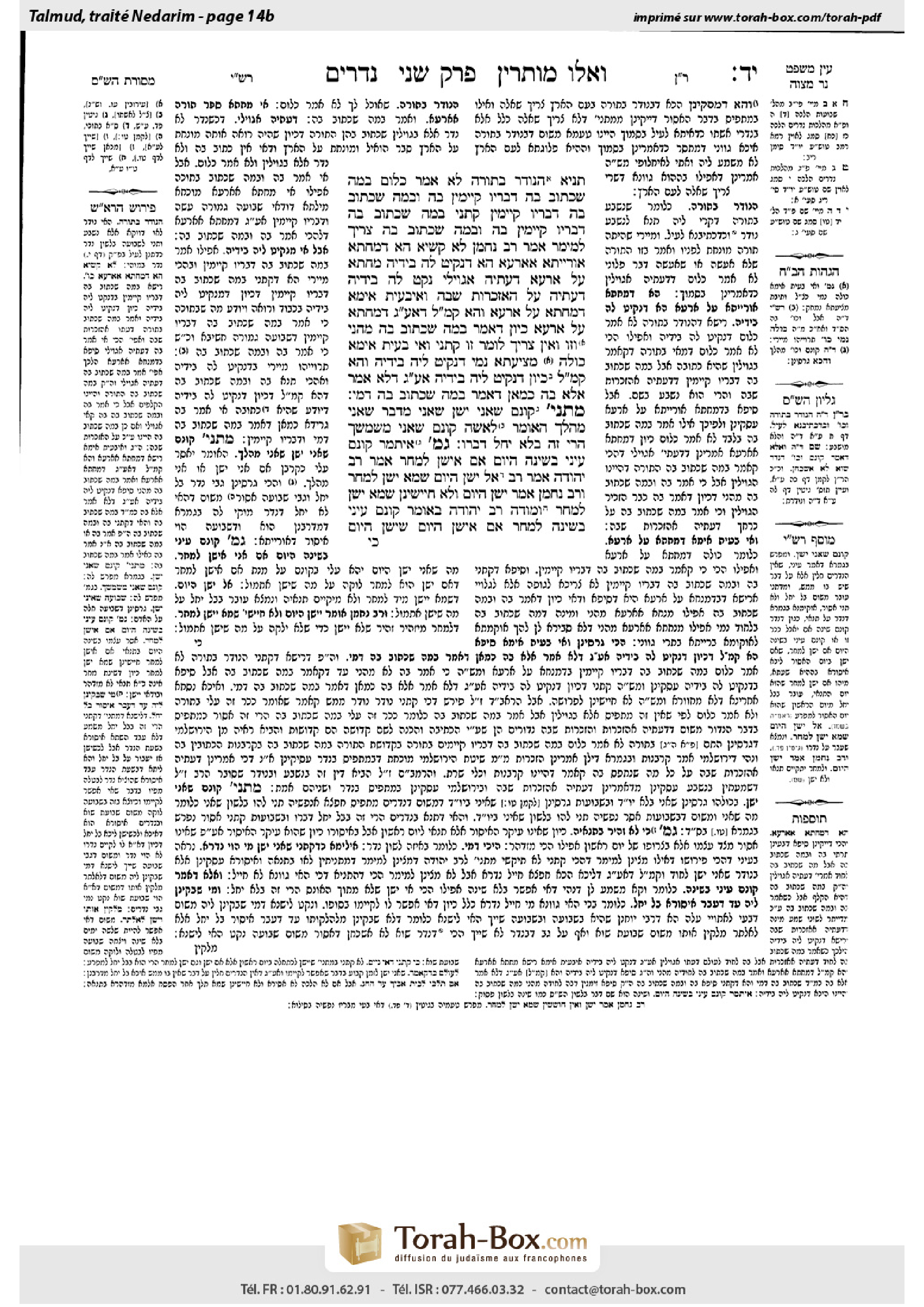
Nedarim 14b: Talmud study for Daf Yomi
Daf Yomi is the daily study of one Talmud folio. Explore 37 tractates with scans, Hebrew text, Sefaria English and AI-generated French translations where annotated.
Passage selection and English or AI-generated French translation are available where the scan has annotations. Daf Study is independent of Torah-Box and Sefaria.
Browse Nedarim · נדרים · All tractatesNedarim 14b text and translations
This page of Nedarim includes the Aramaic text, an English translation and an AI-generated French translation, alongside the scan above.
נדרים י״ד ב · Aramaic and Hebrew text
תַּנְיָא: הַנּוֹדֵר בַּתּוֹרָה — לֹא אָמַר כְּלוּם. בְּמַה שֶּׁכָּתוּב בָּהּ — דְּבָרָיו קַיָּימִין. בָּהּ וּבְמַה שֶּׁכָּתוּב בָּהּ — דְּבָרָיו קַיָּימִין.
קָתָנֵי ״בְּמַה שֶּׁכָּתוּב בָּהּ״ — דְּבָרָיו קַיָּימִין, ״בָּהּ וּבְמַה שֶּׁכָּתוּב בָּהּ״ — צְרִיךְ לְמֵימַר?
אָמַר רַב נַחְמָן, לָא קַשְׁיָא: הָא — דְּמַחֲתָא אוֹרָיְיתָא אַאַרְעָא, הָא — דְּנָקֵיט לַהּ בִּידֵיהּ. מַחֲתָא עַל אַרְעָא — דַּעְתֵּיהּ אַגְּוִילֵי. נָקֵט לַהּ בִּידֵיהּ — דַּעְתֵּיהּ עַל הָאַזְכָּרוֹת שֶׁבָּהּ.
וְאִיבָּעֵית אֵימָא: דְּמַחֲתָא עַל אַרְעָא. וְהָא קָא מַשְׁמַע לַן, דְּאַף עַל גַּב דְּמַחֲתָא עַל אַרְעָא — כֵּיוָן דְּאָמַר ״בְּמַה שֶּׁכָּתוּב בָּהּ״ מַהֲנֵי. וְזוֹ וְאֵין צָרִיךְ לוֹמַר זוֹ קָתָנֵי.
וְאִי בָּעֵית אֵימָא: כּוּלָּהּ מְצִיעֲתָא נָמֵי דְּנָקֵיט לֵיהּ בִּידֵיהּ. וְהָא קָא מַשְׁמַע לַן: כֵּיוָן דְּנָקֵיט לֵיהּ בִּידֵיהּ, אַף עַל גַּב דְּלָא אָמַר אֶלָּא ״בָּהּ״ — כְּמַאן דְּאָמַר ״בְּמַה שֶּׁכָּתוּב בָּהּ״ דָּמֵי.
מַתְנִי׳ ״קֻוֽנָּם שֶׁאֲנִי יָשֵׁן״, ״שֶׁאֲנִי מְדַבֵּר״, ״שֶׁאֲנִי מְהַלֵּךְ״, הָאוֹמֵר לְאִשָּׁה ״קֻוֽנָּם שֶׁאֲנִי מְשַׁמְּשֵׁךְ״ — הֲרֵי זֶה בְּ״לֹא יַחֵל דְּבָרוֹ״.
גְּמָ׳ אִיתְּמַר: ״קֻוֽנָּם עֵינַי בְּשֵׁינָה הַיּוֹם אִם אִישַׁן לְמָחָר״, אָמַר רַב יְהוּדָה אָמַר רַב: אַל יִשַׁן הַיּוֹם, שֶׁמָּא יִשַׁן לְמָחָר. וְרַב נַחְמָן אָמַר: יִשַׁן הַיּוֹם, וְלָא חָיְישִׁינַן שֶׁמָּא יִשַׁן לְמָחָר. וּמוֹדֶה רַב יְהוּדָה בְּאוֹמֵר ״קֻוֽנָּם עֵינַי בְּשֵׁינָה לְמָחָר אִם אִישַׁן הַיּוֹם״, שֶׁיִּשַׁן הַיּוֹם.
Nedarim 14b · English translation
§ It is taught in a baraita: One who takes a vow by associating an item with a Torah scroll has not said anything, and the vow does not take effect. However, he associates the item with what is written in the Torah scroll, his statement is upheld. Since the name of God is written in the Torah, he has invoked God’s name in his vow. If he associates the item with it and with what is written in it, his statement is upheld.
The Gemara asks: It is taught that if he associates the item with what is written in the Torah scroll, his statement is upheld. Need it be said that the halakha is the same if he associates the item with it and with what is written in it? That is obvious.
Rav Naḥman said: This is not difficult. This case, in which the item is associated with it and with what is written in it, is referring to where the Torah scroll is placed on the ground, while that case, in which the item is associated with what is written in it, is referring to where he is holding it in his hands. If it is placed on the ground, whether one mentions the Torah scroll or what is written in it, his thoughts are concerning the parchment, i.e., the physical scroll, as he naturally assumes that since the scroll is placed on the ground, the parchment must be blank. Therefore, the vow takes effect only if he mentions both it and what is written in it, indicating that he is aware that it is a Torah scroll. However, where he is holding it in his hands and associates the item with what is written in it, his thoughts are concerning the mentions [azkarot] of the name of God that are in it, and the vow takes effect.
And if you wish, say instead that the entire baraita is referring to a case where it is placed on the ground, and this middle clause of: With what is written in the Torah scroll, teaches us that even though it is placed on the ground, since he said: With what is written in it, it is an effective vow, as he was clearly referring to the names of God. And the tanna of the baraita teaches employing the style: This, and it is unnecessary to say that. The baraita teaches the halakha where he said: What is written in it, which has a novel element, and then states a more obvious ruling, i.e., it goes without saying that if he associates the item with it and with what is written in it, the vow takes effect.
And if you wish, say instead that the entire middle clause, i.e., the latter clause, where he associates the item with it and with what is written in it, is referring to a case where he is holding the Torah scroll in his hands. And the baraita teaches us this: Since he is holding it in his hands, even though he said only: With the Torah scroll, and did not explicitly state: With what is written in it, he is considered to be like one who said: With what is written in it. Therefore, the item is prohibited.
MISHNA: With regard to one who says: Sleeping is forbidden for me as if it were an offering [konam], thereby prohibiting himself from sleeping; or: Speaking is konam for me; or: Walking is konam for me; or one who says to his wife: Engaging in sexual intercourse with you is konam for me, if he violates the vow he is in violation of the prohibition “He shall not profane his word” (Numbers 30:3).
GEMARA: It was stated that with regard to one who says: Sleeping is konam for my eyes today if I will sleep tomorrow, Rav Yehuda said that Rav said: He may not sleep today, lest he sleep tomorrow and thereby cause the vow to have been violated today, retroactively. And Rav Naḥman said: He may sleep today, as there is currently no prohibition, and we are not concerned that he will perhaps sleep tomorrow, as he will be careful not to sleep. And Rav Yehuda concedes that in a case where he says: Sleeping is konam for my eyes tomorrow if I sleep today, he may sleep today.
Nedarim 14b · Traduction française (IA)
§ Il est enseigné dans une baraïta : Celui qui prononce un vœu en associant une chose à un rouleau de Torah n’a rien dit, et son vœu ne prend pas effet. En revanche, s’il associe cette chose à ce qui est écrit dans le rouleau de Torah, sa parole est valable. Puisque le nom de Dieu est écrit dans la Torah, il a invoqué le nom de Dieu dans son vœu. S’il associe cette chose au rouleau et à ce qui y est écrit, sa parole est valable.
La Guemara demande : Il est enseigné que si quelqu’un associe cette chose à ce qui est écrit dans le rouleau de Torah, sa parole est valable. Est-il nécessaire de préciser que la halakha est la même s’il associe cette chose au rouleau et à ce qui y est écrit ? Cela va de soi.
Rav Naḥman a dit : Il n’y a pas de difficulté. Le cas où la chose est associée au rouleau et à ce qui y est écrit concerne un rouleau de Torah posé à terre, tandis que le cas où la chose est associée à ce qui y est écrit concerne un rouleau qu’il tient dans ses mains. S’il est posé à terre, qu’il mentionne le rouleau de Torah ou ce qui y est écrit, ses pensées portent sur le parchemin, c’est-à-dire sur le rouleau matériel, car il suppose naturellement que, puisque le rouleau est posé à terre, le parchemin doit être vierge. Par conséquent, le vœu ne prend effet que s’il mentionne à la fois le rouleau et ce qui y est écrit, indiquant ainsi qu’il sait qu’il s’agit d’un rouleau de Torah. En revanche, lorsqu’il le tient dans ses mains et associe la chose à ce qui y est écrit, ses pensées portent sur les mentions [azkarot] du nom de Dieu qui s’y trouvent, et le vœu prend effet.
Et si tu préfères, dis plutôt que toute la baraïta concerne un cas où le rouleau est posé à terre. La clause intermédiaire, « ce qui est écrit dans le rouleau de Torah », nous enseigne que, même s’il est posé à terre, son vœu prend effet dès lors qu’il a dit « ce qui y est écrit », car il faisait clairement référence aux noms de Dieu. Le tanna de la baraïta enseigne selon la formule : « Ceci, et il n’est pas nécessaire de dire cela. » La baraïta enseigne la halakha dans le cas où il a dit « ce qui y est écrit », ce qui comporte un élément nouveau, puis énonce une décision plus évidente : il va sans dire que si quelqu’un associe cette chose au rouleau et à ce qui y est écrit, le vœu prend effet.
Et si tu préfères, dis plutôt que toute la clause intermédiaire, c’est-à-dire la clause suivante, où il associe la chose au rouleau et à ce qui y est écrit, concerne un cas où il tient le rouleau de Torah dans ses mains. La baraïta nous enseigne ceci : puisqu’il le tient dans ses mains, même s’il a seulement dit « le rouleau de Torah », sans préciser « ce qui y est écrit », il est considéré comme ayant dit « ce qui y est écrit ». Par conséquent, la chose est interdite.
MICHNA : Celui qui dit : « Dormir m’est interdit comme une offrande [konam] », s’interdisant ainsi de dormir ; ou : « Parler m’est interdit comme une offrande [konam] » ; ou : « Marcher m’est interdit comme une offrande [konam] » ; ou celui qui dit à sa femme : « Avoir des relations sexuelles avec toi m’est interdit comme une offrande [konam] » — s’il enfreint son vœu, il transgresse l’interdiction : « Il ne profanera pas sa parole » (Nombres 30, 3).
GUEMARA : Il a été enseigné que, concernant celui qui dit : « Dormir est interdit à mes yeux aujourd’hui comme une offrande [konam] si je dors demain », Rav Yehouda a dit au nom de Rav : Il ne peut pas dormir aujourd’hui, de crainte qu’il ne dorme demain et que son vœu ne soit ainsi enfreint rétroactivement dès aujourd’hui. Rav Naḥman a dit : Il peut dormir aujourd’hui, car il n’y a pour l’instant aucune interdiction, et nous ne craignons pas qu’il dorme demain, puisqu’il prendra garde à ne pas dormir. Rav Yehouda reconnaît que, dans le cas où il dit : « Dormir sera interdit à mes yeux demain comme une offrande [konam] si je dors aujourd’hui », il peut dormir aujourd’hui.
Traduction française générée par IA à partir de l’édition anglaise de Sefaria. Vérifie toujours un passage avec le texte source.
Text from Sefaria: William Davidson Edition - Vocalized Aramaic (CC BY NC); William Davidson Edition - English (CC BY NC).