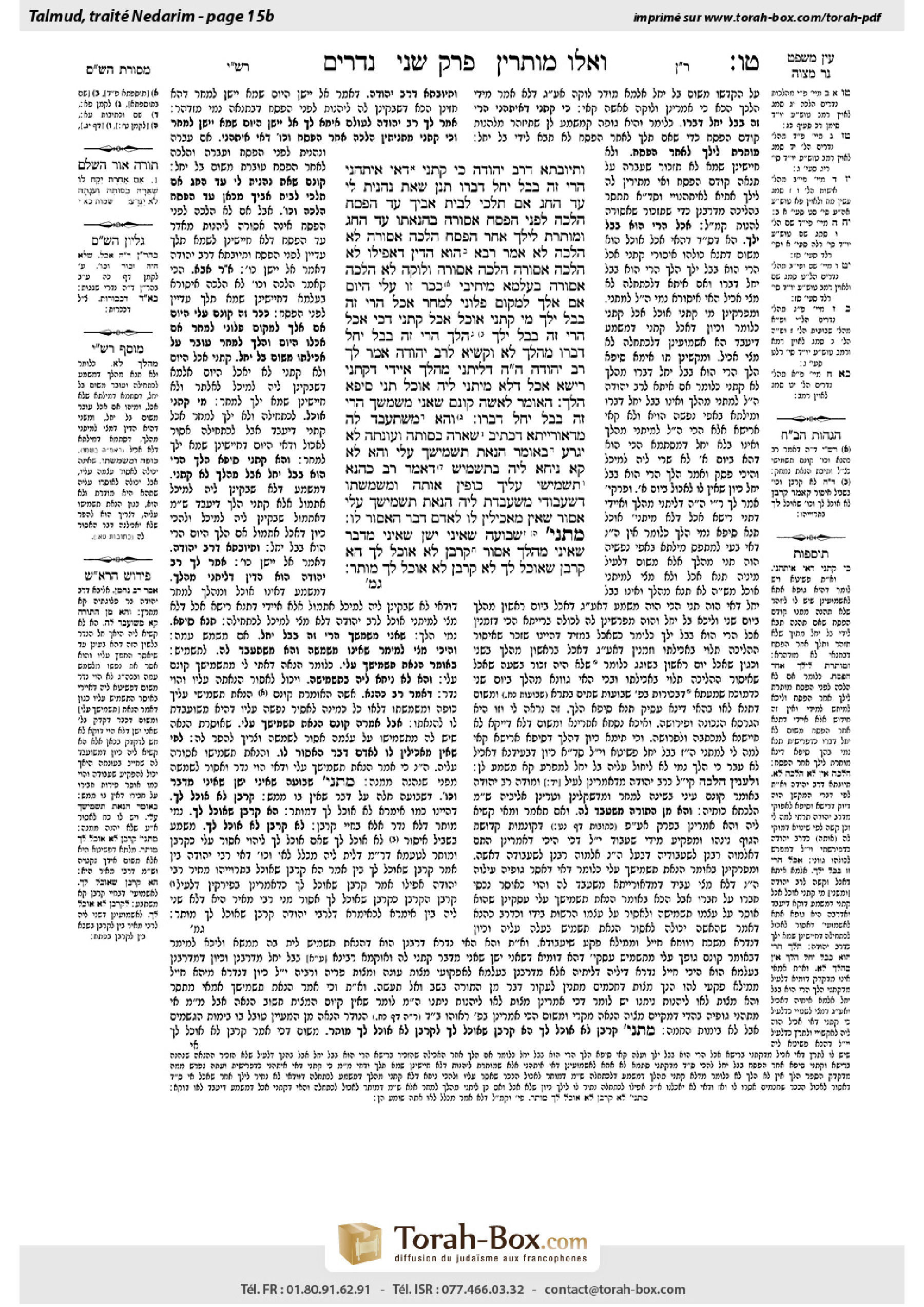
Nedarim 15b: Talmud study for Daf Yomi
Daf Yomi is the daily study of one Talmud folio. Explore 37 tractates with scans, Hebrew text, Sefaria English and AI-generated French translations where annotated.
Passage selection and English or AI-generated French translation are available where the scan has annotations. Daf Study is independent of Torah-Box and Sefaria.
Browse Nedarim · נדרים · All tractatesNedarim 15b text and translations
This page of Nedarim includes the Aramaic text, an English translation and an AI-generated French translation, alongside the scan above.
נדרים י״ה ב · Aramaic and Hebrew text
וּתְיוּבְתָּא דְרַב יְהוּדָה!
כִּי קָתָנֵי, דְּאִי אִיתְהֲנִי הֲרֵי זֶה בְּ״בַל יַחֵל דְּבָרוֹ״.
תְּנַן: ״שֶׁאַתְּ נֶהֱנֵית לִי עַד הֶחָג אִם תֵּלְכִי לְבֵית אָבִיךְ עַד הַפֶּסַח״, הָלְכָה לִפְנֵי הַפֶּסַח — אֲסוּרָה בַּהֲנָאָתוֹ עַד הֶחָג, וּמוּתֶּרֶת לֵילֵךְ אַחַר הַפֶּסַח.
הָלְכָה — אֲסוּרָה, לֹא הָלְכָה — לָא.
אָמַר רָבָא: הוּא הַדִּין דַּאֲפִילּוּ לֹא הָלְכָה אֲסוּרָה. הָלְכָה — אֲסוּרָה וְלוֹקָה, לֹא הָלְכָה — אֲסוּרָה בְּעָלְמָא.
מֵיתִיבִי: ״כִּכָּר זוֹ עָלַי הַיּוֹם אִם אֵלֵךְ לְמָקוֹם פְּלוֹנִי לְמָחָר״, אָכַל — הֲרֵי זֶה בְּ״בַל יֵלֵךְ״!
מִי קָתָנֵי ״אוֹכֵל״? ״אָכַל״ קָתָנֵי, דְּכִי אֲכַל הֲרֵי זֶה בְּ״בַל יֵלֵךְ״.
הָלַךְ — הֲרֵי זֶה בְּ״בַל יַחֵל״ דְּבָרוֹ. מְהַלֵּךְ — לָא. וְקַשְׁיָא לְרַב יְהוּדָה!
אָמַר לָךְ רַב יְהוּדָה: הוּא הַדִּין דְּלִיתְנֵי ״מְהַלֵּךְ״. אַיְּידֵי דְּקָתָנֵי רֵישָׁא ״אָכַל״, דְּלָא מִיתְנֵי לֵיהּ ״אוֹכֵל״ — תָּנֵי סֵיפָא ״הָלַךְ״.
הָאוֹמֵר לְאִשָּׁה ״קֻוֽנָּם שֶׁאֲנִי מְשַׁמְּשֵׁךְ״, הֲרֵי זֶה בְּ״בַל יַחֵל דְּבָרוֹ״. וְהָא מִשְׁתַּעְבַּד לָהּ מִדְּאוֹרָיְיתָא, דִּכְתִיב: ״שְׁאֵרָהּ כְּסוּתָהּ וְעֹנָתָהּ לֹא יִגְרָע״!
בְּאוֹמֵר ״הֲנָאַת תַּשְׁמִישֵׁךְ עָלַי״, וְהָא לָא קָא נִיחָא לֵיהּ בְּתַשְׁמִישׁ.
דְּאָמַר רַב כָּהֲנָא: ״תַּשְׁמִישִׁי עָלֶיךָ״ — כּוֹפִין אוֹתָהּ וּמְשַׁמַּשְׁתּוֹ, דְּשַׁעְבּוֹדֵי מְשׁוּעְבֶּדֶת לֵיהּ. ״הֲנָאַת תַּשְׁמִישְׁךָ עָלַי״ — אָסוּר, שֶׁאֵין מַאֲכִילִין לוֹ לְאָדָם דָּבָר הָאָסוּר לוֹ.
מַתְנִי׳ שְׁבוּעָה שֶׁאֵינִי יָשֵׁן, שֶׁאֵינִי מְדַבֵּר, שֶׁאֵינִי מְהַלֵּךְ — אָסוּר. קׇרְבָּן לֹא אוֹכַל לָךְ, הָא קׇרְבָּן שֶׁאוֹכַל לָךְ, לֹא קׇרְבָּן לֹא אוֹכַל לָךְ — מוּתָּר.
Nedarim 15b · English translation
And this is a conclusive refutation of the opinion of Rav Yehuda.
The Gemara answers: When the mishna teaches this, it does not mean that before she went she was permitted to derive benefit from him ab initio. Rather, it means that if she derived benefit from him after the fact, she is in violation of: He shall not profane his word.
We learn further on (57b) that if the husband said to his wife: Deriving benefit from me until the festival of Sukkot is konam for you if you go to your father’s house until Passover, then, if she went before Passover, she is prohibited from deriving benefit from him until the festival of Sukkot, as the vow took effect, and she is permitted to go to her father’s house after Passover.
The Gemara infers: Only if she went before Passover is it prohibited for her to derive benefit from him. However, if she did not go it is not prohibited for her to do so. She may derive benefit from him, and there is no concern that she will subsequently go to her father’s house, transgressing the prohibition. This is difficult according to the opinion of Rav Yehuda that one may not perform an action that will be rendered retroactively a violation of a vow if the condition is met.
Rava said: The same is true, that even if she did not go, she is prohibited from deriving benefit from him. The difference is that if she went it is not only prohibited for her to derive benefit from him, but if she does so she is flogged; whereas if she did not go, it is merely prohibited for her to derive benefit from him, lest she violate the vow by going to her father’s house before Passover.
The Gemara raises an objection to the opinion of Rav Yehuda: It is taught in a baraita that if one said: This loaf is forbidden to me today if I go to such and such a place tomorrow, then if he ate the loaf today, he is subject to the prohibition that he shall not go tomorrow. Apparently, he may eat it today, as there is no concern that he will go tomorrow.
The Gemara answers: Where is the contradiction? Does the baraita teach that he may eat the loaf ab initio? It teaches only that he ate, i.e., that once he ate, he is subject to the prohibition that he shall not go.
It is further taught in the baraita: If he went the next day, he is in violation of: He shall not profane his word. The Gemara infers from the fact that the baraita is referring only to a case in which he went after the fact, that he may not go ab initio. This indicates that he is permitted to eat the loaf, thereby prohibiting himself from going the next day. This accords with the opinion of Rav Naḥman that one may cause a vow to take effect by fulfilling its condition, and it poses a difficulty to the opinion of Rav Yehuda.
The Gemara answers: Rav Yehuda could have said to you that the same is true, that the baraita could have taught that he may go. However, since the first clause teaches the halakha where he ate the loaf after the fact, as it cannot teach that he may eat it according to Rav Yehuda, who holds that it is prohibited for him to eat it ab initio, the latter clause also teaches the halakha in the case where he went, and does not teach that he may go, to maintain a uniform style. In conclusion, neither opinion is refuted.
§ It is taught in the mishna that with regard to one who says to his wife: Engaging in sexual intercourse with you is konam for me, if he violates the vow he is in violation of the prohibition: He shall not profane his word. The Gemara asks: How can one render prohibited engaging in sexual intercourse with his wife? But isn’t he duty bound by Torah law to engage in sexual intercourse with her, as it is written: “Her food, her clothing, and her conjugal rights he may not diminish” (Exodus 21:10)?
The Gemara answers: The vow does not take effect if it is formulated as cited. Rather, the mishna is referring to a case where he says: The pleasure I derive from engaging in sexual intercourse with you is forbidden to me, and sexual intercourse is therefore not amenable to him. Since he is not obligated to experience the pleasure he derives from sexual intercourse with her, he can prohibit himself from experiencing this pleasure. In this manner he can render their sexual intercourse forbidden by means of a vow.
As Rav Kahana said: If a woman vows: Sexual intercourse with me is forbidden to you, the court coerces her to engage in sexual intercourse with him, as she is duty bound to engage in sexual intercourse with him due to his conjugal rights. However, if she vows: The pleasure I derive from engaging in sexual intercourse with you is forbidden to me, it is prohibited for them to engage in sexual intercourse, as she derives pleasure from the sexual intercourse and one may not feed a person that which is forbidden to him.
MISHNA: If one says: I take an oath that I will not sleep, or: That I will not speak, or: That I will not walk, this activity is prohibited to him. As taught earlier (10a), one of the primary methods of taking a vow is by invoking an offering. The mishna provides several examples where invoking the term korban is not effective. If one says: An offering [korban] that I will not eat of yours, or: This offering [ha korban] that I will eat of yours, or: That which I will not eat of yours is not an offering [la korban], the food is permitted.
Nedarim 15b · Traduction française (IA)
Et cela constitue une réfutation décisive de l’opinion de Rav Yehuda.
La Guemara répond : lorsque la Michna enseigne cela, elle ne veut pas dire qu’avant qu’elle ne parte, elle avait le droit de tirer profit de lui a priori. Elle veut plutôt dire que si, après coup, elle a tiré profit de lui, elle transgresse l’interdit : « Il ne profanera pas sa parole. »
Nous apprenons plus loin (57b) que si le mari dit à sa femme : « Tirer profit de moi t’est interdit par konam jusqu’à la fête de Souccot si tu vas chez ton père avant Pessa’h », alors, si elle s’y est rendue avant Pessa’h, il lui est interdit de tirer profit de lui jusqu’à la fête de Souccot, car le vœu a pris effet, et elle a le droit d’aller chez son père après Pessa’h.
La Guemara déduit que c’est seulement si elle s’y est rendue avant Pessa’h qu’il lui est interdit de tirer profit de lui. En revanche, si elle ne s’y est pas rendue, cela ne lui est pas interdit. Elle peut tirer profit de lui, sans qu’il y ait lieu de craindre qu’elle se rende ensuite chez son père et transgresse ainsi l’interdit. Cela pose une difficulté à l’opinion de Rav Yehuda, selon laquelle on ne peut pas accomplir une action qui, si la condition est remplie, constituera rétroactivement une transgression du vœu.
Rava a dit : Il en va de même même si elle ne s’y est pas rendue : il lui est interdit de tirer profit de lui. La différence est que, si elle s’y est rendue, non seulement il lui est interdit de tirer profit de lui, mais elle est passible de la flagellation si elle le fait ; tandis que si elle ne s’y est pas rendue, il lui est simplement interdit de tirer profit de lui, de peur qu’elle ne transgresse le vœu en allant chez son père avant Pessa’h.
La Guemara soulève une objection à l’opinion de Rav Yehuda : il est enseigné dans une baraïta que si quelqu’un dit : « Cette miche m’est interdite aujourd’hui si je me rends demain à tel endroit », alors, s’il mange la miche aujourd’hui, il est soumis à l’interdit de se rendre à cet endroit demain. Apparemment, il peut manger la miche aujourd’hui, puisqu’il n’y a pas lieu de craindre qu’il s’y rende demain.
La Guemara répond : où est la contradiction ? La baraïta enseigne-t-elle qu’il peut manger la miche a priori ? Elle enseigne seulement qu’il l’a mangée, c’est-à-dire qu’une fois qu’il l’a mangée, il est soumis à l’interdit de se rendre à cet endroit.
La baraïta enseigne également que s’il s’y est rendu le lendemain, il transgresse l’interdit : « Il ne profanera pas sa parole. » La Guemara déduit du fait que la baraïta ne traite que du cas où il s’y est rendu après coup qu’il ne peut pas s’y rendre a priori. Cela indique qu’il a le droit de manger la miche, s’interdisant ainsi de s’y rendre le lendemain. Cela concorde avec l’opinion de Rav Naḥman, selon laquelle on peut faire prendre effet à un vœu en remplissant sa condition, et pose une difficulté à l’opinion de Rav Yehuda.
La Guemara répond : Rav Yehuda aurait pu te dire qu’il en va de même et que la baraïta aurait pu enseigner qu’il a le droit de s’y rendre. Cependant, puisque la première partie enseigne la halakha dans le cas où il a mangé la miche après coup — car, selon Rav Yehuda, qui estime qu’il lui est interdit de la manger a priori, elle ne peut pas enseigner qu’il a le droit de la manger —, la seconde partie enseigne également la halakha dans le cas où il s’y est rendu, sans enseigner qu’il a le droit de s’y rendre, afin de conserver une formulation uniforme. En conclusion, aucune des deux opinions n’est réfutée.
§ La Michna enseigne que celui qui dit à sa femme : « Avoir des relations sexuelles avec toi m’est interdit par konam », s’il transgresse le vœu, enfreint l’interdit : « Il ne profanera pas sa parole. » La Guemara demande : comment peut-on interdire d’avoir des relations sexuelles avec sa femme ? N’est-il pas tenu, selon la Torah, d’avoir des relations sexuelles avec elle, comme il est écrit : « Il ne diminuera ni sa nourriture, ni son vêtement, ni ses droits conjugaux » (Exode 21:10) ?
La Guemara répond : le vœu ne prend pas effet s’il est formulé comme cité. La Michna parle plutôt du cas où il dit : « Le plaisir que je tire d’avoir des relations sexuelles avec toi m’est interdit », si bien qu’il ne peut pas avoir de relations sexuelles avec elle. Puisqu’il n’est pas tenu d’éprouver le plaisir qu’il tire de ces relations, il peut s’interdire d’éprouver ce plaisir. De cette manière, il peut rendre leurs relations sexuelles interdites par un vœu.
Comme l’a dit Rav Kahana : si une femme fait un vœu en disant : « Avoir des relations sexuelles avec moi t’est interdit », le tribunal la contraint à avoir des relations sexuelles avec lui, car elle est tenue de le faire en vertu des droits conjugaux de son mari. En revanche, si elle fait un vœu en disant : « Le plaisir que je tire d’avoir des relations sexuelles avec toi m’est interdit », il leur est interdit d’avoir des relations sexuelles, car elle en tire du plaisir et on ne peut pas donner à une personne ce qui lui est interdit.
MICHNA : Si quelqu’un dit : « Je jure que je ne dormirai pas », ou : « que je ne parlerai pas », ou : « que je ne marcherai pas », l’activité correspondante lui est interdite. Comme cela a été enseigné plus haut (10a), l’une des principales façons de faire un vœu consiste à invoquer une offrande. La Michna donne plusieurs exemples où l’emploi du terme korban n’a pas d’effet. Si quelqu’un dit : « Une offrande [korban] : je ne mangerai pas de ce qui t’appartient », ou : « Cette offrande [ha korban] : je mangerai de ce qui t’appartient », ou : « Ce que je ne mangerai pas de ce qui t’appartient n’est pas une offrande [la korban] », la nourriture lui est permise.
Traduction française générée par IA à partir de l’édition anglaise de Sefaria. Vérifie toujours un passage avec le texte source.
Text from Sefaria: William Davidson Edition - Vocalized Aramaic (CC BY NC); William Davidson Edition - English (CC BY NC).