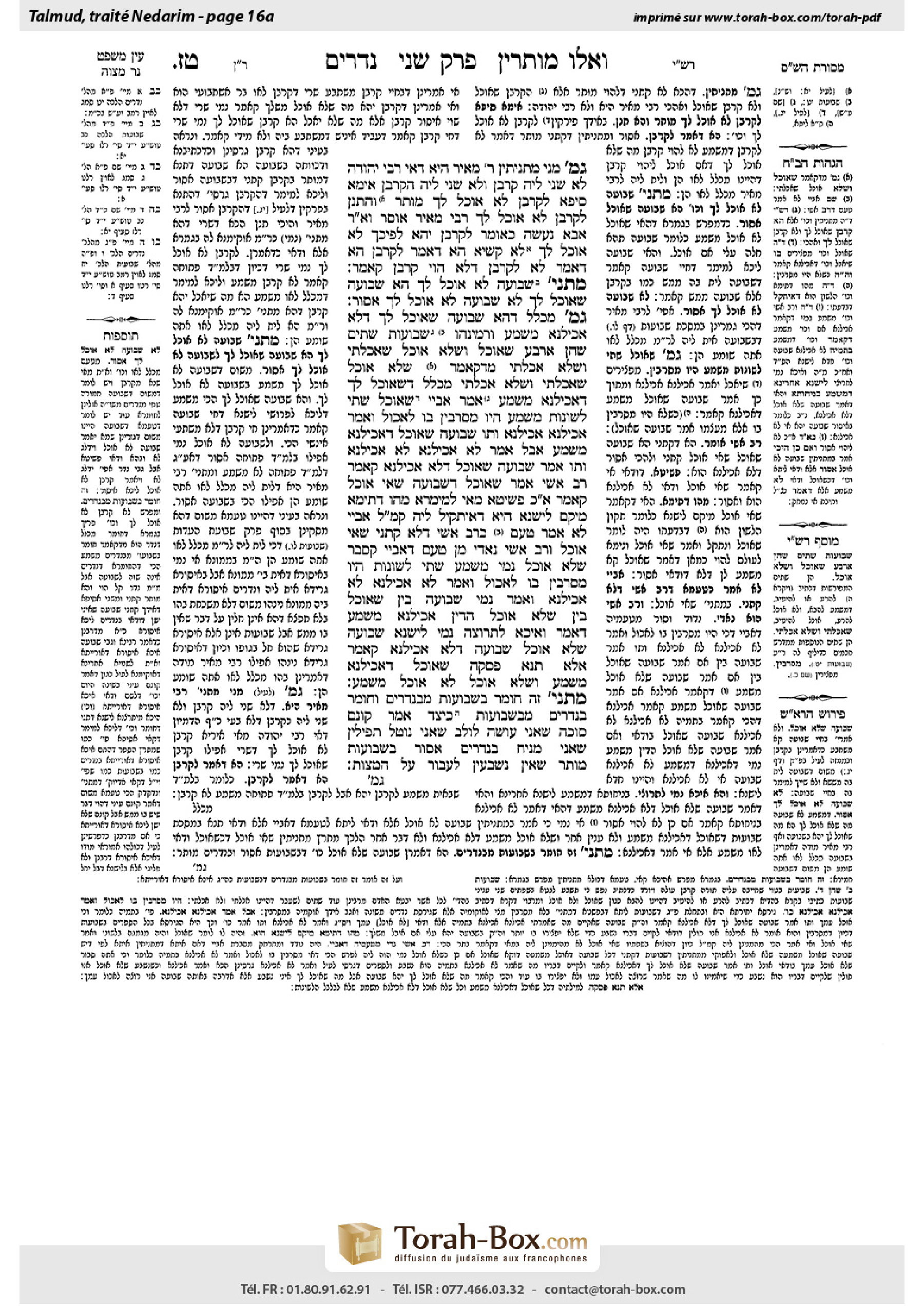
Nedarim 16a: Talmud study for Daf Yomi
Daf Yomi is the daily study of one Talmud folio. Explore 37 tractates with scans, Hebrew text, Sefaria English and AI-generated French translations where annotated.
Passage selection and English or AI-generated French translation are available where the scan has annotations. Daf Study is independent of Torah-Box and Sefaria.
Browse Nedarim · נדרים · All tractatesNedarim 16a text and translations
This page of Nedarim includes the Aramaic text, an English translation and an AI-generated French translation, alongside the scan above.
נדרים י״ו א · Aramaic and Hebrew text
גְּמָ׳ מַנִּי מַתְנִיתִין — רַבִּי מֵאִיר הִיא, דְּאִי רַבִּי יְהוּדָה — לָא שָׁנֵי לֵיהּ ״קׇרְבָּן״ וְלָא שָׁנֵי לֵיהּ ״הַקׇּרְבָּן״.
אֵימָא סֵיפָא: ״לַקׇּרְבָּן לֹא אוֹכַל לָךְ״ — מוּתָּר. וְהָתְנַן: ״לַקׇּרְבָּן לֹא אוֹכַל לָךְ״ — רַבִּי מֵאִיר אוֹסֵר, וְאָמַר רַבִּי אַבָּא: נַעֲשָׂה כְּאוֹמֵר: ״לַקׇּרְבָּן יְהֵא, לְפִיכָךְ לֹא אוֹכַל לָךְ״.
לָא קַשְׁיָא: הָא דְּאָמַר ״לַקׇּרְבָּן״, הָא דְּאָמַר ״לָא לְקׇרְבָּן״ — דְּלָא הָוֵי קׇרְבָּן קָאָמַר.
מַתְנִי׳ שְׁבוּעָה לֹא אוֹכַל לָךְ, הָא שְׁבוּעָה שֶׁאוֹכַל לָךְ, לָא שְׁבוּעָה לֹא אוֹכַל לָךְ — אָסוּר.
גְּמָ׳ מִכְּלָל דְּהָא שְׁבוּעָה שֶׁאוֹכַל לָךְ — דְּלָא אָכֵילְנָא מַשְׁמַע. וּרְמִינְהוּ: שְׁבוּעוֹת שְׁתַּיִם שֶׁהֵן אַרְבַּע. שֶׁאוֹכַל וְשֶׁלֹּא אוֹכַל, שֶׁאָכַלְתִּי וְשֶׁלֹּא אָכַלְתִּי. מִדְּקָאָמַר שֶׁלֹּא אוֹכַל, שֶׁאָכַלְתִּי וְשֶׁלֹּא אָכַלְתִּי, מִכְּלָל דְּשֶׁאוֹכַל לָךְ — דְּאָכֵילְנָא מַשְׁמַע!
אָמַר אַבָּיֵי: ״שֶׁאוֹכַל״ שְׁתֵּי לְשׁוֹנוֹת מַשְׁמַע. הָיוּ מְסָרְבִין בּוֹ לֶאֱכוֹל, וְאָמַר: ״אָכֵילְנָא אָכֵילְנָא״, וְתוּ: ״שְׁבוּעָה שֶׁאוֹכַל״ — דְּאָכֵילְנָא מַשְׁמַע. אֲבָל אָמַר: ״לָא אָכֵילְנָא לָא אָכֵילְנָא״, וְתוּ אָמַר: ״שְׁבוּעָה שֶׁאוֹכַל״ — ״דְּלָא אָכֵילְנָא״ קָאָמַר.
רַב אָשֵׁי אָמַר: ״שֶׁאוֹכַל״ דִּשְׁבוּעָה — ״שֶׁאִי אוֹכַל״ קָאָמַר. אִם כֵּן, פְּשִׁיטָא! מַאי לְמֵימְרָא? מַהוּ דְּתֵימָא: מֵיקַם לִישָּׁנָא הִיא דְּאִיתְּקִיל לֵיהּ, קָא מַשְׁמַע לַן.
אַבָּיֵי לָא אָמַר טַעַם כְּרַב אָשֵׁי — דְּלָא קָתָנֵי ״שֶׁאִי אוֹכַל״.
וְרַב אָשֵׁי נָאדֵי מִן טַעַם דְּאַבָּיֵי. קָסָבַר ״שֶׁלֹּא אוֹכַל״ נָמֵי, מַשְׁמַע שְׁתֵּי לְשׁוֹנוֹת. הָיוּ מְסָרְבִין בּוֹ לֶאֱכוֹל וְאָמַר: ״לָא אָכֵילְנָא לָא אָכֵילְנָא״, וְאָמַר נָמֵי: ״שְׁבוּעָה״, בֵּין ״שֶׁאוֹכַל״ בֵּין ״שֶׁלֹּא אוֹכַל״ — הָדֵין ״אָכֵילְנָא״ מַשְׁמַע דְּאָמַר.
וְאִיכָּא לְתָרוֹצַהּ נָמֵי לִישָּׁנָא ״שְׁבוּעָה שֶׁלֹּא אוֹכַל״ — ״שְׁבוּעָה דְּלָא אָכֵילְנָא״ קָאָמַר. אֶלָּא תַּנָּא פַּסְקַהּ: ״שֶׁאוֹכַל״ — ״דְּאָכֵילְנָא״ מַשְׁמַע, וְ״שֶׁלֹּא אוֹכַל״ — ״לֹא אוֹכַל״ מַשְׁמַע.
מַתְנִי׳ זֶה חוֹמֶר בַּשְּׁבוּעוֹת מִבַּנְּדָרִים, וְחוֹמֶר בַּנְּדָרִים מִבַּשְּׁבוּעוֹת. כֵּיצַד? אָמַר: ״קֻוֽנָּם סוּכָּה שֶׁאֲנִי עוֹשֶׂה״, ״לוּלָב שֶׁאֲנִי נוֹטֵל״, ״תְּפִילִּין שֶׁאֲנִי מַנִּיחַ״ — בַּנְּדָרִים אָסוּר, בַּשְּׁבוּעוֹת מוּתָּר, שֶׁאֵין נִשְׁבָּעִין לַעֲבוֹר עַל הַמִּצְוֹת.
Nedarim 16a · English translation
GEMARA: Whose opinion is expressed in the mishna? It is apparently the opinion of Rabbi Meir. As, if it is the opinion of Rabbi Yehuda, there is a contradiction, because he does not differentiate whether one takes a vow by saying: An offering, and he does not differentiate whether he takes a vow by saying: This offering. In both cases the vow does not take effect, as he did not use the phrase: Like an offering. The mishna, by contrast, indicates that only a vow that is phrased: An offering that I will not eat of yours, or: This offering that I will eat of yours, does not take effect. If it is phrased: An offering I will eat of yours, it takes effect, as it indicates that his eating will be like an offering.
The Gemara continues its analysis: Say the latter clause of the mishna: If he says: That which I will not eat of yours is not an offering, the food is permitted. The Gemara asks: But didn’t we learn in a mishna (13a) that if one said: That which I will not eat of yours will be for an offering [lekorban], Rabbi Meir forbids the food to him? And Rabbi Abba said that it is rendered as one who says: Your food will be to me for an offering; therefore, I will not eat of yours. The mishna appears to be incompatible with the opinion of Rabbi Meir as well.
The Gemara answers that this is not difficult. That mishna is referring to one who said: For an offering [lekorban], and the vow therefore takes effect. This mishna is referring to one who said: Not for an offering [la lekorban], where he is saying that it should not be an offering, and therefore the vow does not take effect.
MISHNA: If one says: An oath that I will not eat of yours, or: This is an oath that I will eat of yours [she’okhal lekha], or: Not an oath that I will not eat of yours, the food is forbidden.
GEMARA: By inference from the mishna, it may be derived that the statement: This is an oath that I will eat of yours, indicates that I will not eat. And the Gemara raises a contradiction from a mishna (Shevuot 19b): There are two basic types of oaths that are in fact four: An oath that I will eat, and: That I will not eat; an oath that I ate, and: That I did not eat. From the fact that the mishna states: That I will eat, in contradistinction to: That I will not eat; that I ate, and in contradistinction: That I did not eat, it may be derived by inference that an oath that I will eat of yours [she’okhal lekha] indicates: An oath that I will eat. This contradicts our mishna.
Abaye said: The phrase: That I will eat [she’okhal], indicates two expressions, depending on the context in which it is used. How so? If they were importuning [mesarevin] him to eat, and he said: I will eat, I will eat, and he furthermore said: An oath that I will eat [she’okhal], it indicates: That I will eat. However, if he said: I will not eat, I will not eat, and he furthermore said: An oath that I will eat [she’okhal], he is saying: That I will not eat. The oath is intended to reinforce his refusal to eat.
Rav Ashi said that the phrase: That I will eat [she’okhal], cited in the mishna with regard to an oath, is actually saying that he said: That I will not eat [she’i okhal]. The Gemara asks: If so, the prohibition is obvious, as he explicitly took an oath not to eat. What is the purpose of stating this halakha? The Gemara answers: Lest you say that he blundered in properly upholding the wording, i.e., he mispronounced the vow, as his intention was to say: An oath that I will eat [she’okhal], the mishna teaches us that he meant that he will not eat.
Abaye did not state the reason for the ruling of the mishna that was stated by Rav Ashi, as the mishna does not teach the case of: That I will not eat [she’i okhal]. Rather, it teaches the case of that I will eat [she’okhal].
And Rav Ashi turned away [nadei] from the reason that Abaye stated, because he held that the phrase: That I will not eat, also indicates two expressions, depending on the context. For example, if they were importuning him to eat and he said: I will not eat, I will not eat, and subsequently he also said: An oath, then, in this case, whether the wording of the oath was: That I will eat, or: That I will not eat, this expression indicates that he is saying: I will eat. The statement: An oath that I will not eat, should be interpreted rhetorically in this context: Did I take an oath that I will not eat? Certainly I did not, as I will eat.
And there is also a way to interpret the expression: An oath that I will not eat, as indicating its straightforward meaning, i.e., that he is saying: An oath that I will not eat. Therefore, the mishna cannot be interpreted in this manner. Rather, the tanna in tractate Shevuot clearly established a principle: That I will eat, indicates that I will eat, and: That I will not eat, indicates I will not eat. Therefore, the correct version of the mishna must be: That I will not eat [she’i okhal].
MISHNA: This rule, that oaths can render actions, which do not have actual substance, either prohibited or obligatory, is a stringency of oaths vis-à-vis vows, which do not take effect with regard to matters that do not have actual substance. And there is also a stringency of vows vis-à-vis oaths. How so? With regard to one who said: Making a sukka is konam for me, or: Taking a lulav is konam for me, or: Donning phylacteries is konam for me, in the case of vows, the items are rendered forbidden, and he may not perform the mitzva until the vow is dissolved. However, in the case of similar oaths, these items are permitted, as one cannot take an oath to transgress the mitzvot.
Nedarim 16a · Traduction française (IA)
GUEMARA : Selon l’opinion de qui la Michna est-elle formulée ? Apparemment, selon celle de Rabbi Meïr. En effet, si elle reflétait celle de Rabbi Yehouda, il y aurait une contradiction : celui-ci ne fait aucune distinction entre un vœu formulé par les mots « offrande » et un vœu formulé par les mots « cette offrande ». Dans les deux cas, le vœu ne prend pas effet, puisqu’il n’a pas employé l’expression « comme une offrande ». Or la Michna indique que seul un vœu formulé ainsi — « offrande, ce que je ne mangerai pas de ce qui est à toi », ou « cette offrande, ce que je mangerai de ce qui est à toi » — ne prend pas effet. S’il formule son vœu ainsi : « offrande, ce que je mangerai de ce qui est à toi », le vœu prend effet, car cela indique que sa consommation sera comme une offrande.
La Guemara poursuit son analyse : considérons la dernière clause de la Michna : s’il dit : « Ce que je ne mangerai pas de ce qui est à toi n’est pas une offrande », la nourriture lui est permise. La Guemara demande : mais n’avons-nous pas appris dans une Michna (13a) que si quelqu’un dit : « Ce que je ne mangerai pas de ce qui est à toi sera une offrande [lekorban] », Rabbi Meïr lui interdit cette nourriture ? Rabbi Abba a expliqué que cela revient à dire : « Ta nourriture sera pour moi une offrande ; c’est pourquoi je ne mangerai pas de ce qui est à toi. » La Michna semble donc également incompatible avec l’opinion de Rabbi Meïr.
La Guemara répond qu’il n’y a pas de difficulté. Cette Michna parle de quelqu’un qui a dit : « Pour une offrande [lekorban] » ; le vœu prend donc effet. Notre Michna parle de quelqu’un qui a dit : « Pas pour une offrande [la lekorban] » : il dit que cela ne doit pas être une offrande, et le vœu ne prend donc pas effet.
MICHNA : Si quelqu’un dit : « Serment : je ne mangerai pas de ce qui est à toi », ou : « Ceci est un serment : je mangerai de ce qui est à toi [she’okhal lekha] », ou : « Pas un serment : je ne mangerai pas de ce qui est à toi », la nourriture lui est interdite.
GUEMARA : On peut déduire de la Michna que l’expression « ceci est un serment : je mangerai de ce qui est à toi » signifie : « je ne mangerai pas ». La Guemara soulève une contradiction à partir d’une Michna (Chevouot 19b) : il existe deux catégories fondamentales de serments, qui sont en fait quatre : un serment que je mangerai, un serment que je ne mangerai pas, un serment que j’ai mangé et un serment que je n’ai pas mangé. Puisque la Michna énonce « que je mangerai », par opposition à « que je ne mangerai pas », et « que j’ai mangé », par opposition à « que je n’ai pas mangé », on peut en déduire qu’un serment formulé par les mots « je mangerai de ce qui est à toi [she’okhal lekha] » signifie : « un serment que je mangerai ». Cela contredit notre Michna.
Abayé dit que l’expression « que je mangerai [she’okhal] » peut avoir deux sens, selon le contexte. Comment cela ? Si l’on insistait [mesarevin] pour qu’il mange et qu’il répondait : « Je mangerai, je mangerai », puis ajoutait : « Serment : je mangerai [she’okhal] », cela signifie : « que je mangerai ». En revanche, s’il disait : « Je ne mangerai pas, je ne mangerai pas », puis ajoutait : « Serment : je mangerai [she’okhal] », il veut dire en réalité : « que je ne mangerai pas ». Le serment vise à renforcer son refus de manger.
Rav Achi dit que l’expression « que je mangerai [she’okhal] », citée dans la Michna à propos d’un serment, signifie en réalité qu’il a dit : « que je ne mangerai pas [she’i okhal] ». La Guemara demande : dans ce cas, l’interdiction est évidente, puisqu’il a explicitement prêté serment de ne pas manger. À quoi bon énoncer cette halakha ? La Guemara répond : on pourrait croire qu’il s’est trompé dans la formulation, c’est-à-dire qu’il a mal prononcé son serment, car son intention était de dire : « Serment : je mangerai [she’okhal] ». La Michna nous apprend qu’il voulait dire qu’il ne mangerait pas.
Abayé n’a pas donné comme explication de la règle de la Michna celle qu’a donnée Rav Achi, car la Michna n’enseigne pas le cas de « que je ne mangerai pas [she’i okhal] », mais celui de « que je mangerai [she’okhal] ».
Rav Achi s’est écarté [nadei] de l’explication donnée par Abayé, car il estimait que l’expression « que je ne mangerai pas » peut elle aussi avoir deux sens, selon le contexte. Par exemple, si l’on insistait pour qu’il mange et qu’il disait : « Je ne mangerai pas, je ne mangerai pas », puis prêtait serment, alors, dans ce cas, que le serment soit formulé « que je mangerai » ou « que je ne mangerai pas », cette expression signifie qu’il dit : « Je mangerai ». Dans ce contexte, la déclaration « Serment : je ne mangerai pas » doit être comprise comme une question rhétorique : « Ai-je prêté serment de ne pas manger ? » Certainement pas, puisque je vais manger.
Il est également possible d’interpréter l’expression « Serment : je ne mangerai pas » dans son sens littéral, c’est-à-dire qu’il dit : « Serment : je ne mangerai pas ». La Michna ne peut donc pas être interprétée ainsi. Le tanna du traité Chevouot a plutôt clairement établi le principe suivant : « que je mangerai » signifie qu’il mangera, et « que je ne mangerai pas » signifie qu’il ne mangera pas. Par conséquent, la version correcte de la Michna doit être : « que je ne mangerai pas [she’i okhal] ».
MICHNA : Cette règle, selon laquelle les serments peuvent rendre interdites ou obligatoires des actions dépourvues de substance concrète, constitue une rigueur des serments par rapport aux vœux, qui ne prennent pas effet lorsqu’ils portent sur des choses dépourvues de substance concrète. Il existe aussi une rigueur des vœux par rapport aux serments. Comment cela ? Si quelqu’un dit : « Faire une soukka est konam pour moi », ou : « Prendre un loulav est konam pour moi », ou : « Porter des tefillin est konam pour moi », ces objets lui sont interdits en vertu du vœu et il ne peut accomplir la mitsva tant que le vœu n’a pas été annulé. En revanche, si l’on prononce des serments équivalents, ces actes restent permis, car on ne peut pas prêter serment de transgresser les mitsvot.
Traduction française générée par IA à partir de l’édition anglaise de Sefaria. Vérifie toujours un passage avec le texte source.
Text from Sefaria: William Davidson Edition - Vocalized Aramaic (CC BY NC); William Davidson Edition - English (CC BY NC).