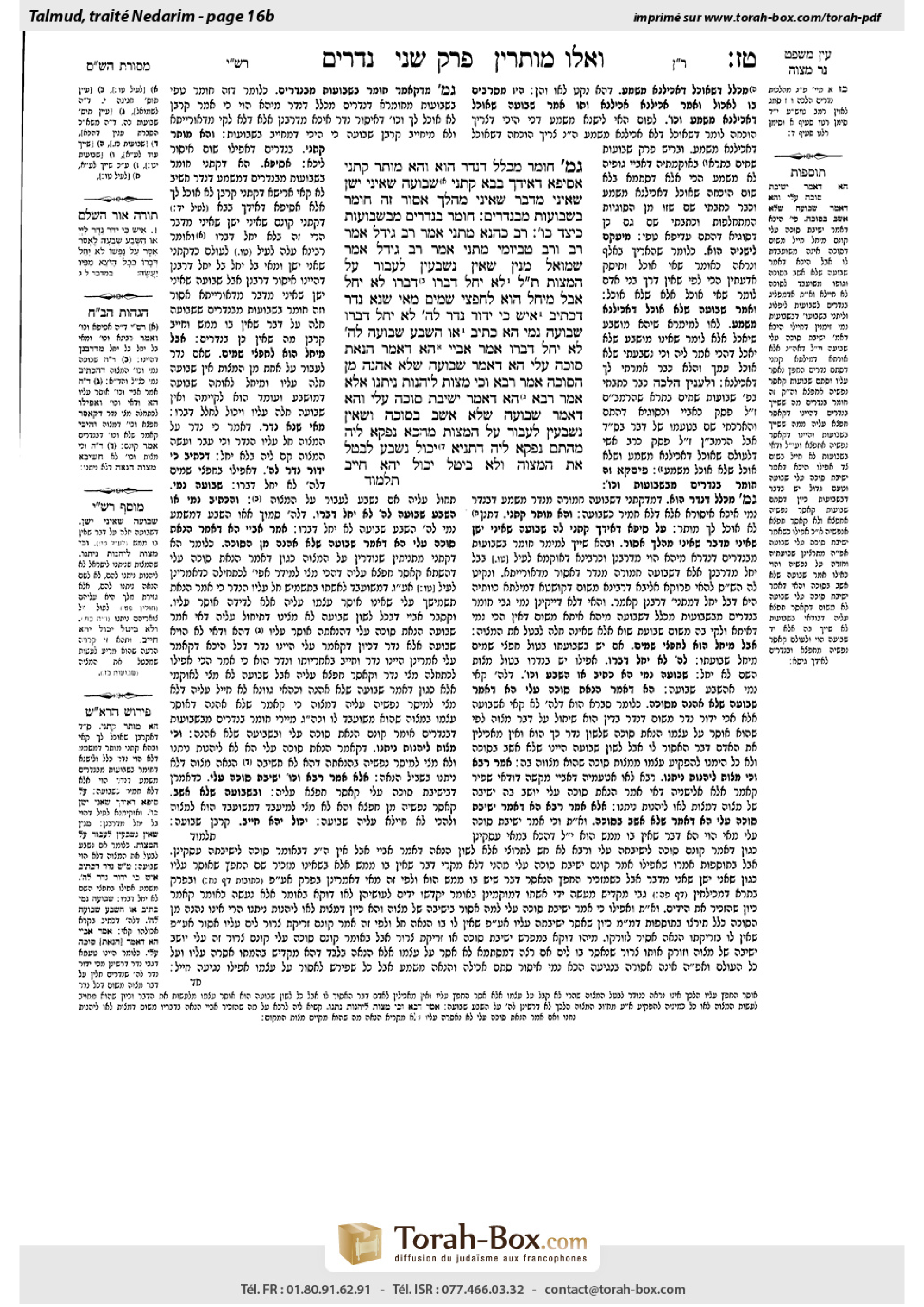
Nedarim 16b: Talmud study for Daf Yomi
Daf Yomi is the daily study of one Talmud folio. Explore 37 tractates with scans, Hebrew text, Sefaria English and AI-generated French translations where annotated.
Passage selection and English or AI-generated French translation are available where the scan has annotations. Daf Study is independent of Torah-Box and Sefaria.
Browse Nedarim · נדרים · All tractatesNedarim 16b text and translations
This page of Nedarim includes the Aramaic text, an English translation and an AI-generated French translation, alongside the scan above.
נדרים י״ו ב · Aramaic and Hebrew text
גְּמָ׳ ״חוֹמֶר״, מִכְּלָל דְּנֶדֶר הוּא. וְהָא ״מוּתָּר״ קָתָנֵי!
אַסֵּיפָא דְּאִידַּךְ בָּבָא קָתָנֵי. ״שְׁבוּעָה שֶׁאֵינִי יָשֵׁן״, ״שֶׁאֵינִי מְדַבֵּר״, ״שֶׁאֵינִי מְהַלֵּךְ״ — אָסוּר. זֶה חוֹמֶר בַּשְּׁבוּעוֹת מִבַּנְּדָרִים.
חוֹמֶר בַּנְּדָרִים מִבַּשְּׁבוּעוֹת כֵּיצַד כּוּ׳. רַב כָּהֲנָא מַתְנֵי: אָמַר רַב גִּידֵּל אָמַר רַב. וְרַב טָבְיוֹמֵי מַתְנֵי: אָמַר רַב גִּידֵּל אָמַר שְׁמוּאֵל. מִנַּיִן שֶׁאֵין נִשְׁבָּעִין לַעֲבוֹר עַל הַמִּצְוֹת? תַּלְמוּד לוֹמַר: ״לֹא יַחֵל דְּבָרוֹ״, ״דְּבָרוֹ לֹא יַחֵל״ — אֲבָל מֵיחֵל הוּא לְחֶפְצֵי שָׁמַיִם.
מַאי שְׁנָא נֶדֶר — דִּכְתִיב: ״אִישׁ כִּי יִדֹּר נֶדֶר לַה׳ ... לֹא יַחֵל דְּבָרוֹ״. שְׁבוּעָה נָמֵי, הָא כְּתִיב: ״אוֹ הִשָּׁבַע שְׁבֻעָה לַה׳ לֹא יַחֵל דְּבָרוֹ״!
אָמַר אַבָּיֵי: הָא דְּאָמַר ״הֲנָאַת סוּכָּה עָלַי״, הָא דְּאָמַר ״שְׁבוּעָה שֶׁלֹּא אֶהֱנֶה מִן הַסּוּכָּה״.
אָמַר רָבָא: וְכִי מִצְוֹת לֵיהָנוֹת נִיתְּנוּ? אֶלָּא, אָמַר רָבָא: הָא דְּאָמַר ״יְשִׁיבַת סוּכָּה עָלַי״, וְהָא דְּאָמַר ״שְׁבוּעָה שֶׁלֹּא אֵשֵׁב בַּסּוּכָּה״.
וְשֶׁאֵין נִשְׁבָּעִין לַעֲבוֹר עַל הַמִּצְוֹת מֵהָכָא נָפְקָא לֵיהּ? מֵהָתָם נָפְקָא לֵיהּ, דְּתַנְיָא: יָכוֹל נִשְׁבַּע לְבַטֵּל אֶת הַמִּצְוָה וְלֹא בִּיטֵּל, יָכוֹל יְהֵא חַיָּיב —
Nedarim 16b · English translation
GEMARA: It is stated in the mishna: This is a stringency of oaths vis-à-vis vows. The Gemara presumes that the mishna is referring to the distinction stated in previous mishnayot between saying: An offering that I will not eat of yours, and saying: An oath that I will not eat of yours. The Gemara asks: Should it be derived by inference that the statement: An offering that I will not eat of yours, is a valid vow by rabbinic law, and it is merely less stringent than the corresponding oath, which takes effect by Torah law? But doesn’t the mishna teach that it is permitted for him to eat, implying that the vow does not take effect at all?
The Gemara answers: This is taught with regard to the latter clause of the other section. As opposed to a vow that is taken with regard to a matter that does not have actual substance, which takes effect only by rabbinic law, as articulated in the mishna (14b) and Gemara (15a), the subsequent mishna (15b) teaches that if someone says: An oath that I will not sleep, or: That I will not speak, or: That I will not walk, this activity is forbidden to him. It is concerning this contrast that the mishna says: This is a stringency of oaths vis-à-vis vows.
§ It is stated in the mishna that there is a stringency of vows vis-à-vis oaths. How so? Whereas a vow can override a mitzva, an oath cannot. Rav Kahana teaches that Rav Giddel said that Rav said, and Rav Tavyumei teaches the same statement with a different attribution, i.e., Rav Giddel said that Shmuel said: From where is it derived that one cannot take an oath to transgress the mitzvot? The verse states: “He shall not profane his word” (Numbers 30:3). It is inferred that his word, i.e., the prohibition he accepted upon himself, he shall not profane. However, he may profane it for the desires of Heaven. If he took an oath to act against the will of God, the oath does not take effect.
The Gemara asks: What is different about a vow that enables it to override mitzvot? Granted, as it is written in the Torah: “When a man takes a vow to the Lord…he shall not profane his word” (Numbers 30:3), which indicates that even with regard to matters that pertain to the Lord, i.e., mitzvot, one shall not profane his word, as the vow takes effect. However, with regard to an oath it is also written in the same verse: “Or swears an oath” to God, “he shall not profane his word.”
Abaye said: The distinction is not between oaths and vows per se, but rather between the phraseology in each case. How so? This case, in which the prohibition overrides the mitzva, is referring to one who said: The benefit derived from a sukka is hereby forbidden to me. Since the vow renders the sukka a forbidden object, it takes effect and overrides the mitzva, as one may not be fed what is forbidden to him, even if it is forbidden only to him. By contrast, that case, in which the prohibition does not take effect, is referring to one who said: I hereby take an oath that I will not derive benefit from the sukka. The oath does not take effect, as one is not entitled to take an oath to abstain from an act that he is obligated to perform.
Rava said in objection to the explanation of Abaye: But were mitzvot given for the purpose of deriving benefit? The performance of mitzvot is not considered benefit. Why then would performance of the mitzva with the sukka be considered deriving benefit? Rather, Rava said a different explanation: This case is referring to one who said: Dwelling in a sukka is hereby prohibited to me, and that case is referring to one who said: I hereby take an oath that I will not dwell in a sukka.
§ The Gemara asks: And is the principle that one cannot take an oath to transgress the mitzvot derived from here, i.e., the above verse? It is derived from there, i.e., another verse, as it is taught in a baraita: One might have thought that if one takes an oath to nullify a mitzva and does not nullify it, one might have thought that he will be liable for violating an oath on a statement.
Nedarim 16b · Traduction française (IA)
GUEMARA : Il est enseigné dans la Michna : « C’est là une rigueur des serments par rapport aux vœux. » La Guemara suppose que la Michna fait référence à la distinction établie dans les Michnayot précédentes entre celui qui dit : « Que ce que je mangerai de ce qui t’appartient soit pour moi comme une offrande », et celui qui dit : « Je fais serment de ne pas manger de ce qui t’appartient. » La Guemara demande : Faut-il en déduire que la formule « Que ce que je mangerai de ce qui t’appartient soit pour moi comme une offrande » constitue un vœu valable selon la loi rabbinique, et qu’elle est simplement moins rigoureuse que le serment correspondant, qui prend effet selon la Torah ? Pourtant, la Michna enseigne qu’il lui est permis de manger, ce qui implique que le vœu ne prend pas effet du tout.
La Guemara répond : Cet enseignement concerne la dernière partie de l’autre section. Contrairement au vœu portant sur une chose dépourvue de substance concrète, qui ne prend effet que selon la loi rabbinique, comme l’indiquent la Michna (14b) et la Guemara (15a), la Michna suivante (15b) enseigne que si quelqu’un dit : « Je fais serment de ne pas dormir », ou : « de ne pas parler », ou : « de ne pas marcher », l’activité en question lui est interdite. C’est à propos de ce contraste que la Michna dit : « C’est là une rigueur des serments par rapport aux vœux. »
§ Il est enseigné dans la Michna qu’il y a une rigueur des vœux par rapport aux serments. En quoi consiste-t-elle ? Un vœu peut prévaloir sur une mitsva, tandis qu’un serment ne le peut pas. Rav Kahana rapporte que Rav Giddel a dit au nom de Rav, et Rav Tavyumei rapporte le même enseignement avec une attribution différente, à savoir que Rav Giddel a dit au nom de Shmuel : D’où apprend-on qu’on ne peut pas faire serment de transgresser les mitsvot ? Le verset dit : « Il ne profanera pas sa parole » (Nombres 30, 3). On en déduit que sa parole, c’est-à-dire l’interdiction qu’il s’est imposée, il ne la profanera pas. Toutefois, il peut la profaner pour les désirs du Ciel. S’il a fait serment d’agir contre la volonté de Dieu, le serment ne prend pas effet.
La Guemara demande : Qu’est-ce qui distingue le vœu, au point qu’il puisse prévaloir sur les mitsvot ? Certes, il est écrit dans la Torah : « Lorsqu’un homme fait un vœu à l’Éternel… il ne profanera pas sa parole » (Nombres 30, 3), ce qui indique que même lorsqu’il s’agit de ce qui relève de l’Éternel, c’est-à-dire des mitsvot, il ne profanera pas sa parole, car le vœu prend effet. Cependant, à propos d’un serment, le même verset dit aussi : « Ou fait un serment » à Dieu, « il ne profanera pas sa parole ».
Abaye dit : La distinction ne porte pas, en soi, sur les serments et les vœux, mais sur la formulation employée dans chaque cas. Comment cela ? Le premier cas, où l’interdiction prévaut sur la mitsva, concerne celui qui a dit : « Le bénéfice que je tirerais d’une soukka m’est désormais interdit. » Puisque le vœu fait de la soukka un objet interdit, il prend effet et prévaut sur la mitsva : on ne peut pas lui donner ce qui lui est interdit, même si cela ne l’est qu’à lui. En revanche, l’autre cas, où l’interdiction ne prend pas effet, concerne celui qui a dit : « Je fais serment de ne tirer aucun bénéfice de la soukka. » Le serment ne prend pas effet, car on ne peut pas faire serment de s’abstenir d’un acte que l’on est tenu d’accomplir.
Rava objecte à l’explication d’Abaye : Mais les mitsvot ont-elles été données pour qu’on en tire un bénéfice ? L’accomplissement des mitsvot n’est pas considéré comme un bénéfice. Pourquoi, dès lors, l’accomplissement de la mitsva de la soukka serait-il considéré comme un bénéfice ? Rava donne plutôt une autre explication : Le premier cas concerne celui qui a dit : « Habiter dans une soukka m’est désormais interdit », et l’autre cas concerne celui qui a dit : « Je fais serment de ne pas habiter dans une soukka. »
§ La Guemara demande : Le principe selon lequel on ne peut pas faire serment de transgresser les mitsvot est-il donc tiré d’ici, c’est-à-dire du verset cité plus haut ? Il est tiré de là, c’est-à-dire d’un autre verset, comme l’enseigne une baraïta : On aurait pu penser que si quelqu’un fait serment de ne pas accomplir une mitsva et ne l’accomplit pas, il serait passible pour avoir violé un serment portant sur une déclaration.
Traduction française générée par IA à partir de l’édition anglaise de Sefaria. Vérifie toujours un passage avec le texte source.
Text from Sefaria: William Davidson Edition - Vocalized Aramaic (CC BY NC); William Davidson Edition - English (CC BY NC).