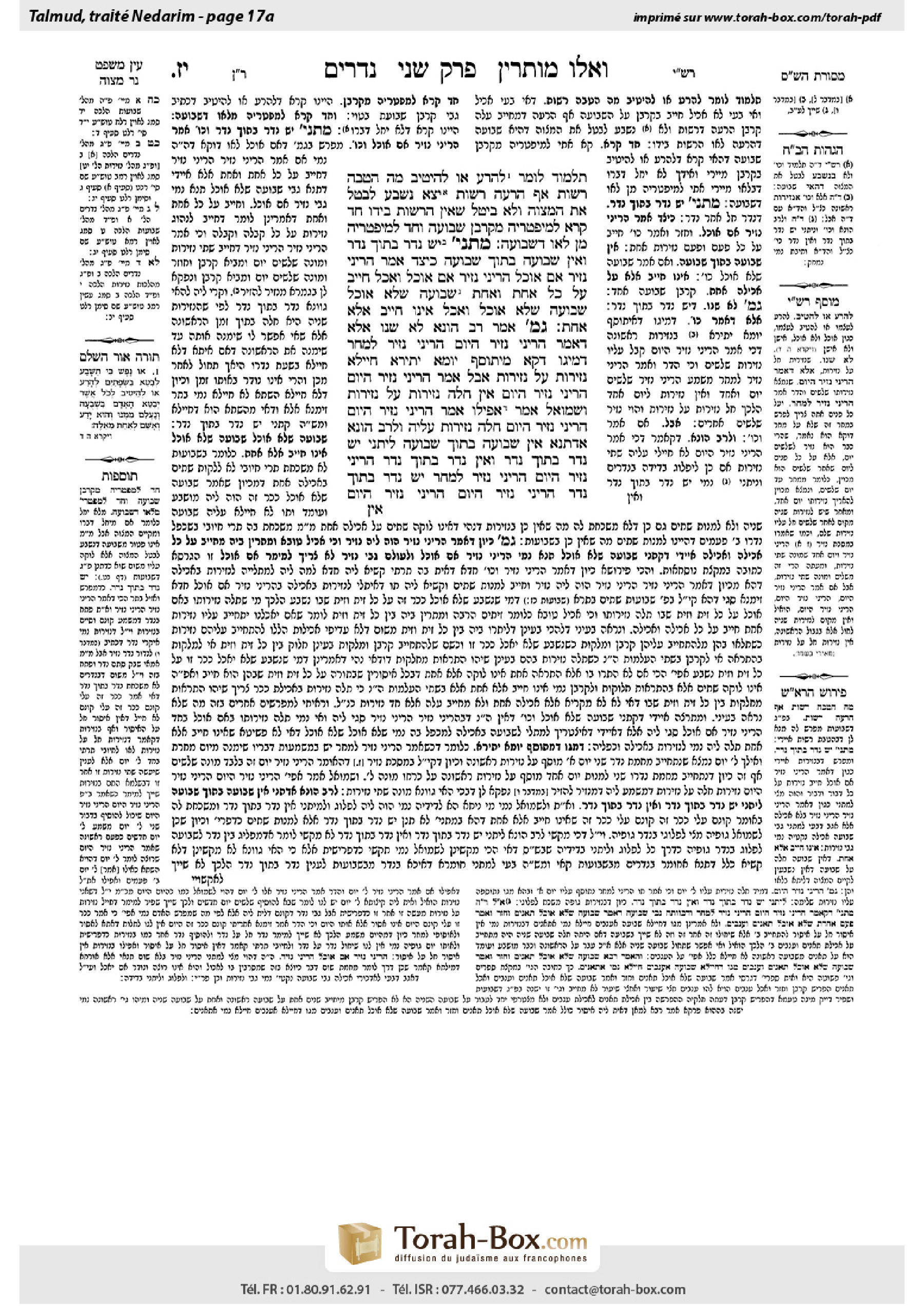
Nedarim 17a: Talmud study for Daf Yomi
Daf Yomi is the daily study of one Talmud folio. Explore 37 tractates with scans, Hebrew text, Sefaria English and AI-generated French translations where annotated.
Passage selection and English or AI-generated French translation are available where the scan has annotations. Daf Study is independent of Torah-Box and Sefaria.
Browse Nedarim · נדרים · All tractatesNedarim 17a text and translations
This page of Nedarim includes the Aramaic text, an English translation and an AI-generated French translation, alongside the scan above.
נדרים י״ז א · Aramaic and Hebrew text
תַּלְמוּד לוֹמַר: ״לְהָרַע אוֹ לְהֵיטִיב״. מָה הֲטָבָה רְשׁוּת, אַף הֲרָעָה רְשׁוּת. יָצָא נִשְׁבַּע לְבַטֵּל אֶת הַמִּצְוָה וְלֹא בִּיטֵּל — שֶׁאֵין הָרְשׁוּת בְּיָדוֹ!
חַד קְרָא לְמִיפְטְרֵיהּ מִקׇּרְבַּן שְׁבוּעָה, וְחַד לְמִיפְטְרֵיהּ מִן לָאו דִּשְׁבוּעָה.
מַתְנִי׳ יֵשׁ נֶדֶר בְּתוֹךְ נֶדֶר, וְאֵין שְׁבוּעָה בְּתוֹךְ שְׁבוּעָה. כֵּיצַד? אָמַר: ״הֲרֵינִי נָזִיר אִם אוֹכַל״, ״הֲרֵינִי נָזִיר אִם אוֹכַל״, וְאָכַל — חַיָּיב עַל כׇּל אַחַת וְאַחַת. ״שְׁבוּעָה שֶׁלֹּא אוֹכַל״, ״שְׁבוּעָה שֶׁלֹּא אוֹכַל״, וְאָכַל — אֵינוֹ חַיָּיב אֶלָּא אַחַת.
גְּמָ׳ אָמַר רַב הוּנָא: לֹא שָׁנוּ אֶלָּא דְּאָמַר ״הֲרֵינִי נָזִיר הַיּוֹם״ ״הֲרֵינִי נָזִיר לְמָחָר״, דְּמִיגּוֹ דְּקָא מִיתּוֹסַף יוֹמָא יַתִּירָא — חָיְילָא נְזִירוּת עַל נְזִירוּת. אֲבָל אָמַר ״הֲרֵינִי נָזִיר הַיּוֹם״, ״הֲרֵינִי נָזִיר הַיּוֹם״ — אֵין חָלָה נְזִירוּת עַל נְזִירוּת. וּשְׁמוּאֵל אָמַר: אֲפִילּוּ אָמַר: ״הֲרֵינִי נָזִיר הַיּוֹם״, ״הֲרֵינִי נָזִיר הַיּוֹם״ — חָלָה נְזִירוּת עֲלֵיהּ.
וּלְרַב הוּנָא, אַדִּתְנָא אֵין שְׁבוּעָה בְּתוֹךְ שְׁבוּעָה, לִיתְנֵי: יֵשׁ נֶדֶר בְּתוֹךְ נֶדֶר, וְאֵין נֶדֶר בְּתוֹךְ נֶדֶר. ״הֲרֵינִי נָזִיר הַיּוֹם, הֲרֵינִי נָזִיר לְמָחָר״ — יֵשׁ נֶדֶר בְּתוֹךְ נֶדֶר, ״הֲרֵינִי נָזִיר הַיּוֹם״ ״הֲרֵינִי נָזִיר הַיּוֹם״ —
Nedarim 17a · English translation
However, the verse states: “Or if anyone swears clearly with his lips to do evil, or to do good” (Leviticus 5:4). From the juxtaposition of evil and good it is derived that just as the doing of good, which is interpreted as obligating himself to take a positive action, is referring to a permitted activity, e.g., to eat, so too, the doing of evil, which is interpreted as prohibiting himself from something, refers only to that which is permitted, e.g., not to eat. This excludes one who takes an oath to nullify a mitzva and does not nullify it; he is not liable for violating the oath, as the permission to nullify it is not in his power.
The Gemara answers that both verses are necessary. One verse: “To do evil or to do good,” which is stated in the context of the halakhot of offerings, is necessary to exempt him from bringing an offering for violating an oath, and one verse: “He shall not profane,” is necessary to exempt him from the prohibition for violating an oath.
MISHNA: There is a vow within a vow. It is possible to impose an additional prohibition, by means of a vow, on an item that is already forbidden by means of a vow. But there is no oath within an oath. If one takes an oath twice with regard to the same action, the second oath does not take effect. How so? If one said: I am hereby a nazirite if I eat, and then repeated: I am hereby a nazirite if I eat, and then he ate, he is obligated to observe naziriteship for thirty days for each and every one of the vows, as both vows took effect. However, if he said: I hereby take an oath that I will not eat, and repeated: I hereby take an oath that I will not eat, and then he ate, he is liable to bring an offering for only one violation of an oath.
GEMARA: Rav Huna said: They taught that there is a vow within a vow only where he said: I am hereby a nazirite today, and then he said: I am hereby a nazirite tomorrow. As since an additional day of naziriteship is added by the second vow, an additional thirty-day obligation of naziriteship takes effect upon the first term of naziriteship. However, if he said: I am hereby a nazirite today, and then repeated: I am hereby a nazirite today, a vow of naziriteship does not take effect upon a previous vow of naziriteship, and he must observe only one term of naziriteship. And Shmuel said that even if he said: I am hereby a nazirite today, I am hereby a nazirite today, a second vow of naziriteship takes effect with regard to him, as one can apply two obligations of naziriteship to himself one after the other.
The Gemara asks: And according to Rav Huna, instead of teaching that there is no oath within an oath, drawing a distinction between a vow and an oath, let the mishna teach a narrower distinction between different vows, stating that there is a case of a vow within a vow, and there is a case in which there is not a vow within a vow. How so? If one says: I am hereby a nazirite today, I am hereby a nazirite tomorrow, in this case there is a vow within a vow. However, if one says: I am hereby a nazirite today, and then again says: I am hereby a nazirite today,
Nedarim 17a · Traduction française (IA)
Cependant, le verset dit : « Ou si quelqu’un jure clairement de ses lèvres de faire le mal ou le bien » (Lévitique 5, 4). De la juxtaposition du mal et du bien, on déduit que, de même que faire le bien — interprété comme le fait de s’engager à accomplir une action positive — concerne une activité permise, par exemple manger, de même faire le mal — interprété comme le fait de s’interdire quelque chose — ne concerne que ce qui est permis, par exemple ne pas manger. Cela exclut celui qui fait serment d’annuler une mitsva mais ne l’annule pas : il n’est pas passible pour avoir transgressé son serment, puisqu’il n’est pas en son pouvoir de l’annuler.
La Guemara répond que les deux versets sont nécessaires. Le verset « faire le mal ou le bien », énoncé dans le contexte des halakhot relatives aux offrandes, est nécessaire pour l’exempter d’apporter une offrande pour avoir transgressé un serment ; le verset « il ne profanera pas » est nécessaire pour l’exempter de l’interdit lié à la transgression d’un serment.
MICHNA : Il existe un vœu à l’intérieur d’un vœu. Il est possible d’imposer, par un vœu, une interdiction supplémentaire sur un élément déjà interdit par un vœu. Mais il n’existe pas de serment à l’intérieur d’un serment. Si quelqu’un prête deux fois serment au sujet de la même action, le second serment ne prend pas effet. Comment cela ? Si quelqu’un dit : « Je suis naziréen à partir de maintenant si je mange », puis répète : « Je suis naziréen à partir de maintenant si je mange », et qu’il mange ensuite, il doit observer trente jours de naziréat pour chacun des deux vœux, car ils ont tous deux pris effet. En revanche, s’il dit : « Je fais serment de ne pas manger », puis répète : « Je fais serment de ne pas manger », et qu’il mange ensuite, il n’est passible d’apporter une offrande que pour une seule transgression de serment.
GUEMARA : Rav Houna a dit : Ils ont enseigné qu’il existe un vœu à l’intérieur d’un vœu uniquement dans le cas où il a dit : « Je suis naziréen à partir d’aujourd’hui », puis : « Je suis naziréen à partir de demain ». En effet, puisque le second vœu ajoute un jour de naziréat, une obligation supplémentaire de trente jours de naziréat s’ajoute à la première période de naziréat. En revanche, s’il a dit : « Je suis naziréen à partir d’aujourd’hui », puis a répété : « Je suis naziréen à partir d’aujourd’hui », un vœu de naziréat ne prend pas effet sur un vœu de naziréat antérieur, et il ne doit observer qu’une seule période de naziréat. Chmouel a dit que même s’il a dit : « Je suis naziréen à partir d’aujourd’hui, je suis naziréen à partir d’aujourd’hui », un second vœu de naziréat prend effet à son égard, car on peut s’imposer deux obligations successives de naziréat.
La Guemara demande : Selon Rav Houna, au lieu d’enseigner qu’il n’existe pas de serment à l’intérieur d’un serment, établissant ainsi une distinction entre un vœu et un serment, que la Michna enseigne une distinction plus étroite entre différents vœux et dise qu’il existe un cas de vœu à l’intérieur d’un vœu et un cas où il n’existe pas de vœu à l’intérieur d’un vœu. Comment cela ? Si quelqu’un dit : « Je suis naziréen à partir d’aujourd’hui, je suis naziréen à partir de demain », il existe alors un vœu à l’intérieur d’un vœu. En revanche, si quelqu’un dit : « Je suis naziréen à partir d’aujourd’hui », puis dit de nouveau : « Je suis naziréen à partir d’aujourd’hui »,
Traduction française générée par IA à partir de l’édition anglaise de Sefaria. Vérifie toujours un passage avec le texte source.
Text from Sefaria: William Davidson Edition - Vocalized Aramaic (CC BY NC); William Davidson Edition - English (CC BY NC).