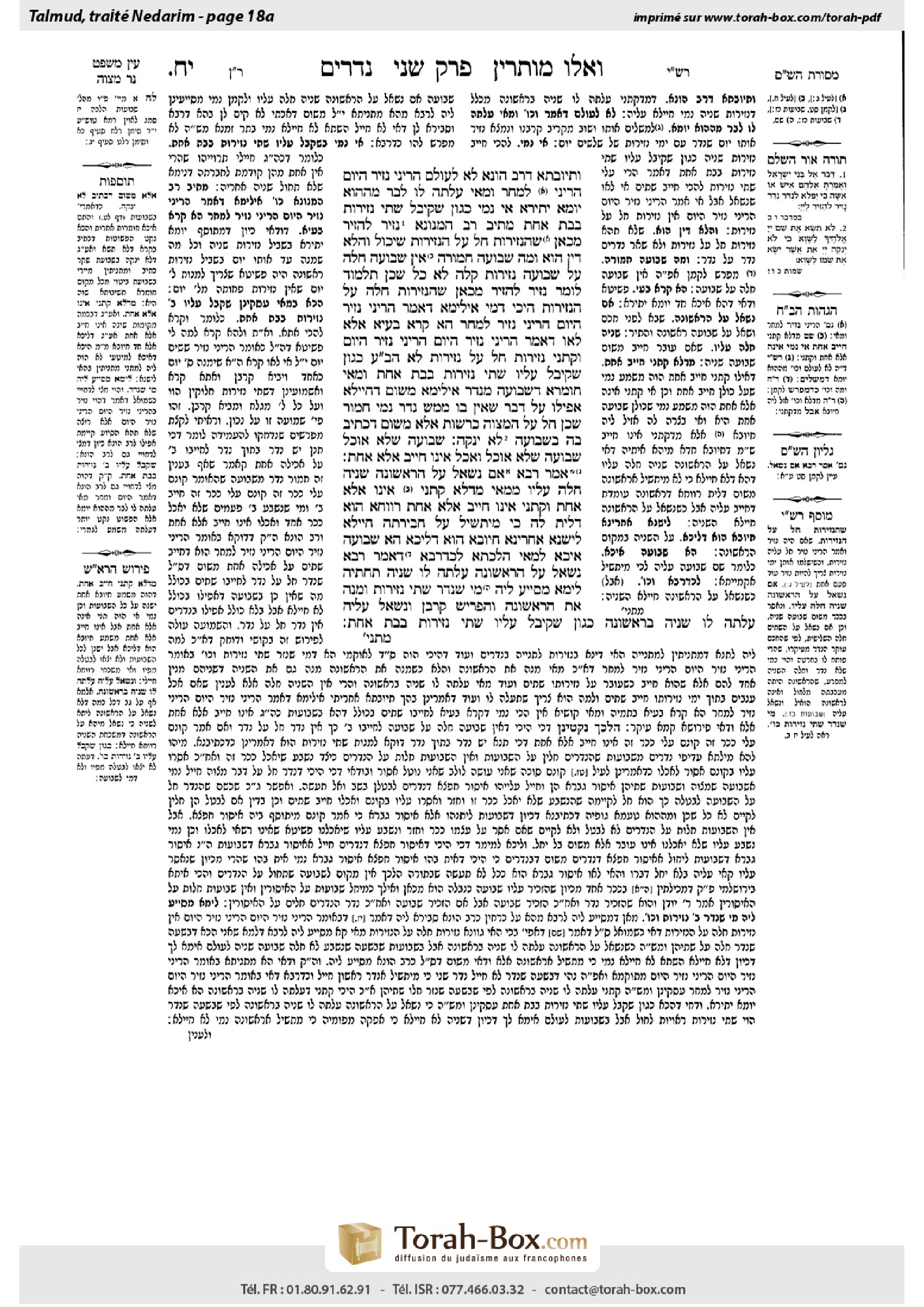
Nedarim 18a: Talmud study for Daf Yomi
Daf Yomi is the daily study of one Talmud folio. Explore 37 tractates with scans, Hebrew text, Sefaria English and AI-generated French translations where annotated.
Passage selection and English or AI-generated French translation are available where the scan has annotations. Daf Study is independent of Torah-Box and Sefaria.
Browse Nedarim · נדרים · All tractatesNedarim 18a text and translations
This page of Nedarim includes the Aramaic text, an English translation and an AI-generated French translation, alongside the scan above.
נדרים י״ח א · Aramaic and Hebrew text
וּתְיוּבְתָּא דְרַב הוּנָא!
לָא, לְעוֹלָם ״הֲרֵינִי נָזִיר הַיּוֹם, הֲרֵינִי לְמָחָר״, וּמַאי ״עָלְתָה לוֹ״ — לְבַר מֵהָהוּא יוֹמָא יַתִּירָא. אִי נָמֵי, כְּגוֹן שֶׁקִּיבֵּל שְׁתֵּי נְזִירוּת בְּבַת אַחַת.
מֵתִיב רַב הַמְנוּנָא: ״נָזִיר לְהַזִּיר״ — מִכָּאן שֶׁהַנְּזִירוּת חָל עַל הַנְּזִירוּת. שֶׁיָּכוֹל, וַהֲלֹא דִּין הוּא: וּמָה שְׁבוּעָה חֲמוּרָה — אֵין שְׁבוּעָה חָלָה עַל שְׁבוּעָה, נְזִירוּת קַלָּה לֹא כׇּל שֶׁכֵּן — תַּלְמוּד לוֹמַר: נָזִיר לְהַזִּיר, מִכָּאן שֶׁהַנְּזִירוּת חָלָה עַל הַנְּזִירוּת.
הֵיכִי דָמֵי? אִילֵימָא דְּאָמַר ״הֲרֵינִי נָזִיר הַיּוֹם, הֲרֵינִי נָזִיר לְמָחָר״, הָא קְרָא בָּעֲיָא?! אֶלָּא לָאו: דְּאָמַר ״הֲרֵינִי נָזִיר הַיּוֹם, הֲרֵינִי נָזִיר הַיּוֹם״ — וְקָתָנֵי נְזִירוּת חָל עַל נְזִירוּת!
לָא, הָכָא בְּמַאי עָסְקִינַן — כְּגוֹן שֶׁקִּיבֵּל עָלָיו שְׁתֵּי נְזִירוּת בְּבַת אַחַת.
וּמַאי חוּמְרָא דִּשְׁבוּעָה מִנֶּדֶר? אִילֵּימָא מִשּׁוּם דְּחָיְילָא אֲפִילּוּ עַל דָּבָר שֶׁאֵין בּוֹ מַמָּשׁ, נֶדֶר נָמֵי חָמוּר, שֶׁכֵּן חָל עַל הַמִּצְוָה כִּרְשׁוּת. אֶלָּא — מִשּׁוּם דִּכְתִיב בָּהּ בִּשְׁבוּעָה: ״לֹא יְנַקֶּה״.
״שְׁבוּעָה שֶׁלֹּא אוֹכַל, שְׁבוּעָה שֶׁלֹּא אוֹכַל״, וְאָכַל — אֵינוֹ חַיָּיב אֶלָּא אַחַת. אָמַר רָבָא: אִם נִשְׁאַל עַל הָרִאשׁוֹנָה — שְׁנִיָּה חָלָה עָלָיו. מִמַּאי — מִדְּלָא קָתָנֵי ״אֵינוֹ אֶלָּא אַחַת״, וְקָתָנֵי ״אֵינוֹ חַיָּיב אֶלָּא אַחַת״, רַוְוחָא הוּא דְּלֵית לַהּ. כִּי מִיתְּשִׁיל עַל חֲבֶירְתַּהּ — חָיְילָא.
לִישָּׁנָא אַחֲרִינָא: חִיּוּבָא הוּא דְּלֵיכָּא, הָא שְׁבוּעָה אִיכָּא. לְמַאי הִלְכְתָא? לְכִדְרָבָא. דְּאָמַר רָבָא: נִשְׁאַל עַל הָרִאשׁוֹנָה — עָלְתָה לוֹ שְׁנִיָּה תַּחְתֶּיהָ.
לֵימָא מְסַיַּיע לֵיהּ: מִי שֶׁנָּדַר שְׁתֵּי נְזִירוֹת וּמָנָה אֶת הָרִאשׁוֹנָה, וְהִפְרִישׁ קׇרְבָּן וְנִשְׁאַל עָלֶיהָ — עָלְתָה לוֹ שְׁנִיָּה בָּרִאשׁוֹנָה.
כְּגוֹן שֶׁקִּיבֵּל עָלָיו שְׁתֵּי נְזִירוֹת בְּבַת אַחַת.
Nedarim 18a · English translation
and this is a conclusive refutation of the statement of Rav Huna.
The Gemara answers: No, actually the case is where he said: I am hereby a nazirite today, I am hereby a nazirite tomorrow. And what is the meaning of the statement: The second term of naziriteship is counted for him instead of the first? It is counted except for that additional day, which he still must observe. Alternatively, it may be a case where he accepted upon himself two periods of naziriteship simultaneously, i.e., he said: I am hereby a nazirite twice. Therefore, when the vow with regard to the first term of naziriteship is dissolved, the days he observed count entirely for his second term.
Rav Hamnuna raised an additional objection against the opinion of Rav Huna from a baraita. It is stated in the verse: “A nazirite, to consecrate [nazir lehazzir]” (Numbers 6:2). From the use of similar, repetitive wording in the verse here it is derived that naziriteship takes effect upon a prior vow of naziriteship. As one might have thought that it could be derived through an a fortiori inference that naziriteship does not take effect, as follows: And just as with regard to an oath, which is more stringent, an oath does not take effect upon a prior oath, with regard to naziriteship, which is more lenient, all the more so is it not clear that it does not take effect where a vow of naziriteship was already in effect? Therefore, the verse states: “Nazir lehazzir.” From here it is derived that naziriteship takes effect upon a prior vow of naziriteship.
What are the circumstances? If we say it is a case where one said: I am hereby a nazirite today, I am hereby a nazirite tomorrow, does that case require proof from a verse that it takes effect? It is obvious that the second vow of naziriteship takes effect at least on the additional day. And as the minimum term of naziriteship is thirty days, an additional thirty days must be observed. Rather, is it not a case where one said: I am a nazirite today, I am a nazirite today? And the baraita teaches that in this case as well, naziriteship takes effect upon a prior vow of naziriteship, contrary to the opinion of Rav Huna.
The Gemara answers: That is not the case. Rather, with what are we dealing here? We are dealing with a case where he accepted upon himself two terms of naziriteship simultaneously. The baraita teaches that he must observe two terms of naziriteship and bring a separate offering for each.
The baraita stated that an oath is more stringent than a vow. The Gemara asks: And what is the stringency of an oath vis-à-vis a vow, such as a vow of naziriteship? If we say the baraita posits this because an oath, unlike a vow, takes effect even with regard to a matter that has no actual substance, there is a counterargument that a vow also has stringency vis-à-vis an oath, in that it, unlike an oath, takes effect with regard to a mitzva just as it does with regard to a matter that is permitted. Rather, oaths are more stringent because it is written with regard to an oath: “The Lord will not hold guiltless he who takes His name in vain” (Exodus 20:6).
§ It is taught in the mishna that if one said: I hereby take an oath that I will not eat, I hereby take an oath that I will not eat, and he then ate, he is liable to bring an offering for only one violation of an oath. Rava said: If he requested and received dissolution from a halakhic authority for the first oath, the second oath takes effect upon him. From where is this derived? From the fact that it is not taught in the mishna that there is only one, i.e., it is as though he took only one oath as the oaths are identical. Rather, it is taught that he is liable for only one. Evidently, he is not liable for the second oath only because it does not have a span of time in which to take effect, as he is already under oath not to eat. However, when he requests dissolution of the other oath, i.e. the first oath, the second oath has a span of time in which to take effect, and takes effect.
Another version of Rava’s proof from the mishna is that it may be inferred from the statement: He is liable for only one, that although there is no liability to bring an offering for violating the second oath, there is an effective oath. But if there is no liability, then with regard to what halakha is it effective? Certainly it is effective with regard to the statement of Rava, as Rava said: If he requested and received dissolution from a halakhic authority for the first oath, the second is counted for him in its place.
The Gemara proposes: Let us say that the following mishna (Shevuot 27b) supports his opinion: In the case of one who took two vows of naziriteship, and counted the first term, and set aside an offering, and requested and received dissolution from a halakhic authority for the first oath, the second term counts for him instead of the first. Evidently, although initially the second term of naziriteship did not have a span of time in which to take effect, it was not completely void. Therefore, when the first vow was dissolved, the second one immediately took its place. It may be proved from here that this is true with regard to oaths as well.
The Gemara refutes this proof: That mishna may be referring to a case where he accepted upon himself two terms of naziriteship simultaneously. Since two terms cannot be observed concurrently, when he accepts two terms simultaneously, the halakha is that the second term commences immediately following the close of the first, which immediately took effect upon sequential periods of time. However, when one takes an oath prohibiting himself from a matter that is already prohibited by an oath in the same period of time, the second oath may not take effect at all.
Nedarim 18a · Traduction française (IA)
Et cela réfute définitivement la déclaration de Rav Houna.
La Guemara répond : Non, en réalité, il s’agit du cas où il a dit : « Me voici nazir aujourd’hui ; me voici nazir demain. » Que signifie alors la déclaration selon laquelle la seconde période de naziréat est comptée à la place de la première ? Elle est comptée, à l’exception de ce jour supplémentaire, qu’il doit encore observer. Autre possibilité : il a accepté sur lui deux périodes de naziréat simultanément, c’est-à-dire qu’il a dit : « Me voici nazir deux fois. » Par conséquent, lorsque le vœu relatif à la première période de naziréat est annulé, les jours qu’il a observés sont entièrement comptés pour sa seconde période.
Rav Hamnouna soulève une objection supplémentaire contre l’opinion de Rav Houna à partir d’une baraïta. Il est dit dans le verset : « Un nazir, pour se consacrer [nazir lehazzir] » (Nombres 6, 2). L’emploi, dans ce verset, d’une expression similaire et répétitive permet de déduire que le naziréat prend effet alors qu’un vœu de naziréat antérieur est déjà en vigueur. On aurait pu penser qu’on pouvait déduire par raisonnement a fortiori que le naziréat ne prend pas effet, de la manière suivante : puisque, en ce qui concerne un serment, qui est plus strict, un serment ne prend pas effet lorsqu’un serment antérieur est déjà en vigueur, à plus forte raison le naziréat, qui est moins strict, ne prend-il pas effet lorsqu’un vœu de naziréat est déjà en vigueur. Le verset dit donc : « Nazir lehazzir ». On en déduit que le naziréat prend effet alors qu’un vœu de naziréat antérieur est déjà en vigueur.
Dans quelles circonstances ? Si nous disons qu’il s’agit du cas où quelqu’un a dit : « Me voici nazir aujourd’hui ; me voici nazir demain », faut-il un verset pour prouver que cela prend effet ? Il est évident que le second vœu de naziréat prend effet au moins pour le jour supplémentaire. Et comme la durée minimale du naziréat est de trente jours, il doit observer trente jours supplémentaires. Il s’agit donc, n’est-ce pas, du cas où quelqu’un a dit : « Je suis nazir aujourd’hui ; je suis nazir aujourd’hui. » La baraïta enseigne que, dans ce cas également, le naziréat prend effet alors qu’un vœu de naziréat antérieur est déjà en vigueur, contrairement à l’opinion de Rav Houna.
La Guemara répond : Ce n’est pas le cas. De quoi s’agit-il alors ? D’un cas où il a accepté sur lui deux périodes de naziréat simultanément. La baraïta enseigne qu’il doit observer deux périodes de naziréat et apporter une offrande distincte pour chacune.
La baraïta a déclaré qu’un serment est plus strict qu’un vœu. La Guemara demande : En quoi un serment est-il plus strict qu’un vœu, tel qu’un vœu de naziréat ? Si nous disons que la baraïta l’affirme parce qu’un serment, contrairement à un vœu, prend effet même lorsqu’il porte sur une chose dépourvue de substance concrète, on peut opposer que le vœu a lui aussi une rigueur par rapport au serment : contrairement au serment, il prend effet à l’égard d’une mitsva, comme il le fait à l’égard d’une chose permise. Les serments sont plutôt plus stricts parce qu’il est écrit à propos d’un serment : « Le Seigneur ne tiendra pas pour innocent celui qui prononce Son nom en vain » (Exode 20, 6).
§ La Michna enseigne que si quelqu’un a dit : « Je jure que je ne mangerai pas ; je jure que je ne mangerai pas », puis a mangé, il est tenu d’apporter une offrande pour une seule transgression du serment. Rava a dit : S’il a demandé et obtenu d’une autorité halakhique l’annulation du premier serment, le second serment prend effet à son égard. D’où le déduit-on ? Du fait que la Michna n’enseigne pas qu’il n’y en a qu’un seul, c’est-à-dire que c’est comme s’il n’avait prononcé qu’un seul serment, puisque les serments sont identiques. Elle enseigne plutôt qu’il n’est passible que pour un seul. Il ressort de là qu’il n’est passible pour le second serment que parce qu’il ne dispose d’aucune période pendant laquelle prendre effet, puisqu’il est déjà lié par le serment de ne pas manger. Cependant, lorsqu’il demande l’annulation de l’autre serment, c’est-à-dire du premier, le second serment dispose d’une période pendant laquelle prendre effet et prend donc effet.
Selon une autre version, la preuve que Rava tire de la Michna peut être déduite de la déclaration : « Il n’est passible que pour un seul » : bien qu’il ne soit pas tenu d’apporter une offrande pour la transgression du second serment, celui-ci constitue néanmoins un serment effectif. Mais s’il n’entraîne aucune responsabilité, à l’égard de quelle halakha est-il effectif ? Il l’est certainement en ce qui concerne la déclaration de Rava, car Rava a dit : S’il a demandé et obtenu d’une autorité halakhique l’annulation du premier serment, le second est compté à sa place.
La Guemara propose : Disons que la Michna suivante (Shevouot 27b) étaye son opinion : dans le cas de quelqu’un qui a pris deux vœux de naziréat, a compté la première période, a mis de côté une offrande, puis a demandé et obtenu d’une autorité halakhique l’annulation du premier vœu, la seconde période est comptée à la place de la première. Il ressort de là que, bien qu’au départ la seconde période de naziréat ne disposât d’aucune période pendant laquelle prendre effet, elle n’était pas entièrement nulle. Par conséquent, lorsque le premier vœu a été annulé, le second a immédiatement pris sa place. On peut en déduire qu’il en va de même pour les serments.
La Guemara réfute cette preuve : cette Michna peut parler d’un cas où il a accepté sur lui deux périodes de naziréat simultanément. Puisqu’on ne peut pas observer deux périodes en même temps, lorsqu’il accepte simultanément deux périodes, la halakha est que la seconde commence immédiatement après la fin de la première, qui a pris effet aussitôt pour des périodes successives. En revanche, lorsqu’on prononce un serment qui interdit une chose déjà interdite par un serment pendant la même période, le second serment peut ne jamais prendre effet.
Traduction française générée par IA à partir de l’édition anglaise de Sefaria. Vérifie toujours un passage avec le texte source.
Text from Sefaria: William Davidson Edition - Vocalized Aramaic (CC BY NC); William Davidson Edition - English (CC BY NC).