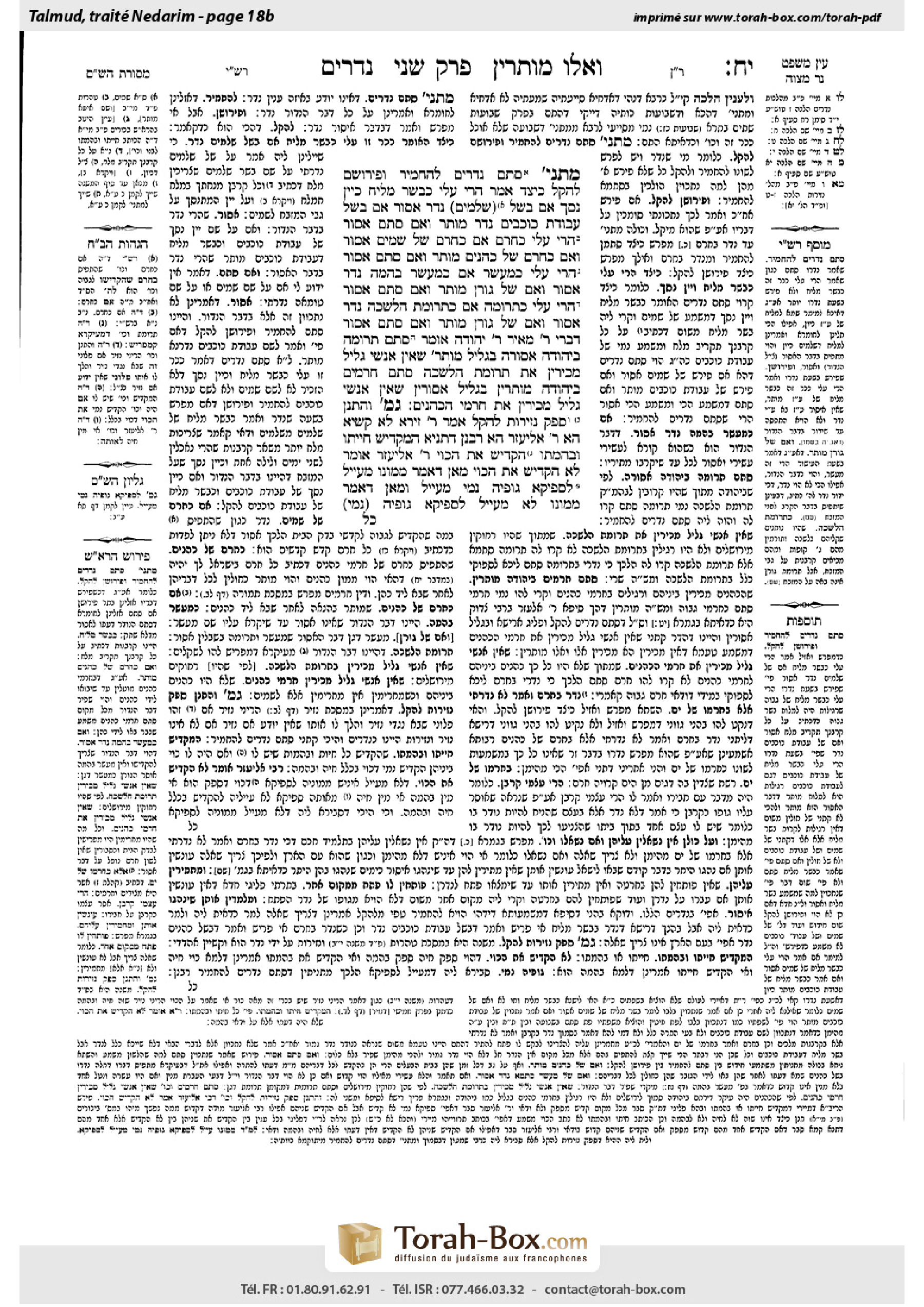
Nedarim 18b: Talmud study for Daf Yomi
Daf Yomi is the daily study of one Talmud folio. Explore 37 tractates with scans, Hebrew text, Sefaria English and AI-generated French translations where annotated.
Passage selection and English or AI-generated French translation are available where the scan has annotations. Daf Study is independent of Torah-Box and Sefaria.
Browse Nedarim · נדרים · All tractatesNedarim 18b text and translations
This page of Nedarim includes the Aramaic text, an English translation and an AI-generated French translation, alongside the scan above.
נדרים י״ח ב · Aramaic and Hebrew text
מַתְנִי׳ סְתַם נְדָרִים לְהַחֲמִיר, וּפֵירוּשָׁם לְהָקֵל. כֵּיצַד? אָמַר ״הֲרֵי עָלַי כְּבָשָׂר מָלִיחַ״ ״כְּיֵין נֶסֶךְ״, אִם בְּשֶׁל שְׁלָמִים נָדַר — אָסוּר.
אִם בְּשֶׁל עֲבוֹדָה זָרָה נָדַר — מוּתָּר. וְאִם סְתָם — אָסוּר.
״הֲרֵי עָלַי כְּחֵרֶם״, אִם כְּחֵרֶם שֶׁל שָׁמַיִם — אָסוּר, וְאִם כְּחֵרֶם שֶׁל כֹּהֲנִים — מוּתָּר. וְאִם סְתָם — אָסוּר.
״הֲרֵי עָלַי כְּמַעֲשֵׂר״, אִם כְּמַעְשַׂר בְּהֵמָה נָדַר — אָסוּר. וְאִם שֶׁל גּוֹרֶן, — מוּתָּר. וְאִם סְתָם — אָסוּר.
״הֲרֵי עָלַי כִּתְרוּמָה״, אִם כִּתְרוּמַת הַלִּשְׁכָּה נָדַר — אָסוּר. וְאִם שֶׁל גּוֹרֶן — מוּתָּר. וְאִם סְתָם — אָסוּר. דִּבְרֵי רַבִּי מֵאִיר.
רַבִּי יְהוּדָה אוֹמֵר: סְתַם תְּרוּמָה, בִּיהוּדָה — אֲסוּרָה, בַּגָּלִיל — מוּתֶּרֶת, שֶׁאֵין אַנְשֵׁי גָלִיל מַכִּירִין אֶת תְּרוּמַת הַלִּשְׁכָּה. סְתַם חֲרָמִים, בִּיהוּדָה — מוּתָּרִין, בַּגָּלִיל — אֲסוּרִין, שֶׁאֵין אַנְשֵׁי גָלִיל מַכִּירִין אֶת חֶרְמֵי הַכֹּהֲנִים.
גְּמָ׳ וְהָתְנַן: סְפֵק נְזִירוּת לְהָקֵל?
אָמַר רַבִּי זֵירָא, לָא קַשְׁיָא: הָא רַבִּי אֱלִיעֶזֶר, הָא רַבָּנַן. דְּתַנְיָא: הַמַּקְדִּישׁ חַיָּיתוֹ וּבְהֶמְתּוֹ — הִקְדִּישׁ אֶת הַכּוֹי. רַבִּי אֱלִיעֶזֶר אוֹמֵר: לֹא הִקְדִּישׁ אֶת הַכּוֹי.
מַאן דְּאָמַר מָמוֹנוֹ מְעַיֵּיל לִסְפֵיקָא, גּוּפֵיהּ נָמֵי מְעַיֵּיל. וּמַאן דְּאָמַר מָמוֹנוֹ לָא מְעַיֵּיל לִסְפֵיקָא, גּוּפֵיהּ (נָמֵי)
Nedarim 18b · English translation
MISHNA: Unspecified vows are treated stringently, but their specification, if specification is necessary, is treated leniently. How so? If one said: This item is prohibited to me like salted meat, or: This item is prohibited to me like the wine used for libations, if he vowed in reference to meat or libations of a peace-offering, i.e., if he claimed that his intention was that the item will be forbidden to him like the salted meat of an offering, or like wine that is used for libations on the altar, it is forbidden, as he associated the item of the vow with an item forbidden by means of a vow, i.e., the offering.
If he claims that he vowed in reference to meat or libations of idol worship, i.e., that the item will be like the salted meat of an offering for an idol, or like wine that is used for libations as idol worship, it is permitted, as the item of the vow was associated with an item forbidden by the Torah. By enabling the one who took the vow to later clarify his intent, the vow is treated leniently. And if the vow was without specification, i.e., the one who took the vow did not specify whether his intention was to associate the item with an offering for Heaven or to associate the item with idol worship, it is forbidden.
Similarly, if one said: This item is hereby forbidden to me like an item dedicated to the Temple, if his intention was that it would be like a dedication to Heaven, which is a form of consecration, it is forbidden. And if his intention was that it would be like a dedication to priests, whereby one pledges his asset as a gift to priests, it is permitted, as this type of gift is not forbidden at all. And if he said it without specification, it is forbidden.
Likewise, if he said: This item is hereby forbidden to me like tithes, if he took a vow with the intention that it would be like the animal tithe, it is forbidden, as the item of the vow was associated with an item forbidden by a vow. And if his intention was that it will be like the tithe of the granary, i.e., grain that is given to the Levites and has no sanctity, it is permitted. And if he said it without specification, it is forbidden.
Similarly, if he said: This item is hereby forbidden to me like teruma, if he took a vow with the intention that it would be like the collection of the Temple treasury chamber [terumat halishka], which is a tax for the communal offerings, it is forbidden, his vow was associated with an item forbidden by a vow. And if his intention was that it would be like teruma of the granary that is given to the priests, it is permitted, as teruma is not an item forbidden by a vow. And if the vow was taken without specification, it is forbidden. This is the statement of Rabbi Meir.
Rabbi Yehuda says: Unspecified teruma in Judea is forbidden. However, in the Galilee it is permitted, as the people of the Galilee are unfamiliar with the collection of the chamber. When they say teruma they are referring to the teruma allotted to the priests, which is familiar to them. Conversely, unspecified dedications in Judea are permitted, but in the Galilee they are forbidden, as the people of the Galilee are unfamiliar with dedications allotted to the priests, so when they say dedication they are referring to dedication to Heaven.
GEMARA: The Gemara raises a problem with the principle stated in the mishna that unspecified vows are treated stringently. But didn’t we learn in a mishna (Taharot 4:12): Uncertainty with regard to naziriteship is treated leniently? And naziriteship is a type of vow.
Rabbi Zeira said: This is not difficult. That mishna is in accordance with the opinion of Rabbi Eliezer, and this mishna is in accordance with the opinion of the Rabbis, who disagree with him. As it is taught in a baraita: One who consecrates his undomesticated animal and his domesticated animal has consecrated the koy as well, although it is uncertain whether it is an undomesticated or a domesticated animal. Rabbi Eliezer says: He has not consecrated the koy.
The Rabbis who said that one puts his possessions into a state of uncertainty, and therefore a koy is included in the aforementioned vow, hold that one enters himself into a state of uncertainty as well. Therefore, uncertainty with regard to naziriteship is treated stringently. And Rabbi Eliezer, who said that one does not put his possessions into a state of uncertainty, and therefore the phrase: Undomesticated and domesticated animals, refers only to definitely undomesticated and definitely domesticated animals,
Nedarim 18b · Traduction française (IA)
MICHNA : Les vœux non précisés sont traités avec rigueur, mais leur interprétation, lorsqu’elle est nécessaire, est traitée avec indulgence. Comment cela ? Si quelqu’un dit : « Cet objet m’est interdit comme de la viande salée » ou : « Cet objet m’est interdit comme le vin destiné aux libations », et qu’il entend par là la viande ou les libations d’un sacrifice de paix — c’est-à-dire s’il affirme avoir voulu que l’objet lui soit interdit comme la viande salée d’une offrande ou comme le vin destiné aux libations sur l’autel —, l’objet est interdit, car il a assimilé l’objet de son vœu à un objet interdit par un vœu, à savoir l’offrande.
S’il affirme qu’il entendait par là la viande ou les libations liées à l’idolâtrie — c’est-à-dire que l’objet soit comme la viande salée d’une offrande à une idole ou comme le vin utilisé pour les libations dans le cadre de l’idolâtrie —, l’objet est permis, car l’objet du vœu a été assimilé à un objet interdit par la Torah. En permettant à celui qui a prononcé le vœu de préciser ensuite son intention, on traite le vœu avec indulgence. En revanche, si le vœu n’a pas été précisé, c’est-à-dire si celui qui l’a prononcé n’a pas précisé s’il entendait assimiler l’objet à une offrande pour le Ciel ou à une offrande liée à l’idolâtrie, l’objet est interdit.
De même, si quelqu’un dit : « Cet objet m’est désormais interdit comme un objet consacré au Temple », et que son intention était qu’il soit assimilé à une consécration au Ciel, qui constitue une forme de consécration, l’objet est interdit. Si son intention était qu’il soit assimilé à un don fait aux prêtres, par lequel on leur lègue un bien, l’objet est permis, car ce type de don n’est nullement interdit. Si sa déclaration n’a pas été précisée, l’objet est interdit.
De même, s’il dit : « Cet objet m’est désormais interdit comme les dîmes », et qu’il a prononcé son vœu avec l’intention que l’objet soit assimilé à la dîme du bétail, il est interdit, car il a assimilé l’objet de son vœu à un objet interdit par un vœu. Si son intention était que l’objet soit assimilé à la dîme de l’aire de battage, c’est-à-dire au grain donné aux Lévites et dépourvu de sainteté, l’objet est permis. Si sa déclaration n’a pas été précisée, l’objet est interdit.
De même, s’il dit : « Cet objet m’est désormais interdit comme la terouma », et qu’il a prononcé son vœu avec l’intention que l’objet soit assimilé au prélèvement de la chambre du Trésor du Temple [terumat halishka], qui est une taxe destinée aux offrandes communautaires, l’objet est interdit, car il a assimilé son vœu à un objet interdit par un vœu. Si son intention était que l’objet soit assimilé à la terouma de l’aire de battage donnée aux prêtres, l’objet est permis, car la terouma n’est pas un objet interdit par un vœu. Si le vœu n’a pas été précisé, l’objet est interdit. Telle est la position de Rabbi Meïr.
Rabbi Yehuda dit : En Judée, la terouma non précisée est interdite. En revanche, en Galilée, elle est permise, car les habitants de la Galilée ne connaissent pas le prélèvement de la chambre du Trésor. Lorsqu’ils disent « terouma », ils désignent la terouma attribuée aux prêtres, qui leur est familière. À l’inverse, en Judée, les consécrations non précisées sont permises, tandis qu’en Galilée elles sont interdites, car les habitants de la Galilée ne connaissent pas les dons consacrés aux prêtres ; lorsqu’ils disent « consécration », ils désignent donc une consécration au Ciel.
GUEMARA : La Guemara soulève une difficulté concernant le principe énoncé dans la Michna, selon lequel les vœux non précisés sont traités avec rigueur. N’avons-nous pas appris dans une Michna (Taharot 4:12) : « En cas de doute concernant le naziréat, on agit avec indulgence » ? Or, le naziréat est une forme de vœu.
Rabbi Zeira dit : Il n’y a pas de contradiction. Cette Michna suit l’opinion de Rabbi Eliezer, tandis que notre Michna suit celle des Rabbins, qui sont en désaccord avec lui. En effet, il est enseigné dans une baraïta : Celui qui consacre ses animaux sauvages et ses animaux domestiques a également consacré le koy, bien qu’on ne sache pas s’il s’agit d’un animal sauvage ou d’un animal domestique. Rabbi Eliezer dit : Il n’a pas consacré le koy.
Les Rabbins, qui disent qu’une personne place ses biens dans une situation d’incertitude et que le koy est donc inclus dans le vœu susmentionné, considèrent également qu’elle s’expose elle-même à une situation d’incertitude. Par conséquent, en cas de doute concernant le naziréat, on agit avec rigueur. Quant à Rabbi Eliezer, qui dit qu’une personne ne place pas ses biens dans une situation d’incertitude, l’expression « animaux sauvages et animaux domestiques » ne désigne donc, selon lui, que des animaux certainement sauvages et certainement domestiques,
Traduction française générée par IA à partir de l’édition anglaise de Sefaria. Vérifie toujours un passage avec le texte source.
Text from Sefaria: William Davidson Edition - Vocalized Aramaic (CC BY NC); William Davidson Edition - English (CC BY NC).