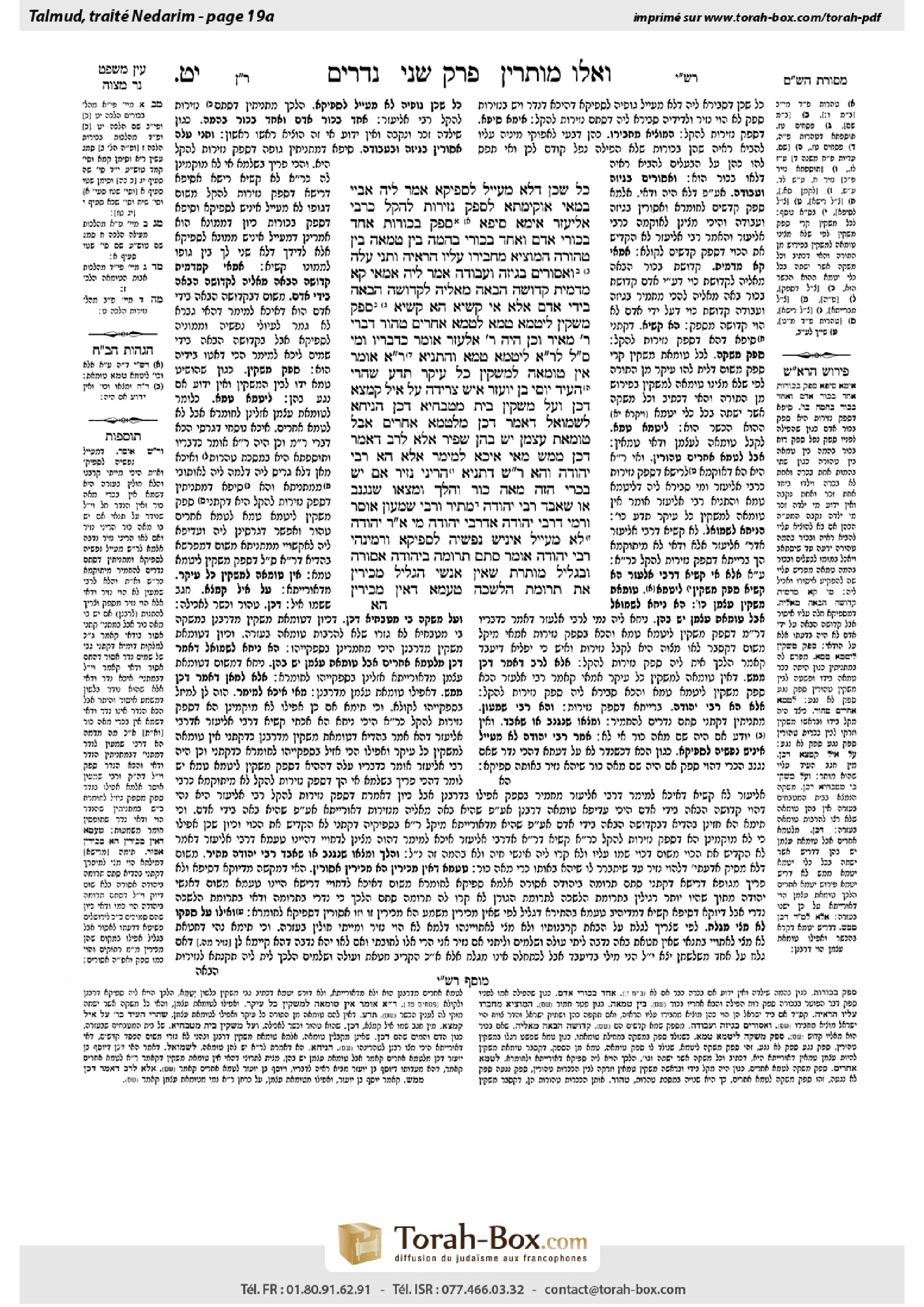
Nedarim 19a: Talmud study for Daf Yomi
Daf Yomi is the daily study of one Talmud folio. Explore 37 tractates with scans, Hebrew text, Sefaria English and AI-generated French translations where annotated.
Passage selection and English or AI-generated French translation are available where the scan has annotations. Daf Study is independent of Torah-Box and Sefaria.
Browse Nedarim · נדרים · All tractatesNedarim 19a text and translations
This page of Nedarim includes the Aramaic text, an English translation and an AI-generated French translation, alongside the scan above.
נדרים י״ט א · Aramaic and Hebrew text
כׇּל שֶׁכֵּן דְּלָא מְעַיֵּיל לִסְפֵיקָא.
אֲמַר לֵיהּ אַבָּיֵי: בְּמַאי אוֹקֵימְתָּא לִסְפֵק נְזִירוּת לְהָקֵל — כְּרַבִּי אֱלִיעֶזֶר, אֵימָא סֵיפָא: סְפֵק בְּכוֹרוֹת, אֶחָד בְּכוֹרֵי אָדָם וְאֶחָד בְּכוֹרֵי בְהֵמָה, בֵּין טְמֵאָה בֵּין טְהוֹרָה — הַמּוֹצִיא מֵחֲבֵירוֹ עָלָיו הָרְאָיָה.
וְתָנֵי עֲלַהּ: וַאֲסוּרִים בְּגִיזָּה וַעֲבוֹדָה!
אֲמַר לֵיהּ: אַמַּאי קָא מְדַמֵּית קְדוּשָּׁה הַבָּאָה מֵאֵלֶיהָ, לִקְדוּשָּׁה הַבָּאָה בִּידֵי אָדָם?
אֶלָּא אִי קַשְׁיָא, הָא קַשְׁיָא: סְפֵק מַשְׁקִין, לִיטָּמֵא — טָמֵא, לְטַמֵּא אֲחֵרִים — טָהוֹר, דִּבְרֵי רַבִּי מֵאִיר, וְכֵן הָיָה רַבִּי אֶלְעָזָר אוֹמֵר כִּדְבָרָיו.
וּמִי סְבִירָא לֵיהּ לְרַבִּי אֱלִיעֶזֶר לִיטָּמֵא טָמֵא?
וְהָתַנְיָא, רַבִּי אֱלִיעֶזֶר אוֹמֵר: אֵין טוּמְאָה לְמַשְׁקִין כׇּל עִיקָּר. תֵּדַע: שֶׁהֲרֵי הֵעִיד יוֹסֵי בֶּן יוֹעֶזֶר אִישׁ צְרֵידָה עַל אַיָּל קַמְצָא דְּכַן, וְעַל מַשְׁקִין בֵּית מִטְבְּחַיָּא דְּכַן?
הָנִיחָא לִשְׁמוּאֵל, דְּאָמַר: דְּכַן מִלְּטַמֵּא אֲחֵרִים, אֲבָל טוּמְאַת עַצְמָן יֵשׁ בָּהֶן, שַׁפִּיר.
אֶלָּא לְרַב דְּאָמַר דְּכַן מַמָּשׁ, מַאי אִיכָּא לְמֵימַר?
אֶלָּא: הָא רַבִּי יְהוּדָה, וְהָא רַבִּי שִׁמְעוֹן.
דְּתַנְיָא: ״הֲרֵינִי נָזִיר אִם יֵשׁ בִּכְרִי הַזֶּה מֵאָה כּוֹר״, וְהָלַךְ וּמְצָאוֹ שֶׁנִּגְנַב אוֹ שֶׁאָבַד — רַבִּי יְהוּדָה מַתִּיר, וְרַבִּי שִׁמְעוֹן אוֹסֵר.
וְרָמֵי דְּרַבִּי יְהוּדָה אַדְּרַבִּי יְהוּדָה: מִי אָמַר רַבִּי יְהוּדָה לָא מְעַיֵּיל אִינִישׁ נַפְשֵׁיהּ לִסְפֵיקָא? וּרְמִינְהִי, רַבִּי יְהוּדָה אוֹמֵר: סְתַם תְּרוּמָה בִּיהוּדָה — אֲסוּרָה, וּבַגָּלִיל — מוּתֶּרֶת, שֶׁאֵין אַנְשֵׁי הַגָּלִיל מַכִּירִין אֶת תְּרוּמַת הַלִּשְׁכָּה. טַעְמָא דְּאֵין מַכִּירִין,
Nedarim 19a · English translation
holds that all the more so, one does not enter himself into uncertainty either. Therefore, uncertainty with regard to naziriteship is treated leniently.
Abaye said to Rabbi Zeira: In what manner did you establish the mishna that states that uncertainty with regard to naziriteship is treated leniently? You established it in accordance with the opinion of Rabbi Eliezer. Say the latter clause of that mishna: If there is uncertainty with regard to firstborns, whether human firstborns, or animal firstborns, whether non-kosher firstborns, i.e., the firstborn of a donkey, or the firstborn of kosher animals, the burden of proof rests upon the claimant. In other words, the priest cannot take the redemption money from the father of the child, or the animal from its owner, and conversely, if the father or owner mistakenly gave it to a priest, he does not get it back.
And it is taught in a baraita in that regard: But with regard to shearing and working these uncertain animal firstborns, they are forbidden, just like definite firstborns. This indicates a difference between the monetary issue, with regard to which it is ruled that the animal cannot be taken from the owner by the priest, and the prohibition, which applies despite the uncertainty. Evidently, even the tanna of this mishna does not hold that all uncertainties with regard to consecration are to be treated leniently.
Rabbi Zeira said to Abaye: This is not difficult. Why do you compare sanctity that emerges by itself, i.e., the sanctity of a firstborn, which results from objective reality and not human intent, to sanctity that emerges by the volition of a person and is dependent on his intention? Only with regard to the latter type of sanctity can it be established that a person does not intend to consecrate an item in an uncertain manner.
Rather, if Rabbi Zeira’s answer is difficult, this is what is difficult. It is stated in that same mishna: In the case of liquid with regard to which there is uncertainty whether it became ritually impure through contact with someone who was ritually impure, the halakha is as follows: It is considered impure with regard to its being impure in and of itself, but it is considered pure with regard to its ability to render other items impure. This is the statement of Rabbi Meir. And Rabbi Elazar would also say in accordance with the statements of Rabbi Meir.
According to Rabbi Zeira’s assertion that the rulings of this mishna with regard to uncertainty are in accordance with the opinion of Rabbi Eliezer, this causes a difficulty: But does Rabbi Eliezer hold that with regard to liquid of uncertain ritual status being impure, it is considered impure?
But isn’t it taught in a baraita that Rabbi Eliezer says: By Torah law, impurity does not apply to liquids at all? Know that this is so, as Yosei ben Yo’ezer of Tzereida testified concerning a grasshopper species called eil kamtza that it is kosher, and concerning the liquids of the Temple slaughterhouse that they are pure. Liquids are susceptible to ritual impurity only by rabbinic law, and liquids in the Temple were not included in this decree so as not to cause additional impurity there. Since Rabbi Eliezer holds that by Torah law liquids are not susceptible to impurity, how can it be his opinion that liquids of uncertain ritual status are considered impure?
The Gemara comments: This works out well according to Shmuel, who said that the meaning of Rabbi Eliezer’s ruling that the liquids of the Temple slaughterhouse are pure is that they cannot render other items impure, but they themselves are susceptible to impurity. Accordingly, liquids are susceptible to impurity by Torah law; only their ability to render other items impure is by rabbinic law. The ruling in the mishna that liquid of uncertain ritual status is considered impure is therefore consistent with the opinion of Rabbi Eliezer, and Rabbi Zeira’s answer works out well.
However, according to Rav, who said that they are actually pure, i.e., they are not susceptible to impurity, what is there to say? The mishna that is lenient with regard to uncertain naziriteship and stringent with regard to liquid of uncertain ritual status is clearly not in accordance with the opinion of Rabbi Eliezer.
Rather, Rabbi Zeira’s answer should be rejected, and the contradiction between the mishna here, which states that unspecified vows should be treated stringently, and the mishna in tractate Teharot, which states that uncertain naziriteship should be treated leniently, should be resolved as follows: That mishna, in Teharot, is in accordance with the opinion of Rabbi Yehuda, and this mishna is in accordance with the opinion of Rabbi Shimon.
As it is taught in a baraita that if someone says: I am hereby a nazirite if there are in this heap of grain one hundred kor, and he went to measure the heap and found that it was stolen or that it was lost and cannot be measured, Rabbi Yehuda permits him to perform actions forbidden to a nazirite, as he holds that this uncertain naziriteship does not take effect. And Rabbi Shimon prohibits him from doing so, as he maintains that it does take effect. This indicates that Rabbi Shimon is of the opinion that uncertain naziriteship is treated stringently.
And the Gemara raises a contradiction between the statement of Rabbi Yehuda and another statement of Rabbi Yehuda. Did Rabbi Yehuda actually say that a person does not enter himself into a state of uncertainty, and therefore as long as the volume of the heap is unknown, naziriteship does not take effect? And the Gemara raises a contradiction from the mishna, where Rabbi Yehuda says: Unspecified teruma in Judea is forbidden but in the Galilee it is permitted, as the people of the Galilee are not familiar with the collection of the chamber. The Gemara infers: The reason it is permitted is that they are not familiar;
Nedarim 19a · Traduction française (IA)
soutient qu’à plus forte raison, on ne s’expose pas non plus à l’incertitude. Par conséquent, l’incertitude concernant le naziréat est traitée avec indulgence.
Abayé dit à Rabbi Zeira : Comment as-tu interprété la Michna qui affirme que l’incertitude concernant le naziréat est traitée avec indulgence ? Tu l’as interprétée conformément à l’opinion de Rabbi Eliezer. Considère la dernière clause de cette Michna : en cas d’incertitude concernant des premiers-nés, qu’il s’agisse de premiers-nés humains ou animaux — premiers-nés d’animaux non cachères, c’est-à-dire le premier-né d’un âne, ou premiers-nés d’animaux cachères —, la charge de la preuve incombe au demandeur. Autrement dit, le prêtre ne peut prendre l’argent du rachat au père de l’enfant, ni l’animal à son propriétaire ; inversement, si le père ou le propriétaire l’a remis par erreur à un prêtre, il ne le récupère pas.
Et une baraïta enseigne à ce sujet : quant à la tonte et au travail de ces premiers-nés animaux au statut incertain, ils sont interdits, comme les premiers-nés dont le statut est certain. Cela indique une différence entre la question financière — pour laquelle il est établi que le prêtre ne peut prendre l’animal à son propriétaire — et l’interdiction, qui s’applique malgré l’incertitude. Il est donc évident que même le tanna de cette Michna ne considère pas que toutes les incertitudes concernant la consécration doivent être traitées avec indulgence.
Rabbi Zeira dit à Abayé : Il n’y a pas de difficulté. Pourquoi compares-tu la sainteté qui apparaît d’elle-même, c’est-à-dire celle d’un premier-né, qui résulte d’une réalité objective et non d’une intention humaine, à la sainteté qui apparaît par la volonté d’une personne et dépend de son intention ? C’est uniquement pour ce second type de sainteté qu’on peut établir qu’une personne n’a pas l’intention de consacrer un objet dans une situation d’incertitude.
Mais si la réponse de Rabbi Zeira pose une difficulté, voici en quoi elle consiste. Cette même Michna énonce : dans le cas d’un liquide dont on ne sait pas s’il est devenu rituellement impur au contact d’une personne rituellement impure, la halakha est la suivante : il est considéré comme impur quant à sa propre impureté, mais comme pur quant à sa capacité à rendre d’autres objets impurs. Telle est l’opinion de Rabbi Meïr. Rabbi Elazar disait lui aussi la même chose que Rabbi Meïr.
Selon l’affirmation de Rabbi Zeira, d’après laquelle les décisions de cette Michna concernant les cas d’incertitude suivent l’opinion de Rabbi Eliezer, cela pose une difficulté : Rabbi Eliezer considère-t-il vraiment qu’un liquide au statut rituel incertain est impur ?
Mais n’est-il pas enseigné dans une baraïta que Rabbi Eliezer dit : selon la Torah écrite, l’impureté ne s’applique pas du tout aux liquides ? On sait que c’est le cas, car Yosse ben Yoézer de Tséredah a témoigné au sujet d’une espèce de sauterelle appelée eil kamtza qu’elle est cachère, et au sujet des liquides de l’abattoir du Temple qu’ils sont purs. Les liquides ne sont susceptibles d’impureté rituelle qu’en vertu d’une loi rabbinique, et les liquides du Temple n’ont pas été inclus dans ce décret, afin de ne pas y entraîner davantage d’impureté. Puisque, selon Rabbi Eliezer, la Torah écrite ne rend pas les liquides susceptibles d’impureté, comment peut-il être de son avis que les liquides au statut rituel incertain sont considérés comme impurs ?
La Guemara fait remarquer : cela s’accorde bien avec l’opinion de Shmuel, qui a dit que la décision de Rabbi Eliezer selon laquelle les liquides de l’abattoir du Temple sont purs signifie qu’ils ne peuvent pas rendre d’autres objets impurs, mais qu’eux-mêmes sont susceptibles d’impureté. Ainsi, les liquides sont susceptibles d’impureté selon la Torah écrite ; seule leur capacité à rendre d’autres objets impurs relève d’une loi rabbinique. La décision de la Michna selon laquelle un liquide au statut rituel incertain est considéré comme impur est donc conforme à l’opinion de Rabbi Eliezer, et la réponse de Rabbi Zeira s’accorde bien.
Cependant, selon Rav, qui a dit que les liquides sont véritablement purs, c’est-à-dire qu’ils ne sont pas susceptibles d’impureté, que peut-on répondre ? La Michna qui se montre indulgente à l’égard d’un naziréat incertain et stricte à l’égard d’un liquide au statut rituel incertain n’est manifestement pas conforme à l’opinion de Rabbi Eliezer.
Il faut plutôt écarter la réponse de Rabbi Zeira et résoudre ainsi la contradiction entre la Michna ici, qui dit que les vœux non précisés doivent être traités avec rigueur, et la Michna du traité Teharot, qui dit que l’incertitude concernant le naziréat doit être traitée avec indulgence : cette Michna, dans Teharot, suit l’opinion de Rabbi Yehouda, tandis que cette Michna suit celle de Rabbi Shimon.
En effet, une baraïta enseigne que si quelqu’un dit : « Me voici nazir si cette meule de grain contient cent kor », puis va mesurer la meule et découvre qu’elle a été volée ou perdue, de sorte qu’il est impossible de la mesurer, Rabbi Yehouda lui permet d’accomplir les actes interdits à un nazir, car il considère que ce naziréat incertain ne prend pas effet. Rabbi Shimon le lui interdit, car il estime qu’il prend effet. Cela indique que Rabbi Shimon est d’avis que l’incertitude concernant le naziréat est traitée avec rigueur.
Et la Guemara soulève une contradiction entre une déclaration de Rabbi Yehouda et une autre déclaration de Rabbi Yehouda. Rabbi Yehouda a-t-il vraiment dit qu’une personne ne s’expose pas à l’incertitude et que, par conséquent, tant que le volume de la meule est inconnu, le naziréat ne prend pas effet ? La Guemara soulève une contradiction à partir de la Michna, où Rabbi Yehouda dit : la terouma non précisée est interdite en Judée, mais permise en Galilée, car les habitants de Galilée ne connaissent pas le prélèvement de la chambre. La Guemara en déduit que la raison pour laquelle elle est permise est qu’ils ne le connaissent pas ;
Traduction française générée par IA à partir de l’édition anglaise de Sefaria. Vérifie toujours un passage avec le texte source.
Text from Sefaria: William Davidson Edition - Vocalized Aramaic (CC BY NC); William Davidson Edition - English (CC BY NC).