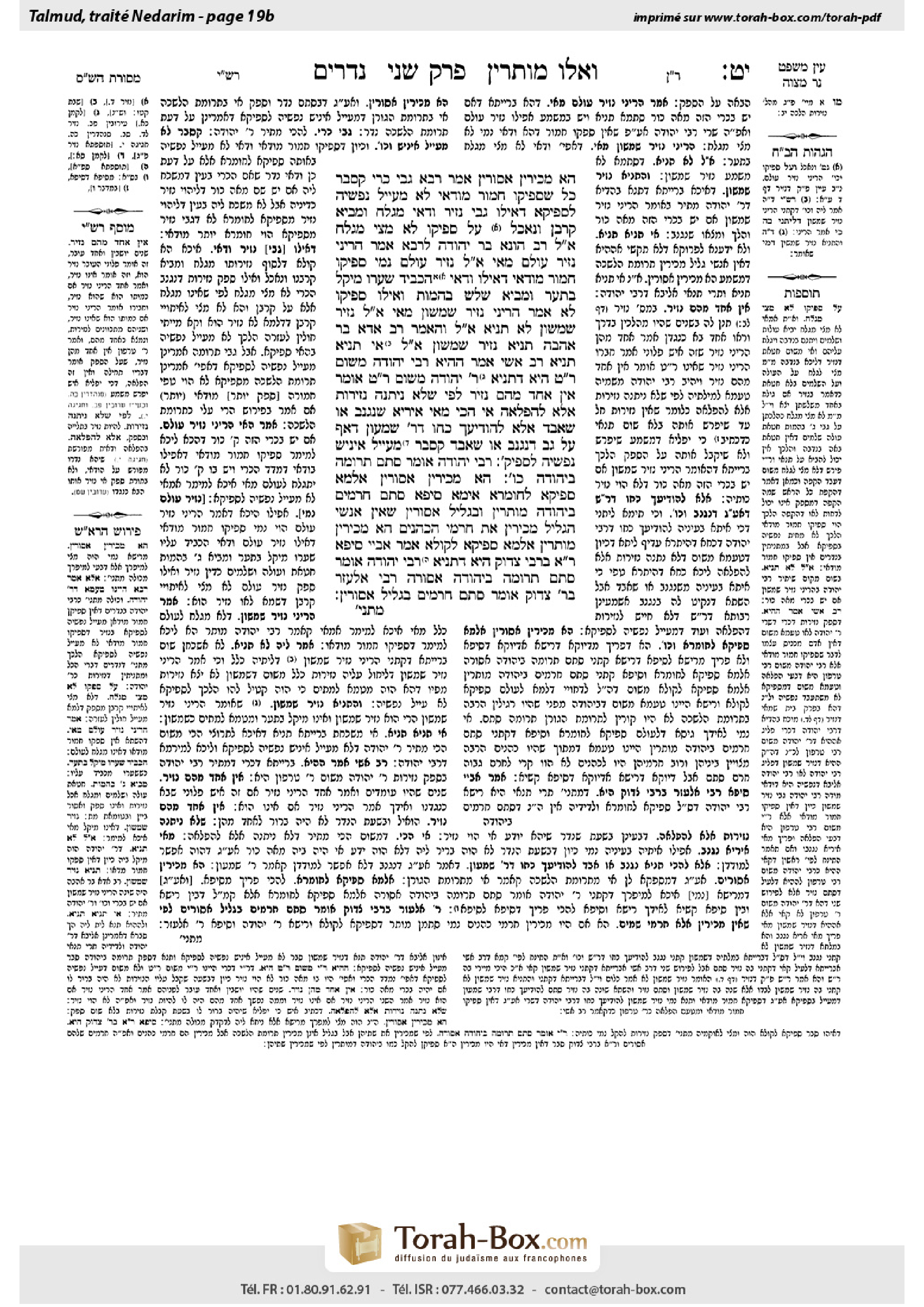
Nedarim 19b: Talmud study for Daf Yomi
Daf Yomi is the daily study of one Talmud folio. Explore 37 tractates with scans, Hebrew text, Sefaria English and AI-generated French translations where annotated.
Passage selection and English or AI-generated French translation are available where the scan has annotations. Daf Study is independent of Torah-Box and Sefaria.
Browse Nedarim · נדרים · All tractatesNedarim 19b text and translations
This page of Nedarim includes the Aramaic text, an English translation and an AI-generated French translation, alongside the scan above.
נדרים י״ט ב · Aramaic and Hebrew text
הָא מַכִּירִין — אֲסוּרִין!
אָמַר רָבָא: גַּבֵּי כְּרִי קָסָבַר כׇּל שֶׁסְּפֵיקוֹ חָמוּר מִוַּדַּאי — לָא מְעַיֵּיל נַפְשֵׁיהּ לִסְפֵיקָא, דְּאִילּוּ גַּבֵּי נָזִיר וַדַּאי, מְגַלֵּחַ וּמֵבִיא קׇרְבָּן וְנֶאֱכָל. עַל סְפֵיקוֹ, לָא מָצֵי מְגַלַּח.
אֲמַר לֵיהּ רַב הוּנָא בַּר יְהוּדָה לְרָבָא: אָמַר ״הֲרֵינִי נְזִיר עוֹלָם״, מַאי?
אֲמַר לֵיהּ: נְזִיר עוֹלָם נָמֵי סְפֵיקוֹ חָמוּר מִוַּדַּאי, דְּאִילּוּ וַדַּאי הִכְבִּיד שְׂעָרוֹ — מֵיקֵל בְּתַעַר, וּמֵבִיא שָׁלוֹשׁ בְּהֵמוֹת. וְאִילּוּ סְפֵיקוֹ — לֹא.
אָמַר ״הֲרֵינִי נְזִיר שִׁמְשׁוֹן״ מַאי?
אֲמַר לֵיהּ: נְזִיר שִׁמְשׁוֹן לָא תַּנְיָא. אֲמַר לֵיהּ: וְהָאָמַר רַב אַדָּא בַּר אַהֲבָה: תַּנְיָא נְזִיר שִׁמְשׁוֹן! אֲמַר לֵיהּ: אִי תַּנְיָא — תַּנְיָא.
רַב אָשֵׁי אָמַר: הָהִיא — רַבִּי יְהוּדָה מִשּׁוּם רַבִּי טַרְפוֹן הִיא. דְּתַנְיָא, רַבִּי יְהוּדָה מִשּׁוּם רַבִּי טַרְפוֹן אוֹמֵר: אֵין אֶחָד מֵהֶם נָזִיר — לְפִי שֶׁלֹּא נִיתְּנָה נְזִירוּת אֶלָּא לְהַפְלָאָה.
אִי הָכִי מַאי אִירְיָא שֶׁנִּגְנַב אוֹ שֶׁאָבַד? אֶלָּא, לְהוֹדִיעֲךָ כֹּחוֹ דְּרַבִּי שִׁמְעוֹן, דְּאַף עַל גַּב דְּנִגְנַב אוֹ שֶׁאָבַד, קָסָבַר מְעַיֵּיל אִינִישׁ נַפְשֵׁיהּ לִסְפֵיקָא.
רַבִּי יְהוּדָה אוֹמֵר: סְתָם תְּרוּמָה בִּיהוּדָה כּוּ׳. הָא מַכִּירִין — אֲסוּרִין, אַלְמָא סְפֵיקָא לְחוּמְרָא.
אֵימָא סֵיפָא: סְתָם חֲרָמִים בִּיהוּדָה — מוּתָּרִין, וּבַגָּלִיל — אֲסוּרִין, שֶׁאֵין אַנְשֵׁי הַגָּלִיל מַכִּירִין אֶת חֶרְמֵי הַכֹּהֲנִים. הָא מַכִּירִין — מוּתָּרִין. אַלְמָא סְפֵיקָא לְקוּלָּא!
אָמַר אַבָּיֵי: סֵיפָא רַבִּי אֶלְעָזָר בְּרַבִּי צָדוֹק הִיא. דְּתַנְיָא, רַבִּי יְהוּדָה אוֹמֵר: סְתַם תְּרוּמָה בִּיהוּדָה — אֲסוּרָה, רַבִּי אֶלְעָזָר בְּרַבִּי צָדוֹק אוֹמֵר: סְתַם חֲרָמִים בַּגָּלִיל — אֲסוּרִין.
Nedarim 19b · English translation
but where they are familiar, it is forbidden, even if the person mentioned teruma without specification, and there is still uncertainty with regard to which teruma he was referring.
Rava said that the contradiction can be resolved as follows: With regard to the case of a vow conditioned on the volume of a heap, Rabbi Yehuda holds that wherever uncertainty is more stringent than certainty, one does not enter himself into a state of uncertainty. Uncertain naziriteship is more stringent than definite naziriteship, as while a definite nazirite has a remedy, i.e., at the end of his naziriteship he shaves his hair and brings an offering and it is eaten, one cannot shave his hair for uncertain naziriteship. He cannot bring an offering in case he is not a nazirite, which would render his offering a non-sacred animal in the Temple courtyard. Since he cannot bring an offering he may not shave.
Rav Huna bar Yehuda said to Rava: According to your answer, that Rabbi Yehuda holds that he is not a nazirite only because uncertain naziriteship is more stringent than definite naziriteship, if one said: If there are a hundred kor in this heap I am hereby a permanent nazirite, what is the halakha? In this case, uncertainty is apparently not more stringent than certainty, as the naziriteship will never end even if it is definite.
Rava said to him: Even with regard to a permanent nazirite, his uncertainty is more stringent than certainty with regard to a different halakha: As when the hair of a definite nazirite is too heavy for him he may lighten the hair with a razor and bring the three animal offerings that a nazirite brings when he has completed his term of naziriteship, before continuing to observe naziriteship; whereas in a case of uncertainty he cannot do so. Since it is not certain that he is a nazirite, he cannot bring these offerings and is therefore prohibited from shaving. Therefore, uncertainty is more stringent than certainty with regard to a permanent nazirite as well.
Rav Huna further asked him: If one said: If there are one hundred kor in this heap, I am hereby a nazirite like Samson (Judges, chapters 13–16), i.e., he would be like Samson, whose permanent naziriteship could not be dissolved and who had no remedy at all, even by bringing offerings, and therefore could never shave, what is the halakha? Uncertainty is definitely not more stringent than certainty in this case.
Rava said to him: The concept of a nazirite like Samson is not taught. It was not mentioned at all by the Sages, as the naziriteship of Samson could not have been created through a vow. It was a one-time, divine order that cannot be emulated. Rav Huna said to him: But didn’t Rav Adda bar Ahava say that the concept of a nazirite like Samson is taught in a baraita, which shows that it takes effect? Rava said to him: If this baraita is taught, it is taught, and I cannot take issue with it. Apparently, Rabbi Yehuda acknowledges that in this case even uncertain naziriteship takes effect.
Rav Ashi said a different resolution to the contradiction between the statements of Rabbi Yehuda. That baraita, in which Rabbi Yehuda treats uncertain naziriteship leniently, is the statement of Rabbi Yehuda in the name of Rabbi Tarfon. As it is taught in a baraita: If a number of people wager on the truth of a statement, and they stipulate that whoever is correct will be a nazirite, Rabbi Yehuda says in the name of Rabbi Tarfon: None of them is a nazirite no matter who is correct, because naziriteship was given to take effect only through explicitness of intent. A vow of naziriteship takes effect only if it is taken unconditionally. Therefore, in the case of the heap, since the speaker was uncertain of its volume at the time the vow of naziriteship was taken, the vow does not take effect.
The Gemara asks: If so, why is it specifically stated that the heap was stolen or that it was lost? Even if it was still present and measured, the naziriteship would not have taken effect as it was conditioned and was not a clear expression. The Gemara answers: Rather, that detail was established to convey the far-reaching nature of the opinion of Rabbi Shimon, that even if it is the case that it was stolen or that it was lost and consequently cannot be measured, nevertheless he holds that a person enters himself into uncertainty, and therefore the vow takes effect.
§ It is stated in the mishna that Rabbi Yehuda says: Unspecified teruma in Judea is forbidden, but in the Galilee it is permitted, as the people of the Galilee are unfamiliar with the collection of the Temple treasury chamber. The Gemara infers: Where they are familiar with the collection of the chamber, it is forbidden. Apparently, uncertainty with regard to vows is treated stringently.
However, say the latter clause of the mishna: Unspecified dedications in Judea are permitted, but in the Galilee they are forbidden, because the people of the Galilee are unfamiliar with dedications allotted to the priests. It may be inferred that where they are familiar with dedications allotted to the priests they are permitted, due to the uncertainty. Apparently, uncertainty with regard to vows is treated leniently.
Abaye said: The latter clause is the opinion of Rabbi Elazar, son of Rabbi Tzadok, not of Rabbi Yehuda, as it is taught in a baraita: Rabbi Yehuda says that unspecified teruma in Judea is forbidden. Rabbi Elazar, son of Rabbi Tzadok, says that unspecified dedications in the Galilee are forbidden.
Nedarim 19b · Traduction française (IA)
Mais là où cette distinction leur est familière, c’est interdit, même si la personne a mentionné la terouma sans préciser laquelle ; il reste alors incertain de quelle terouma elle parlait.
Rava dit que la contradiction peut être résolue ainsi : dans le cas d’un vœu conditionné par le volume d’un tas, Rabbi Yehouda considère que, chaque fois que l’incertitude est plus stricte que la certitude, on ne se met pas soi-même dans une situation d’incertitude. Un naziréat incertain est plus strict qu’un naziréat certain : en effet, un nazir certain dispose d’une issue : à la fin de son naziréat, il se rase les cheveux et apporte une offrande, qui est ensuite consommée. En revanche, on ne peut pas se raser dans le cas d’un naziréat incertain. Il ne peut pas apporter d’offrande, au cas où il ne serait pas nazir, car son offrande deviendrait alors un animal non consacré dans le parvis du Temple. Puisqu’il ne peut pas apporter d’offrande, il ne peut pas se raser.
Rav Houna bar Yehouda dit à Rava : Selon ta réponse, Rabbi Yehouda considère qu’il n’est pas nazir uniquement parce que le naziréat incertain est plus strict que le naziréat certain. Si quelqu’un disait : « S’il y a cent kor dans ce tas, me voici nazir à vie », quelle est la halakha ? Dans ce cas, l’incertitude ne semble pas plus stricte que la certitude, puisque le naziréat ne prendra jamais fin, même s’il est certain.
Rava lui dit : Même pour un nazir à vie, l’incertitude est plus stricte que la certitude au regard d’une autre halakha : lorsqu’un nazir certain trouve ses cheveux trop lourds, il peut les alléger au rasoir et apporter les trois sacrifices animaux qu’un nazir apporte à la fin de son naziréat, avant de poursuivre celui-ci ; dans un cas d’incertitude, il ne peut pas le faire. Puisqu’on ne sait pas avec certitude s’il est nazir, il ne peut pas apporter ces sacrifices et il lui est donc interdit de se raser. Ainsi, même pour un nazir à vie, l’incertitude est plus stricte que la certitude.
Rav Houna lui demanda encore : Si quelqu’un disait : « S’il y a cent kor dans ce tas, me voici nazir comme Samson » (Juges, chapitres 13–16), c’est-à-dire qu’il serait comme Samson, dont le naziréat à vie ne pouvait être annulé et qui ne disposait d’aucune issue, même en apportant des sacrifices, de sorte qu’il ne pouvait jamais se raser, quelle est la halakha ? Dans ce cas, l’incertitude n’est certainement pas plus stricte que la certitude.
Rava lui dit : La notion de nazir comme Samson n’est pas enseignée. Les Sages ne l’ont pas mentionnée du tout, car le naziréat de Samson ne pouvait pas être institué par un vœu. C’était un ordre divin unique, impossible à imiter. Rav Houna lui dit : Mais Rav Adda bar Ahava n’a-t-il pas dit que la notion de nazir comme Samson est enseignée dans une baraïta, ce qui montre qu’elle prend effet ? Rava lui répondit : Si cette baraïta est enseignée, elle l’est, et je ne peux pas la contester. Il apparaît donc que Rabbi Yehouda reconnaît que, dans ce cas, même un naziréat incertain prend effet.
Rav Achi proposa une autre résolution de la contradiction entre les propos de Rabbi Yehouda. Cette baraïta, dans laquelle Rabbi Yehouda traite le naziréat incertain avec indulgence, rapporte les propos de Rabbi Yehouda au nom de Rabbi Tarfon. En effet, il est enseigné dans une baraïta : si plusieurs personnes parient sur la véracité d’une affirmation et conviennent que celui qui aura raison sera nazir, Rabbi Yehouda dit au nom de Rabbi Tarfon : aucun d’eux n’est nazir, quel que soit celui qui aura raison, car le naziréat ne prend effet que si l’intention est explicite. Un vœu de naziréat ne prend effet que s’il est formulé sans condition. Par conséquent, dans le cas du tas, puisque celui qui a parlé ignorait son volume au moment où il a prononcé le vœu de naziréat, celui-ci ne prend pas effet.
La Guemara demande : Si c’est ainsi, pourquoi préciser que le tas a été volé ou perdu ? Même s’il était toujours là et avait été mesuré, le naziréat n’aurait pas pris effet, puisqu’il était conditionnel et que l’expression n’était pas explicite. La Guemara répond : cette précision visait plutôt à faire ressortir toute la portée de l’opinion de Rabbi Shimon : même si le tas a été volé ou perdu et ne peut donc pas être mesuré, il considère néanmoins qu’une personne se met elle-même dans une situation d’incertitude, et le vœu prend donc effet.
§ Il est dit dans la Michna que Rabbi Yehouda affirme : la terouma non précisée est interdite en Judée, mais permise en Galilée, car les habitants de Galilée ne connaissent pas les prélèvements destinés au trésor du Temple. La Guemara en déduit que là où ils connaissent les prélèvements destinés au trésor, c’est interdit. Il semble donc que l’incertitude relative aux vœux soit traitée avec rigueur.
Cependant, examinons la dernière partie de la Michna : les consécrations non précisées sont permises en Judée, mais interdites en Galilée, car les habitants de Galilée ne connaissent pas les consécrations destinées aux prêtres. On peut en déduire que là où ils connaissent ces consécrations, elles sont permises en raison de l’incertitude. Il semble donc que l’incertitude relative aux vœux soit traitée avec indulgence.
Abayé dit : la dernière partie exprime l’opinion de Rabbi Elazar, fils de Rabbi Tsadok, et non celle de Rabbi Yehouda, car il est enseigné dans une baraïta : Rabbi Yehouda dit que la terouma non précisée est interdite en Judée. Rabbi Elazar, fils de Rabbi Tsadok, dit que les consécrations non précisées sont interdites en Galilée.
Traduction française générée par IA à partir de l’édition anglaise de Sefaria. Vérifie toujours un passage avec le texte source.
Text from Sefaria: William Davidson Edition - Vocalized Aramaic (CC BY NC); William Davidson Edition - English (CC BY NC).