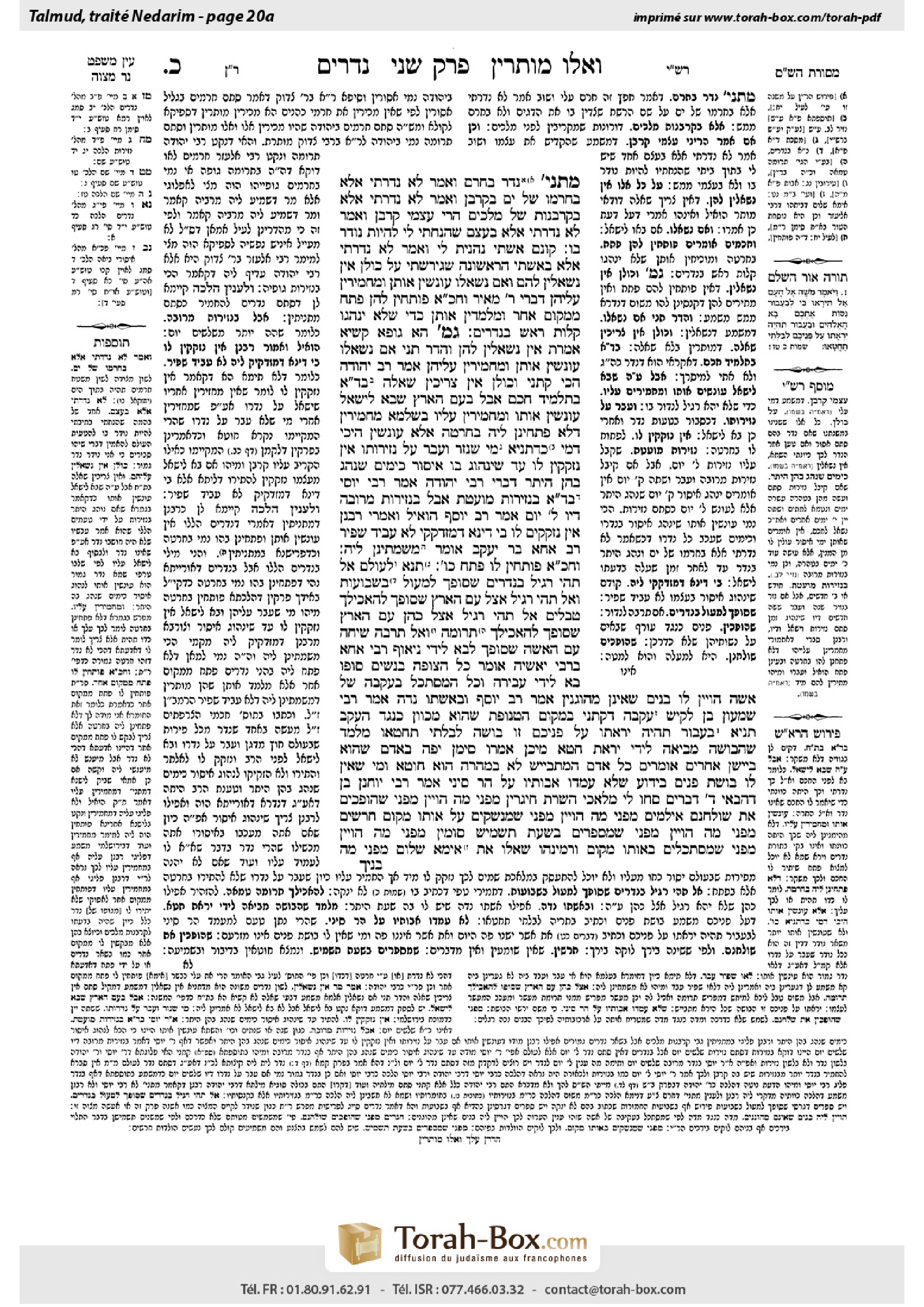
Nedarim 20a: Talmud study for Daf Yomi
Daf Yomi is the daily study of one Talmud folio. Explore 37 tractates with scans, Hebrew text, Sefaria English and AI-generated French translations where annotated.
Passage selection and English or AI-generated French translation are available where the scan has annotations. Daf Study is independent of Torah-Box and Sefaria.
Browse Nedarim · נדרים · All tractatesNedarim 20a text and translations
This page of Nedarim includes the Aramaic text, an English translation and an AI-generated French translation, alongside the scan above.
נדרים כ׳ א · Aramaic and Hebrew text
מַתְנִי׳ נָדַר בְּחֵרֶם, וְאָמַר: לֹא נָדַרְתִּי אֶלָּא בְּחֶרְמוֹ שֶׁל יָם. בְּקׇרְבָּן, וְאָמַר: לֹא נָדַרְתִּי אֶלָּא בְּקׇרְבָּנוֹת שֶׁל מְלָכִים.
״הֲרֵי עַצְמִי קׇרְבָּן״, וְאָמַר: לֹא נָדַרְתִּי אֶלָּא בְּעֶצֶם שֶׁהִנַּחְתִּי לִי לִהְיוֹת נוֹדֵר בּוֹ, ״קֻוֽנָּם אִשְׁתִּי נֶהֱנֵית לִי״, וְאָמַר: לֹא נָדַרְתִּי אֶלָּא בְּאִשְׁתִּי הָרִאשׁוֹנָה שֶׁגֵּירַשְׁתִּי —
עַל כּוּלָּן אֵין נִשְׁאָלִין לָהֶם. וְאִם נִשְׁאֲלוּ — עוֹנְשִׁין אוֹתָן וּמַחְמִירִין עֲלֵיהֶן. דִּבְרֵי רַבִּי מֵאִיר.
וַחֲכָמִים אוֹמְרִים: פּוֹתְחִין לָהֶן פֶּתַח מִמָּקוֹם אַחֵר, וּמְלַמְּדִין אוֹתָן — כְּדֵי שֶׁלֹּא יִנְהֲגוּ קַלּוּת רֹאשׁ בִּנְדָרִים.
גְּמָ׳ הָא גּוּפָא קַשְׁיָא, אָמְרַתְּ: אֵין נִשְׁאָלִין לָהֶן, וַהֲדַר תָּנֵי: אִם נִשְׁאֲלוּ עוֹנְשִׁין אוֹתָן וּמַחְמִירִין עֲלֵיהֶן?
אָמַר רַב יְהוּדָה, הָכִי קָתָנֵי: וְכוּלָּן אֵין צְרִיכִין שְׁאֵלָה, בַּמֶּה דְּבָרִים אֲמוּרִים — בְּתַלְמִיד חָכָם, אֲבָל בְּעַם הָאָרֶץ שֶׁבָּא לִישָּׁאֵל — עוֹנְשִׁין אוֹתוֹ וּמַחְמִירִין עָלָיו.
בִּשְׁלָמָא מַחְמִירִין — דְּלָא פָּתְחִינַן לֵיהּ בַּחֲרָטָה, אֶלָּא עוֹנְשִׁין הֵיכִי דָּמֵי?
כִּדְתַנְיָא: מִי שֶׁנָּזַר וְעָבַר עַל נְזִירוּתוֹ — אֵין נִזְקָקִין לוֹ עַד שֶׁיִּנְהוֹג בּוֹ אִיסּוּר כַּיָּמִים שֶׁנָּהַג בָּהֶן הֶיתֵּר. דִּבְרֵי רַבִּי יְהוּדָה. אָמַר רַבִּי יוֹסֵי: בַּמֶּה דְּבָרִים אֲמוּרִים — בִּנְזִירוּת מוּעֶטֶת. אֲבָל בִּנְזִירוּת מְרוּבָּה — דַּיּוֹ שְׁלֹשִׁים יוֹם.
אָמַר רַב יוֹסֵף: הוֹאִיל וְאָמְרִי רַבָּנַן אֵין נִזְקָקִים לוֹ, בֵּי דִינָא דְּמִזְדַּקְקִי לָא עָבֵיד שַׁפִּיר. רַב אַחָא בַּר יַעֲקֹב אוֹמֵר: מְשַׁמְּתִינַן לֵיהּ.
וַחֲכָמִים אוֹמְרִים פּוֹתְחִין לוֹ פֶּתַח כּוּ׳. תָּנָא: לְעוֹלָם אַל תְּהִי רָגִיל בַּנְּדָרִים, שֶׁסּוֹפְךָ לִמְעוֹל בִּשְׁבוּעוֹת. וְאַל תְּהִי רָגִיל אֵצֶל עַם הָאָרֶץ, שֶׁסּוֹפְךָ לְהַאֲכִילְךָ טְבָלִים. אַל תְּהִי רָגִיל אֵצֶל כֹּהֵן עַם הָאָרֶץ, שֶׁסּוֹפְךָ לְהַאֲכִילְךָ תְּרוּמָה. וְאַל תַּרְבֶּה שִׂיחָה עִם הָאִשָּׁה, שֶׁסּוֹפְךָ לָבוֹא לִידֵי נִיאוּף.
רַבִּי אַחָא בְּרַבִּי יֹאשִׁיָּה אוֹמֵר: כׇּל הַצּוֹפֶה בְּנָשִׁים, סוֹפוֹ בָּא לִידֵי עֲבֵירָה. וְכׇל הַמִּסְתַּכֵּל בַּעֲקֵבָהּ שֶׁל אִשָּׁה, הָוְיִין לוֹ בָּנִים שֶׁאֵינָן מְהוּגָּנִין. אָמַר רַב יוֹסֵף: וּבְאִשְׁתּוֹ נִדָּה. אָמַר רַבִּי שִׁמְעוֹן בֶּן לָקִישׁ: עֲקֵבָהּ דְּקָתָנֵי, בִּמְקוֹם הַטִּנּוֹפֶת, שֶׁהוּא מְכֻוּוֹן כְּנֶגֶד הֶעָקֵב.
תַּנְיָא: ״בַּעֲבוּר תִּהְיֶה יִרְאָתוֹ עַל פְּנֵיכֶם״ — זוֹ בּוּשָׁה. ״לְבִלְתִּי תֶחֱטָאוּ״ — מְלַמֵּד שֶׁהַבּוּשָׁה מְבִיאָה לִידֵי יִרְאַת חֵטְא. מִיכָּן אָמְרוּ: סִימָן יָפֶה בְּאָדָם שֶׁהוּא בַּיְישָׁן. אֲחֵרִים אוֹמְרִים: כׇּל אָדָם הַמִּתְבַּיֵּישׁ, לֹא בִּמְהֵרָה הוּא חוֹטֵא. וּמִי שֶׁאֵין לוֹ בּוֹשֶׁת פָּנִים — בְּיָדוּעַ שֶׁלֹּא עָמְדוּ אֲבוֹתָיו עַל הַר סִינַי.
אָמַר רַבִּי יוֹחָנָן בֶּן דַּהֲבַאי, אַרְבָּעָה דְּבָרִים סָחוּ לִי מַלְאֲכֵי הַשָּׁרֵת: חִיגְּרִין מִפְּנֵי מָה הָוְיִין — מִפְּנֵי שֶׁהוֹפְכִים אֶת שׁוּלְחָנָם. אִילְּמִים מִפְּנֵי מָה הָוְיִין — מִפְּנֵי שֶׁמְּנַשְּׁקִים עַל אוֹתוֹ מָקוֹם. חֵרְשִׁים מִפְּנֵי מָה הָוְיִין — מִפְּנֵי שֶׁמְסַפְּרִים בִּשְׁעַת תַּשְׁמִישׁ. סוֹמִין מִפְּנֵי מָה הָוְיִין — מִפְּנֵי שֶׁמִּסְתַּכְּלִים בְּאוֹתוֹ מָקוֹם.
וּרְמִינְהוּ, שָׁאֲלוּ אֶת אִימָּא שָׁלוֹם: מִפְּנֵי מָה
Nedarim 20a · English translation
MISHNA: One who took a vow by associating an item with a dedication [ḥerem], saying: This item is hereby forbidden to me like an item dedicated to the Temple, and then said: I took a vow only with the intention that it would be like a sea net [ḥermo shel yam] that is used to catch fish; or one who took a vow by associating an item with an offering, and then said: I took a vow only with reference to offerings to kings, i.e., a gift for a king, not an offering to God.
Or one who said: I am hereby an offering myself [atzmi], and then said: I took a vow only with reference to a bone [etzem] that I set aside for myself to vow with, as atzmi means both myself and my bone, i.e., he set aside a bone so as to pretend to take a vow upon himself; or one who said: Deriving benefit from me is konam for my wife, and then said: I took a vow only with regard to my first wife whom I divorced, not with regard to my current wife.
For all of the above vows, those who took them do not need to request of a halakhic authority to dissolve them, as the speaker interpreted the vows in a manner that caused them not to take effect at all. However, if they requested dissolution, apparently due to their being uncertain of their explanations, the court punishes them and treats them stringently and the vows are not dissolved. This is the statement of Rabbi Meir.
And the Rabbis say: These vows are not treated stringently. Rather, dissolution is broached with them by suggesting a different extenuation, i.e., the halakhic authority suggests extenuating circumstances that undermine the vow but do not pertain to its wording. And we teach them that they should not take this kind of vow in the future, in order that they will not take vows lightly.
GEMARA: This matter is itself difficult. On the one hand, you said they do not need to request to dissolve them, and then it is taught that if they requested dissolution, the court punishes them and treats them stringently, i.e., the vows took effect and the vows are not dissolved.
Rav Yehuda said that this is what the mishna is teaching: All of these vows do not need a request. However, in what case is this statement said? In the case of a Torah scholar, who knows that these vows do not take effect, and he obviously did not intend for them to take effect in the first place. However, in the case of an ignoramus who comes to request dissolution of the vow, the court punishes him and treats him stringently.
The Gemara asks: Granted, the court treats him stringently in that the halakhic authorities do not broach dissolution with him merely by means of regret; rather, extenuating circumstances must be found. However, what are the circumstances in which the court punishes him?
The Gemara answers that the circumstances are as it is taught in a baraita: With regard to one who vowed to be a nazirite and violated his naziriteship, the halakhic authority does not attend to him to dissolve his vow until he observes the prohibitions of naziriteship for the same number of days in which he behaved with permissiveness concerning the restrictions of a nazirite. This is the statement of Rabbi Yehuda. Rabbi Yosei said: In what case is this statement, that he must observe naziriteship for a period of time corresponding to his vow, said? It is said in the case of a short term of naziriteship, which is not longer than the minimum thirty days. However, in the case of a long term of naziriteship it is enough for him to observe it for thirty days, even if he violated it for a greater number of days. This explains the punishment mentioned in the mishna: An ignoramus who requests the dissolution of his vow must first observe the vow for a certain period of time.
Rav Yosef said: Since the Sages say that the halakhic authority does not attend to him, a court that does attend to him and dissolves his vow immediately is not acting properly. Rav Aḥa bar Yaakov says: A halakhic authority who dissolves the vow prematurely is excommunicated.
§ It is stated in the mishna that the Rabbis say: Dissolution is broached with him by suggesting a different extenuation, and he is taught not to take this kind of vow so that he will not take vows lightly. It is taught in a baraita: Never be accustomed to taking vows, because ultimately you will disregard them, and you will even abuse oaths, which are more grave. And do not regularly be around an ignoramus, because ultimately he will feed you untithed produce, as he is not careful to tithe. Do not regularly be by an ignorant priest, because ultimately he will feed you teruma due to his close relationship with you, and teruma is forbidden to a non-priest. And do not talk extensively with a woman, because ultimately you will come to adultery.
Rabbi Aḥa, son of Rabbi Yoshiya, says: Anyone who watches women will ultimately come to sin, and anyone who looks at the heel of a woman will have indecent children as a punishment. Rav Yosef said: And this relates to all women, including his wife when she has the status of a menstruating woman. Rabbi Shimon ben Lakish said: The heel of a woman that is mentioned is not the heel of the foot, but the place of uncleanliness, i.e., the genitalia, and it is called a heel as a euphemism, as it is situated opposite the heel.
§ It is taught in a baraita: “That His fear may be upon your faces” (Exodus 20:17); this is referring to shame, as shame causes one to blush. “That you not sin” (Exodus 20:17) teaches that shame leads to fear of sin. From here the Sages said: It is a good sign in a person that he is one who experiences shame. Others say: Any person who experiences shame will not quickly sin, and conversely, one who does not have the capacity to be shamefaced, it is known that his forefathers did not stand at Mount Sinai.
§ Rabbi Yoḥanan ben Dehavai said: The ministering angels told me four matters: For what reason do lame people come into existence? It is because their fathers overturn their tables, i.e., they engage in sexual intercourse in an atypical way. For what reason do mute people come into existence? It is because their fathers kiss that place of nakedness. For what reason do deaf people come into existence? It is because their parents converse while engaging in sexual intercourse. For what reason do blind people come into existence? It is because their fathers stare at that place.
And the Gemara raises a contradiction: Imma Shalom, the wife of Rabbi Eliezer ben Hyrcanus, was asked: For what reason
Nedarim 20a · Traduction française (IA)
MICHNA : Celui qui a fait un vœu en comparant un objet à une chose vouée [ḥerem], en disant : « Cet objet m’est désormais interdit comme une chose vouée au Temple », puis a déclaré : « Je n’ai fait ce vœu qu’en voulant qu’il soit comme un filet de pêche [ḥermo shel yam], utilisé pour attraper des poissons » ; ou celui qui a fait un vœu en comparant un objet à une offrande, puis a déclaré : « Je n’ai fait ce vœu qu’en référence aux offrandes destinées aux rois », c’est-à-dire un présent pour un roi, et non une offrande à Dieu.
Ou celui qui a dit : « Je suis désormais une offrande », en parlant de lui-même [atzmi], puis a déclaré : « Je n’ai fait ce vœu qu’en référence à un os [etzem] que j’avais mis de côté pour moi afin de faire un vœu », car atzmi signifie à la fois « moi-même » et « mon os » ; autrement dit, il avait mis un os de côté pour faire semblant de faire un vœu sur lui-même. Ou celui qui a dit : « Tirer profit de moi est konam pour ma femme », puis a déclaré : « Je n’ai fait ce vœu qu’au sujet de ma première épouse, dont j’ai divorcé, et non au sujet de mon épouse actuelle ».
Pour tous les vœux susmentionnés, ceux qui les ont prononcés n’ont pas besoin de demander à une autorité halakhique de les délier, car le locuteur les a interprétés d’une manière qui les empêche de prendre effet. Toutefois, s’ils ont demandé à les délier, apparemment parce qu’ils doutaient de leurs propres explications, le tribunal les punit et se montre rigoureux à leur égard : les vœux ne sont pas déliés. Telle est l’opinion de Rabbi Meïr.
Et les Sages disent : On ne se montre pas rigoureux à propos de ces vœux. Au contraire, on amorce leur dissolution en proposant un autre motif d’exemption, c’est-à-dire que l’autorité halakhique suggère des circonstances atténuantes qui invalident le vœu sans concerner sa formulation. Et on leur enseigne de ne pas faire ce genre de vœu à l’avenir, afin qu’ils ne prennent pas les vœux à la légère.
GUEMARA : Cette question est en elle-même difficile. D’une part, on a dit qu’ils n’ont pas besoin de demander à faire délier leurs vœux ; puis il est enseigné que, s’ils ont demandé à les faire délier, le tribunal les punit et se montre rigoureux à leur égard, c’est-à-dire que les vœux ont pris effet et ne sont pas déliés.
Rav Yehouda dit que voici ce qu’enseigne la Michna : Aucun de ces vœux ne nécessite de demande. Mais dans quel cas cette règle s’applique-t-elle ? Dans le cas d’un érudit en Torah, qui sait que ces vœux ne prennent pas effet et n’avait manifestement pas l’intention qu’ils prennent effet dès le départ. En revanche, dans le cas d’un ignorant qui vient demander la dissolution de son vœu, le tribunal le punit et se montre rigoureux à son égard.
La Guemara demande : Il est compréhensible que le tribunal se montre rigoureux à son égard en ce que les autorités halakhiques n’amorcent pas la dissolution en se fondant uniquement sur le regret ; il faut plutôt trouver des circonstances atténuantes. Mais en quoi consiste la punition que lui inflige le tribunal ?
La Guemara répond que la situation est celle décrite dans une baraïta : Si quelqu’un a fait le vœu d’être nazir et a transgressé les règles de son naziréat, l’autorité halakhique ne s’occupe pas de délier son vœu avant qu’il ait observé les interdictions du naziréat pendant autant de jours qu’il s’est permis d’enfreindre les restrictions. Telle est l’opinion de Rabbi Yehouda. Rabbi Yossi dit : Dans quel cas cette règle, selon laquelle il doit observer le naziréat pendant une période correspondant à la durée de son vœu, s’applique-t-elle ? Elle s’applique à une période courte de naziréat, qui ne dépasse pas la durée minimale de trente jours. En revanche, dans le cas d’une longue période de naziréat, il suffit qu’il l’observe pendant trente jours, même s’il l’a transgressée pendant un plus grand nombre de jours. Cela explique la punition mentionnée dans la Michna : un ignorant qui demande la dissolution de son vœu doit d’abord l’observer pendant un certain temps.
Rav Yossef dit : Puisque les Sages disent que l’autorité halakhique ne s’occupe pas de lui, un tribunal qui s’en occupe et dissout immédiatement son vœu n’agit pas comme il convient. Rav Aḥa bar Yaakov dit : Une autorité halakhique qui dissout le vœu prématurément est mise au ban.
§ La Michna rapporte que les Sages disent : On amorce la dissolution de son vœu en lui suggérant un autre motif d’exemption, et on lui enseigne de ne pas faire ce genre de vœu, afin qu’il ne prenne pas les vœux à la légère. Une baraïta enseigne : Ne prenez jamais l’habitude de faire des vœux, car vous finirez par les négliger et vous en viendrez même à abuser des serments, qui sont plus graves. Ne fréquentez pas régulièrement un ignorant, car vous finirez par manger des produits dont les dîmes n’ont pas été prélevées, puisqu’il ne veille pas à prélever la dîme. Ne fréquentez pas régulièrement un prêtre ignorant, car il finira par vous donner de la terouma en raison de ses liens étroits avec vous, alors que la terouma est interdite à celui qui n’est pas prêtre. Et ne conversez pas longuement avec une femme, car vous finirez par commettre l’adultère.
Rabbi Aḥa, fils de Rabbi Yoshiya, dit : Quiconque regarde les femmes finira par pécher, et quiconque regarde le talon d’une femme aura, en punition, des enfants dépravés. Rav Yossef dit : Cela concerne toutes les femmes, y compris sa propre épouse lorsqu’elle est en état de menstruation. Rabbi Shimon ben Lakish dit : Le « talon » d’une femme dont il est question n’est pas le talon du pied, mais l’endroit impur, c’est-à-dire les organes génitaux. On l’appelle « talon » par euphémisme, car il se trouve en face du talon.
§ Une baraïta enseigne : « Afin que sa crainte soit sur vos visages » (Exode 20:17) fait référence à la honte, car celle-ci fait rougir. « Afin que vous ne péchiez pas » (Exode 20:17) enseigne que la honte conduit à la crainte du péché. De là, les Sages ont dit : C’est bon signe chez une personne qu’elle éprouve de la honte. D’autres disent : Toute personne qui éprouve de la honte ne pèchera pas facilement ; inversement, on sait que les ancêtres de celui qui est incapable d’éprouver de la honte ne se tenaient pas au mont Sinaï.
§ Rabbi Yoḥanan ben Dehavai dit : Les anges de service m’ont rapporté quatre choses : Pourquoi naît-il des boiteux ? Parce que leurs pères renversent leurs tables, c’est-à-dire qu’ils ont des rapports sexuels d’une manière inhabituelle. Pourquoi naît-il des muets ? Parce que leurs pères embrassent cet endroit de nudité. Pourquoi naît-il des sourds ? Parce que leurs parents conversent pendant leurs rapports sexuels. Pourquoi naît-il des aveugles ? Parce que leurs pères fixent cet endroit du regard.
Et la Guemara soulève une contradiction : Imma Shalom, l’épouse de Rabbi Eliezer ben Hyrcanus, fut interrogée : « Pour quelle raison
Traduction française générée par IA à partir de l’édition anglaise de Sefaria. Vérifie toujours un passage avec le texte source.
Text from Sefaria: William Davidson Edition - Vocalized Aramaic (CC BY NC); William Davidson Edition - English (CC BY NC).