Nedarim 20b: Talmud study for Daf Yomi
Daf Yomi is the daily study of one Talmud folio. Explore 37 tractates with scans, Hebrew text, Sefaria English and AI-generated French translations where annotated.
Passage selection and English or AI-generated French translation are available where the scan has annotations. Daf Study is independent of Torah-Box and Sefaria.
Browse Nedarim · נדרים · All tractatesNedarim 20b text and translations
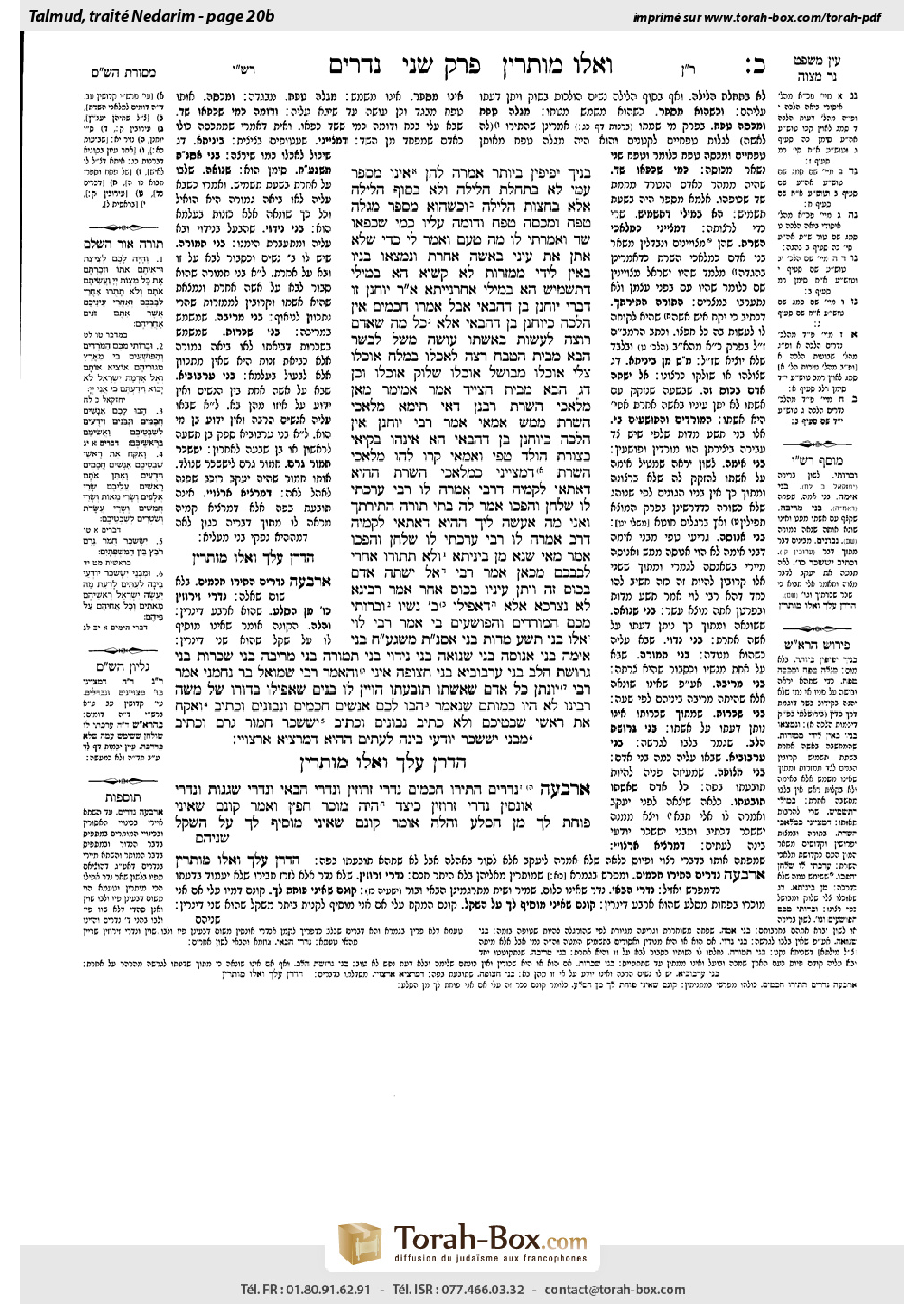
This page of Nedarim includes the Aramaic text, an English translation and an AI-generated French translation, alongside the scan above.
נדרים כ׳ ב · Aramaic and Hebrew text
בָּנַיִךְ יְפֵיפִין בְּיוֹתֵר? אָמְרָה לָהֶן: אֵינוֹ מְסַפֵּר עִמִּי לֹא בִּתְחִלַּת הַלַּיְלָה, וְלֹא בְּסוֹף הַלַּיְלָה, אֶלָּא בַּחֲצוֹת הַלַּיְלָה. וּכְשֶׁהוּא מְסַפֵּר, מְגַלֶּה טֶפַח וּמְכַסֶּה טֶפַח, וְדוֹמֶה עָלָיו כְּמִי שֶׁכְּפָאוֹ שֵׁד.
וְאָמַרְתִּי לוֹ: מָה טַעַם? וְאָמַר לִי: כְּדֵי שֶׁלֹּא אֶתֵּן אֶת עֵינַי בְּאִשָּׁה אַחֶרֶת, וְנִמְצְאוּ בָּנָיו בָּאִין לִידֵי מַמְזֵרוּת.
לָא קַשְׁיָא: הָא — בְּמִילֵּי דְתַשְׁמִישׁ, הָא — בְּמִילֵּי אַחְרָנְיָיתָא.
אָמַר רַבִּי יוֹחָנָן: זוֹ דִּבְרֵי יוֹחָנָן בֶּן דַּהֲבַאי, אֲבָל אָמְרוּ חֲכָמִים: אֵין הֲלָכָה כְּיוֹחָנָן בֶּן דַּהֲבַאי, אֶלָּא כֹּל מַה שֶּׁאָדָם רוֹצֶה לַעֲשׂוֹת בְּאִשְׁתּוֹ — עוֹשֶׂה. מָשָׁל לְבָשָׂר הַבָּא מִבֵּית הַטַּבָּח, רָצָה לְאׇכְלוֹ בְּמֶלַח — אוֹכְלוֹ. צָלִי — אוֹכְלוֹ. מְבוּשָּׁל — אוֹכְלוֹ. שָׁלוּק — אוֹכְלוֹ. וְכֵן דָּג הַבָּא מִבֵּית הַצַּיָּיד.
אָמַר אַמֵּימָר: מַאן מַלְאֲכֵי הַשָּׁרֵת — רַבָּנַן, דְּאִי תֵּימָא מַלְאֲכֵי הַשָּׁרֵת מַמָּשׁ, אַמַּאי אָמַר רַבִּי יוֹחָנָן אֵין הֲלָכָה כְּיוֹחָנָן בֶּן דַּהֲבַאי? הָא אִינְהוּ בְּקִיאִי בְּצוּרַת הַוָּלָד טְפֵי! וְאַמַּאי קָרוּ לְהוּ מַלְאֲכֵי הַשָּׁרֵת — דִּמְצַיְּינִי כְּמַלְאֲכֵי הַשָּׁרֵת.
הַהִיא דַּאֲתַאי לְקַמֵּיהּ דְּרַבִּי, אָמְרָה לוֹ: רַבִּי, עָרַכְתִּי לוֹ שׁוּלְחָן וַהֲפָכוֹ! אֲמַר לָהּ: בִּתִּי, תּוֹרָה הִתִּירָתֶךְ, וַאֲנִי מָה אֶעֱשֶׂה לִיךְ? הָהִיא דַּאֲתַאי לְקַמֵּיהּ דְּרַב, אָמְרָה לוֹ: רַבִּי, עָרַכְתִּי לוֹ שׁוּלְחָן וַהֲפָכוֹ! אָמַר: מַאי שְׁנָא מִן בִּינִיתָא?
״וְלֹא תָתוּרוּ אַחֲרֵי לְבַבְכֶם״, מִכָּאן אָמַר רַבִּי: אַל יִשְׁתֶּה אָדָם בְּכוֹס זֶה וְיִתֵּן עֵינָיו בְּכוֹס אַחֵר. אָמַר רָבִינָא: לֹא נִצְרְכָא, אֶלָּא דַּאֲפִילּוּ שְׁתֵּי נָשָׁיו.
״וּבָרוֹתִי מִכֶּם הַמֹּרְדִים וְהַפּוֹשְׁעִים בִּי״, אָמַר רַבִּי לֵוִי: אֵלּוּ בְּנֵי תֵּשַׁע מִדּוֹת, בְּנֵי אׇסְנַ״ת משגע״ח.
בְּנֵי אֵימָה, בְּנֵי אֲנוּסָה, בְּנֵי שְׂנוּאָה, בְּנֵי נִידּוּי, בְּנֵי תְמוּרָה, בְּנֵי מְרִיבָה, בְּנֵי שִׁכְרוּת, בְּנֵי גְּרוּשַׁת הַלֵּב, בְּנֵי עִרְבּוּבְיָא, בְּנֵי חֲצוּפָה.
אִינִי? וְהָאָמַר רַבִּי שְׁמוּאֵל בַּר נַחְמָנִי אָמַר רַבִּי יוֹנָתָן: כׇּל אָדָם שֶׁאִשְׁתּוֹ תּוֹבַעְתּוֹ — הָוְיִין לוֹ בָּנִים שֶׁאֲפִילּוּ בְּדוֹרוֹ שֶׁל מֹשֶׁה רַבֵּינוּ לֹא הָיוּ כְּמוֹתָם. שֶׁנֶּאֱמַר: ״הָבוּ לָכֶם אֲנָשִׁים חֲכָמִים וּנְבֹנִים״, וּכְתִיב: ״וָאֶקַּח אֶת רָאשֵׁי שִׁבְטֵיכֶם״, וְלָא כְּתִיב ״נְבוֹנִים״.
וּכְתִיב ״יִשָּׂשכָר חֲמֹר גָּרֶם״, וּכְתִיב: ״מִבְּנֵי יִשָּׂשכָר יוֹדְעֵי בִינָה לַעִתִּים״!
הַהִיא דְּמַרְצְיָא אַרְצוֹיֵי.
הֲדַרַן עֲלָךְ וְאֵלּוּ מוּתָּרִין
אַרְבָּעָה נְדָרִים הִתִּירוּ חֲכָמִים: נִדְרֵי זֵרוּזִין, וְנִדְרֵי הֲבַאי, וְנִדְרֵי שְׁגָגוֹת, וְנִדְרֵי אוֹנָסִין. נִדְרֵי זֵרוּזִין כֵּיצַד? הָיָה מוֹכֵר חֵפֶץ, וְאָמַר: ״קֻוֽנָּם שֶׁאֵינִי פּוֹחֵת לְךָ מִן הַסֶּלַע״, וְהַלָּה אוֹמֵר: ״קֻוֽנָּם שֶׁאֵינִי מוֹסִיף לָךְ עַל הַשֶּׁקֶל״,
Nedarim 20b · English translation
are your children so beautiful? She said to them: My husband does not converse with me while engaging in sexual intercourse, neither at the beginning of the night nor at the end of the night, but rather at midnight. And when he converses with me while engaging in sexual intercourse, he reveals a handbreadth of my body and covers a handbreadth, and he covers himself up as though he were being coerced by a demon and is covering himself out of fear.
And I said to my husband: What is the reason for this behavior? And he said to me: It is so that I will not set my eyes on another woman, i.e., think about another woman; if a man thinks about another woman during sexual intercourse with his wife, his children consequently come close to receiving a mamzer status, i.e., the nature of their souls is tantamount to that of a mamzer. Therefore I engage in sexual intercourse with you at an hour when there are no people in the street, and in this manner. In any event, it can be seen from her words that a Sage conversed with his wife while engaging in sexual intercourse with her.
The Gemara answers: This is not difficult. This permission to converse with her is with regard to matters of sexual intercourse, whereas that restriction of conversation is with regard to other matters that are not related to sexual intercourse.
Rabbi Yoḥanan said: That is the statement of Yoḥanan ben Dehavai. However, the Rabbis said: The halakha is not in accordance with the opinion of Yoḥanan ben Dehavai. Rather, whatever a man wishes to do with his wife he may do. He may engage in sexual intercourse with her in any manner that he wishes, and need not concern himself with these restrictions. As an allegory, it is like meat that comes from the butcher. If he wants to eat it with salt, he may eat it that way. If he wants to eat it roasted, he may eat it roasted. If he wants to eat it cooked, he may eat it cooked. If he wants to eat it boiled, he may eat it boiled. And likewise with regard to fish that come from the fisherman.
Ameimar said: Who are the ministering angels that Rabbi Yoḥanan ben Dehavai mentioned? He was referring to the Sages, for whom he employed the honorary title: Ministering angels. Because if you say that he was referring to actual ministering angels, why did Rabbi Yoḥanan say that the halakha is not in accordance with the opinion of Yoḥanan ben Dehavai? The ministering angels are more knowledgeable about the forming of the fetus than people are. Clearly, if the ministering angels were the source for the ruling of Rabbi Yoḥanan ben Dehavai it would have been imperative to heed his instructions. And why are the Sages called ministering angels? Because they stand out like ministering angels, as they are recognized by their clothing.
The Gemara relates: A certain woman, who came before Rabbi Yehuda HaNasi to complain about her husband, said to him: My teacher, I set him a table, using a euphemism to say that she lay before him during intimacy, and he turned it over. Rabbi Yehuda HaNasi said to her: My daughter, the Torah permitted him to engage in sexual intercourse with you even in an atypical manner, and what can I do for you if he does so? Similarly, a certain woman who came before Rav said to him: My teacher, I set a table for him and he turned it over. He said to her: In what way is this case different from a fish [binnita] that one may eat any way he wishes?
§ The verse states: “And that you not go about after your own heart” (Numbers 15:39). Rabbi Yehuda HaNasi said that it is derived from here that a man should not drink from this cup while setting his eyes on another cup, i.e., one should not engage in sexual intercourse with one woman while thinking about another woman. Ravina said: This statement is not necessary with regard to an unrelated woman. Rather, it is necessary only to state that even with regard to his own two wives, he should not engage in sexual intercourse with one while thinking about the other.
The verse states: “And I will purge out from among you the rebels, and those that transgress against Me” (Ezekiel 20:38). Rabbi Levi said: These are children of those who have nine traits, who are defective from their conception and from whom rebels and transgressors emerge. The mnemonic for these nine traits is children of the acronym aleph, samekh, nun, tav, mem, shin, gimmel, ayin, ḥet.
The children of nine traits are as follows: Children of fear [eima], i.e., where the wife was afraid of her husband and engaged in sexual intercourse with him out of fear; children of a woman who was raped [anusa]; children of a hated woman [senua], i.e., a woman who was hated by her husband; children of ostracism [niddui], i.e., one of the parents was ostracized by the court; children of substitution [temura], i.e., while engaging in intercourse with the woman, the man thought that she was another woman; children of strife [meriva], i.e., the parents engaged in intercourse while they were quarreling; children of drunkenness [shikhrut], i.e., the parents engaged in intercourse while they were drunk; children of a woman who was divorced in the heart [gerushat halev], i.e., the husband had already decided to divorce her when they engaged in intercourse; children of mixture [irbuveya], i.e., the man did not know with which woman he was engaging in intercourse; children of a shameless woman [ḥatzufa] who demands of her husband that he engage in intercourse with her.
The Gemara asks: Is that so? But didn’t Rabbi Shmuel bar Naḥmani say that Rabbi Yonatan said: Any man whose wife demands of him that he engage in sexual intercourse with her will have children the likes of whom did not exist even in the generation of Moses our teacher? As it is stated: “Get you wise men, and understanding, and well known from each one of your tribes, and I will make them head over you” (Deuteronomy 1:13); and it is written subsequently: “So I took the heads of your tribes, wise men, and well known” (Deuteronomy 1:15). And it does not say that they were understanding. Evidently, even Moses could not find understanding men in his generation.
And by contrast, it is written: “Issachar is a large-boned donkey” (Genesis 49:14). The Sages transmitted a tradition that this is an allusion to the incident when Jacob came in from the field riding on a donkey, and Leah went out to greet him, saying: “You must come in to me; for I have hired you with my son’s mandrakes” (Genesis 30:16). Issachar was conceived from their subsequent sexual intercourse. And it is written: “And of the children of Issachar, men that had understanding of the times” (I Chronicles 12:33). The descendants of Issachar were understanding men. It is derived from here that a woman who demands from her husband that he engage in sexual intercourse with her has a positive effect on their children.
The Gemara answers: That baraita is not referring to a woman who demands intercourse explicitly, but rather to one who entices her husband, so that he understands that she wants to engage in sexual intercourse with him. They consequently have excellent children.
MISHNA: The Sages dissolved four types of vows without the requirement of a request to a halakhic authority: Vows of exhortation, vows of exaggeration, vows that are unintentional, and vows whose fulfillment is impeded by circumstances beyond one’s control. The mishna explains: Vows of exhortation are those by which one encourages another using vow terminology that is exaggerated. How so? One was selling an item and said: I will not lower the price for you to less than a sela, as that is konam, forbidden as if it were an offering, for me. And the other one, the buyer, says: I will not raise my payment to you to more than a shekel, as that is konam for me.
Nedarim 20b · Traduction française (IA)
vos enfants sont-ils si beaux ? Elle leur dit : Mon mari ne converse pas avec moi pendant les rapports sexuels, ni au début de la nuit, ni à la fin de la nuit, mais plutôt à minuit. Et lorsqu'il converse avec moi pendant les rapports sexuels, il découvre une empanche de mon corps et en couvre une autre, et il se couvre lui-même comme s'il était contraint par un démon et se couvre par peur.
Et j'ai dit à mon mari : Quelle est la raison de ce comportement ? Et il m'a dit : C'est afin que je ne pose pas mes yeux sur une autre femme, c'est-à-dire que je ne pense pas à une autre femme ; si un homme pense à une autre femme pendant les rapports sexuels avec sa femme, ses enfants en conséquence approchent du statut de mamzer, c'est-à-dire que la nature de leurs âmes est équivalente à celle d'un mamzer. C'est pourquoi j'entre en relation sexuelle avec vous à une heure où il n'y a pas de gens dans la rue, et de cette manière. En tout état de cause, il peut être déduit de ses paroles qu'un Sage a conversé avec sa femme pendant qu'il avait des rapports sexuels avec elle.
La Guemara répond : Cela n'est pas difficile. Cette permission de converser avec elle concerne les questions de rapports sexuels, tandis que cette restriction de conversation concerne d'autres questions qui ne sont pas liées aux rapports sexuels.
Rabbi Yoḥanan a dit : C'est là l'opinion de Yoḥanan ben Dehavai. Cependant, les Sages ont dit : La halakha ne suit pas l'opinion de Yoḥanan ben Dehavai. Au contraire, un homme peut faire avec sa femme tout ce qu'il souhaite. Il peut avoir des rapports sexuels avec elle de toute manière qu'il désire, et n'a pas à se soucier de ces restrictions. Pour illustrer cela par une allégorie, c'est comme de la viande provenant du boucher. S'il veut la manger avec du sel, il peut la manger ainsi. S'il veut la manger rôtie, il peut la manger rôtie. S'il veut la manger cuite, il peut la manger cuite. S'il veut la manger bouillie, il peut la manger bouillie. Et de même en ce qui concerne le poisson provenant du pêcheur.
Ameimar a dit : Qui sont les anges ministériels que Rabbi Yoḥanan ben Dehavai a mentionnés ? Il faisait référence aux Sages, pour qui il a employé le titre honorifique : Anges ministériels. Car si vous dites qu'il faisait référence à de véritables anges ministériels, pourquoi Rabbi Yoḥanan a-t-il dit que la halakha ne suit pas l'opinion de Yoḥanan ben Dehavai ? Les anges ministériels sont plus savants que les êtres humains en matière de formation du fœtus. Évidemment, si les anges ministériels étaient la source de la décision de Rabbi Yoḥanan ben Dehavai, il aurait été impératif de suivre ses instructions. Et pourquoi les Sages sont-ils appelés anges ministériels ? Parce qu'ils se distinguent comme des anges ministériels, étant reconnus par leur vêtement.
La Guemara rapporte : Une certaine femme, qui est venue devant Rabbi Yehuda HaNasi pour se plaindre de son mari, lui a dit : Mon maître, je lui ai dressé une table, expression euphémistique pour dire qu'elle s'est couchée devant lui lors de l'acte conjugal, et il l'a renversée. Rabbi Yehuda HaNasi lui a dit : Ma fille, la Torah lui a permis d'avoir des rapports sexuels avec vous, même d'une manière atypique, et que puis-je faire pour vous s'il le fait ? De même, une certaine femme qui est venue devant Rav lui a dit : Mon maître, je lui ai dressé une table et il l'a renversée. Il lui a dit : En quoi ce cas est-il différent d'un poisson [binnita] que l'on peut manger de la manière que l'on souhaite ?
§ Le verset dit : « Et que vous ne suiviez pas votre propre cœur » (Nombres 15:39). Rabbi Yehuda HaNasi a dit qu'il est déduit d'ici qu'un homme ne doit pas boire de cette coupe en posant ses yeux sur une autre coupe, c'est-à-dire qu'on ne doit pas avoir de rapports sexuels avec une femme en pensant à une autre femme. Ravina a dit : Cette déclaration n'est pas nécessaire en ce qui concerne une femme sans lien de parenté. Plutôt, il est nécessaire de dire seulement qu'en ce qui concerne ses deux propres épouses, il ne doit pas avoir de rapports sexuels avec l'une en pensant à l'autre.
Le verset dit : « Et je purgerai du milieu de vous les rebelles, et ceux qui transgressent contre Moi » (Ézéchiel 20:38). Rabbi Levi a dit : Ce sont les enfants de ceux qui ont neuf traits, qui sont défectueux dès leur conception et d'où émergent des rebelles et des transgresseurs. La mnémonique pour ces neuf traits est les enfants de l'acronyme aleph, samekh, nun, tav, mem, shin, gimmel, ayin, ḥet.
Les enfants issus de neuf circonstances sont les suivants : enfants de la peur [eima], c'est-à-dire lorsque la femme, par crainte de son mari, a eu des rapports sexuels avec lui ; enfants d'une femme violée [anusa] ; enfants d'une femme détestée [senua], c'est-à-dire une femme que son mari détestait ; enfants de l'excommunication [niddui], c'est-à-dire lorsque l'un des parents avait été excommunié par le tribunal ; enfants de la confusion [temura], c'est-à-dire lorsque, en ayant des rapports avec la femme, l'homme croyait qu'il s'agissait d'une autre femme ; enfants de la querelle [meriva], c'est-à-dire lorsque les parents ont eu des rapports en se querellant ; enfants de l'ivresse [shikhrut], c'est-à-dire lorsque les parents ont eu des rapports alors qu'ils étaient ivres ; enfants d'une femme divorcée dans le cœur [gerushat halev], c'est-à-dire lorsque le mari avait déjà résolu de la divorcer au moment où ils ont eu des rapports ; enfants du mélange [irbuveya], c'est-à-dire lorsque l'homme ne savait pas avec quelle femme il avait des rapports ; enfants d'une femme impudique [ḥatzufa] qui exige de son mari qu'il ait des rapports avec elle.
La Guemara demande : En est-il ainsi ? Mais n'a-t-il pas été dit par Rabbi Shmuel bar Naḥmani que Rabbi Yonatan a dit : Tout homme dont la femme lui demande d'avoir des rapports sexuels avec elle aura des enfants tels qu'il n'en a jamais existé, même dans la génération de Moïse notre maître ? Car il est écrit : « Prenez-vous des hommes sages, intelligents et renommés, tirés de chacune de vos tribus, et je les mettrai à votre tête » (Deutéronome 1:13) ; et il est écrit ensuite : « Alors je pris les chefs de vos tribus, des hommes sages et renommés » (Deutéronome 1:15). Or, il n'est pas dit qu'ils étaient intelligents. Évidemment, même Moïse ne pouvait pas trouver d'hommes intelligents dans sa génération.
En revanche, il est écrit : « Issachar est un âne aux os larges » (Genèse 49:14). Les Sages ont transmis une tradition selon laquelle cela fait allusion à l'épisode où Jacob rentra des champs en montant sur un âne, et où Léa sortit à sa rencontre en disant : « Tu dois venir chez moi ; car je t'ai loué avec les mandragores de mon fils » (Genèse 30:16). Issachar fut conçu lors de leurs rapports sexuels ultérieurs. Et il est écrit : « Et parmi les fils d'Issachar, des hommes qui avaient la compréhension des temps » (I Chroniques 12:33). Les descendants d'Issachar étaient des hommes intelligents. On en déduit d'ici qu'une femme qui demande à son mari d'avoir des rapports sexuels avec elle a un effet positif sur leurs enfants.
La Guemara répond : Cette baraïta ne fait pas référence à une femme qui demande explicitement des rapports sexuels, mais plutôt à une femme qui séduit son mari, de sorte qu'il comprenne qu'elle souhaite avoir des rapports sexuels avec lui. Ils ont par conséquent d'excellents enfants.
MICHNA : Les Sages ont annulé quatre types de vœux sans exiger de demande auprès d'une autorité halakhique : les vœux d'exhortation, les vœux d'exagération, les vœux involontaires, et les vœux dont l'accomplissement est empêché par des circonstances indépendantes de la volonté de la personne. La Michna explique : Les vœux d'exhortation sont ceux par lesquels on encourage un autre en utilisant un langage de vœu qui est exagéré. Comment cela se présente-t-il ? L'un vendait un article et disait : Je ne baisserai pas le prix pour toi en dessous d'un sela, car cela est konam, interdit pour moi comme si c'était une offrande. Et l'autre, l'acheteur, disait : Je n'augmenterai pas mon paiement pour toi au-delà d'un shekel, car cela est konam pour moi.
Traduction française générée par IA à partir de l’édition anglaise de Sefaria. Vérifie toujours un passage avec le texte source.
Text from Sefaria: William Davidson Edition - Vocalized Aramaic (CC BY NC); William Davidson Edition - English (CC BY NC).