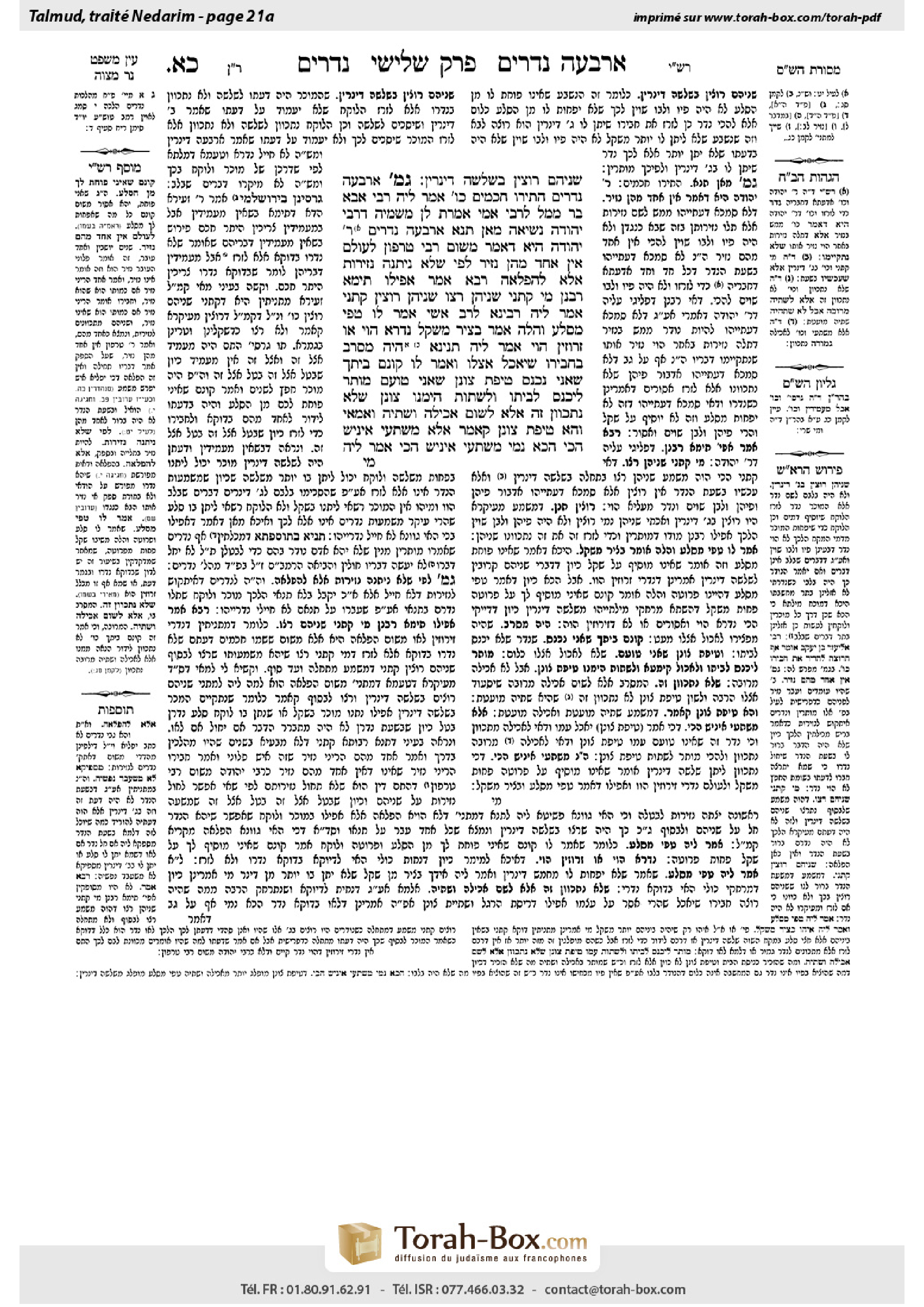
Nedarim 21a: Talmud study for Daf Yomi
Daf Yomi is the daily study of one Talmud folio. Explore 37 tractates with scans, Hebrew text, Sefaria English and AI-generated French translations where annotated.
Passage selection and English or AI-generated French translation are available where the scan has annotations. Daf Study is independent of Torah-Box and Sefaria.
Browse Nedarim · נדרים · All tractatesNedarim 21a text and translations
This page of Nedarim includes the Aramaic text, an English translation and an AI-generated French translation, alongside the scan above.
נדרים כ״א א · Aramaic and Hebrew text
שְׁנֵיהֶם רוֹצִין בִּשְׁלֹשָׁה דִּינָרִין.
גְּמָ׳ אַרְבָּעָה נְדָרִים הִתִּירוּ חֲכָמִים כּוּ׳. אֲמַר לֵיהּ רַבִּי אַבָּא בַּר מֶמֶל לְרַבִּי אַמֵּי: אֲמַרְתְּ לַן מִשְּׁמֵיהּ דְּרַבִּי יְהוּדָה נְשִׂיאָה: מַאן תְּנָא אַרְבָּעָה נְדָרִים — רַבִּי יְהוּדָה הִיא, דְּאָמַר מִשּׁוּם רַבִּי טַרְפוֹן: לְעוֹלָם אֵין אֶחָד מֵהֶן נָזִיר, לְפִי שֶׁלֹּא נִיתְּנָה נְזִירוּת אֶלָּא לְהַפְלָאָה.
רָבָא אָמַר: אֲפִילּוּ תֵּימָא רַבָּנַן, מִי קָתָנֵי ״שְׁנֵיהֶן רָצוּ״? ״שְׁנֵיהֶן רוֹצִין״ קָתָנֵי.
אֲמַר לֵיהּ רָבִינָא לְרַב אָשֵׁי: אָמַר לוֹ טְפֵי מִסֶּלַע, וְהַלָּה אֹמֵר בְּצִיר מִשֶּׁקֶל, נִדְרָא הָוֵי, אוֹ זֵרוּזִין הָוֵי?
אֲמַר לֵיהּ, תְּנֵינָא: הָיָה מְסָרֵב בַּחֲבֵירוֹ שֶׁיֹּאכַל אֶצְלוֹ, וְאָמַר לוֹ ״קֻוֽנָּם בֵּיתְךָ שֶׁאֲנִי נִכְנָס״, ״טִיפַּת צוֹנֵן שֶׁאֲנִי טוֹעֵם״ — מוּתָּר לִיכָּנֵס לְבֵיתוֹ וְלִשְׁתּוֹת הֵימֶנּוּ צוֹנֵן, שֶׁלֹּא נִתְכַּוֵּון זֶה אֶלָּא לְשׁוּם אֲכִילָה וּשְׁתִיָּה.
וְאַמַּאי? וְהָא ״טִיפַּת צוֹנֵן״ קָאָמַר! אֶלָּא מִשְׁתַּעֵי אִינִישׁ הָכִי. הָכָא נָמֵי מִשְׁתַּעֵי אִינִישׁ הָכִי.
אֲמַר לֵיהּ:
Nedarim 21a · English translation
In this case, one may assume that both want to complete the deal at three dinars, and they did not intend to vow but only exaggerated for purposes of bargaining.
GEMARA: The mishna states: The Sages dissolved four types of vows. Rabbi Abba bar Memel said to Rabbi Ami: You said to us in the name of Rabbi Yehuda Nesia: Who is the tanna who taught this mishna of four vows? It is the opinion of Rabbi Yehuda, who said in the name of Rabbi Tarfon: With regard to two people who entered into a wager, and each declared that he would become a nazirite if the other was right, then actually neither of them becomes a nazirite, because naziriteship is determined only by explicitness of intent. One cannot become a nazirite unless he vows clearly and with certitude. Here too, since the intent of the wagering parties was not actually to vow, the halakha is that the vow is invalid.
Rava said: You can even say that the mishna is in accordance with the Rabbis, who disagree with Rabbi Yehuda. Does the mishna teach: Both wanted the price to be three dinars? It teaches: Both want, in the present tense, demonstrating that they would have been satisfied with that price from the outset and never intended to vow, so the vow is not binding.
Ravina said to Rav Ashi: If the seller said to the buyer in the form of a vow that the price must remain more than a sela, and the other declared in the form of a vow that the price must remain less than a shekel, what is the halakha? Is this a vow, where each stands firmly in his position? Or perhaps this is also merely for encouragement?
Rav Ashi said to him: We already learned about a similar case: If one was importuning another that he should eat with him and the other refused and said to him: Entering your house is konam for me, or: A drop of cold water is konam for me, and for that reason I will not taste it with you, it is permitted for him to enter his house and drink cold water since he intended it as a vow only for the purpose of eating and drinking a large amount but did not mean literally that he would not drink anything.
The Gemara asks: And why is this permitted? But he said: A drop of cold water, so how can you say that the vow is only with regard to drinking a large amount? Rather, it must be that a person speaks this way in exaggerated terms but does not mean literally what he says. Here also, in the case of the buyer and seller, a person speaks this way. He exaggerates and does not intend the literal meaning of his words, even though he was quite precise in his wording.
Ravina said to him:
Nedarim 21a · Traduction française (IA)
Dans ce cas, on peut supposer que tous deux veulent conclure la transaction au prix de trois dinars et qu’ils n’avaient pas l’intention de prononcer un vœu, mais qu’ils ont simplement exagéré pour les besoins de la négociation.
GUEMARA : La Michna enseigne : Les Sages ont annulé quatre types de vœux. Rabbi Abba bar Memel dit à Rabbi Ami : « Tu nous as transmis au nom de Rabbi Yehuda Nesia : Qui est le tanna qui a enseigné cette Michna des quatre vœux ? C’est Rabbi Yehuda, qui a dit au nom de Rabbi Tarfon : Lorsque deux personnes ont conclu un pari, chacune déclarant qu’elle deviendrait nazir si l’autre avait raison, en réalité, aucune des deux ne devient nazir, car le naziréat dépend uniquement de la clarté de l’intention. On ne peut devenir nazir que si l’on prononce un vœu clairement et avec certitude. Ici aussi, puisque les parties au pari n’avaient pas réellement l’intention de prononcer un vœu, celui-ci n’est pas valide selon la halakha. »
Rava dit : On peut même dire que la Michna est conforme à l’opinion des Rabbins, qui sont en désaccord avec Rabbi Yehuda. La Michna enseigne-t-elle : « Tous deux voulaient que le prix soit de trois dinars » ? Elle enseigne : « Tous deux veulent », au présent, ce qui montre qu’ils auraient été satisfaits de ce prix dès le départ et n’avaient jamais l’intention de prononcer un vœu ; celui-ci n’est donc pas contraignant.
Ravina dit à Rav Ashi : Si le vendeur déclare sous forme de vœu que le prix doit rester supérieur à un séla, et que l’acheteur déclare sous forme de vœu qu’il doit rester inférieur à un shekel, quelle est la halakha ? S’agit-il d’un vœu, chacun campant fermement sur sa position ? Ou peut-être n’est-ce là aussi qu’une façon d’insister ?
Rav Ashi lui dit : Nous avons déjà appris un cas semblable : si quelqu’un insistait auprès d’un autre pour qu’il vienne manger chez lui, mais que celui-ci refusait et lui disait : « Entrer chez toi m’est konam », ou : « Une goutte d’eau froide m’est konam », et ajoutait qu’il ne goûterait donc rien chez lui, il lui est permis d’entrer dans sa maison et de boire de l’eau froide, puisqu’il n’entendait prononcer un vœu que pour refuser un repas copieux et une grande quantité à boire, et qu’il ne voulait pas dire littéralement qu’il ne boirait rien.
La Guemara demande : Pourquoi cela est-il permis ? Il a pourtant dit : « Une goutte d’eau froide » ; comment peut-on donc dire que le vœu ne concernait que le fait de boire une grande quantité ? Il faut plutôt en déduire qu’une personne s’exprime ainsi de manière exagérée, sans vouloir dire littéralement ce qu’elle dit. Ici aussi, dans le cas de l’acheteur et du vendeur, une personne s’exprime ainsi : elle exagère et ne donne pas à ses paroles leur sens littéral, même si elle a formulé son vœu avec beaucoup de précision.
Ravina lui dit :
Traduction française générée par IA à partir de l’édition anglaise de Sefaria. Vérifie toujours un passage avec le texte source.
Text from Sefaria: William Davidson Edition - Vocalized Aramaic (CC BY NC); William Davidson Edition - English (CC BY NC).