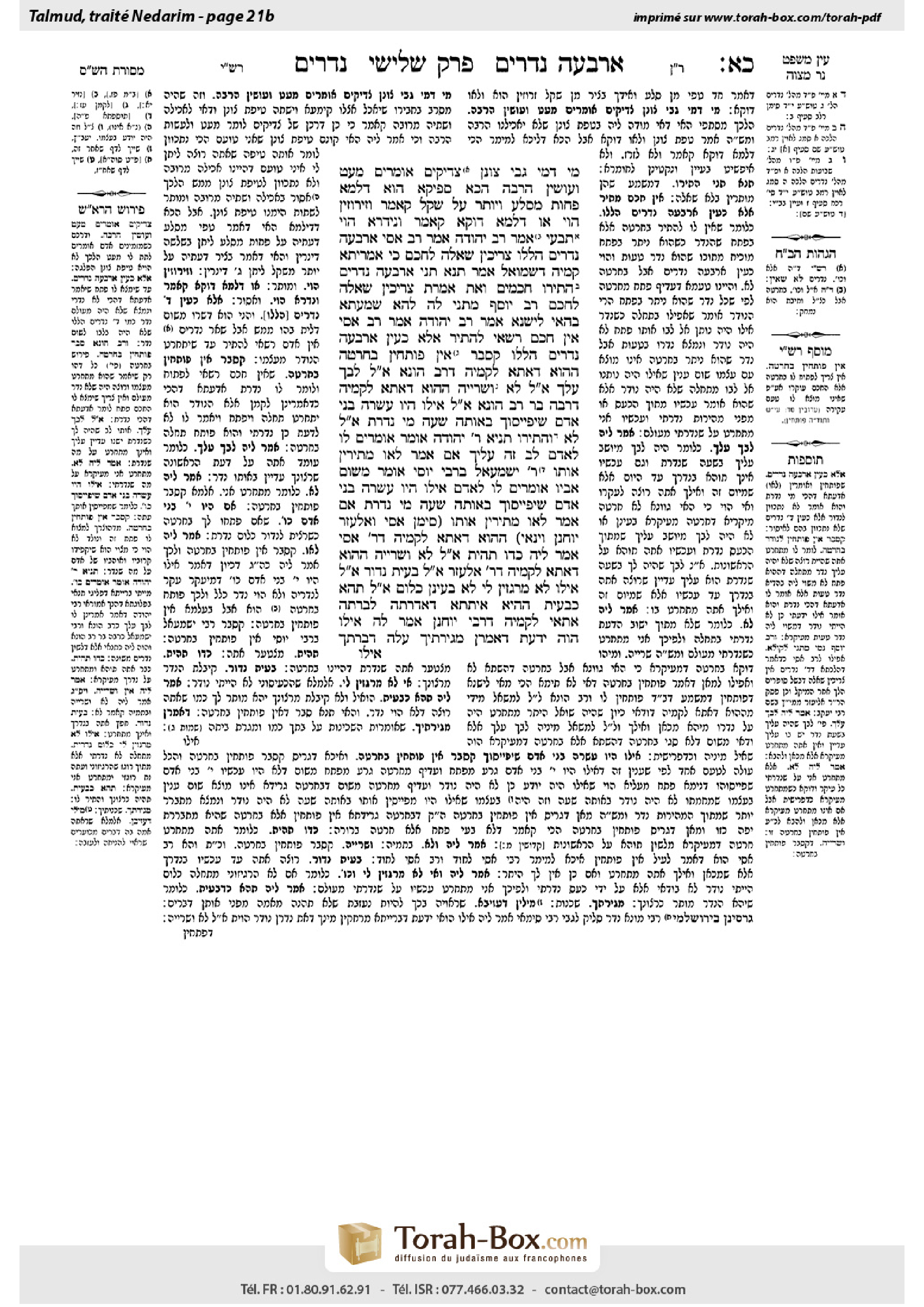
Nedarim 21b: Talmud study for Daf Yomi
Daf Yomi is the daily study of one Talmud folio. Explore 37 tractates with scans, Hebrew text, Sefaria English and AI-generated French translations where annotated.
Passage selection and English or AI-generated French translation are available where the scan has annotations. Daf Study is independent of Torah-Box and Sefaria.
Browse Nedarim · נדרים · All tractatesNedarim 21b text and translations
This page of Nedarim includes the Aramaic text, an English translation and an AI-generated French translation, alongside the scan above.
נדרים כ״א ב · Aramaic and Hebrew text
מִי דָּמֵי? גַּבֵּי צוֹנֵן, צַדִּיקִים אוֹמְרִים מְעַט וְעוֹשִׂין הַרְבֵּה —
הָכָא סְפֵיקָא הוּא, דִּלְמָא פָּחוֹת מִסֶּלַע וְיוֹתֵר עַל שֶׁקֶל קָאָמַר, וְזֵירוּזִין הָוֵי, אוֹ דִּלְמָא דַּוְקָא קָאָמַר, וְנִידְרָא הָוֵי. תִּבְּעֵי.
אָמַר רַב יְהוּדָה אָמַר רַב אַסִּי: אַרְבָּעָה נְדָרִים הַלָּלוּ צְרִיכִין שְׁאֵלָה לְחָכָם. כִּי אַמְרִיתָא קַמֵּיהּ דִּשְׁמוּאֵל, אָמַר: תַּנָּא תָּנֵי ״אַרְבָּעָה נְדָרִים הִתִּירוּ חֲכָמִים״, וְאַתְּ אָמְרַתְּ צְרִיכִין שְׁאֵלָה לְחָכָם?!
רַב יוֹסֵף מַתְנִי לַהּ לְהָא שְׁמַעְתָּא בְּהַאי לִישָּׁנָא: אָמַר רַב יְהוּדָה אָמַר רַב אַסִּי: אֵין חָכָם רַשַּׁאי לְהַתִּיר אֶלָּא כְּעֵין אַרְבָּעָה נְדָרִים הַלָּלוּ. קָסָבַר אֵין פּוֹתְחִין בַּחֲרָטָה.
הַהוּא דַּאֲתָא לְקַמֵּיהּ דְּרַב הוּנָא, אָמַר לֵיהּ: לִבָּךְ עֲלָךְ? אֲמַר לֵיהּ: לָא, וְשַׁרְיֵיהּ.
הָהוּא דַּאֲתָא לְקַמֵּיהּ דְּרַבָּה בַּר רַב הוּנָא, אֲמַר לֵיהּ: אִילּוּ הָיוּ עֲשָׂרָה בְּנֵי אָדָם שֶׁיְּפַיְּיסוּךְ בְּאוֹתָהּ שָׁעָה מִי נָדַרְתָּ? אֲמַר לֵיהּ: לֹא, וְהִתִּירוֹ.
תַּנְיָא, רַבִּי יְהוּדָה אוֹמֵר: אוֹמְרִים לוֹ לָאָדָם: לֵב זֶה עָלֶיךָ? אִם אָמַר ״לָאו״ — מַתִּירִין אוֹתוֹ. רַבִּי יִשְׁמָעֵאל בְּרַבִּי יוֹסֵי אוֹמֵר מִשּׁוּם אָבִיו: אוֹמְרִים לוֹ לָאָדָם: אִילּוּ הָיוּ עֲשָׂרָה בְּנֵי אָדָם שֶׁיְּפַיְּיסוּךְ בְּאוֹתָהּ שָׁעָה מִי נָדַרְתָּ? אִם אָמַר ״לָאו״ — מַתִּירִין אוֹתוֹ.
(סִימָן: אַסִּי וְאֶלְעָזָר, יוֹחָנָן וְיַנַּאי).
הַהוּא דַּאֲתָא לְקַמֵּיהּ דְּרַבִּי אַסִּי אֲמַר לֵיהּ: כְּדוּ תָּהֵית? אֲמַר לֵיהּ: לָא, וְשַׁרְיֵיהּ. הָהוּא דַּאֲתָא לְקַמֵּיהּ דְּרַבִּי אֶלְעָזָר, אֲמַר לֵיהּ: בָּעֵית נָדוּר? אֲמַר לֵיהּ: אִילּוּ לָא מַרְגְּזִין לִי לָא בָּעֵינַן כְּלוּם. אֲמַר לֵיהּ: תְּהֵא כְּבָעֵית. הָהִיא אִיתְּתָא דְּאַדַּרְתַּהּ לִבְרַתַּהּ, אֲתַאי לְקַמֵּיהּ דְּרַבִּי יוֹחָנָן, אָמַר לַהּ: אִילּוּ הֲוָה יָדְעַתְּ דְּאָמְרָן מְגֵירָתִיךְ עֲלַהּ דִּבְרַתִּךְ:
Nedarim 21b · English translation
Are these cases comparable? Concerning the case of cold water, the righteous say little and do much. Therefore, when the host says to the other: Enter my house and drink a drop of cold water, he intended to offer him an entire meal. So too, the one who vows is referring to an entire meal and not literally to a drop of water. Therefore, he may drink a bit of cold water in the host’s house.
But here it is uncertain. Perhaps when the seller says he will only accept more than a sela, he really intends to accept less than a sela, and when the buyer says he will not pay more than a shekel, he really intends to pay more than a shekel; and this is also an exhortation vow. Or, perhaps he meant specifically what he said, and it is a vow, because he did not intend to compromise on the price. The Gemara concludes: The dilemma remains unresolved.
§ Rav Yehuda said that Rav Asi said: These four vows that are taught in the mishna still require a request made to a halakhic authority to dissolve them. Rav Yehuda continues: When I said this halakha before Shmuel, he said: The tanna teaches that the Sages dissolved four vows, and you say they require a request made to a halakhic authority?
Rav Yosef taught this halakha in this manner: Rav Yehuda said that Rav Asi said: A halakhic authority is able to dissolve only a vow that is similar to these four vows in that it was not intended to be a vow at all but was simply expressed in the language of a vow. In addition, he can dissolve a vow taken by mistake. The Gemara comments: It can be derived from here that he holds that a halakhic authority does not broach dissolution based on regret. A halakhic authority must search for a factor that, had the one making the vow been aware of it at the time of the vow, he would not have vowed. Simply expressing regret about the vow is an insufficient basis on which to dissolve it.
The Gemara relates an incident that illustrates a different opinion concerning broaching dissolution based on regret. There was a certain person who came before Rav Huna to request dissolution of a vow. Rav Huna said to him: Is your heart upon you? Do you still have the same desire that you had when you made the vow? He said to him: No. And Rav Huna dissolved the vow for him. Since Rav Huna dissolved the vow based on regret alone, he evidently holds that one may broach dissolution based on regret.
Similarly, there was a certain person who came before Rabba bar Rav Huna to dissolve his vow. Rabba bar Rav Huna said to him: Had there been ten people who could have appeased you at the time you vowed, would you have made the vow? He said to him: No. And he dissolved the vow for him.
It is taught in a baraita that Rabbi Yehuda says: The halakhic authorities who dissolve the vow say to the person who vowed: Is this heart, i.e., this desire, still upon you? If he says no, they dissolve it. Rabbi Yishmael, son of Rabbi Yosei, says in the name of his father: They say to the person who vowed: Had there been ten people who could have appeased you at the time, would you have made the vow? If he says no, they dissolve it.
The Gemara prefaces the next discussion with a mnemonic device: Asi and Elazar, Yoḥanan and Yannai.
The Gemara relates that there was a certain person who came before Rabbi Asi to request dissolution of a vow. Rabbi Asi said to him: Do you have regret? He said to him rhetorically: No, do I not have regret? In other words, certainly I have regret. And he dissolved the vow for him. Similarly, there was a certain person who came before Rabbi Elazar, and Rabbi Elazar said to him: Did you want to vow? Was this really your desire? He said to Rabbi Elazar: If they had not angered me, I would not have wanted anything. He said to him: Let it be like you want, and the vow is dissolved. In another instance, there was a certain woman who took a vow with regard to her daughter that the daughter may not benefit from her, and she came before Rabbi Yoḥanan to dissolve the vow. He said to her: Had you known that your neighbors would say about your daughter:
Nedarim 21b · Traduction française (IA)
Ces cas sont-ils comparables ? Dans le cas de l’eau froide, les justes parlent peu et font beaucoup. Ainsi, lorsque l’hôte dit à l’autre : « Entre chez moi et bois une goutte d’eau froide », il entend en réalité lui offrir un repas entier. De même, celui qui prononce le vœu fait référence à un repas entier, et non littéralement à une goutte d’eau. Il peut donc boire un peu d’eau froide chez son hôte.
Mais ici, la situation est incertaine. Peut-être que lorsque le vendeur dit qu’il n’acceptera qu’un prix supérieur à un sela, il entend en réalité accepter moins d’un sela, et que lorsque l’acheteur dit qu’il ne paiera pas plus d’un shekel, il entend en réalité payer plus d’un shekel ; il s’agit alors aussi d’un vœu d’exhortation. Ou peut-être voulait-il dire précisément ce qu’il a dit, et s’agit-il d’un vœu, puisqu’il n’avait pas l’intention de faire un compromis sur le prix. La Guemara conclut : la question reste sans réponse.
§ Rav Yehuda a dit au nom de Rav Asi : Ces quatre vœux enseignés dans la Michna nécessitent encore une demande adressée à une autorité halakhique pour être annulés. Rav Yehuda poursuit : Lorsque j’ai énoncé cette halakha devant Shmuel, il m’a dit : « Le tanna enseigne que les Sages ont annulé quatre vœux, et toi, tu dis qu’ils nécessitent une demande adressée à une autorité halakhique ? »
Rav Yosef enseignait cette halakha ainsi : Rav Yehuda a dit au nom de Rav Asi : Une autorité halakhique ne peut annuler qu’un vœu semblable à ces quatre vœux, c’est-à-dire un vœu qui n’était pas destiné à en être un, mais qui a simplement été formulé sous la forme d’un vœu. Elle peut aussi annuler un vœu prononcé par erreur. La Guemara fait remarquer : On peut en déduire qu’il estime qu’une autorité halakhique ne peut pas engager l’examen d’une demande d’annulation en se fondant sur le regret. Elle doit rechercher un élément dont celui qui a prononcé le vœu aurait tenu compte au moment de le prononcer et qui l’aurait alors empêché de le faire. Le simple fait d’exprimer des regrets au sujet du vœu ne constitue pas un fondement suffisant pour l’annuler.
La Guemara rapporte un épisode qui illustre une opinion différente concernant la possibilité d’engager l’examen d’une demande d’annulation en se fondant sur le regret. Un homme se présenta devant Rav Huna pour demander l’annulation d’un vœu. Rav Huna lui dit : « Ce désir est-il encore présent en toi ? Désires-tu toujours la même chose qu’au moment où tu as prononcé le vœu ? » Il lui répondit : « Non. » Rav Huna annula alors son vœu. Puisqu’il annula le vœu sur la seule base du regret, Rav Huna estime manifestement qu’on peut engager l’examen d’une demande d’annulation en se fondant sur le regret.
De même, un homme se présenta devant Rabba bar Rav Huna pour demander l’annulation de son vœu. Rabba bar Rav Huna lui dit : « Si, au moment où tu as prononcé ton vœu, dix personnes avaient pu te réconcilier, aurais-tu prononcé ce vœu ? » Il lui répondit : « Non. » Rabba bar Rav Huna annula alors son vœu.
Il est enseigné dans une baraïta que Rabbi Yehuda dit : Les autorités halakhiques chargées d’annuler un vœu demandent à celui qui l’a prononcé : « Ce cœur, c’est-à-dire ce désir, est-il encore présent en toi ? » S’il répond non, elles annulent le vœu. Rabbi Yishmael, fils de Rabbi Yosei, dit au nom de son père : Elles demandent à celui qui a prononcé le vœu : « Si, à ce moment-là, dix personnes avaient pu te réconcilier, aurais-tu prononcé ce vœu ? » S’il répond non, elles annulent le vœu.
La Guemara introduit la discussion suivante au moyen d’un aide-mémoire : Asi et Elazar, Yoḥanan et Yannai.
La Guemara rapporte qu’un homme se présenta devant Rabbi Asi pour demander l’annulation d’un vœu. Rabbi Asi lui dit : « Regrettes-tu ton vœu ? » Il lui répondit sur un ton rhétorique : « Non, est-ce que je ne le regrette pas ? » Autrement dit, il le regrettait assurément. Rabbi Asi annula alors son vœu. De même, un homme se présenta devant Rabbi Elazar, qui lui dit : « Vouliez-vous prononcer un vœu ? Était-ce vraiment votre désir ? » Il répondit à Rabbi Elazar : « Si on ne m’avait pas mis en colère, je n’aurais rien voulu. » Rabbi Elazar lui dit : « Qu’il en soit comme tu le souhaites », et le vœu fut annulé. En une autre occasion, une femme avait prononcé un vœu concernant sa fille, stipulant que celle-ci ne pourrait pas tirer profit d’elle, et elle se présenta devant Rabbi Yoḥanan pour demander l’annulation du vœu. Il lui dit : « Si vous aviez su que vos voisines diraient au sujet de votre fille : »
Traduction française générée par IA à partir de l’édition anglaise de Sefaria. Vérifie toujours un passage avec le texte source.
Text from Sefaria: William Davidson Edition - Vocalized Aramaic (CC BY NC); William Davidson Edition - English (CC BY NC).