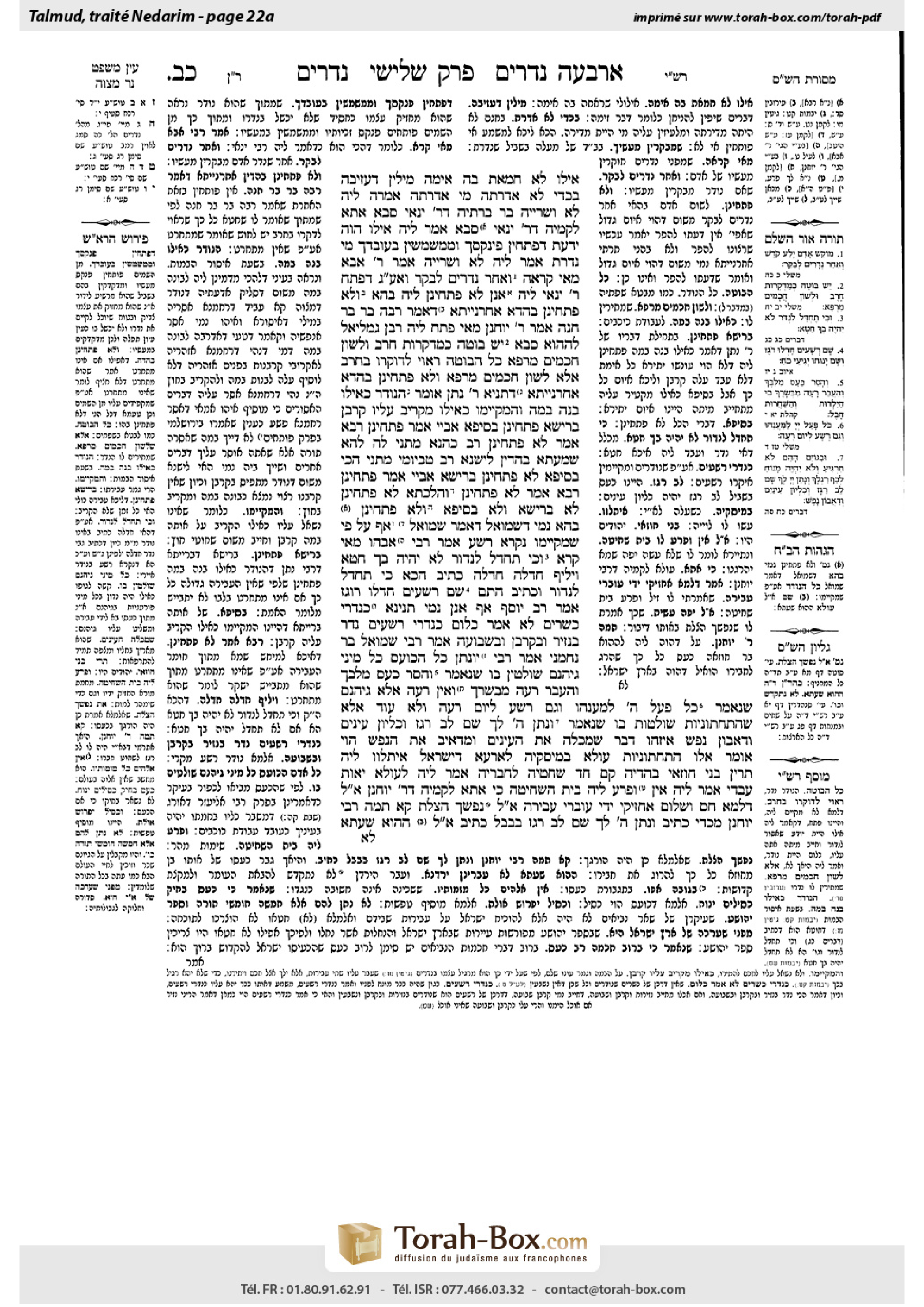
Nedarim 22a: Talmud study for Daf Yomi
Daf Yomi is the daily study of one Talmud folio. Explore 37 tractates with scans, Hebrew text, Sefaria English and AI-generated French translations where annotated.
Passage selection and English or AI-generated French translation are available where the scan has annotations. Daf Study is independent of Torah-Box and Sefaria.
Browse Nedarim · נדרים · All tractatesNedarim 22a text and translations
This page of Nedarim includes the Aramaic text, an English translation and an AI-generated French translation, alongside the scan above.
נדרים כ״ב א · Aramaic and Hebrew text
אִילּוּ לָא חֲמָאת בָּהּ אִימַּהּ מִילִּין דַּעֲזִיבָה — בִּכְדִי לָא אַדַּרְתַּהּ! מִי אַדַּרְתַּהּ? אֲמַרָה לֵיהּ: לָא, וְשַׁרְיַיהּ.
בַּר בְּרַתֵּיה דְּרַבִּי יַנַּאי סָבָא אֲתָא לְקַמֵּיהּ דְּרַבִּי יַנַּאי סָבָא, אֲמַר לֵיהּ: אִילּוּ הֲוָה יָדְעַתְּ דְּפָתְחִין פִּינְקְסָךְ וּמְמַשְׁמְשִׁין בְּעוֹבָדָךְ, מִי נְדַרְתְּ? אֲמַר לֵיהּ: לָא, וְשַׁרְיֵיהּ.
אָמַר רַבִּי אַבָּא: מַאי קְרָאָה — ״וְאַחַר נְדָרִים לְבַקֵּר״. וְאַף עַל גַּב דִּפְתַח רַבִּי יַנַּאי לֵיהּ — אֲנַן לָא פָּתְחִינַן לֵיהּ בְּהָא.
וְלָא פָּתְחִינַן בְּהָדָא אַחְרָנִייתָא, דְּאָמַר רַבָּה בַּר בַּר חָנָה אָמַר רַבִּי יוֹחָנָן: מַאי פְּתַח לֵיהּ רַבָּן גַּמְלִיאֵל לְהָהוּא סָבָא: ״יֵשׁ בּוֹטֶה כְּמַדְקְרוֹת חָרֶב וּלְשׁוֹן חֲכָמִים מַרְפֵּא״. כׇּל הַבּוֹטֶה — רָאוּי לְדוֹקְרוֹ בְּחֶרֶב, אֶלָּא — לְשׁוֹן חֲכָמִים מַרְפֵּא.
וְלָא פָּתְחִינַן בַּהֲדָא אַחְרָנִייתָא, דְּתַנְיָא, רַבִּי נָתָן אוֹמֵר: הַנּוֹדֵר — כְּאִילּוּ בָּנָה בָּמָה, וְהַמְקַיְּימוֹ — כְּאִילּוּ מַקְרִיב עָלָיו קׇרְבָּן. בְּרֵישָׁא פָּתְחִינַן. בְּסֵיפָא, אַבָּיֵי אָמַר: פָּתְחִינַן, רָבָא אָמַר: לָא פָּתְחִינַן.
רַב כָּהֲנָא מַתְנֵי לַהּ לְהָא שְׁמַעְתָּא בְּהָדֵין לִישָּׁנָא. רַב טַבְיוֹמֵי מַתְנֵי הָכִי: בְּסֵיפָא לָא פָּתְחִינַן. בְּרֵישָׁא, אַבָּיֵי אָמַר: פָּתְחִינַן, רָבָא אָמַר: לָא פָּתְחִינַן. וְהִלְכְתָא: לָא פָּתְחִינַן לָא בְּרֵישָׁא וְלָא בְּסֵיפָא.
וְלָא פָּתְחִינַן בְּהָא נָמֵי דִּשְׁמוּאֵל. דְּאָמַר שְׁמוּאֵל: אַף עַל פִּי שֶׁמְּקַיְּימוֹ — נִקְרָא רָשָׁע. אָמַר רַבִּי אֲבָהוּ, מַאי קְרָא: ״וְכִי תֶחְדַּל לִנְדֹּר לֹא יִהְיֶה בְךָ חֵטְא״, וְיָלֵיף ״חֲדָלָה״ ״חֲדָלָה״. כְּתִיב הָכָא: ״וְכִי תֶחְדַּל לִנְדֹּר״, וּכְתִיב הָתָם: ״שָׁם רְשָׁעִים חָדְלוּ רֹגֶז״.
אָמַר רַב יוֹסֵף, אַף אֲנַן נָמֵי תְּנֵינָא: ״כְּנִדְרֵי כְשֵׁרִים״ — לֹא אָמַר כְּלוּם, ״כְּנִדְרֵי רְשָׁעִים״ — נָדַר בְּנָזִיר וּבְקׇרְבָּן וּבִשְׁבוּעָה.
אָמַר רַבִּי שְׁמוּאֵל בַּר נַחְמָנִי אָמַר רַבִּי יוֹנָתָן: כׇּל הַכּוֹעֵס כׇּל מִינֵי גֵיהִנָּם שׁוֹלְטִין בּוֹ, שֶׁנֶּאֱמַר: ״וְהָסֵר כַּעַס מִלִּבֶּךָ וְהַעֲבֵר רָעָה מִבְּשָׂרֶךָ״, וְאֵין ״רָעָה״ אֶלָּא גֵּיהִנָּם, שֶׁנֶּאֱמַר: ״כֹּל פָּעַל ה׳ לַמַּעֲנֵהוּ וְגַם רָשָׁע לְיוֹם רָעָה״.
וְלֹא עוֹד אֶלָּא שֶׁהַתַּחְתּוֹנִיּוֹת שׁוֹלְטוֹת בּוֹ, שֶׁנֶּאֱמַר: ״וְנָתַן ה׳ לְךָ שָׁם לֵב רַגָּז וְכִלְיוֹן עֵינַיִם וְדַאֲבוֹן נָפֶשׁ״, אֵיזֶהוּ דָּבָר שֶׁמְּכַלֶּה אֶת הָעֵינַיִם וּמַדְאִיב אֶת הַנֶּפֶשׁ — הֱוֵי אוֹמֵר: אֵלּוּ הַתַּחְתּוֹנִיּוֹת.
עוּלָּא בְּמִיסְּקֵיהּ לְאַרְעָא דְּיִשְׂרָאֵל אִיתְלְווֹ לֵיהּ תְּרֵין בְּנֵי חוֹזָאֵי בַּהֲדֵיהּ. קָם חַד שַׁחְטֵיהּ לְחַבְרֵיהּ. אֲמַר לֵיהּ לְעוּלָּא: יָאוּת עֲבַדִי? אֲמַר לֵיהּ: אִין, וּפְרַע לֵיהּ בֵּית הַשְּׁחִיטָה. כִּי אֲתָא לְקַמֵּיהּ דְּרַבִּי יוֹחָנָן, אֲמַר לֵיהּ: דִּלְמָא חַס וְשָׁלוֹם אַחְזִיקִי יְדֵי עוֹבְרֵי עֲבֵירָה? אֲמַר לֵיהּ: נַפְשְׁךָ הִצַּלְתָּ.
קָא תָמַהּ רַבִּי יוֹחָנָן, מִכְּדִי כְּתִיב: ״וְנָתַן ה׳ לְךָ שָׁם לֵב רַגָּז״ בְּבָבֶל כְּתִיב? אֲמַר לֵיהּ: הָהוּא שַׁעְתָּא
Nedarim 22a · English translation
Had her mother not seen inappropriate [aziva] matters or behavior in her that should be stopped, she would not have taken a vow with regard to her for nothing; had you known that the neighbors would say that, would you have taken a vow with regard to her? She said to him: No, and he dissolved the vow for her.
The Gemara relates: The son of the daughter of Rabbi Yannai the Elder came before Rabbi Yannai the Elder to dissolve a vow. He said to him: Had you known that when you make a vow they open your record book [pinekas] in heaven and examine your actions, would you have vowed? He said to him: No, and he dissolved the vow for him.
Rabbi Abba said: What is the verse from which it is derived that taking a vow leads to one’s deeds being examined? It is “And after vows to make inquiry” (Proverbs 20:25). This is interpreted to mean that after one takes a vow, his actions are reviewed in heaven. The Gemara comments: And although Rabbi Yannai broached dissolution with him in this way, we do not broach dissolution in this manner for one who vows, by asking if he regrets it because his actions will be examined in heaven. This is because one might be embarrassed, upon hearing such a question, to say that he does not have regret, and he will claim untruthfully that he is regretful.
And we also do not broach dissolution in this other way, as Rabba bar bar Ḥana said that Rabbi Yoḥanan said: What type of dissolution did Rabban Gamliel broach for a certain elderly man who had taken a vow and came before him for dissolution? He informed him that it is written: “There is one who speaks like the piercing of a sword, but the tongue of the wise is health” (Proverbs 12:18), which is interpreted to mean: Anyone who verbally expresses the language of a vow, it is appropriate to pierce him with a sword, but he has another option: “The tongue of the wise is health,” since the Sages can release him from his vow. Quoting this verse with its interpretation is also not an acceptable method of broaching dissolution.
We also do not broach dissolution using this other method, as it is taught in a baraita: Rabbi Natan says: One who vows is considered as if he built a personal altar outside the Temple, which is prohibited, and one who fulfills this vow is considered as if he sacrifices an offering on it. With the first clause, we may broach dissolution by informing the one who vowed that vowing is akin to building an altar outside the Temple, but with regard to the latter clause there is a dispute among the Sages. Abaye said: We do broach dissolution by telling someone that fulfilling a vow is like sacrificing an offering on a forbidden altar, while Rava said: We do not broach dissolution with it.
Rav Kahana taught this halakha in this wording, i.e., the wording that was just cited. However, Rav Tavyumei taught this halakha in this way: With regard to what is written in the last clause, all agree that we do not broach dissolution in this way. With regard to what is written in the first clause, there is a dispute among the Sages. Abaye said: We do broach dissolution in this manner, while Rava said: We do not broach dissolution in this manner either. The Gemara concludes: And the halakha is that we do not broach dissolution using either the language in the first clause or the language in the latter clause.
And furthermore, we also do not broach dissolution with this statement of Shmuel, as Shmuel said: With regard to one who vows, although he fulfills it, he is called wicked. Rabbi Abbahu said: What is the verse from which this is derived? It is “But if you refrain [teḥdal] from vowing there will be no sin in you” (Deuteronomy 23:23), and he derives the word ḥadala here from the word ḥadala elsewhere. It is written here: “But if you refrain [teḥdal] from vowing,” and it is written there: “There the wicked cease [ḥadlu] from troubling” (Job 3:17). The parallel language demonstrates that vowing is an act of the wicked.
Rav Yosef said: We, too, learn in the mishna (9a): If one says he vows like the vows of the virtuous, he has not said anything. If he says: Like the vows of the wicked, he has vowed with regard to becoming a nazirite, or with regard to obligating himself in an offering, or with regard to taking an oath. From here it is also apparent that vowing is an act of the wicked.
§ Apropos the verse “There the wicked cease from troubling,” the Gemara cites a related statement: Rabbi Shmuel bar Naḥmani said that Rabbi Yonatan said: Anyone who gets angry, all kinds of Gehenna rule over him, because anger causes him to transgress all kinds of severe sins, as it is stated: “Therefore remove vexation from your heart and put away evil from your flesh” (Ecclesiastes 11:10), and the evil mentioned is nothing other than Gehenna, as it is stated: “The Lord has made everything for His own purpose and even the wicked for the day of evil” (Proverbs 16:4), which is interpreted to mean that ultimately the day of the evildoer in Gehenna will arrive.
And not only that, but also hemorrhoids will control him, as it is stated: “But the Lord shall give you there a trembling heart, and failing of eyes, and languishing of soul” (Deuteronomy 28:65). Which is the matter of sickness that causes failing of the eyes in pain and causes languishing of the soul? You must say this is referring to hemorrhoids.
The Gemara relates: Ulla, on his ascent to Eretz Yisrael, had two residents of Ḥozai join him. Because of a brawl between them, one arose and slaughtered the other. The assailant said to Ulla: Did I act properly? He said to him: Yes, and open the place of the slaughter, i.e., cut it more so that he will die faster. When Ulla came before Rabbi Yoḥanan, Ulla said to him: Perhaps, Heaven forbid, I strengthened the hands of sinners by commending him, although I did so merely because I was afraid that he would kill me. He said to him: You saved yourself by doing so, as it is permitted for one to say words like this in order to save his own life.
With regard to the narrative itself, Rabbi Yoḥanan wondered: Now, it is written in the passage of curses: “But the Lord shall give you there a trembling heart” (Deuteronomy 28:65) and this is written with regard to Babylonia, because in the exile an individual possesses a trembling and angry heart. How is it possible that in Eretz Yisrael a person can get so angry as to murder another? Ulla said to him: At that moment when the incident occurred
Nedarim 22a · Traduction française (IA)
Si sa mère n’avait pas vu chez elle des choses ou des comportements inconvenants [aziva] qu’il fallait faire cesser, elle n’aurait pas prononcé à son sujet un vœu sans raison. Si tu avais su que les voisines diraient cela, aurais-tu prononcé un vœu à son sujet ? Elle lui répondit : Non. Il délia alors son vœu.
La Guemara rapporte : Le petit-fils de Rabbi Yannai l’Ancien, fils de sa fille, se présenta devant Rabbi Yannai l’Ancien afin qu’il délie un vœu. Celui-ci lui demanda : Si tu avais su que, lorsque tu prononces un vœu, on ouvre au Ciel ton registre [pinekas] et qu’on examine tes actes, aurais-tu prononcé ce vœu ? Il lui répondit : Non. Il délia alors son vœu.
Rabbi Abba dit : Quel verset enseigne que le fait de prononcer un vœu entraîne l’examen des actes d’une personne ? C’est : « Et après les vœux, on fait une enquête » (Proverbes 20, 25). Cela s’interprète ainsi : après qu’une personne a prononcé un vœu, ses actes sont examinés au Ciel. La Guemara fait remarquer : Bien que Rabbi Yannai ait engagé la procédure de déliaison de cette manière, nous ne l’engageons pas ainsi pour celui qui prononce un vœu, en lui demandant s’il le regrette parce que ses actes seront examinés au Ciel. En effet, en entendant une telle question, il pourrait avoir honte de dire qu’il ne le regrette pas et prétendre à tort qu’il le regrette.
Nous n’engageons pas non plus la procédure de déliaison de cette autre manière, comme Rabba bar bar Ḥana a dit au nom de Rabbi Yoḥanan : De quelle manière Rabban Gamliel a-t-il engagé la déliaison pour un certain vieillard qui avait prononcé un vœu et s’était présenté devant lui pour le faire délier ? Il lui fit savoir qu’il est écrit : « Il en est un qui parle comme un coup d’épée, mais la langue des sages apporte la guérison » (Proverbes 12, 18). Ce verset s’interprète ainsi : quiconque exprime oralement la formulation d’un vœu mérite qu’on le transperce d’une épée ; mais il a une autre possibilité : « la langue des sages apporte la guérison », car les Sages peuvent le délier de son vœu. Citer ce verset avec cette interprétation n’est pas non plus une manière acceptable d’engager la déliaison.
Nous n’engageons pas non plus la procédure de déliaison par cette autre méthode, comme l’enseigne une baraïta : Rabbi Natan dit : Celui qui prononce un vœu est considéré comme s’il avait construit un autel privé hors du Temple, ce qui est interdit ; et celui qui accomplit ce vœu est considéré comme s’il y avait offert un sacrifice. Dans la première partie, on peut engager la déliaison en informant celui qui a prononcé le vœu que faire un vœu équivaut à construire un autel hors du Temple ; mais, concernant la dernière partie, les Sages sont en désaccord. Abaye dit : On engage la déliaison en disant à quelqu’un qu’accomplir un vœu équivaut à offrir un sacrifice sur un autel interdit. Rava dit : On ne l’engage pas ainsi.
Rav Kahana enseignait cette halakha sous la formulation qui vient d’être citée. Rav Tavyumei, toutefois, l’enseignait ainsi : concernant ce qui est écrit dans la dernière partie, tous conviennent qu’on n’engage pas la déliaison de cette manière. Concernant ce qui est écrit dans la première partie, les Sages sont en désaccord. Abaye dit : On engage la déliaison de cette manière. Rava dit : On ne l’engage pas non plus de cette manière. La Guemara conclut : La halakha est qu’on n’engage la déliaison ni avec la formulation de la première partie ni avec celle de la dernière partie.
En outre, nous n’engageons pas non plus la déliaison en citant cette déclaration de Shmuel, car Shmuel a dit : Celui qui prononce un vœu, même s’il l’accomplit, est appelé méchant. Rabbi Abbahou dit : Quel verset l’enseigne ? C’est : « Mais si tu t’abstiens [teḥdal] de faire un vœu, il n’y aura pas de péché en toi » (Deutéronome 23, 23). Il rapproche ici le mot ḥadala du mot ḥadala employé ailleurs. Il est écrit ici : « Mais si tu t’abstiens [teḥdal] de faire un vœu », et il est écrit là : « Là, les méchants cessent [ḥadlu] de troubler » (Job 3, 17). Cette formulation parallèle montre que prononcer un vœu est un acte de méchant.
Rav Yosef dit : Nous l’apprenons également dans la Michna (9a) : Si quelqu’un dit qu’il fait des vœux comme les vœux des justes, il n’a rien dit. S’il dit : « Comme les vœux des méchants », il a prononcé un vœu de naziréat, ou s’est engagé à apporter un sacrifice, ou a prononcé un serment. Cela montre également que prononcer un vœu est un acte de méchant.
§ À propos du verset « Là, les méchants cessent de troubler », la Guemara cite une déclaration connexe : Rabbi Shmuel bar Naḥmani a dit au nom de Rabbi Yonatan : Quiconque se met en colère, toutes sortes de Gehinnom ont pouvoir sur lui, car la colère l’amène à transgresser toutes sortes de fautes graves, comme il est dit : « Éloigne donc le chagrin de ton cœur et écarte le mal de ta chair » (Ecclésiaste 11, 10). Or, le mal mentionné ici n’est autre que le Gehinnom, comme il est dit : « L’Éternel a tout fait pour sa propre fin, même le méchant pour le jour du malheur » (Proverbes 16, 4). Ce verset s’interprète ainsi : le jour où le malfaiteur se retrouvera au Gehinnom finira par arriver.
Et ce n’est pas tout : les hémorroïdes auront aussi pouvoir sur lui, comme il est dit : « L’Éternel te donnera là un cœur tremblant, des yeux qui défaillent et une âme languissante » (Deutéronome 28, 65). Quelle maladie provoque une défaillance douloureuse des yeux et fait languir l’âme ? Il faut dire qu’il s’agit des hémorroïdes.
La Guemara rapporte : Ulla, alors qu’il montait en Eretz Israël, fut rejoint par deux habitants de Ḥozai. À la suite d’une querelle entre eux, l’un se leva et égorgea l’autre. L’agresseur demanda à Ulla : Ai-je bien agi ? Ulla lui répondit : Oui, et ouvre davantage la plaie de l’égorgement, c’est-à-dire coupe plus profondément afin qu’il meure plus vite. Quand Ulla se présenta devant Rabbi Yoḥanan, il lui dit : Peut-être, à Dieu ne plaise, ai-je renforcé les mains des pécheurs en l’approuvant, même si je l’ai fait uniquement parce que j’avais peur qu’il me tue. Rabbi Yoḥanan lui dit : Tu t’es sauvé en agissant ainsi, car il est permis de dire de telles paroles pour sauver sa propre vie.
À propos du récit lui-même, Rabbi Yoḥanan s’étonna : Or, il est écrit dans le passage des malédictions : « L’Éternel te donnera là un cœur tremblant » (Deutéronome 28, 65), et cela concerne la Babylonie, car en exil, un individu a le cœur tremblant et colérique. Comment est-il possible qu’en Eretz Israël une personne se mette tellement en colère qu’elle en tue une autre ? Ulla lui dit : Au moment où l’incident s’est produit
Traduction française générée par IA à partir de l’édition anglaise de Sefaria. Vérifie toujours un passage avec le texte source.
Text from Sefaria: William Davidson Edition - Vocalized Aramaic (CC BY NC); William Davidson Edition - English (CC BY NC).