Nedarim 24a: Talmud study for Daf Yomi
Daf Yomi is the daily study of one Talmud folio. Explore 37 tractates with scans, Hebrew text, Sefaria English and AI-generated French translations where annotated.
Passage selection and English or AI-generated French translation are available where the scan has annotations. Daf Study is independent of Torah-Box and Sefaria.
Browse Nedarim · נדרים · All tractatesNedarim 24a text and translations
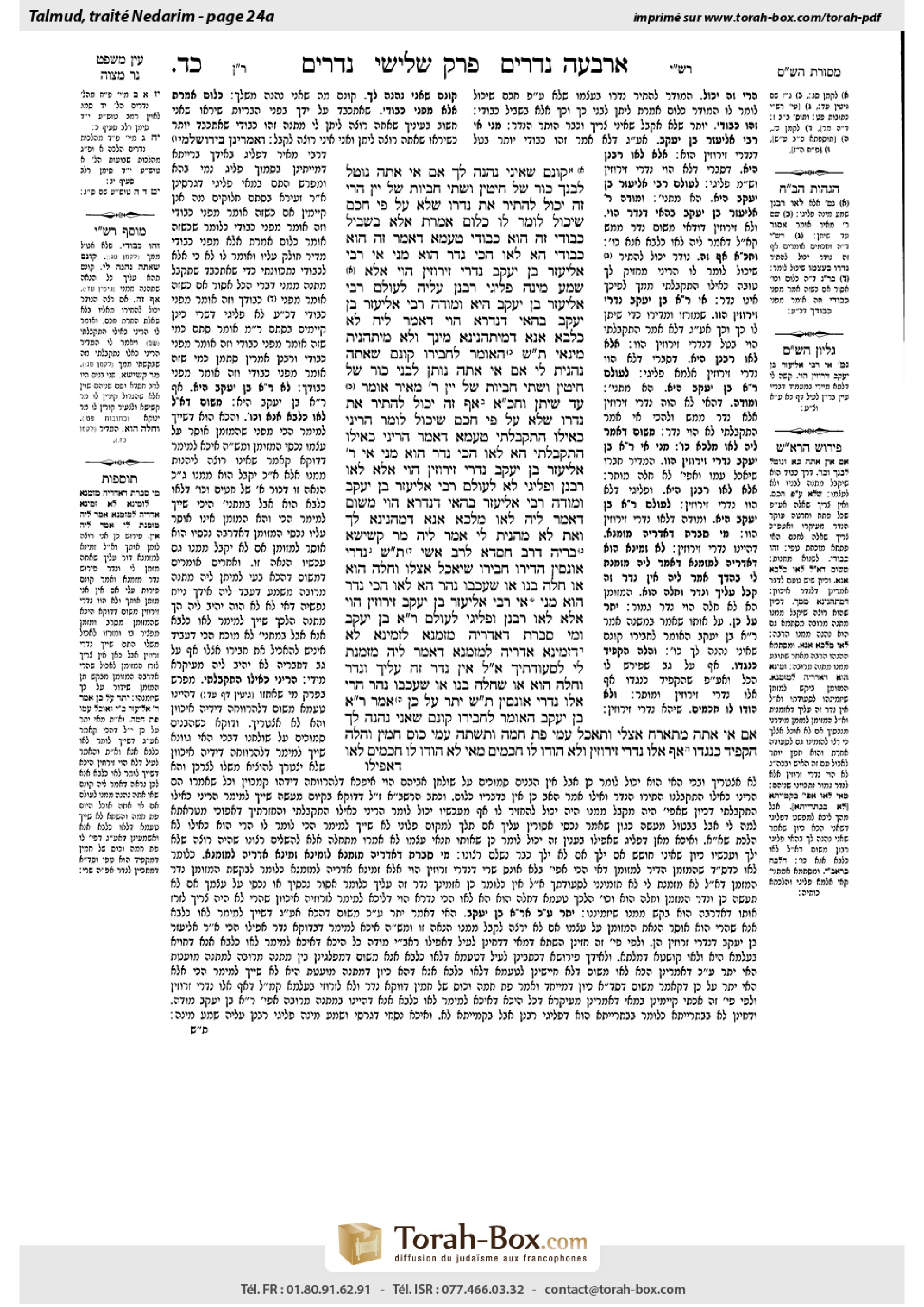
This page of Nedarim includes the Aramaic text, an English translation and an AI-generated French translation, alongside the scan above.
נדרים כ״ד א · Aramaic and Hebrew text
״קֻוֽנָּם שֶׁאֵינִי נֶהֱנֶה לְךָ אִם אִי אַתָּה נוֹטֵל לְבִנְךָ כּוֹר שֶׁל חִיטִּין וּשְׁתֵּי חָבִיּוֹת שֶׁל יַיִן״, הֲרֵי זֶה יָכוֹל לְהַתִּיר אֶת נִדְרוֹ שֶׁלֹּא עַל פִּי חָכָם, שֶׁיָּכוֹל לוֹמַר לוֹ: כְּלוּם אָמַרְתָּ אֶלָּא בִּשְׁבִיל כְּבוֹדִי — זֶה הוּא כְּבוֹדִי.
טַעְמָא דְּאָמַר ״זֶה הוּא כְּבוֹדִי״, הָא לָאו הָכִי — נֶדֶר הוּא. מַנִּי? אִי רַבִּי אֱלִיעֶזֶר בֶּן יַעֲקֹב — נִדְרֵי זֵירוּזִין הָוֵי. אֶלָּא שְׁמַע מִינַּהּ: פְּלִיגִי רַבָּנַן עֲלֵיהּ.
לְעוֹלָם רַבִּי אֱלִיעֶזֶר בֶּן יַעֲקֹב הִיא, וּמוֹדֶה רַבִּי אֱלִיעֶזֶר בֶּן יַעֲקֹב בְּהַאי דְּנִדְרָא הָוֵי, דְּאָמַר לֵיהּ: לָא כַּלְבָּא אֲנָא, דְּמִיתְהֲנֵינָא מִינָּךְ וְלָא מִיתְהֲנֵית מִינַּאי.
תָּא שְׁמַע: הָאוֹמֵר לַחֲבֵירוֹ ״קֻוֽנָּם שֶׁאַתָּה נֶהֱנֵית לִי אִם אִי אַתָּה נוֹתֵן לִבְנִי כּוֹר שֶׁל חִיטִּין וּשְׁתֵּי חָבִיּוֹת שֶׁל יַיִן״, רַבִּי מֵאִיר אוֹמֵר: עַד שֶׁיִּתֵּן. וַחֲכָמִים אוֹמְרִים: אַף זֶה יָכוֹל לְהַתִּיר אֶת נִדְרוֹ שֶׁלֹּא עַל פִּי חָכָם, שֶׁיָּכוֹל לוֹמַר: הֲרֵינִי כְּאִילּוּ הִתְקַבַּלְתִּי.
טַעְמָא דְּאָמַר ״הֲרֵינִי כְּאִילּוּ הִתְקַבַּלְתִּי״, הָא לָאו הָכִי — נֶדֶר הוּא. מַנִּי? אִי רַבִּי אֱלִיעֶזֶר בֶּן יַעֲקֹב — נִדְרֵי זֵירוּזִין הָוֵי, אֶלָּא לָאו: רַבָּנַן, וּפְלִיגִי!
לָא, לְעוֹלָם רַבִּי אֱלִיעֶזֶר בֶּן יַעֲקֹב, וּמוֹדֶה רַבִּי אֱלִיעֶזֶר בְּהַאי דְּנִדְרָא הָוֵי, מִשּׁוּם דְּאָמַר לֵיהּ: לָאו מַלְכָּא אֲנָא, דִּמְהַנֵּינָא לָךְ וְאַתְּ לָא מְהַנֵּית לִי.
אֲמַר לֵיהּ מָר קַשִּׁישָׁא בְּרֵיהּ דְּרַב חִסְדָּא לְרַב אָשֵׁי, תָּא שְׁמַע: נִדְרֵי אוֹנָסִין, הִדִּירוֹ חֲבֵירוֹ שֶׁיֹּאכַל אֶצְלוֹ, וְחָלָה הוּא אוֹ חָלָה בְּנוֹ אוֹ שֶׁעִכְּבוֹ נָהָר. הָא לָאו הָכִי — נֶדֶר הוּא. מַנִּי? אִי רַבִּי אֱלִיעֶזֶר בֶּן יַעֲקֹב — זֵירוּזִין הָוֵי. אֶלָּא לָאו: רַבָּנַן, וּפְלִיגִי!
לְעוֹלָם רַבִּי אֱלִיעֶזֶר בֶּן יַעֲקֹב, וּמִי סָבְרַתְּ דְּאַדְּרֵיהּ מְזַמְּנָא לִזְמִינָא? לָא, דִּזְמִינָא אַדְּרֵיהּ לִמְזַמְּנָא. דַּאֲמַר לֵיהּ מְזַמְּנַתְּ לִי לִסְעוֹדְתָּיךְ? אֲמַר לֵיהּ: אִין. נֶדֶר זֶה עָלֶיךָ? וְנָדַר. וְחָלָה הוּא אוֹ שֶׁחָלָה בְּנוֹ אוֹ שֶׁעִכְּבוֹ נָהָר — הֲרֵי אֵלּוּ נִדְרֵי אוֹנָסִין.
תָּא שְׁמַע: יָתֵר עַל כֵּן, אָמַר רַבִּי אֱלִיעֶזֶר בֶּן יַעֲקֹב: הָאוֹמֵר לַחֲבֵירוֹ ״קֻוֽנָּם שֶׁאֲנִי נֶהֱנֶה לָךְ אִם אִי אַתָּה מִתְאָרֵחַ אֶצְלִי וְתֹאכַל עִמִּי פַּת חַמָּה וְתִשְׁתֶּה עִמִּי כּוֹס חַמִּין״, וְהַלָּה הִקְפִּיד כְּנֶגְדּוֹ — אַף אֵלּוּ נִדְרֵי זֵירוּזִין. וְלֹא הוֹדוּ לוֹ חֲכָמִים. מַאי ״לֹא הוֹדוּ לוֹ חֲכָמִים״? לָאו
Nedarim 24a · English translation
Benefiting from you is konam for me if you do not take from me for your son a kor of wheat and two barrels of wine as a gift, this other individual can dissolve his vow without the involvement of a halakhic authority. This is because he can say to the one who vowed: Did you say your vow for any reason other than due to my honor, in order to convince me to accept a gift for my son? This is my honor, that I refrain from accepting the gift.
The Gemara infers: The reason that he may dissolve the vow without a halakhic authority is because the potential recipient said: This is my honor. But if he did not say so, then it is a vow. The Gemara clarifies: Whose opinion does this follow? If it is the opinion of Rabbi Eliezer ben Ya’akov, then it is included in the category of vows of exhortation and is not considered a vow, since the intention was solely to encourage the other individual to accept the gift. Rather, conclude from this mishna that the Rabbis disagree with him and hold that vows of exhortation are also vows.
The Gemara responds: Actually, it is in accordance with the opinion of Rabbi Eliezer ben Ya’akov, but Rabbi Eliezer ben Ya’akov concedes in this case that it is a vow and not just a means of encouragement because the one who took the vow said to him: I am not a dog, that I benefit from you and you do not benefit from me. Therefore, one truly wants the vow to be valid so that the other will accept the gift, and it was not intended merely as a means of encouragement.
The Gemara suggests another proof: Come and hear the continuation of that mishna: So too, in the case of one who says to another: Benefiting from me is konam for you if you do not give my son a kor of wheat and two barrels of wine, Rabbi Meir says: The vow is valid, and he may not benefit from the one who took the vow until he gives the gift. And the Rabbis say: Even this individual who took the vow can dissolve his own vow without the involvement of a halakhic authority, as he can say: I hereby consider it as though I received the gift from you.
The Gemara infers: The reason is because he said: I hereby consider it as though I received it from you. But if he did not say so, it would be a vow. The Gemara clarifies: Whose opinion does this statement reflect? If it reflects the opinion of Rabbi Eliezer ben Ya’akov, then it is included in the category of vows of exhortation. Rather, is it not the opinion of the Rabbis, and this demonstrates that the Rabbis disagree with him with regard to vows of exhortation?
The Gemara responds: No, actually it is possible that it is in accordance with the opinion of Rabbi Eliezer ben Ya’akov. And Rabbi Eliezer ben Ya’akov concedes in this case that it is considered a vow because the one that took the vow says to him: I am not a king that I provide benefit to you and you do not provide benefit to me. Consequently, the intent is not simply to encourage him but rather, to actually take a vow.
Mar Kashisha, son of Rav Ḥisda, said to Rav Ashi: Come and hear a proof from a mishna (27a): What are examples of vows impeded by circumstances beyond one’s control, which do not require dissolution? If one’s friend took a vow with regard to him that he should eat with him, and then he became sick, or his son became sick, or a river that he was unable to cross barred him from coming, these are vows impeded by circumstances beyond one’s control. The Gemara infers: Such a vow does not require dissolution in cases like these, but if not for this unavoidable element, it would be a vow. The Gemara clarifies: Whose opinion does this follow? If it follows the opinion of Rabbi Eliezer ben Ya’akov, then they are vows of exhortation that he did not intend to be treated as vows at all. Rather, is it not the opinion of the Rabbis, and it is therefore clear that the Rabbis disagree with him?
Rav Ashi responds: Actually, this follows the opinion of Rabbi Eliezer ben Ya’akov. But do you hold that in the case here the host took a vow with regard to the potential guest? No, the case here is where the potential guest caused a vow to be taken by the host and said to him: Do you invite me to your meal? The inviter said to him: Yes. The invitee then asked him: Is this vow upon you, i.e., do you vow to do so? The inviter agreed and he vowed, and then he became sick, or his son became sick, or a river barred him from coming; these are vows impeded by circumstances beyond one’s control. Because the vow was initiated by the potential guest rather than the host, it cannot qualify as a vow of exhortation. Consequently, dissolution is not allowed except when unavoidable situations like these occur.
Come and hear another proof: Further to the point of the mishna, Rabbi Eliezer ben Ya’akov said: In the case of one who says to his friend: Benefiting from you is konam for me if you do not lodge with me, and eat hot bread with me, and drink a cup of hot water with me, and the other becomes irritated at him because he was forcing him to do so, these are also vows of exhortation. But the Rabbis did not concede to him on this issue, because the friend’s opposition implies that the vow must be a valid vow and not a vow of exhortation. The Gemara clarifies: What is the meaning of: The Rabbis did not concede to him? Does it not
Nedarim 24a · Traduction française (IA)
« Que le bénéfice que je tire de toi me soit konam si tu ne prends pas de moi, pour ton fils, un kor de blé et deux barils de vin en cadeau » : cet autre individu peut faire annuler son vœu sans l’intervention d’une autorité halakhique. En effet, il peut dire à celui qui a prononcé le vœu : « As-tu fait ce vœu pour une autre raison que mon honneur, afin de me convaincre d’accepter un cadeau pour mon fils ? Mon honneur consiste à m’abstenir d’accepter le cadeau. »
La Guemara en déduit que s’il peut faire annuler le vœu sans l’intervention d’une autorité halakhique, c’est parce que le destinataire potentiel a dit : « C’est là mon honneur. » Mais s’il ne l’avait pas dit, il s’agirait alors d’un vœu. La Guemara précise : De qui cette opinion est-elle celle ? Si c’est celle de Rabbi Eliezer ben Ya’akov, ce cas relève de la catégorie des vœux d’incitation et n’est pas considéré comme un vœu, puisque l’intention était uniquement d’encourager l’autre individu à accepter le cadeau. Il faut plutôt conclure de cette Michna que les Rabbins sont en désaccord avec lui et considèrent que les vœux d’incitation sont eux aussi des vœux.
La Guemara répond : En réalité, cela suit l’opinion de Rabbi Eliezer ben Ya’akov, mais celui-ci reconnaît dans ce cas qu’il s’agit d’un vœu et non d’un simple moyen d’incitation, car celui qui a prononcé le vœu lui a dit : « Suis-je un chien, pour tirer bénéfice de toi sans que tu en tires de moi ? » Par conséquent, il veut véritablement que le vœu soit valide afin que l’autre accepte le cadeau ; son intention n’était pas simplement de l’inciter.
La Guemara propose une autre preuve : « Viens et écoute » la suite de cette Michna : De même, dans le cas de celui qui dit à un autre : « Que le bénéfice que tu tires de moi te soit konam si tu ne donnes pas à mon fils un kor de blé et deux barils de vin », Rabbi Meïr dit : « Le vœu est valide, et l’autre ne peut tirer bénéfice de celui qui l’a prononcé tant que celui-ci n’a pas donné le cadeau. » Les Rabbins disent : « Cet individu qui a prononcé le vœu peut lui aussi faire annuler son propre vœu sans l’intervention d’une autorité halakhique, car il peut dire : “Je considère que c’est comme si j’avais reçu le cadeau de toi.” »
La Guemara en déduit que la raison en est qu’il a dit : « Je considère que c’est comme si je l’avais reçu de toi. » Mais s’il ne l’avait pas dit, il s’agirait d’un vœu. La Guemara précise : De qui cette déclaration est-elle celle ? Si elle reflète l’opinion de Rabbi Eliezer ben Ya’akov, ce cas relève de la catégorie des vœux d’incitation. N’est-ce pas plutôt l’opinion des Rabbins, ce qui démontre qu’ils sont en désaccord avec lui au sujet des vœux d’incitation ?
La Guemara répond : Non, il est en réalité possible que cela suive l’opinion de Rabbi Eliezer ben Ya’akov. Celui-ci reconnaît dans ce cas qu’il s’agit d’un vœu, car celui qui l’a prononcé lui dit : « Suis-je un roi, pour te procurer un bénéfice sans que tu m’en procures un ? » Par conséquent, son intention n’est pas simplement de l’inciter, mais bien de prononcer véritablement un vœu.
Mar Kashisha, fils de Rav Ḥisda, dit à Rav Ashi : « Viens et écoute une preuve tirée d’une Michna (27a) : Quels sont des exemples de vœux empêchés par des circonstances indépendantes de la volonté de la personne et qui ne nécessitent pas d’annulation ? Si un ami a fait un vœu à son sujet, selon lequel il devait manger chez lui, puis que cet homme tombe malade, que son fils tombe malade, ou qu’une rivière qu’il ne peut traverser l’empêche de venir, ce sont des vœux empêchés par des circonstances indépendantes de sa volonté. » La Guemara en déduit qu’un tel vœu ne nécessite pas d’annulation dans ces cas, mais que, sans cet empêchement inévitable, il s’agirait d’un vœu. La Guemara précise : De qui cette opinion est-elle celle ? Si elle suit l’opinion de Rabbi Eliezer ben Ya’akov, il s’agit de vœux d’incitation que l’on ne voulait pas du tout voir considérés comme des vœux. N’est-ce pas plutôt l’opinion des Rabbins, et n’est-il donc pas clair qu’ils sont en désaccord avec lui ?
Rav Ashi répond : En réalité, cela suit l’opinion de Rabbi Eliezer ben Ya’akov. Mais pensez-vous que, dans le cas évoqué ici, l’hôte ait fait un vœu à l’égard de l’invité potentiel ? Non. Le cas concerne un invité potentiel qui a amené l’hôte à faire un vœu et lui a dit : « M’invites-tu à ton repas ? » Celui qui l’invitait lui a répondu : « Oui. » L’invité lui a alors demandé : « Est-ce un vœu de ta part ? », c’est-à-dire : « Fais-tu le vœu de le faire ? » Celui qui l’invitait a donné son accord et a fait un vœu. Puis il est tombé malade, son fils est tombé malade, ou une rivière l’a empêché de venir : ce sont des vœux empêchés par des circonstances indépendantes de sa volonté. Comme le vœu a été suscité par l’invité potentiel et non par l’hôte, il ne peut être qualifié de vœu d’incitation. Par conséquent, l’annulation n’est possible que lorsque surviennent de telles circonstances inévitables.
« Viens et écoute » une autre preuve : À la suite de la Michna, Rabbi Eliezer ben Ya’akov a dit : « Dans le cas de celui qui dit à son ami : “Que le bénéfice que je tire de toi me soit konam si tu ne loges pas chez moi, ne manges pas avec moi du pain chaud et ne bois pas avec moi une tasse d’eau chaude”, et que l’autre s’irrite contre lui parce qu’il le contraint à le faire, il s’agit là aussi de vœux d’incitation. » Mais les Rabbins ne se sont pas ralliés à son avis sur ce point, car l’opposition de l’ami implique que le vœu doit être valide et non être un vœu d’incitation. La Guemara précise : Que signifie « les Rabbins ne se sont pas ralliés à son avis » ? N’est-ce pas
Traduction française générée par IA à partir de l’édition anglaise de Sefaria. Vérifie toujours un passage avec le texte source.
Text from Sefaria: William Davidson Edition - Vocalized Aramaic (CC BY NC); William Davidson Edition - English (CC BY NC).