Nedarim 24b: Talmud study for Daf Yomi
Daf Yomi is the daily study of one Talmud folio. Explore 37 tractates with scans, Hebrew text, Sefaria English and AI-generated French translations where annotated.
Passage selection and English or AI-generated French translation are available where the scan has annotations. Daf Study is independent of Torah-Box and Sefaria.
Browse Nedarim · נדרים · All tractatesNedarim 24b text and translations
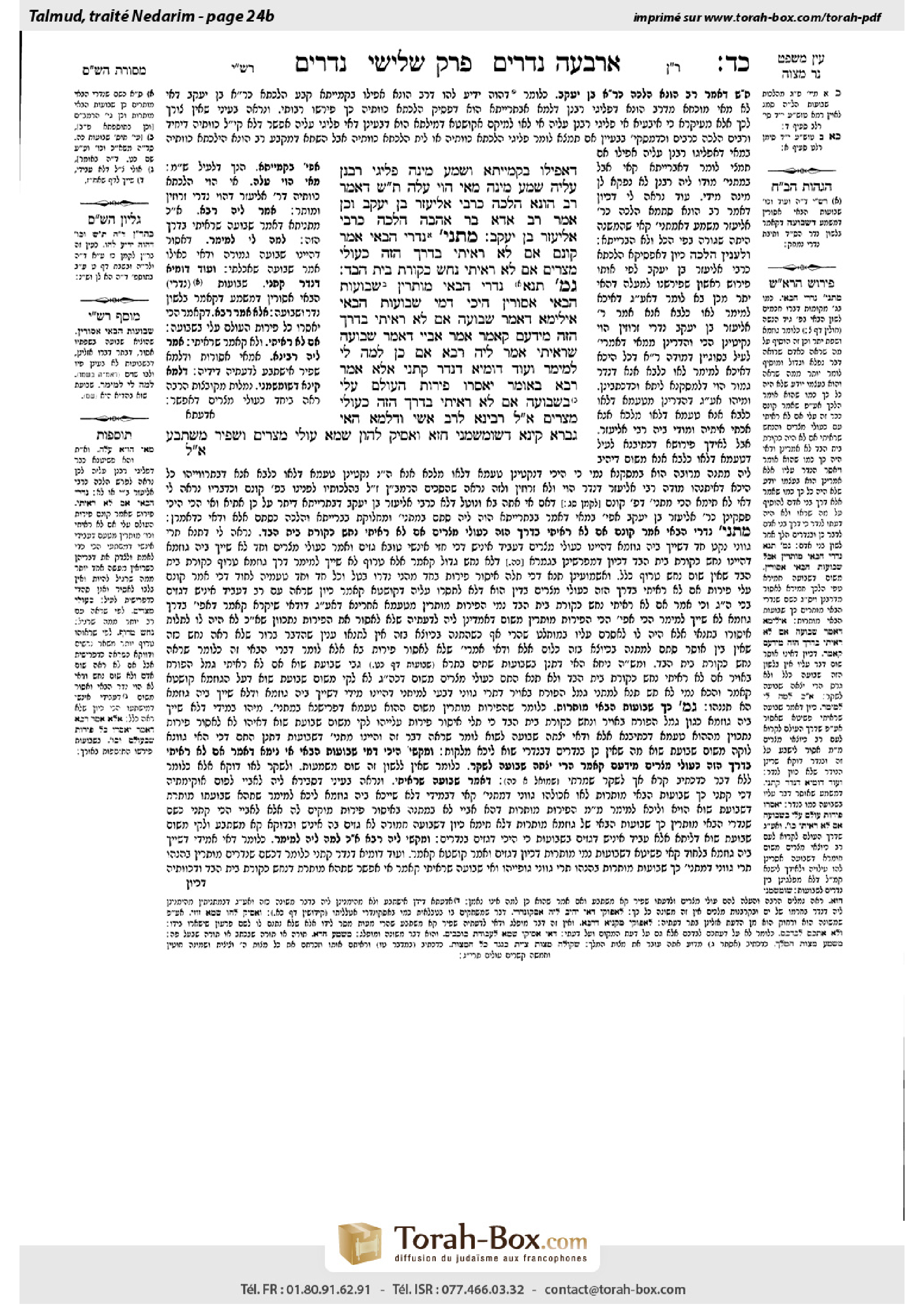
This page of Nedarim includes the Aramaic text, an English translation and an AI-generated French translation, alongside the scan above.
נדרים כ״ד ב · Aramaic and Hebrew text
דַּאֲפִילּוּ בְּקַמַּיְיתָא, וּשְׁמַע מִינַּהּ פְּלִיגִי רַבָּנַן עֲלֵיהּ. שְׁמַע מִינַּהּ.
מַאי הָוֵי עֲלַהּ? תָּא שְׁמַע, דְּאָמַר רַב הוּנָא: הֲלָכָה כְּרַבִּי אֱלִיעֶזֶר בֶּן יַעֲקֹב, וְכֵן אָמַר רַב אַדָּא בַּר אַהֲבָה: הֲלָכָה כְּרַבִּי אֱלִיעֶזֶר בֶּן יַעֲקֹב.
מַתְנִי׳ נִדְרֵי הֲבַאי, אָמַר: ״קֻוֽנָּם אִם לֹא רָאִיתִי בַּדֶּרֶךְ הַזֶּה כְּעוֹלֵי מִצְרַיִם״, ״אִם לֹא רָאִיתִי נָחָשׁ כְּקוֹרַת בֵּית הַבַּד״.
גְּמָ׳ תָּנָא: נִדְרֵי הֲבַאי — מוּתָּרִין, שָׁבוּעוֹת הֲבַאי — אֲסוּרִין.
הֵיכִי דָּמֵי שָׁבוּעוֹת הֲבַאי? אִילֵימָא דְּאָמַר ״שְׁבוּעָה אִם לֹא רָאִיתִי בַּדֶּרֶךְ הַזֶּה״ — מִידַּעַם קָאָמַר?!
אָמַר אַבָּיֵי: דְּאָמַר ״שְׁבוּעָה שֶׁרָאִיתִי״. אֲמַר לֵיהּ רָבָא: אִם כֵּן לְמָה לִי לְמֵימַר? וְעוֹד: דּוּמְיָא דְּנֶדֶר קָתָנֵי! אֶלָּא אָמַר רָבָא, בְּאוֹמֵר: ״יֵאָסְרוּ פֵּירוֹת הָעוֹלָם עָלַי בִּשְׁבוּעָה אִם לֹא רָאִיתִי בַּדֶּרֶךְ הַזֶּה כְּעוֹלֵי מִצְרַיִם״.
אֲמַר לֵיהּ רָבִינָא לְרַב אָשֵׁי: וְדִלְמָא הַאי גַּבְרָא קִינָּא דְשׁוּמְשְׁמָנֵי חֲזָא וְאַסֵּיק לְהוֹן שְׁמָא ״עוֹלֵי מִצְרַיִם״, וְשַׁפִּיר מִשְׁתְּבַע?
Nedarim 24b · English translation
mean that even in the earlier cases, where he did not become irritated, they disagree with regard to vows of exhortation and hold that these vows are indeed valid, and can one conclude from here that the Rabbis disagree with him? The Gemara concludes: Conclude from here that this is so.
With regard to the practical conclusion of this dispute, the Gemara asks: What halakhic conclusion was reached about this matter? Does the halakha follow the opinion of the Rabbis or that of Rabbi Eliezer ben Ya’akov? The Gemara answers: Come and hear that which Rav Huna said: The halakha is in accordance with the opinion of Rabbi Eliezer ben Ya’akov. And so said Rav Adda bar Ahava: The halakha is in accordance with the opinion of Rabbi Eliezer ben Ya’akov.
MISHNA: Vows of exaggeration that the Sages dissolved without a request to a halakhic authority, as described in the first mishna in the chapter, include the following examples. If one said concerning a certain item: It is konam for me if I did not see on this road as many people as those who ascended from Egypt, or if he said: It is konam for me if I did not see a snake as large as the beam of an olive press, in these cases the speaker did not intend to vow but used hyperbole to demonstrate a point, and it is understood by others that the expression is not to be taken literally.
GEMARA: A Sage taught: Items rendered forbidden through vows of exaggeration [havai] are permitted; items rendered forbidden through oaths of exaggeration are forbidden. Since oaths are very severe, one does not take an oath unless he intends it seriously. Therefore, it is not viewed as an oath of exaggeration.
The Gemara clarifies the details: What are the circumstances of the case of oaths of exaggeration? If we say that it is when one said: I take an oath if I did not see on this road as many people as those who ascended from Egypt, is he saying anything? This statement is not formulated in the form of an oath and therefore has no validity at all, even if he was serious.
The Gemara answers: Abaye said that in a case where one says: I take an oath that I saw on this road as many people as those who ascended from Egypt, the oath is valid. If he did not see that many people, he has taken a false oath. Rava said to him: If so, why do I need to say this; it is not a novelty? And furthermore, it teaches that the case of an oath is similar to that of a vow: Just as in the case of a vow he speaks of not seeing, so too with regard to an oath he must be speaking of not seeing. Rather, Rava said: An oath of exaggeration is where he says: All the produce of the world shall be forbidden to me by an oath if I did not see on this road as many people as those who ascended from Egypt.
Ravina said to Rav Ashi: And perhaps this man saw an anthill and called them: Those who ascended from Egypt, because the quantity of ants was so numerous, and he took an oath properly. Why, then, do we say that this is an oath taken in vain?
Nedarim 24b · Traduction française (IA)
Cela signifie que même dans les cas précédents, où il ne s’est pas irrité, ils sont en désaccord au sujet des vœux d’exhortation et considèrent que ces vœux sont effectivement valides. Peut-on en conclure que les Rabbins sont en désaccord avec lui ? La Guemara conclut : On peut en conclure ainsi.
Au sujet de la conclusion pratique de cette controverse, la Guemara demande : Quelle conclusion halakhique a-t-on tirée sur cette question ? La halakha suit-elle l’opinion des Rabbins ou celle de Rabbi Eliezer ben Ya’akov ? La Guemara répond : Écoute ce que Rav Huna a dit : la halakha est conforme à l’opinion de Rabbi Eliezer ben Ya’akov. Rav Adda bar Ahava a dit lui aussi : la halakha est conforme à l’opinion de Rabbi Eliezer ben Ya’akov.
MICHNA : Les vœux d’exagération que les Sages annulaient sans qu’il soit nécessaire de s’adresser à une autorité halakhique, comme le décrit la première Michna du chapitre, comprennent les exemples suivants. Si quelqu’un a dit au sujet d’un objet : « Il m’est konam si je n’ai pas vu, sur cette route, autant de personnes que celles qui sont montées d’Égypte », ou s’il a dit : « Il m’est konam si je n’ai pas vu un serpent aussi gros que la poutre d’un pressoir à olives », dans ces cas, celui qui parle n’avait pas l’intention de faire un vœu, mais a employé l’hyperbole pour illustrer son propos ; les autres comprennent que l’expression ne doit pas être prise au sens littéral.
GUEMARA : Un Sage a enseigné : Les choses interdites par des vœux d’exagération [havai] sont permises ; les choses interdites par des serments d’exagération sont interdites. Les serments étant très graves, on ne prête serment que si l’on est sérieux. Par conséquent, on ne considère pas cela comme un serment d’exagération.
La Guemara précise les détails : Dans quelles circonstances s’agit-il de serments d’exagération ? Si l’on suppose qu’il s’agit du cas où quelqu’un a dit : « Je jure que je n’ai pas vu, sur cette route, autant de personnes que celles qui sont montées d’Égypte », a-t-il dit quoi que ce soit ? Cette déclaration n’est pas formulée comme un serment et n’a donc aucune validité, même s’il était sérieux.
La Guemara répond : Abaye a dit que, dans le cas où quelqu’un déclare : « Je jure que j’ai vu, sur cette route, autant de personnes que celles qui sont montées d’Égypte », le serment est valide. S’il n’a pas vu autant de personnes, il a prêté un faux serment. Rava lui dit : Dans ce cas, pourquoi faut-il le préciser ? Cela ne présente aucune nouveauté. En outre, l’enseignement indique que le cas d’un serment est analogue à celui d’un vœu : de même que, dans le cas d’un vœu, il parle de ne pas avoir vu, de même, pour un serment, il doit parler de ne pas avoir vu. Rava dit plutôt : Un serment d’exagération est le cas où il dit : « Que tous les produits du monde me soient interdits par serment si je n’ai pas vu, sur cette route, autant de personnes que celles qui sont montées d’Égypte. »
Ravina dit à Rav Ashi : Et peut-être cet homme a-t-il vu une fourmilière et a-t-il appelé les fourmis « celles qui sont montées d’Égypte », parce qu’elles étaient si nombreuses, et a-t-il prêté un serment en bonne et due forme. Pourquoi disons-nous alors qu’il s’agit d’un serment vain ?
Traduction française générée par IA à partir de l’édition anglaise de Sefaria. Vérifie toujours un passage avec le texte source.
Text from Sefaria: William Davidson Edition - Vocalized Aramaic (CC BY NC); William Davidson Edition - English (CC BY NC).