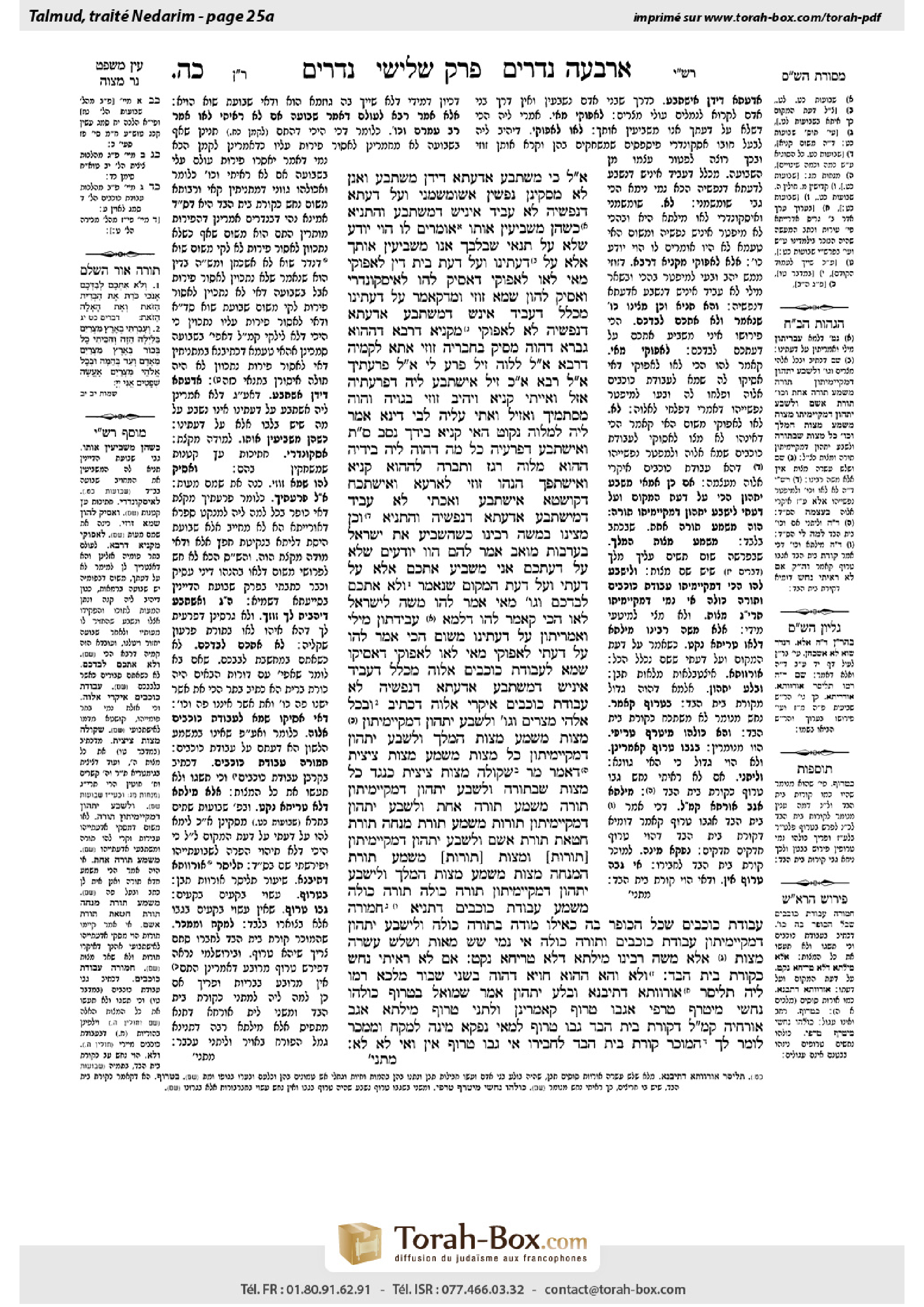
Nedarim 25a: Talmud study for Daf Yomi
Daf Yomi is the daily study of one Talmud folio. Explore 37 tractates with scans, Hebrew text, Sefaria English and AI-generated French translations where annotated.
Passage selection and English or AI-generated French translation are available where the scan has annotations. Daf Study is independent of Torah-Box and Sefaria.
Browse Nedarim · נדרים · All tractatesNedarim 25a text and translations
This page of Nedarim includes the Aramaic text, an English translation and an AI-generated French translation, alongside the scan above.
נדרים כ״ה א · Aramaic and Hebrew text
אֲמַר לֵיהּ: כִּי מִשְׁתְּבַע — אַדַּעְתָּא דִידַן מִשְׁתְּבַע, וַאֲנַן לָא מַסְּקִינַן נַפְשִׁין אַשּׁוּמְשְׁמָנֵי.
וְעַל דַּעְתָּא דְנַפְשֵׁיהּ לָא עֲבִיד אִינִישׁ דְּמִשְׁתְּבַע? וְהָתַנְיָא: כְּשֶׁהֵן מַשְׁבִּיעִין אוֹתוֹ, אוֹמְרִים לוֹ: הֱוֵי יוֹדֵעַ שֶׁלֹּא עַל תְּנַאי שֶׁבְּלִבְּךָ אָנוּ מַשְׁבִּיעִין אוֹתְךָ, אֶלָּא עַל דַּעְתֵּינוּ וְעַל דַּעַת בֵּית דִּין. לְאַפּוֹקֵי מַאי? לָאו לְאַפּוֹקֵי דְּאַסֵּיק לְהוּ לְאִיסְקוּנְדְּרֵי וְאַסֵּיק לְהוֹן שְׁמָא זוּזֵי.
וּמִדְּקָאָמַר ״עַל דַּעְתֵּינוּ״, מִכְּלָל דַּעֲבִיד אִינָשׁ דְּמִשְׁתְּבַע אַדַּעְתָּא דְנַפְשֵׁיהּ!
לָא, לְאַפּוֹקֵי מִקַּנְיָא דְרָבָא. דְּהָהוּא גַּבְרָא דַּהֲוָה מַסֵּיק בְּחַבְרֵיהּ זוּזֵי, אֲתָא לְקַמֵּיהּ דְּרָבָא. אֲמַר לֵיהּ לְלֹוֶה: זִיל פְּרַע לִי. אֲמַר לֵיהּ: פְּרַעְתִּיךָ. אֲמַר לֵיהּ רָבָא: אִם כֵּן, זִיל אִישְׁתְּבַע לֵיהּ דִּפְרַעְתֵּיהּ.
אֲזַל וְאַיְיתִי קַנְיָא, וְיָהֵיב זוּזֵי בְּגַוֵּיהּ, וַהֲוָה מִסְתְּמִיךְ וְאָזֵיל וְאָתֵי עֲלֵיהּ לְבֵי דִּינָא. אֲמַר לֵיהּ לְמַלְוֶה: נְקוֹט הַאי קַנְיָא בִּידָךְ. נְסַב סֵפֶר תּוֹרָה וְאִישְׁתְּבַע דְּפַרְעֵיהּ כֹּל מָה דַּהֲוָה לֵיהּ בִּידֵיהּ.
הָהוּא מַלְוֶה רְגַז וְתַבְרֵהּ לְהָהוּא קַנְיָא, וְאִישְׁתְּפֻךְ הָנְהוּ זוּזֵי לְאַרְעָא, וְאִישְׁתְּכַח דְּקוּשְׁטָא אִישְׁתְּבַע.
וְאַכַּתִּי לָא עֲבִיד דְּמִישְׁתְּבַע אַדַּעְתָּא דְנַפְשֵׁיהּ? וְהָתַנְיָא: וְכֵן מָצִינוּ בְּמֹשֶׁה רַבֵּינוּ כְּשֶׁהִשְׁבִּיעַ אֶת יִשְׂרָאֵל בְּעַרְבוֹת מוֹאָב, אָמַר לָהֶם: הֱווּ יוֹדְעִים שֶׁלֹּא עַל דַּעְתְּכֶם אֲנִי מַשְׁבִּיעַ אֶתְכֶם, אֶלָּא עַל דַּעְתִּי וְעַל דַּעַת הַמָּקוֹם, שֶׁנֶּאֱמַר: ״וְלֹא אִתְּכֶם לְבַדְּכֶם וְגוֹ׳״.
״מַאי אֲמַר לְהוּ מֹשֶׁה לְיִשְׂרָאֵל? לָאו הָכִי קָאָמַר לְהוּ: דִּלְמָא עָבֵידְתּוּן מִילֵּי, וְאָמְרִיתוּן: עַל דַּעְתֵּינוּ — מִשּׁוּם הָכִי אֲמַר לְהוּ: עַל דַּעְתִּי. לְאַפּוֹקֵי מַאי? לָאו לְאַפּוֹקֵי דְּאַסִּיקוּ שְׁמָא לַעֲבוֹדָה זָרָה אֱלוֹהַּ. מִכְּלָל דַּעֲבִיד אִינִישׁ דְּמִשְׁתְּבַע אַדַּעְתָּא דְנַפְשֵׁיהּ!
לָא, עֲבוֹדָה זָרָה אִיקְּרִי אֱלוֹהַּ, דִּכְתִיב: ״וּבְכָל אֱלֹהֵי מִצְרַיִם וְגוֹ׳״.
וְלַשְׁבַּע יָתְהוֹן דִּמְקַיְּימִיתוּן מִצְוֹת! מַשְׁמַע מִצְוֹת הַמֶּלֶךְ.
וְלַשְׁבַּע יָתְהוֹן דִּמְקַיְּימִיתוּן כֹּל מִצְוֹת! מַשְׁמַע מִצְוַת צִיצִית, דְּאָמַר מָר: שְׁקוּלָה מִצְוַת צִיצִית כְּנֶגֶד כׇּל מִצְוֹת שֶׁבַּתּוֹרָה.
וְלַשְׁבַּע יָתְהוֹן דִּמְקַיְּימִיתוּן תּוֹרָה! מַשְׁמַע: תּוֹרָה אַחַת. וְלַשְׁבַּע יָתְהוֹן דִּמְקַיְּימִיתוּן תּוֹרוֹת! מַשְׁמַע: תּוֹרַת מִנְחָה, תּוֹרַת חַטָּאת, תּוֹרַת אָשָׁם. וְלַשְׁבַּע יָתְהוֹן דִּמְקַיְּימִיתוּן [תּוֹרוֹת] וּמִצְוֹת! [תּוֹרוֹת] מַשְׁמַע: תּוֹרַת הַמִּנְחָה. מִצְוֹת, מַשְׁמַע: מִצְוֹת הַמֶּלֶךְ.
וְלַישְׁבַּע יָתְהוֹן דִּמְקַיְּימִיתוּן תּוֹרָה כּוּלָּהּ! תּוֹרָה כּוּלָּהּ, מַשְׁמַע: עֲבוֹדָה זָרָה. דְּתַנְיָא: חֲמוּרָה עֲבוֹדָה זָרָה, שֶׁכׇּל הַכּוֹפֵר בָּהּ — כְּאִילּוּ מוֹדֶה בַּתּוֹרָה כּוּלָּהּ.
וְלַישְׁבַּע יָתְהוֹן דִּמְקַיְּימִיתוּן עֲבוֹדָה זָרָה וְתוֹרָה כּוּלָּהּ, אִי נָמֵי: שֵׁשׁ מֵאוֹת וּשְׁלֹשׁ עֶשְׂרֵה מִצְוֹת! אֶלָּא, מֹשֶׁה רַבֵּינוּ מִילְּתָא דְּלָא טְרִיחָא נְקַט.
אִם לֹא רָאִיתִי נָחָשׁ כְּקוֹרַת בֵּית הַבַּד, וְלָא? וְהָא הָהוּא חִוְיָא דַּהֲוָה בִּשְׁנֵי שַׁבּוּר מַלְכָּא, רְמוֹ לֵיהּ תְּלֵיסַר אוּרָווֹתָא דְתִיבְנָא וּבְלַע יָתְהוֹן! אָמַר שְׁמוּאֵל: בְּטָרוּף, כּוּלְּהוּ נַחֲשֵׁי מִיטְרָף טְרִפִי! אַגַּבּוֹ טָרוּף קָאָמְרִינַן.
וְלִתְנֵי ״טָרוּף״? מִילְּתָא אַגַּב אוֹרְחֵיהּ קָא מַשְׁמַע לַן, דְּקוֹרַת בֵּית הַבַּד גַּבּוֹ טָרוּף. לְמַאי נָפְקָא מִינַּהּ? לְמִקָּח וּמִמְכָּר, לוֹמַר לָךְ: הַמּוֹכֵר קוֹרַת בֵּית הַבַּד לַחֲבֵירוֹ, אִי גַּבּוֹ טָרוּף — אִין, וְאִי לָא — לָא.
Nedarim 25a · English translation
Rav Ashi said to him: When he takes an oath, he takes an oath based on our understanding, which is that of an ordinary person, and we do not entertain the possibility in our mind that he is referring to ants [shumshemanei]. Therefore, if he took an oath in that manner, it is assumed that he referred to people, like those that left Egypt.
The Gemara asks: And does a person not take an oath according to his own understanding? There are times when one takes an oath with a particular stipulation in mind or intends a special meaning to his words. But isn’t it taught in a baraita: When the judges administer an oath to one who claims he paid a debt, they say to him: Know that we do not administer an oath to you based on a stipulation in your heart, i.e., you cannot claim that you are taking the oath based on a condition you have in mind. Rather, your oath is taken based on our understanding and on the understanding of the court. The Gemara clarifies: What does the phrase that they say to him: Based on our understanding, come to exclude? Does it not serve to exclude a case where one gave the debtor tokens [iskundarei] from a game, and in his mind he gives them the title of coins and takes an oath that he returned these coins, which is the truth based on his unspoken thoughts.
The Gemara clarifies its question: And since the baraita says that the oath taken in court is: According to our understanding, by inference it means that a person commonly takes an oath according to his own understanding and the oath would take effect according to his intent. Therefore, such a practice must be specifically excluded when taking an oath in a court.
The Gemara responds: No, this warning comes to exclude a case similar to that cane of Rava, in which a person attempts to deceive the court but does not necessarily utilize his own terminology, as there was a certain man who claimed money from another. He came before Rava to adjudicate the case. The creditor said to the borrower: Go repay me your debt. The borrower said to him: I already repaid you. Rava said to him: If so, go take an oath to him that you repaid him.
The borrower went and brought a hollow cane, and placed the money inside it, and was leaning upon it, and went leaning upon it to the court. He said to the lender: Hold this cane in your hand so that I can take an oath while holding a Torah scroll. The borrower took the Torah scroll and swore that he had repaid the entire sum that had been in his possession.
That creditor then became angry upon hearing the borrower taking a false oath and broke that cane, and all of those coins placed inside fell to the ground. And it turned out that he had taken the oath in truth, since he had returned all the money at the time of the oath by giving him the cane with the money inside. However, this was a deceitful tactic, as he intended that the creditor return the cane and the money in it to him after he had taken the oath. In order to prevent this kind of deception, the one taking the oath is warned that he must take the oath according to the understanding of the court.
The Gemara asks: And still, does a person not commonly take an oath according to his own understanding? But isn’t it taught in a baraita: And so we found with regard to Moses our teacher. When he administered an oath to the Jewish people in the plains of Moab, that they accept the Torah upon themselves, he said to them: Know that I do not administer an oath upon you according to your understanding and the stipulations in your hearts but according to my understanding and the understanding of the Omnipresent, as it is stated: “Neither with you only do I make this covenant” (Deuteronomy 29:13).
What did Moses say to Israel? Isn’t this what he said to them: Perhaps you will perform negative actions, i.e., transgressions, and say: The oath was taken according to our understanding. Due to that reason, he said to them: You take the oath according to my understanding. The Gemara clarifies: What did his warning come to exclude? Does it not serve to exclude the possibility that they give the title God, to an object of idol worship and say that this was their intention when they took an oath to worship God? The fact that Moses needed to preclude this claim indicates by inference that a person commonly takes an oath according to his own understanding.
The Gemara responds: No, idol worship is also called: God, in the Bible, as it is written: “And against all the gods of Egypt I will execute judgments” (Exodus 12:12). Therefore, this would not have been a special stipulation in their minds but a misguided intention within the oath itself. Moses suspected this and therefore issued the warning.
The Gemara asks: And why did Moses have to state the oath with this warning? Let him administer an oath to them with the words: That you will fulfill the mitzvot, which also includes the prohibition against idol worship. The Gemara answers: The word mitzvot, meaning commandments, could also indicate the commandments of the king, and this might be their intention if they were to take an oath in this manner.
The Gemara asks: And let him administer an oath to them with the words: That you will fulfill all the mitzvot. The Gemara answers: This too does not suffice, because this phrase could indicate specifically the mitzva of ritual fringes, as the Master said: The mitzva of ritual fringes is equivalent to all the mitzvot in the Torah. Consequently, if they would accept upon themselves: All the mitzvot, they may have intended to refer only to the mitzva of ritual fringes.
The Gemara asks: And let him administer an oath to them: That you fulfill the Torah. The Gemara answers: That phrase indicates only one Torah, the Written Torah and not the Oral Torah. The Gemara asks: And let him administer an oath: That you fulfill the Torahs, in the plural, to include both the Written Torah and Oral Torah. The Gemara answers: This too does not necessarily include the entire Torah, since it is possible that it indicates the Torah of the meal-offering, the Torah of the sin-offering, and the Torah of the guilt-offering. The Gemara asks: And let him administer an oath: That you fulfill the Torahs and mitzvot. The Gemara answers: This also does not include the entire Torah, because the word Torahs could indicate the Torah of the meal-offering, and mitzvot could indicate the commandments of the king.
The Gemara asks: And let him administer an oath: That you fulfill the entire Torah. The Gemara answers: Fulfilling the entire Torah could indicate specifically the denial of idol worship, which is also deemed fulfilling the entire Torah, as it is taught in a baraita: Idol worship is so severe a sin that anyone who denies it is considered as though he concedes to the truth of the entire Torah. The opposite is true for someone who worships idols. Therefore, the Jewish people could have claimed that fulfilling the entire Torah denotes nothing more than not practicing idol worship.
The Gemara asks: And let him administer an oath: That you fulfill the mitzva to distance oneself from idol worship and also fulfill the entire Torah. Or, alternatively, let Moses administer an oath that the Jewish people will fulfill six hundred thirteen mitzvot, so there will be no doubt as to their intention. Rather, Moses our teacher used an expression that was not troublesome for the Jews. Although he could have found another manner in which they could take an oath, and it would leave no doubt as to the correct intentions, he did not want to trouble them by employing a more complex method. Therefore, he administered the oath and stated that it was according to his understanding and the understanding of the Omnipresent.
§ It was taught in the mishna that if one prohibits an item with a konam vow: If I did not see a snake as large as the beam of an olive press, it is a vow of exaggeration. The Gemara asks: And is there not a snake like this? But a certain snake that lived in the days of King Shapur was so big that they threw thirteen bundles of straw and it swallowed them, so it was certainly bigger than the beam of an olive press. Shmuel said: It is speaking here of a snake that is notched, and the one who took the vow intended to say that the snake had notches in its back like the beam of an olive press. The Gemara asks: But all snakes have notches like this. The Gemara answers: We are saying that it is notched on its back, which is exceedingly rare.
The Gemara asks: And let the tanna teach explicitly that the snake was notched; why did he say: Like the beam of an olive press? The Gemara answers: He teaches us a matter in passing, which is that the back of the beam of an olive press must be notched. The Gemara asks: What is the difference whether there are notches in the beam of an olive press? The Gemara answers: For purposes of buying and selling, to tell you that one who sells the beam of an olive press to another, if its back is notched then yes, the sale is valid, and if its back is not notched and there are no slits, then it is not a valid sale, as a beam without notches is not called a beam of an olive press.
Nedarim 25a · Traduction française (IA)
Rav Ashi lui dit : Lorsqu’une personne prête serment, elle le fait selon ce que nous entendons, c’est-à-dire selon l’interprétation d’une personne ordinaire. Nous n’envisageons pas qu’elle fasse référence à des fourmis [shumshemanei]. Par conséquent, si elle a prêté serment de cette manière, on considère qu’elle faisait référence à des êtres humains, comme ceux qui sont sortis d’Égypte.
La Guemara demande : Une personne ne prête-t-elle donc pas serment selon sa propre intention ? Il arrive qu’on prête serment en ayant à l’esprit une condition particulière ou en donnant un sens particulier à ses paroles. Pourtant, n’est-il pas enseigné dans une baraïta : Lorsque les juges font prêter serment à quelqu’un qui affirme avoir remboursé une dette, ils lui disent : « Sache que nous ne te faisons pas prêter serment en fonction d’une condition que tu as dans le cœur », c’est-à-dire que tu ne peux pas prétendre prêter serment en fonction d’une condition que tu as à l’esprit. « Ton serment est plutôt prêté selon notre compréhension et celle du tribunal. » La Guemara précise : Que vient exclure la formule « selon notre compréhension » qu’ils lui adressent ? N’exclut-elle pas le cas où quelqu’un a donné au débiteur des jetons [iskundarei] d’un jeu, les a désignés dans son esprit comme des pièces de monnaie et jure qu’il a rendu ces pièces, ce qui est vrai selon ses pensées inexprimées ?
La Guemara précise sa question : Puisque la baraïta dit que le serment prêté devant le tribunal est « selon notre compréhension », cela implique qu’une personne prête habituellement serment selon sa propre compréhension et que le serment prend effet conformément à son intention. Il faut donc exclure expressément cette pratique lorsqu’on prête serment devant un tribunal.
La Guemara répond : Non, cet avertissement vient exclure un cas semblable à celui de la canne de Rava, où une personne cherche à tromper le tribunal sans nécessairement recourir à sa propre terminologie. En effet, un homme réclamait de l’argent à un autre. Il se présenta devant Rava pour que l’affaire soit jugée. Le créancier dit à l’emprunteur : « Va me rembourser ta dette. » L’emprunteur lui répondit : « Je t’ai déjà remboursé. » Rava lui dit : « Dans ce cas, va lui jurer que tu l’as remboursé. »
L’emprunteur alla chercher une canne creuse, y plaça l’argent, s’appuya dessus et se rendit ainsi au tribunal. Il dit au prêteur : « Tiens cette canne dans ta main, afin que je puisse prêter serment en tenant un rouleau de la Torah. » L’emprunteur prit le rouleau de la Torah et jura qu’il avait remboursé toute la somme qui avait été en sa possession.
Le créancier, entendant l’emprunteur prêter un faux serment, se mit alors en colère et brisa la canne ; toutes les pièces qui y étaient placées tombèrent à terre. Il apparut alors que l’emprunteur avait prêté serment en disant la vérité, puisqu’au moment du serment il avait rendu tout l’argent en lui donnant la canne qui le contenait. Cependant, c’était une manœuvre trompeuse : il comptait que le créancier lui rende la canne et l’argent qu’elle contenait après le serment. Afin d’empêcher ce genre de tromperie, on avertit celui qui prête serment qu’il doit le faire selon la compréhension du tribunal.
La Guemara demande : Pourtant, une personne ne prête-t-elle pas habituellement serment selon sa propre compréhension ? N’est-il pas enseigné dans une baraïta : Nous trouvons la même chose au sujet de Moïse notre maître. Lorsqu’il fit prêter serment au peuple juif dans les plaines de Moab, afin qu’il accepte la Torah, il lui dit : « Sachez que je ne vous fais pas prêter serment selon votre compréhension ni selon les conditions que vous avez dans le cœur, mais selon ma compréhension et celle de Celui qui est partout », comme il est dit : « Ce n’est pas avec vous seuls que je conclus cette alliance » (Deutéronome 29, 13).
Que dit Moïse à Israël ? Ne leur dit-il pas ceci : « Peut-être commettrez-vous des actes négatifs, c’est-à-dire des transgressions, et direz-vous : “Le serment a été prêté selon notre compréhension.” » C’est pourquoi il leur dit : « Vous prêtez serment selon ma compréhension. » La Guemara précise : Que vient exclure son avertissement ? N’exclut-il pas la possibilité qu’ils appellent « dieu » un objet d’idolâtrie et prétendent que telle était leur intention lorsqu’ils ont juré de servir Dieu ? Le fait que Moïse ait dû écarter cette prétention implique qu’une personne prête habituellement serment selon sa propre compréhension.
La Guemara répond : Non, dans la Bible, l’idolâtrie est également appelée « dieu », comme il est écrit : « J’exercerai des jugements contre tous les dieux de l’Égypte » (Exode 12, 12). Il ne s’agirait donc pas d’une condition particulière qu’ils auraient à l’esprit, mais d’une intention erronée contenue dans le serment lui-même. Moïse soupçonnait cette possibilité et les avertit donc.
La Guemara demande : Pourquoi Moïse devait-il formuler le serment avec cet avertissement ? Qu’il leur fasse prêter serment en disant : « Que vous accomplirez les mitsvot », ce qui inclut également l’interdiction de l’idolâtrie. La Guemara répond : Le mot mitsvot, qui signifie commandements, pourrait aussi désigner les commandements du roi ; telle aurait pu être leur intention s’ils avaient prêté serment de cette manière.
La Guemara demande : Qu’il leur fasse prêter serment en disant : « Que vous accomplirez toutes les mitsvot. » La Guemara répond : Cela ne suffit pas non plus, car cette formule pourrait désigner spécifiquement la mitsva des franges rituelles, puisque le maître a dit : « La mitsva des franges rituelles équivaut à toutes les mitsvot de la Torah. » Par conséquent, s’ils s’engageaient à accomplir « toutes les mitsvot », ils auraient pu vouloir désigner uniquement la mitsva des franges rituelles.
La Guemara demande : Qu’il leur fasse prêter serment en disant : « Que vous accomplirez la Torah. » La Guemara répond : Cette formule ne désigne qu’une seule Torah, la Torah écrite, et non la Torah orale. La Guemara demande : Qu’il leur fasse prêter serment en disant : « Que vous accomplirez les Torah », au pluriel, afin d’inclure à la fois la Torah écrite et la Torah orale. La Guemara répond : Cela n’inclut pas nécessairement toute la Torah, car cette formule peut désigner la Torah de l’offrande végétale, la Torah du sacrifice expiatoire et la Torah du sacrifice de culpabilité. La Guemara demande : Qu’il leur fasse prêter serment en disant : « Que vous accomplirez les Torah et les mitsvot. » La Guemara répond : Cela non plus n’inclut pas toute la Torah, car le mot « Torah », au pluriel, pourrait désigner la Torah de l’offrande végétale, et le mot « mitsvot » pourrait désigner les commandements du roi.
La Guemara demande : Qu’il leur fasse prêter serment en disant : « Que vous accomplirez toute la Torah. » La Guemara répond : Accomplir toute la Torah pourrait désigner spécifiquement le rejet de l’idolâtrie, qui est également considéré comme l’accomplissement de toute la Torah, comme l’enseigne une baraïta : L’idolâtrie est un péché si grave que quiconque la rejette est considéré comme s’il reconnaissait la vérité de toute la Torah. L’inverse est vrai pour celui qui pratique l’idolâtrie. Le peuple juif aurait donc pu prétendre qu’accomplir toute la Torah ne signifiait rien de plus que s’abstenir de pratiquer l’idolâtrie.
La Guemara demande : Qu’il leur fasse prêter serment d’accomplir la mitsva de s’éloigner de l’idolâtrie et d’accomplir également toute la Torah. Ou bien, que Moïse fasse prêter serment au peuple juif d’accomplir les six cent treize mitsvot, afin qu’il n’y ait aucun doute quant à leur intention. En réalité, Moïse notre maître employa une formule qui n’était pas pénible pour les Juifs. Bien qu’il aurait pu trouver une autre manière de leur faire prêter serment qui n’aurait laissé aucun doute quant à leurs intentions véritables, il ne voulut pas les incommoder en recourant à une méthode plus complexe. Il leur fit donc prêter serment en précisant que celui-ci était selon sa compréhension et celle de Celui qui est partout.
§ Il a été enseigné dans la Michna que si quelqu’un formule un vœu de konam au sujet d’un objet en disant : « Si je n’ai pas vu un serpent aussi grand que la poutre d’un pressoir à olives », il s’agit d’un vœu exagéré. La Guemara demande : Mais n’existe-t-il pas un serpent de cette taille ? Un certain serpent, qui vivait à l’époque du roi Shapur, était si grand qu’on lui jeta treize bottes de paille et qu’il les avala ; il était donc certainement plus grand que la poutre d’un pressoir à olives. Shmuel dit : Il est question ici d’un serpent entaillé, et celui qui a formulé le vœu voulait dire que le serpent avait sur le dos des entailles semblables à celles de la poutre d’un pressoir à olives. La Guemara demande : Mais tous les serpents ont de telles entailles. La Guemara répond : Nous parlons d’un serpent entaillé sur le dos, ce qui est extrêmement rare.
La Guemara demande : Pourquoi le tanna n’enseigne-t-il pas explicitement que le serpent était entaillé ? Pourquoi dit-il : « comme la poutre d’un pressoir à olives » ? La Guemara répond : Il nous enseigne incidemment une chose, à savoir que l’arrière de la poutre d’un pressoir à olives doit être entaillé. La Guemara demande : Quelle différence cela fait-il que la poutre d’un pressoir à olives ait des entailles ? La Guemara répond : Cela a une conséquence en matière d’achat et de vente : on t’apprend que lorsqu’une personne vend à une autre une poutre de pressoir à olives, si son arrière est entaillé, la vente est valable ; mais si son arrière n’est pas entaillé et qu’il n’y a pas de fentes, la vente n’est pas valable, car une poutre sans entailles n’est pas appelée une poutre de pressoir à olives.
Traduction française générée par IA à partir de l’édition anglaise de Sefaria. Vérifie toujours un passage avec le texte source.
Text from Sefaria: William Davidson Edition - Vocalized Aramaic (CC BY NC); William Davidson Edition - English (CC BY NC).