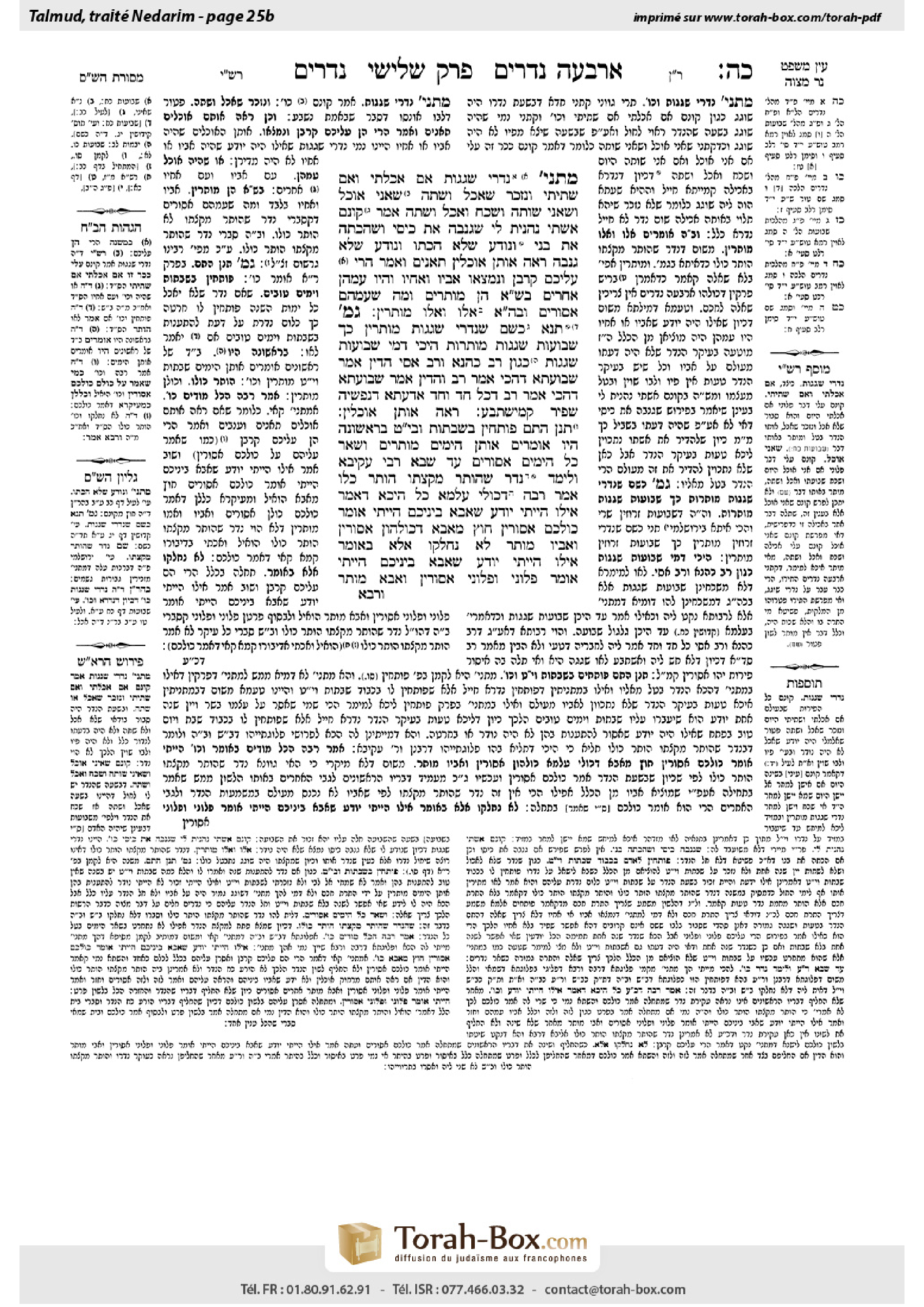
Nedarim 25b: Talmud study for Daf Yomi
Daf Yomi is the daily study of one Talmud folio. Explore 37 tractates with scans, Hebrew text, Sefaria English and AI-generated French translations where annotated.
Passage selection and English or AI-generated French translation are available where the scan has annotations. Daf Study is independent of Torah-Box and Sefaria.
Browse Nedarim · נדרים · All tractatesNedarim 25b text and translations
This page of Nedarim includes the Aramaic text, an English translation and an AI-generated French translation, alongside the scan above.
נדרים כ״ה ב · Aramaic and Hebrew text
מַתְנִי׳ נִדְרֵי שְׁגָגוֹת — ״אִם אָכַלְתִּי וְאִם שָׁתִיתִי״, וְנִזְכַּר שֶׁאָכַל וְשָׁתָה. ״שֶׁאֲנִי אוֹכֵל וְשֶׁאֲנִי שׁוֹתֶה״, וְשָׁכַח וְאָכַל וְשָׁתָה. אָמַר: ״קֻוֽנָּם אִשְׁתִּי נֶהֱנֵית לִי שֶׁגָּנְבָה אֶת כִּיסִי, וְשֶׁהִכְּתָה אֶת בְּנִי״, וְנוֹדַע שֶׁלֹּא הִכַּתּוּ, וְנוֹדַע שֶׁלֹּא גָּנְבָה.
רָאָה אוֹתָן אוֹכְלִין תְּאֵנִים, וְאָמַר: ״הֲרֵי עֲלֵיכֶם קׇרְבָּן״, וְנִמְצְאוּ אָבִיו וְאָחִיו וְהָיוּ עִמָּהֶן אֲחֵרִים. בֵּית שַׁמַּאי אוֹמְרִים: הֵן מוּתָּרִים, וּמַה שֶּׁעִמָּהֶם — אֲסוּרִים. וּבֵית הִלֵּל אוֹמְרִים: אֵלּוּ וָאֵלּוּ מוּתָּרִין.
גְּמָ׳ תָּנָא: כְּשֵׁם שֶׁנִּדְרֵי שְׁגָגוֹת מוּתָּרִין, כָּךְ שְׁבוּעוֹת שְׁגָגוֹת מוּתָּרוֹת. הֵיכִי דָּמֵי שְׁבוּעוֹת שְׁגָגוֹת? כְּגוֹן רַב כָּהֲנָא וְרַב אַסִּי, הָדֵין אָמַר: שְׁבוּעֲתָא דְּהָכִי אָמַר רַב, וְהָדֵין אָמַר: שְׁבוּעֲתָא דְּהָכִי אָמַר רַב. דְּכֹל חַד וְחַד אַדַּעְתָּא דְנַפְשֵׁיהּ שַׁפִּיר קָמִישְׁתְּבַע.
רָאָה אוֹתָן אוֹכְלִין. תְּנַן הָתָם: פּוֹתְחִין בְּשַׁבָּתוֹת וּבְיָמִים טוֹבִים. בָּרִאשׁוֹנָה הָיוּ אוֹמְרִים: אוֹתָן הַיָּמִים — מוּתָּרִים, וּשְׁאָר כׇּל הַיָּמִים — אֲסוּרִים, עַד שֶׁבָּא רַבִּי עֲקִיבָא וְלִימֵּד: נֶדֶר שֶׁהוּתַּר מִקְצָתוֹ הוּתַּר כֻּלּוֹ.
אָמַר רַבָּה: דְּכוּלֵּי עָלְמָא, כֹּל הֵיכָא דְּאָמַר: אִילּוּ הָיִיתִי יוֹדֵעַ שֶׁאַבָּא בֵּינֵיכֶם, הָיִיתִי אוֹמֵר ״כּוּלְּכֶם אֲסוּרִין חוּץ מֵאַבָּא״, דְּכוּלְּהוֹן אֲסוּרִין וְאָבִיו מוּתָּר. לֹא נֶחְלְקוּ אֶלָּא בְּאוֹמֵר: אִילּוּ הָיִיתִי יוֹדֵעַ שֶׁאַבָּא בֵּינֵיכֶם, הָיִיתִי אוֹמֵר: ״פְּלוֹנִי וּפְלוֹנִי אֲסוּרִין וְאַבָּא מוּתָּר״.
Nedarim 25b · English translation
MISHNA: What are examples of vows that are unintentional that are dissolved, as taught at the beginning of the chapter? One who vows: This loaf is forbidden to me as if it were an offering [konam] if I ate or if I drank, and then he remembers that he ate or drank. Or, one who vows: This loaf is konam for me if I will eat or if I will drink, and he then forgets and eats or drinks. Also, one who said: Benefiting from me is konam for my wife because she stole my purse or she hit my son, and then it became known that she had not hit him or it became known that she had not stolen.
The mishna lists another example of an unintentional vow: One who saw people entering his courtyard and eating figs, and because he did not want them to do so he said: The figs are forbidden to you like an offering. And then it was found that his father and brother were in the group, and there were others with them as well, and certainly he did not intend to take a vow prohibiting his father and brother from eating the figs. In such a case, Beit Shammai says: They, his father and brother, are permitted to eat the figs, and those others that were with them are prohibited from doing so. And Beit Hillel says: Both these and those are permitted to eat the figs, as will be clarified in the Gemara.
GEMARA: The Sages taught: Just as vows that are unintentional are dissolved, so too, oaths that are unintentional are dissolved. The Gemara asks: What are the circumstances of unintentional oaths? For example, as in the incident of Rav Kahana and Rav Asi, who disagreed about a halakha. During the dispute this one said: I take an oath that Rav said like this opinion that I hold. And that one said: I take an oath that Rav said like this opinion that I hold. This is an unintentional oath, as each one took an oath properly in his own mind and was sure that he was saying the truth.
With regard to the mishna’s statement: One who saw them eating, the Gemara states that we learned in a mishna there (66a): If one vows to fast or not to eat a certain food, dissolution is broached based on Shabbatot and based on Festivals, since one certainly did not intend to include these days when taking the vow. Initially, they used to say: On those days, Shabbatot and Festivals, which he did not include in his vow, he is permitted to partake of the item, and on all other days he is prohibited from doing so. This was the case until Rabbi Akiva came and taught: A vow that was partially dissolved is dissolved completely. Therefore, one is permitted to partake on other days well.
Rabba said: Everyone in the mishna, i.e., Beit Shammai and Beit Hillel, holds that wherever one says: Had I known that my father was among you I would have said: All of you are prohibited from eating figs except for father, then in that case all are prohibited from doing so and his father is permitted to do so. They disagreed only in an instance where one said: Had I known that my father was among you then I would have said: So-and-so and so-and-so, i.e., all the others, are prohibited from eating figs and father is permitted to do so.
Nedarim 25b · Traduction française (IA)
MICHNA : Quels sont les exemples de vœux involontaires qui sont annulés, comme cela a été enseigné au début du chapitre ? Celui qui fait le vœu suivant : « Cette miche m’est interdite comme une offrande [konam] si j’ai mangé ou si j’ai bu », puis se souvient qu’il a mangé ou bu. Ou celui qui fait le vœu suivant : « Cette miche m’est interdite comme une offrande [konam] si je mange ou si je bois », puis oublie et mange ou boit. De même, celui qui a dit : « Tirer profit de moi est interdit à ma femme comme une offrande [konam], parce qu’elle a volé ma bourse ou qu’elle a frappé mon fils », puis apprend qu’elle ne l’avait pas frappé ou qu’elle n’avait pas volé.
La Michna énumère un autre exemple de vœu involontaire : celui qui a vu des gens entrer dans sa cour et manger des figues et qui, ne voulant pas qu’ils agissent ainsi, a dit : « Les figues vous sont interdites comme une offrande. » Puis il s’est avéré que son père et son frère se trouvaient parmi eux, accompagnés d’autres personnes ; il est certain qu’il n’avait pas l’intention d’interdire à son père et à son frère de manger les figues. Dans un tel cas, Beit Chammaï dit : son père et son frère peuvent manger les figues, tandis que les autres qui étaient avec eux n’en ont pas le droit. Et Beit Hillel dit : aussi bien ceux-ci que ceux-là peuvent manger les figues, comme cela sera précisé dans la Guemara.
GUEMARA : Les Sages ont enseigné : de même que les vœux involontaires sont annulés, les serments involontaires le sont également. La Guemara demande : Dans quelles circonstances s’agit-il de serments involontaires ? Par exemple, dans le cas de Rav Kahana et Rav Asi, qui étaient en désaccord au sujet d’une halakha. Au cours de leur dispute, l’un a dit : « Je jure que Rav a soutenu l’opinion que je défends. » Et l’autre a dit : « Je jure que Rav a soutenu l’opinion que je défends. » Il s’agit d’un serment involontaire, car chacun a juré en toute bonne foi et était certain de dire la vérité.
À propos de la déclaration de la Michna : « Celui qui les a vus manger », la Guemara rapporte que nous avons appris dans une Michna, là-bas (66a) : si quelqu’un fait le vœu de jeûner ou de ne pas manger un aliment donné, on lui propose l’annulation en invoquant les Chabbatot et les fêtes, puisqu’il n’avait certainement pas l’intention d’inclure ces jours lorsqu’il a fait son vœu. Au début, on disait que, ces jours-là — les Chabbatot et les fêtes qu’il n’avait pas inclus dans son vœu —, il lui était permis de consommer l’aliment, mais que tous les autres jours, cela lui était interdit. Il en fut ainsi jusqu’à ce que Rabbi Akiva vienne enseigner : un vœu qui a été annulé en partie est annulé dans son intégralité. Par conséquent, il lui est également permis de consommer l’aliment les autres jours.
Rabba a dit : tous les avis de la Michna, c’est-à-dire ceux de Beit Chammaï et de Beit Hillel, s’accordent à dire que si quelqu’un dit : « Si j’avais su que mon père était parmi vous, j’aurais dit : “Vous tous, à l’exception de mon père, n’avez pas le droit de manger des figues” », alors, dans ce cas, tous les autres n’ont pas le droit d’en manger et son père en a le droit. Leur désaccord ne porte que sur le cas où quelqu’un a dit : « Si j’avais su que mon père était parmi vous, j’aurais dit : “Un tel et un tel, c’est-à-dire tous les autres, n’ont pas le droit de manger des figues, tandis que mon père en a le droit.” »
Traduction française générée par IA à partir de l’édition anglaise de Sefaria. Vérifie toujours un passage avec le texte source.
Text from Sefaria: William Davidson Edition - Vocalized Aramaic (CC BY NC); William Davidson Edition - English (CC BY NC).