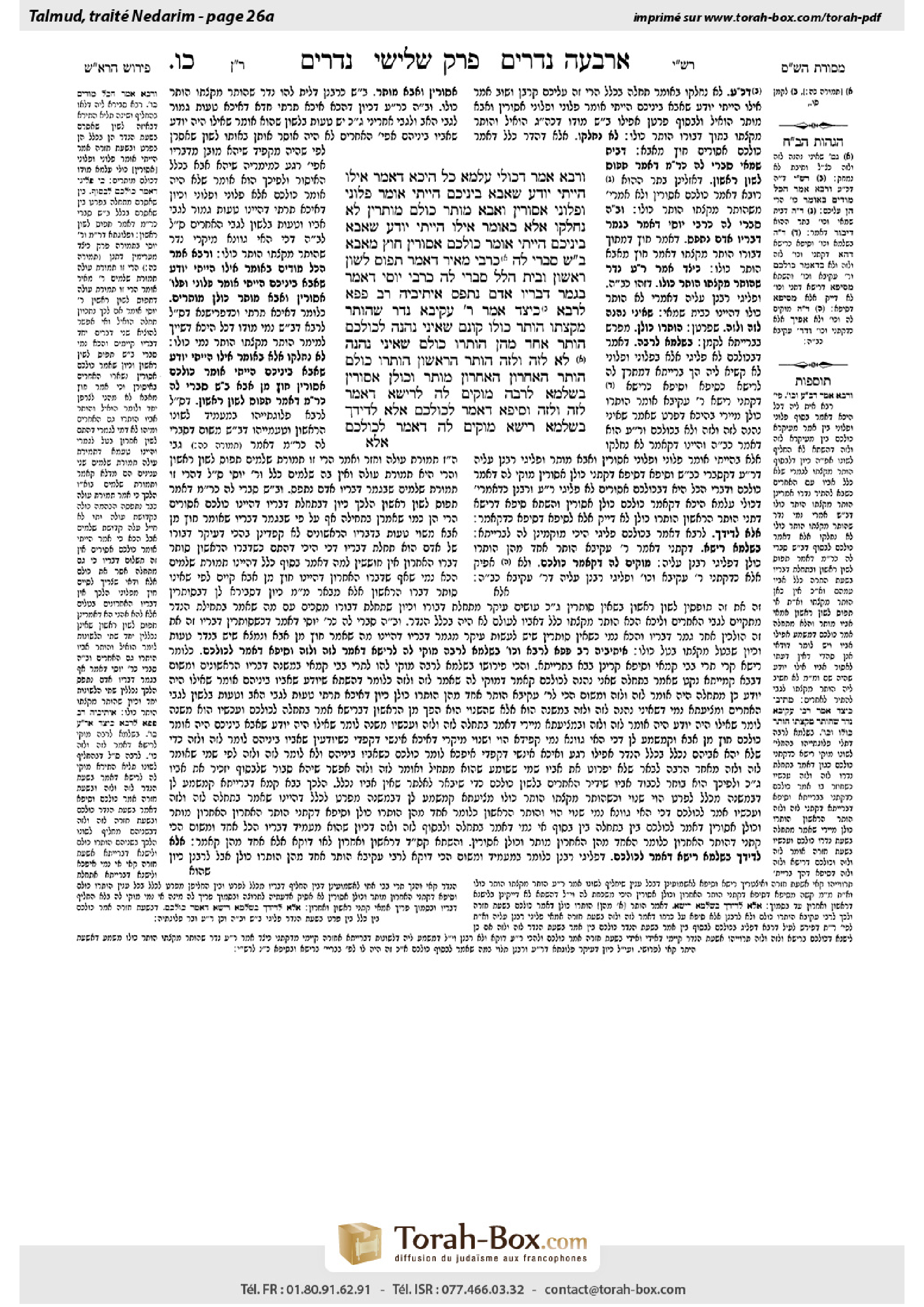
Nedarim 26a: Talmud study for Daf Yomi
Daf Yomi is the daily study of one Talmud folio. Explore 37 tractates with scans, Hebrew text, Sefaria English and AI-generated French translations where annotated.
Passage selection and English or AI-generated French translation are available where the scan has annotations. Daf Study is independent of Torah-Box and Sefaria.
Browse Nedarim · נדרים · All tractatesNedarim 26a text and translations
This page of Nedarim includes the Aramaic text, an English translation and an AI-generated French translation, alongside the scan above.
נדרים כ״ו א · Aramaic and Hebrew text
וְרָבָא אָמַר: דְּכוּלֵּי עָלְמָא, כֹּל הֵיכָא דְּאָמַר: אִילּוּ הָיִיתִי יוֹדֵעַ שֶׁאַבָּא בֵּינֵיכֶם הָיִיתִי אוֹמֵר: ״פְּלוֹנִי וּפְלוֹנִי אֲסוּרִין וְאַבָּא מוּתָּר״ — כּוּלָּם מוּתָּרִין. לֹא נֶחְלְקוּ אֶלָּא בְּאוֹמֵר: אִילּוּ הָיִיתִי יוֹדֵעַ שֶׁאַבָּא בֵּינֵיכֶם, הָיִיתִי אוֹמֵר: ״כּוּלְּכֶם אֲסוּרִין חוּץ מֵאַבָּא״.
בֵּית שַׁמַּאי סָבְרִי לַהּ כְּרַבִּי מֵאִיר, דְּאָמַר: תְּפוֹס לָשׁוֹן רִאשׁוֹן.
וּבֵית הִלֵּל סָבְרִי לַהּ כְּרַבִּי יוֹסֵי, דְּאָמַר: בִּגְמַר דְּבָרָיו אָדָם נִתְפָּס.
אֵיתִיבֵיהּ רַב פָּפָּא לְרָבָא: כֵּיצַד אָמַר רַבִּי עֲקִיבָא נֶדֶר שֶׁהוּתַּר מִקְצָתוֹ הוּתַּר כּוּלּוֹ? ״קֻוֽנָּם שֶׁאֵינִי נֶהֱנֶה לְכוּלְּכֶם״, הוּתַּר אֶחָד מֵהֶן — הוּתְּרוּ כּוּלָּם. ״שֶׁאֵינִי נֶהֱנֶה לֹא לָזֶה וְלָזֶה״, הוּתַּר הָרִאשׁוֹן — הוּתְּרוּ כּוּלָּם, הוּתַּר הָאַחֲרוֹן — הָאַחֲרוֹן מוּתָּר וְכוּלָּן אֲסוּרִין.
בִּשְׁלָמָא לְרַבָּה, מוֹקֵים לֵהּ לְרֵישָׁא, דְּאָמַר לָזֶה וְלָזֶה.
וְסֵיפָא — דְּאָמַר ״לְכוּלְּכֶם״.
אֶלָּא לְדִידָךְ: בִּשְׁלָמָא רֵישָׁא מוֹקֵים לֵהּ דְּאָמַר ״לְכוּלְּכֶם״.
Nedarim 26a · English translation
And Rava said: Everyone holds that anywhere that one says: Had I known that father was among you I would have said: So-and-so and so-and-so are prohibited to partake and father is permitted to do so, then all are permitted to partake. They disagree only in a case where one says: Had I known that father was among you I would have said: All of you are prohibited from partaking except for father.
The rationale of the dispute is the following: Beit Shammai hold in accordance with the opinion of Rabbi Meir, who said: If one initially makes one declaration and immediately afterward makes a conflicting declaration, hold him accountable for the first expression. Since he initially said: All of you are prohibited from partaking, this expression is the effective one and they are all prohibited from doing so. The addition of the words: Except for father, is viewed as a clarification of the previous expression, simply indicating that his father is not included in the prohibition.
And by contrast, Beit Hillel hold in accordance with the opinion of Rabbi Yosei, who said: A person is held accountable even for the conclusion of his statement, and the second formulation is the primary one. Therefore, the fact that one altered his formulation to exclude his father from the prohibition means that the vow is partially canceled, and a vow that is partially dissolved is dissolved completely.
Rav Pappa raised an objection to Rava from the following mishna (66a): In what case did Rabbi Akiva say that a vow which was partially dissolved is dissolved completely? For example, if one said: The property of all of you is konam for me, and for that reason I will not benefit from it, if benefit from one of them was permitted for whatever reason, benefit from all of them is permitted. However, if one said: The property of this one and of that one is konam for me, and for that reason I will not benefit from it, then if benefit from the first one was permitted for whatever reason, benefit from all of them is permitted, but if benefit from the last one was permitted, benefit from the last one alone is permitted and benefit from all the others is forbidden.
Rav Pappa explains his objection: Rabba stated that when one qualifies his words by saying: I would have said all of you are prohibited from partaking except father, then all agree that everyone except his father is prohibited from doing so, but that when he adds to his words by saying: I would have said that so-and-so and so-and-so are prohibited from partaking and father is permitted to do so, there is a dispute between Beit Shammai and Beit Hillel. Granted, according to the opinion of Rabba, he establishes Rabbi Akiva’s first clause, where benefit from all is permitted, as a case where he retracts and says: I meant to say that the property of this one and of that one, but not that of so-and-so, is konam for me, which accords with the opinion of Beit Hillel.
And the last clause of the mishna, in which benefit from the last one alone is permitted, but benefit from all the others remains forbidden, is a case where he retracts and says: The property of all of you is konam for me except for that of one of you. According to the opinion of Rabba, both Beit Shammai and Beit Hillel would agree that in this case the one who stated the vow is permitted to benefit only from the one excluded from the vow.
But according to you, Rava, who holds that if he said: I would have said that so-and-so and so-and-so are prohibited to partake and father is permitted to do so, all concede that everyone is permitted to partake, and that the dispute pertains to when one says: I would have said that all of you are prohibited to partake except for father, granted, he establishes the first clause of Rabbi Akiva’s statement as a case where he retracts and says: The property of all of you is konam for me except for that of father, and benefit from all is permitted, in accordance with the opinion of Beit Hillel.
Nedarim 26a · Traduction française (IA)
Et Rava dit : Tous sont d’accord que, si quelqu’un dit : « Si j’avais su que mon père était parmi vous, j’aurais dit : Untel et untel n’ont pas le droit d’en profiter, mais mon père y est autorisé », alors tous ont le droit d’en profiter. Leur désaccord porte uniquement sur le cas où il dit : « Si j’avais su que mon père était parmi vous, j’aurais dit : Vous tous n’avez pas le droit d’en profiter, à l’exception de mon père. »
La raison de leur désaccord est la suivante : Beit Chammaï suivent l’opinion de Rabbi Meïr, qui dit que, si quelqu’un fait d’abord une déclaration, puis en fait immédiatement une autre qui la contredit, on le tient pour lié par sa première formulation. Puisqu’il a d’abord dit : « Vous tous n’avez pas le droit d’en profiter », c’est cette formulation qui fait foi, et il leur est donc à tous interdit d’en profiter. L’ajout des mots « à l’exception de mon père » est considéré comme une précision de la formulation précédente, indiquant simplement que son père n’est pas inclus dans l’interdit.
À l’inverse, Beit Hillel suivent l’opinion de Rabbi Yossé, qui dit qu’une personne est tenue par la conclusion de sa déclaration également, et que la seconde formulation est la principale. Par conséquent, le fait qu’il ait reformulé sa déclaration pour exclure son père de l’interdit signifie que le vœu est annulé en partie ; or, un vœu annulé en partie est annulé entièrement.
Rav Pappa objecta à Rava en citant la Michna suivante (66a) : Dans quel cas Rabbi Akiva a-t-il dit qu’un vœu annulé en partie est annulé entièrement ? Par exemple, si quelqu’un dit : « Les biens de vous tous me sont konam, et c’est pourquoi je n’en tirerai aucun profit », si, pour une raison quelconque, il est autorisé à tirer profit des biens de l’un d’entre eux, il est autorisé à tirer profit des biens de tous. En revanche, s’il dit : « Les biens de celui-ci et de celui-là me sont konam, et c’est pourquoi je n’en tirerai aucun profit », alors, si, pour une raison quelconque, il est autorisé à tirer profit des biens du premier, il est autorisé à tirer profit des biens de tous ; mais si l’autorisation de tirer profit concerne le dernier, il est autorisé à tirer profit des biens de celui-ci uniquement, et il lui est interdit de tirer profit des biens de tous les autres.
Rav Pappa explique son objection : Rabba a déclaré que, lorsque quelqu’un précise ses propos en disant : « J’aurais dit : Vous tous n’avez pas le droit d’en profiter, à l’exception de mon père », tous conviennent que tous, sauf son père, n’ont pas le droit d’en profiter ; mais que, lorsqu’il précise ses propos en disant : « J’aurais dit qu’untel et untel n’ont pas le droit d’en profiter, mais que mon père y est autorisé », Beit Chammaï et Beit Hillel sont en désaccord. Certes, selon l’opinion de Rabba, il interprète la première clause de l’enseignement de Rabbi Akiva, où l’autorisation de tirer profit des biens de tous est accordée, comme un cas où il revient sur ses paroles et dit : « Je voulais dire que les biens de celui-ci et de celui-là, mais pas ceux d’untel, me sont konam », ce qui correspond à l’opinion de Beit Hillel.
Et la dernière clause de la Michna, où l’autorisation de tirer profit des biens du dernier uniquement est accordée, tandis qu’il reste interdit d’en tirer profit de tous les autres, concerne le cas où il revient sur ses paroles et dit : « Les biens de vous tous me sont konam, à l’exception de ceux de l’un d’entre vous. » Selon l’opinion de Rabba, Beit Chammaï comme Beit Hillel conviendraient que, dans ce cas, celui qui a prononcé le vœu n’est autorisé à tirer profit que des biens de celui qui a été exclu du vœu.
Mais selon toi, Rava, qui soutiens que, s’il a dit : « J’aurais dit qu’untel et untel n’ont pas le droit d’en profiter, mais que mon père y est autorisé », tous reconnaissent que tous ont le droit d’en profiter, et que leur désaccord porte sur le cas où il dit : « J’aurais dit que vous tous n’avez pas le droit d’en profiter, à l’exception de mon père », certes, tu interprètes la première clause de l’enseignement de Rabbi Akiva comme un cas où il revient sur ses paroles et dit : « Les biens de vous tous me sont konam, à l’exception de ceux de mon père », auquel cas l’autorisation de tirer profit des biens de tous est accordée, conformément à l’opinion de Beit Hillel.
Traduction française générée par IA à partir de l’édition anglaise de Sefaria. Vérifie toujours un passage avec le texte source.
Text from Sefaria: William Davidson Edition - Vocalized Aramaic (CC BY NC); William Davidson Edition - English (CC BY NC).