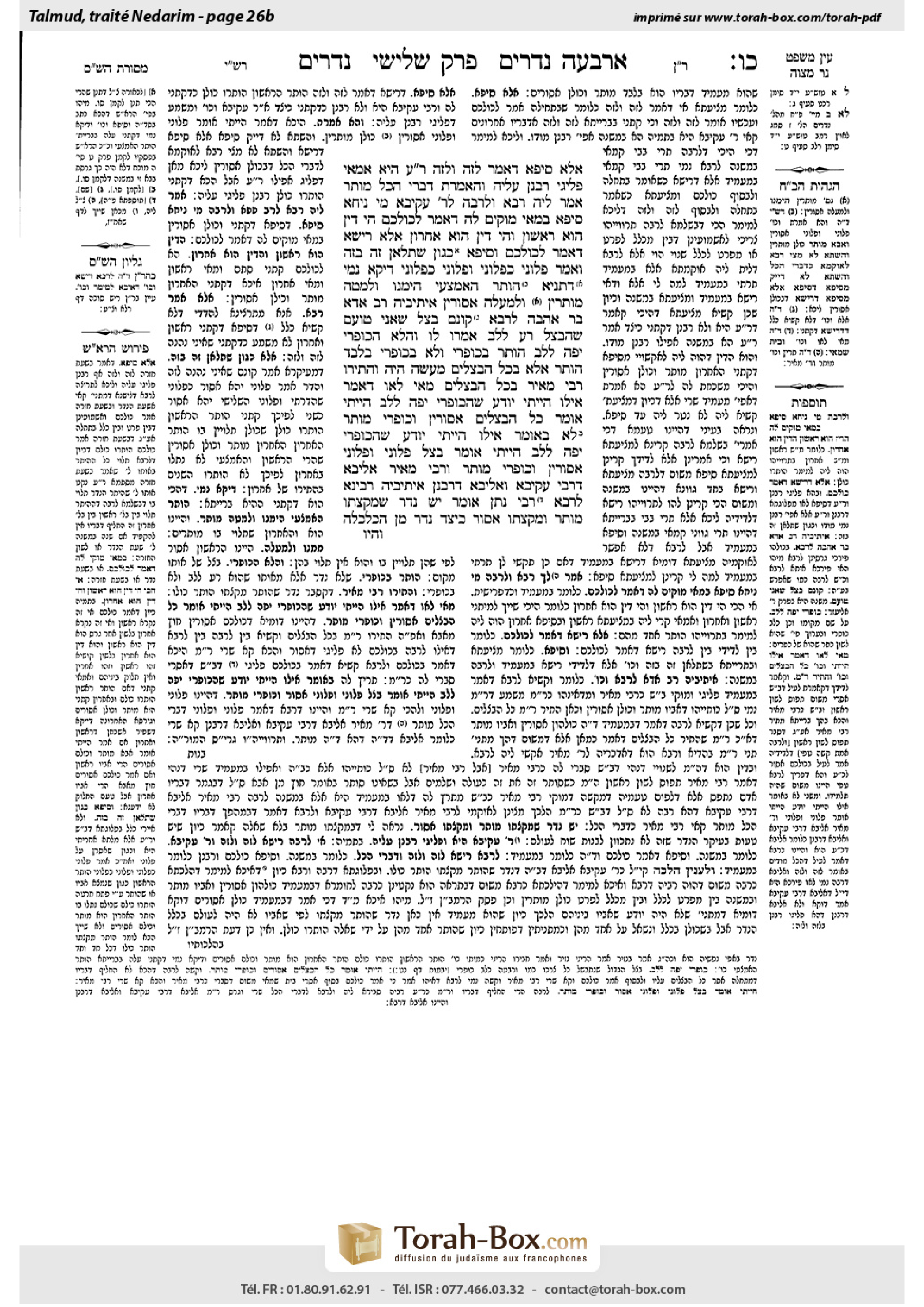
Nedarim 26b: Talmud study for Daf Yomi
Daf Yomi is the daily study of one Talmud folio. Explore 37 tractates with scans, Hebrew text, Sefaria English and AI-generated French translations where annotated.
Passage selection and English or AI-generated French translation are available where the scan has annotations. Daf Study is independent of Torah-Box and Sefaria.
Browse Nedarim · נדרים · All tractatesNedarim 26b text and translations
This page of Nedarim includes the Aramaic text, an English translation and an AI-generated French translation, alongside the scan above.
נדרים כ״ו ב · Aramaic and Hebrew text
אֶלָּא סֵיפָא, דְּאָמַר ״לָזֶה וְלָזֶה״, רַבִּי עֲקִיבָא הִיא, אַמַּאי פְּלִיגִי רַבָּנַן עֲלֵיהּ? וְהָאָמְרַתְּ דִּבְרֵי הַכֹּל מוּתָּר!
אֲמַר לֵיהּ רָבָא: וּלְרַבָּה לְרַבִּי עֲקִיבָא מִי נִיחָא סֵיפָא? בְּמַאי מוֹקֵים לֵהּ — דְּאָמַר ״לְכוּלְּכֶם״, הֵי דֵין הוּא רִאשׁוֹן וְהֵי דֵין הוּא אַחֲרוֹן?
אֶלָּא: רֵישָׁא דְּאָמַר ״לְכוּלְּכֶם״, וְסֵיפָא, כְּגוֹן שֶׁתְּלָאָן זֶה בָּזֶה, וְאָמַר: ״פְּלוֹנִי כִּפְלוֹנִי, וּפְלוֹנִי כִּפְלוֹנִי״.
דַּיְקָא נָמֵי, דְּתַנְיָא: הוּתַּר הָאֶמְצָעִי — הֵימֶנּוּ וּלְמַטָּה מוּתָּרִין, וּלְמַעְלָה — אֲסוּרִין.
אֵיתִיבֵיהּ רַב אַדָּא בַּר אַהֲבָה לְרָבָא: ״קֻוֽנָּם בָּצָל שֶׁאֲנִי טוֹעֵם, שֶׁהַבָּצָל רַע לַלֵּב״. אָמְרוּ לוֹ: וַהֲלֹא הַכּוּפְרִי יָפֶה לַלֵּב! הוּתַּר בַּכּוּפְרִי. וְלֹא בַּכּוּפְרִי בִּלְבַד הוּתַּר, אֶלָּא בְּכׇל הַבְּצָלִים. מַעֲשֶׂה הָיָה, וְהִתִּירוֹ רַבִּי מֵאִיר בְּכׇל הַבְּצָלִים.
מַאי לָאו, דְּאָמַר: אִילּוּ הָיִיתִי יוֹדֵעַ שֶׁהַכּוּפְרִי יָפֶה לַלֵּב, הָיִיתִי אוֹמֵר ״כׇּל הַבְּצָלִים אֲסוּרִין וְכוּפְרִי מוּתָּר״?
לֹא, בְּאוֹמֵר: אִילּוּ הָיִיתִי יוֹדֵעַ שֶׁהַכּוּפְרִי יָפֶה לַלֵּב, הָיִיתִי אוֹמֵר: ״בָּצָל פְּלוֹנִי וּפְלוֹנִי אֲסוּרִין וְכוּפְרִי מוּתָּר״. וְרַבִּי מֵאִיר אַלִּיבָּא דְּרַבִּי עֲקִיבָא וְאַלִּיבָּא דְרַבָּנַן.
אֵיתִיבֵיהּ רָבִינָא לְרָבָא: רַבִּי נָתָן אוֹמֵר: יֵשׁ נֶדֶר שֶׁמִּקְצָתוֹ מוּתָּר וּמִקְצָתוֹ אָסוּר. כֵּיצַד? נָדַר מִן הַכַּלְכַּלָּה,
Nedarim 26b · English translation
But as the latter clause of that mishna, in the case where he said: I intended to prohibit eating figs to this one and to that one, and they are all permitted to do so, is the opinion of Rabbi Akiva, which is evident from the fact that this halakha is cited in his name, then according to your opinion why do the Rabbis disagree with him? But haven’t you said that all agree that they are all permitted to partake when the one who took the vow explains that he meant: To this one and to that one?
Rava said to Rav Pappa: And according to Rabba, whose opinion you are supporting with this objection, does the latter clause work out well according to Rabbi Akiva? In what case does he establish it? In a case where one retracted and said: From all of you, which of them is the first one and which of them is the last one? The mishna stated that if benefit from the last one was permitted, benefit from the last one alone is permitted and benefit from all the others is forbidden. If he is now saying: From all of you, who is the first and who is the last?
Rather, Rava explains as follows: The first clause is referring to where he said: From all of you, and this follows the opinion of Beit Hillel, who say, according to Rava, that the entire vow is dissolved. And in the latter clause, i.e., the last two cases, it is referring to where he did not specify: From this one and from that one, but where, for example, he linked them to one another and said: So-and-so should be prohibited to partake like so-and-so, and so-and-so like so-and-so, but there is no general prohibition on all of them. Rather, each prohibition is linked to another one. Therefore, if the prohibition pertaining to the first individual is dissolved, then all those prohibitions linked to that one are dissolved as well.
The Gemara comments: The language is also precise, as it is taught in a baraita concerning this mishna: If the middle one in this chain of people prohibited by the vow from partaking was permitted to do so, then from him and below, i.e., those who were mentioned after him, are permitted to partake, and from him and above, i.e., those who were mentioned before him, are prohibited from partaking. This indicates that the mishna speaks about a case where the prohibitions are linked together. Therefore, the prohibition is dissolved for those who were mentioned after that individual whose prohibition is dissolved.
Rav Adda bar Ahava raised an objection to Rava: The mishna (66a) states that if one says: Onions are konam for me, and for that reason I will not taste them, because onions are bad for the heart, and others said to him: But isn’t the kuferi onion good for the heart, the vow is dissolved with regard to kuferi onions, and not only with regard to kuferi onions is it dissolved, but with regard to all types of onions. The mishna relates that an incident of this kind occurred, and Rabbi Meir dissolved the vow with regard to all types of onions.
What, is it not speaking here of a case where that person said: Had I known that the kuferi onion is good for the heart I would have said: All onions are forbidden and the kuferi onion is permitted? This would be difficult for Rabba, who argues in similar cases that all opinions maintain that the other onions are forbidden, as well as for Rava, who would hold that only Beit Shammai, who follow the opinion of Rabbi Meir, maintain that all onions are forbidden in this type of case, and yet here Rabbi Meir himself permits all types of onions.
The Gemara responds: No, this should be explained as a case where one says: If I had known that the kuferi onion is good for the heart, I would have said: Such an onion and such an onion are forbidden to me and the kuferi onion is permitted, and the opinion of Rabbi Meir is in accordance with the opinion of Rabbi Akiva and also in accordance with the opinion of the Rabbis. This is because, according to Rava, when one says: This one and that one, all agree that everything is permitted.
Ravina raised an objection to Rava: Rabbi Natan says there is a vow that is partially dissolved and partially binding. How so? One who took a vow that benefit from all the items in a basket be forbidden to him,
Nedarim 26b · Traduction française (IA)
Mais si la dernière clause de cette Michna, dans le cas où il a dit : « J’entendais interdire de manger des figues à celui-ci et à celui-là », et où elles leur sont toutes permises, exprime l’avis de Rabbi Akiva — comme le montre le fait que cette halakha est citée en son nom —, pourquoi les Rabbins sont-ils en désaccord avec lui, selon toi ? N’as-tu pas dit que tous conviennent qu’ils peuvent tous en manger lorsque celui qui a prononcé le vœu explique qu’il voulait dire : « À celui-ci et à celui-là » ?
Rava dit à Rav Pappa : Et selon Rabba, dont tu défends l’avis par cette objection, la dernière clause s’accorde-t-elle avec l’avis de Rabbi Akiva ? Dans quel cas l’interprète-t-il ? Dans le cas où l’intéressé s’est repris et a dit : « De vous tous » ; mais alors, qui d’entre eux est le premier et qui est le dernier ? La Michna enseigne que si l’interdiction concernant le dernier a été levée, seul celui-ci est autorisé à tirer profit, tandis qu’il reste interdit d’en tirer profit pour tous les autres. Mais s’il dit maintenant : « De vous tous », qui est le premier et qui est le dernier ?
Rava explique plutôt les choses ainsi : la première clause se rapporte au cas où il a dit : « De vous tous », et suit l’avis de Beit Hillel, qui, selon Rava, soutiennent que tout le vœu est annulé. Quant à la dernière clause, c’est-à-dire les deux derniers cas, elle se rapporte au cas où il n’a pas précisé : « De celui-ci et de celui-là », mais où, par exemple, il les a liés les uns aux autres en disant : « Untel ne pourra pas en profiter comme Untel, et Untel comme Untel », sans interdire globalement l’accès à tous. Au contraire, chaque interdiction est liée à une autre. Par conséquent, si l’interdiction concernant le premier individu est levée, toutes celles qui lui sont liées le sont également.
La Guemara fait remarquer que le libellé est également précis, car une baraïta enseigne au sujet de cette Michna : si l’interdiction concernant la personne située au milieu de cette chaîne, à qui le vœu interdit de tirer profit, est levée, les personnes qui viennent après elle, c’est-à-dire celles qui ont été mentionnées après elle, sont autorisées à tirer profit ; celles qui viennent avant elle, c’est-à-dire celles qui ont été mentionnées avant elle, en sont empêchées. Cela indique que la Michna traite d’un cas où les interdictions sont liées entre elles. Par conséquent, l’interdiction est levée pour ceux qui ont été mentionnés après l’individu dont l’interdiction est levée.
Rav Adda bar Ahava soulève une objection contre Rava : la Michna (66a) enseigne que si quelqu’un dit : « Les oignons me sont konam, et pour cette raison je n’en goûterai pas, car les oignons sont mauvais pour le cœur », et que d’autres lui disent : « Mais l’oignon kuferi n’est-il pas bon pour le cœur ? », le vœu est levé en ce qui concerne les oignons kuferi ; et il n’est pas seulement levé en ce qui concerne les oignons kuferi, mais aussi en ce qui concerne toutes les sortes d’oignons. La Michna rapporte qu’un incident de ce genre s’est produit et que Rabbi Meir a levé le vœu en ce qui concerne toutes les sortes d’oignons.
N’est-il pas question ici du cas où cette personne a dit : « Si j’avais su que l’oignon kuferi est bon pour le cœur, j’aurais dit : “Tous les oignons sont interdits et l’oignon kuferi est permis” » ? Cela poserait problème à Rabba, qui soutient, dans des cas semblables, que, selon tous les avis, les autres oignons restent interdits. Cela poserait également problème à Rava, selon qui seuls Beit Shammaï, qui suivent l’avis de Rabbi Meir, soutiennent que, dans un tel cas, tous les oignons restent interdits. Pourtant, ici, Rabbi Meir lui-même permet toutes les sortes d’oignons.
La Guemara répond : Non, il faut expliquer qu’il s’agit du cas où quelqu’un dit : « Si j’avais su que l’oignon kuferi est bon pour le cœur, j’aurais dit : “Tel oignon et tel autre oignon me sont interdits, et l’oignon kuferi est permis” ». L’avis de Rabbi Meir s’accorde alors avec celui de Rabbi Akiva comme avec celui des Rabbins. En effet, selon Rava, lorsque quelqu’un dit : « Celui-ci et celui-là », tous conviennent que tout est permis.
Ravina soulève une objection contre Rava : Rabbi Natan dit qu’il existe un vœu qui est partiellement levé et partiellement maintenu. Comment cela ? Quelqu’un a prononcé un vœu interdisant que les objets d’un panier lui procurent le moindre profit,
Traduction française générée par IA à partir de l’édition anglaise de Sefaria. Vérifie toujours un passage avec le texte source.
Text from Sefaria: William Davidson Edition - Vocalized Aramaic (CC BY NC); William Davidson Edition - English (CC BY NC).