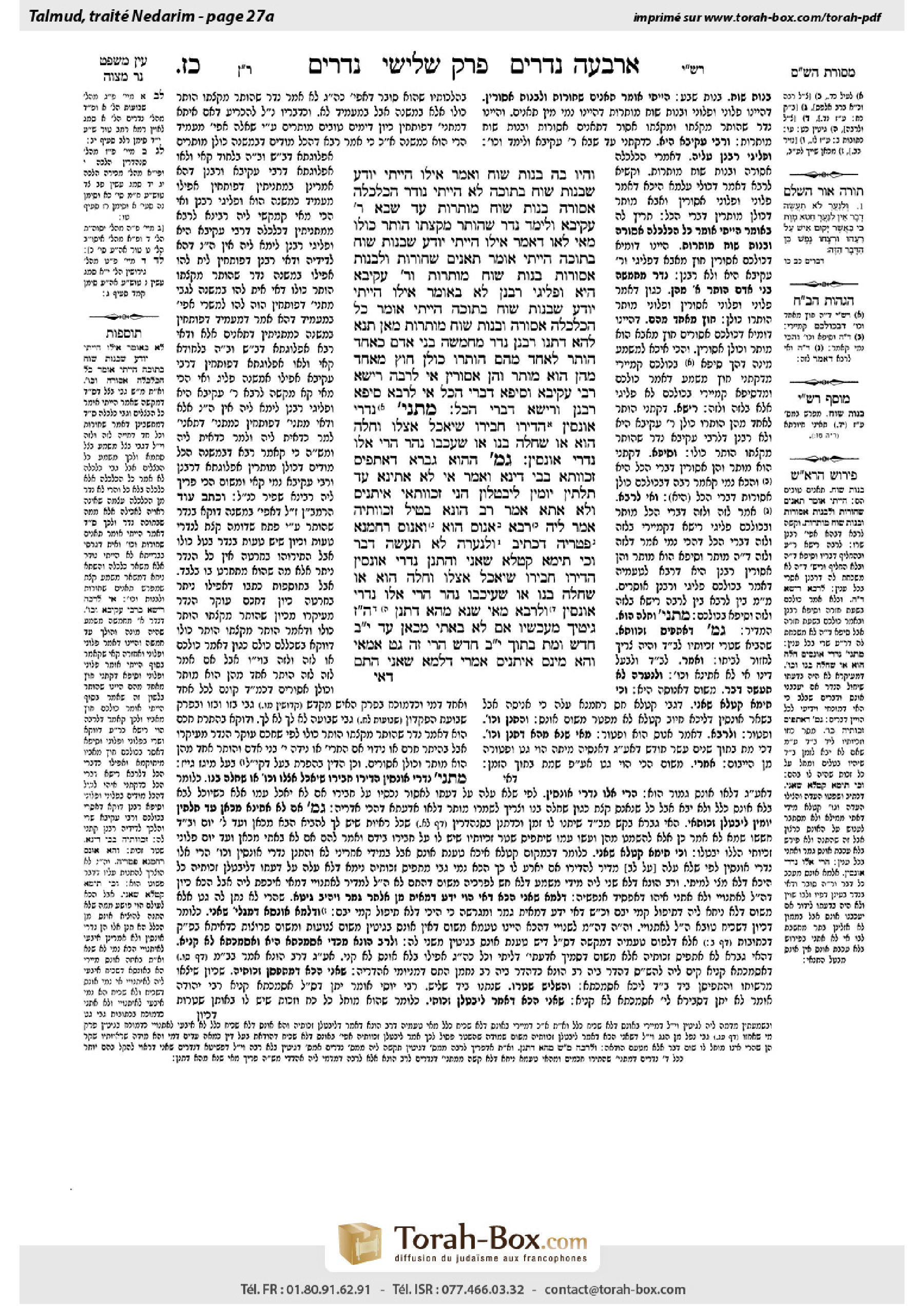
Nedarim 27a: Talmud study for Daf Yomi
Daf Yomi is the daily study of one Talmud folio. Explore 37 tractates with scans, Hebrew text, Sefaria English and AI-generated French translations where annotated.
Passage selection and English or AI-generated French translation are available where the scan has annotations. Daf Study is independent of Torah-Box and Sefaria.
Browse Nedarim · נדרים · All tractatesNedarim 27a text and translations
This page of Nedarim includes the Aramaic text, an English translation and an AI-generated French translation, alongside the scan above.
נדרים כ״ז א · Aramaic and Hebrew text
וְהָיוּ בָּהּ בְּנוֹת שׁוּחַ, וְאָמַר: ״אִילּוּ הָיִיתִי יוֹדֵעַ שֶׁבְּנוֹת שׁוּחַ בְּתוֹכָהּ, לֹא הָיִיתִי נוֹדֵר״ — הַכַּלְכַּלָּה אֲסוּרָה, בְּנוֹת שׁוּחַ מוּתָּרוֹת. עַד שֶׁבָּא רַבִּי עֲקִיבָא וְלִימֵּד: נֶדֶר שֶׁהוּתַּר מִקְצָתוֹ — הוּתַּר כּוּלּוֹ. מַאי לָאו, דְּאָמַר אִילּוּ הָיִיתִי יוֹדֵעַ שֶׁבְּנוֹת שׁוּחַ בְּתוֹכָהּ, הָיִיתִי אוֹמֵר ״תְּאֵנִים שְׁחוֹרוֹת וּלְבָנוֹת אֲסוּרוֹת, בְּנוֹת שׁוּחַ מוּתָּרוֹת״, וְרַבִּי עֲקִיבָא הִיא, וּפְלִיגִי רַבָּנַן?
לָא, בְּאוֹמֵר: אִילּוּ הָיִיתִי יוֹדֵעַ שֶׁבְּנוֹת שׁוּחַ בְּתוֹכָהּ, הָיִיתִי אוֹמֵר: ״כׇּל הַכַּלְכַּלָּה אֲסוּרָה, וּבְנוֹת שׁוּחַ מוּתָּרוֹת״.
מַאן תְּנָא לְהָא דְּתָנוּ רַבָּנַן: נָדַר מֵחֲמִשָּׁה בְּנֵי אָדָם כְּאֶחָד, הוּתַּר לְאֶחָד מֵהֶם — הוּתְּרוּ כּוּלָּן. ״חוּץ מֵאֶחָד מֵהֶן״ — הוּא מוּתָּר, וְהֵן אֲסוּרִין.
אִי לְרַבָּה, רֵישָׁא רַבִּי עֲקִיבָא וְסֵיפָא דִּבְרֵי הַכֹּל. אִי לְרָבָא, סֵיפָא רַבָּנַן וְרֵישָׁא דִּבְרֵי הַכֹּל.
מַתְנִי׳ נִדְרֵי אוֹנָסִין, הִדִּירוֹ חֲבֵירוֹ שֶׁיֹּאכַל אֶצְלוֹ, וְחָלָה הוּא אוֹ שֶׁחָלָה בְּנוֹ אוֹ שֶׁעִכְּבוֹ נָהָר — הֲרֵי אֵלּוּ נִדְרֵי אוֹנָסִין.
גְּמָ׳ הָהוּא גַּבְרָא דְּאַתְפֵּיס זָכְווֹתָא בְּבֵי דִינָא, וְאָמַר: אִי לָא אָתֵינָא עַד תְּלָתִין יוֹמִין, לִיבַּטְלוּן הָנֵי זָכְווֹתַאי. אִיתְּנִיס וְלָא אֲתָא. אֲמַר רַב הוּנָא: בְּטִיל זָכְווֹתֵיהּ.
אֲמַר לֵיהּ רָבָא: אָנוּס הוּא, וְאָנוּס רַחֲמָנָא פַּטְרֵיהּ, דִּכְתִיב: ״וְלַנַּעֲרָה לֹא תַעֲשֶׂה דָבָר״.
וְכִי תֵּימָא קְטָלָא שָׁאנֵי, וְהָתְנַן: נִדְרֵי אוֹנָסִין, הִדִּירוֹ חֲבֵירוֹ שֶׁיֹּאכַל אֶצְלוֹ, וְחָלָה הוּא אוֹ שֶׁחָלָה בְּנוֹ אוֹ שֶׁעִיכְּבוֹ נָהָר — הֲרֵי אֵלּוּ נִדְרֵי אוֹנָסִין!
וּלְרָבָא, מַאי שְׁנָא מֵהָא דִּתְנַן: ״הֲרֵי זֶה גִּיטֵּיךְ מֵעַכְשָׁיו אִם לֹא בָּאתִי מִכָּאן עַד שְׁנֵים עָשָׂר חֹדֶשׁ״, וּמֵת בְּתוֹךְ שְׁנֵים עָשָׂר חֹדֶשׁ — הֲרֵי זֶה גֵּט. אַמַּאי? וְהָא מֵינָס אִיתְּנִיס! אָמְרִי: דִּלְמָא שָׁאנֵי הָתָם
Nedarim 27a · English translation
and there were benot shuaḥ in it, and he said: Had I known that there were benot shuaḥ in it I would not have taken a vow, the basket and the remaining figs inside are forbidden, while the benot shuaḥ are permitted. This was the accepted ruling until Rabbi Akiva came and taught: A vow which is dissolved partially is dissolved completely. Therefore, all of the produce is permitted. What, is it not referring to a case where one said: Had I known that benot shuaḥ were inside it, I would have said that black and white figs are forbidden, and benot shuaḥ are permitted, and this is the opinion of Rabbi Akiva, and the Rabbis disagree with him? But according to Rava everyone agrees that all the produce is permitted in a case like this.
The Gemara responds: No, it is possible to say that it is speaking of a case where he says: Had I known that there were benot shuaḥ in it I would have said that the entire basket is forbidden and the benot shuaḥ are permitted, which is the opinion of Rabbi Akiva according to Rava.
The Gemara asks: Who is the tanna who taught that which the Sages taught: With regard to one who took a vow, in one utterance, prohibiting himself from deriving benefit from five people, if the vow is dissolved for one of them, then the vow concerning all of them is dissolved; but if he retracted and said: I am prohibited to derive benefit from all of these individuals except for one of them, then he, i.e., that individual who was excluded, is permitted and they, the others, are forbidden?
The Gemara explains two possibilities: If one says that it is in accordance with the explanation of Rabba, then the first clause is referring to a case where after having taken a vow prohibiting himself from deriving benefit from all five people, he retracted and said: Benefit from this one and from that one are forbidden but benefit from one is permitted, and it is in accordance with the opinion of Rabbi Akiva, that a vow which is dissolved partially is dissolved completely. And the latter clause is where he adds to the initial vow by stating: Except for one of them, and everyone agrees that only that one is permitted. If one says that it is in accordance with the explanation of Rava, the latter clause is in accordance with the opinion of the Rabbis, and everyone agrees with the ruling of the first clause.
MISHNA: What are examples of vows impeded by circumstances beyond one’s control? If one’s friend took a vow with regard to him that he should eat with him, and he became sick, or his son became sick, or a river that he was unable to cross barred him from coming, these are examples of vows whose fulfillment are impeded by circumstances beyond one’s control. They are not binding and do not require dissolution.
GEMARA: The Gemara relates that there was a certain man who had a dispute in court with another individual and wanted to postpone the trial to a later time in order to search for more evidence. Meanwhile, he deposited his documents for a favorable verdict, i.e., that supported his claim, in court, and since the other litigant did not believe that he would return, the man said: If I do not come back within thirty days, these documents for a favorable verdict will be void. He was impeded by circumstances beyond his control and did not come back. Rav Huna said: His documents for a favorable verdict are void since he did not return by the specified time.
Rava said to him: He is a victim of circumstances beyond his control and the halakha is that the Merciful One exempted a victim of circumstances beyond his control from responsibility for his actions, as it is written concerning a young woman who was raped: “But unto the damsel you shall do nothing; there is in the damsel no sin worthy of death” (Deuteronomy 22:26).
And if you would say that with regard to the penalty of death, which is extremely severe, the halakha is different, and she is treated leniently and not executed, but with regard to other transgressions one’s actions are treated as deliberate, but didn’t we learn in the mishna here: What are examples of vows whose fulfillment are impeded by circumstances beyond one’s control? If one’s friend took a vow with regard to him that he should eat with him, and he became sick, or his son became sick, or a river that he was unable to cross barred him from coming, these are examples of vows whose fulfillment are impeded by circumstances beyond one’s control; they are not binding and do not require dissolution. This demonstrates that even here the exemption due to circumstances beyond one’s control should apply.
The Gemara asks: And according to Rava, in what way is it different from that which we learned in a mishna (Gittin 76b): If a man says to his wife: This is your bill of divorce from now if I do not arrive from now until the conclusion of twelve months, and he died within those twelve months, this document is a valid bill of divorce from the time of his declaration. Why? But he was a victim of circumstances beyond his control, as death is the ultimate example of this? The Gemara answers: Say that perhaps it is different there,
Nedarim 27a · Traduction française (IA)
et qu’il s’y trouvait des benot shuaḥ, et qu’il dit : « Si j’avais su qu’il s’y trouvait des benot shuaḥ, je n’aurais pas fait de vœu », le panier et les autres figues qu’il contient sont interdits, tandis que les benot shuaḥ sont permises. Telle était la décision admise jusqu’à ce que Rabbi Akiva vienne enseigner : « Un vœu qui est annulé en partie est annulé entièrement. » Par conséquent, tous les fruits sont permis. N’est-ce pas là un cas où il dit : « Si j’avais su qu’il s’y trouvait des benot shuaḥ, j’aurais dit que les figues noires et blanches sont interdites et que les benot shuaḥ sont permises » ? Telle est l’opinion de Rabbi Akiva, tandis que les Rabbins sont en désaccord avec lui. Mais, selon Rava, tous reconnaissent que, dans un tel cas, tous les fruits sont permis.
La Guemara répond : Non, on peut dire qu’il s’agit d’un cas où il dit : « Si j’avais su qu’il s’y trouvait des benot shuaḥ, j’aurais dit que tout le panier est interdit et que les benot shuaḥ sont permises », ce qui correspond à l’opinion de Rabbi Akiva selon Rava.
La Guemara demande : Quel est le tanna qui a enseigné ce que les Sages ont enseigné : Celui qui, en une seule déclaration, fait le vœu de s’interdire de tirer profit de cinq personnes, si son vœu est annulé à l’égard de l’une d’elles, est annulé à l’égard de toutes ; mais s’il revient sur ses paroles et dit : « Il m’est interdit de tirer profit de toutes ces personnes, sauf de l’une d’elles », alors cette personne, c’est-à-dire celle qui a été exclue, lui est permise, tandis que les autres lui sont interdites ?
La Guemara expose deux possibilités. Si l’on dit que cela suit l’explication de Rabba, alors la première partie concerne le cas où, après avoir fait le vœu de s’interdire de tirer profit des cinq personnes, il revient sur ses paroles et dit : « Il m’est interdit de tirer profit de celui-ci et de celui-là, mais il m’est permis d’en tirer profit d’un seul », conformément à l’opinion de Rabbi Akiva, selon laquelle un vœu annulé en partie est annulé entièrement. La dernière partie concerne le cas où il ajoute au vœu initial en précisant : « Sauf l’un d’eux » ; tous reconnaissent alors que seul celui-là lui est permis. Si l’on dit que cela suit l’explication de Rava, la dernière partie est conforme à l’opinion des Rabbins, et tous s’accordent avec la décision énoncée dans la première partie.
MICHNA : Quels sont des exemples de vœux dont l’accomplissement est empêché par des circonstances indépendantes de la volonté de la personne ? Si un ami a fait à son sujet le vœu qu’il mangerait avec lui, et que l’intéressé tombe malade, que son fils tombe malade, ou qu’une rivière qu’il ne peut traverser l’empêche de venir, ce sont des exemples de vœux dont l’accomplissement est empêché par des circonstances indépendantes de la volonté de la personne. Ces vœux ne sont pas contraignants et n’ont pas besoin d’être annulés.
GUEMARA : La Guemara rapporte qu’un homme était en litige devant un tribunal avec un autre homme et voulait reporter le procès à une date ultérieure afin de chercher des preuves supplémentaires. Entre-temps, il déposa au tribunal les documents qui appuyaient sa demande et lui étaient favorables. Comme l’autre plaideur ne croyait pas qu’il reviendrait, l’homme dit : « Si je ne reviens pas dans les trente jours, ces documents qui me sont favorables seront nuls. » Des circonstances indépendantes de sa volonté l’empêchèrent de revenir. Rav Houna dit : Ses documents qui lui étaient favorables sont nuls, puisqu’il n’est pas revenu dans le délai fixé.
Rava lui dit : Il est victime de circonstances indépendantes de sa volonté, et la halakha est que le Miséricordieux a exonéré de responsabilité pour ses actes la personne victime de telles circonstances, comme il est écrit au sujet d’une jeune fille violée : « Mais à la jeune fille, tu ne feras rien ; la jeune fille n’a commis aucun péché passible de mort » (Deutéronome 22:26).
Et si tu dis que, s’agissant de la peine de mort, qui est extrêmement sévère, la halakha est différente : on fait preuve d’indulgence envers elle et on ne l’exécute pas, tandis que, pour les autres transgressions, les actes d’une personne sont considérés comme délibérés ; n’avons-nous pas appris dans notre Michna : « Quels sont des exemples de vœux dont l’accomplissement est empêché par des circonstances indépendantes de la volonté de la personne ? Si un ami a fait à son sujet le vœu qu’il mangerait avec lui, et que l’intéressé tombe malade, que son fils tombe malade, ou qu’une rivière qu’il ne peut traverser l’empêche de venir, ce sont des exemples de vœux dont l’accomplissement est empêché par des circonstances indépendantes de la volonté de la personne ; ces vœux ne sont pas contraignants et n’ont pas besoin d’être annulés. » Cela montre que, même dans ce cas, l’exemption liée à des circonstances indépendantes de sa volonté devrait s’appliquer.
La Guemara demande : Et selon Rava, en quoi cela diffère-t-il de ce que nous avons appris dans une Michna (Guittin 76b) : Si un homme dit à sa femme : « Voici ton acte de divorce, qui prendra effet dès maintenant si je ne reviens pas d’ici à la fin des douze mois », et qu’il meurt au cours de ces douze mois, ce document constitue un acte de divorce valide à compter du moment où il a fait cette déclaration. Pourquoi ? N’était-il pas victime de circonstances indépendantes de sa volonté, la mort étant l’exemple ultime de telles circonstances ? La Guemara répond : Dis plutôt que, peut-être, la situation est différente là-bas,
Traduction française générée par IA à partir de l’édition anglaise de Sefaria. Vérifie toujours un passage avec le texte source.
Text from Sefaria: William Davidson Edition - Vocalized Aramaic (CC BY NC); William Davidson Edition - English (CC BY NC).