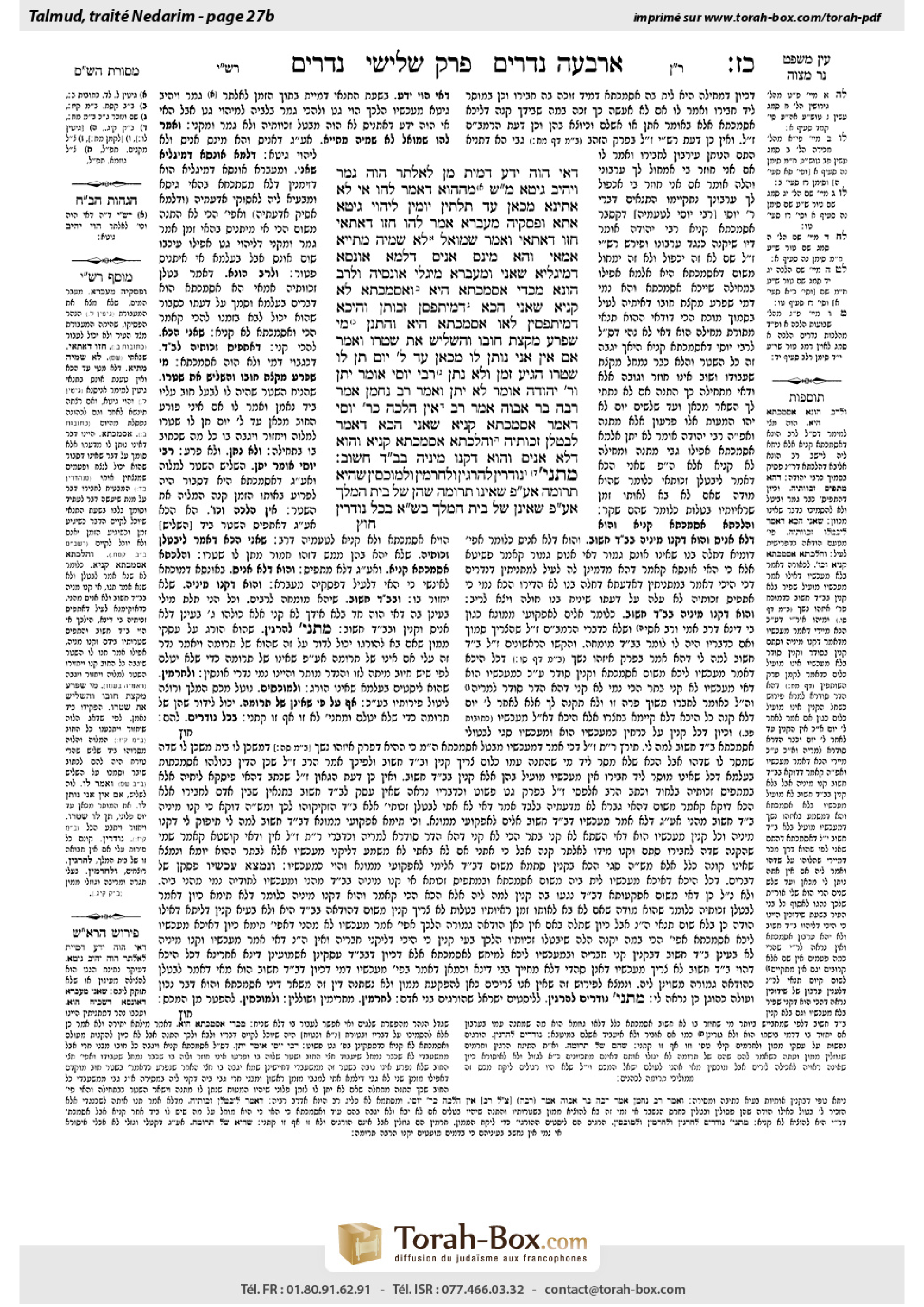
Nedarim 27b: Talmud study for Daf Yomi
Daf Yomi is the daily study of one Talmud folio. Explore 37 tractates with scans, Hebrew text, Sefaria English and AI-generated French translations where annotated.
Passage selection and English or AI-generated French translation are available where the scan has annotations. Daf Study is independent of Torah-Box and Sefaria.
Browse Nedarim · נדרים · All tractatesNedarim 27b text and translations
This page of Nedarim includes the Aramaic text, an English translation and an AI-generated French translation, alongside the scan above.
נדרים כ״ז ב · Aramaic and Hebrew text
דְּאִי הֲוָה יָדַע דְּמִית, מִן לְאַלְתַּר הֲוָה גָּמַר וְיָהֵיב גִּיטָּא.
מַאי שְׁנָא מֵהָהוּא דַּאֲמַר לְהוּ: אִי לָא אָתֵינָא מִכָּאן עַד תְּלָתִין יוֹמִין לֶיהֱוֵי גִּיטָּא. אֲתָא וּפַסְקֵיהּ מַעְבָּרָא. אֲמַר לְהוּ: חֲזוֹ דַּאֲתַאי, חֲזוֹ דַּאֲתַאי! וַאֲמַר שְׁמוּאֵל: לָא שְׁמֵיהּ מֵתְיָיא. אַמַּאי? וְהָא מֵינָס אֲנִיס!
דִּלְמָא אוּנְסָא דְּמִיגַּלְּיָא שָׁאנֵי, וּמַעְבָּרָא מִיגַּלֵּי אוּנְסֵיהּ.
וּלְרַב הוּנָא, מִכְּדִי אַסְמַכְתָּא הִיא. וְאַסְמַכְתָּא לָא קָנְיָא! שָׁאנֵי הָכָא דְּמִיתַּפְסָן זָכְוָתֵיהּ.
וְהֵיכָא דְּמִיתַּפְסִין לָאו אַסְמַכְתָּא הִיא? וְהָתְנַן: מִי שֶׁפָּרַע מִקְצָת חוֹבוֹ, וְהִשְׁלִישׁ אֶת שְׁטָרוֹ, וְאָמַר: אִם אֵין אֲנִי נוֹתֵן לוֹ מִכָּאן עַד שְׁלֹשִׁים יוֹם — תֵּן לוֹ שְׁטָרוֹ.
הִגִּיעַ זְמַן וְלֹא נָתַן, רַבִּי יוֹסֵי אוֹמֵר: יִתֵּן. וְרַבִּי יְהוּדָה אוֹמֵר: לֹא יִתֵּן. וְאָמַר רַב נַחְמָן אָמַר רַבָּה בַּר אֲבוּהּ אָמַר רַב: אֵין הֲלָכָה כְּרַבִּי יוֹסֵי דְּאָמַר אַסְמַכְתָּא קָנְיָא!
שָׁאנֵי הָכָא דְּאָמַר לִבַּטְלָן זָכְוָתֵיהּ.
וְהִלְכְתָא: אַסְמַכְתָּא קָנְיָא. וְהוּא דְּלָא אֲנִיס, וְהוּא דִּקְנוֹ מִינֵּיהּ בְּבֵית דִּין חָשׁוּב.
מַתְנִי׳ נוֹדְרִין לֶהָרָגִין וְלֶחָרָמִין וְלַמּוֹכְסִין. שֶׁהִיא תְּרוּמָה, אַף עַל פִּי שֶׁאֵינוֹ תְּרוּמָה. שֶׁהֵן שֶׁל בֵּית הַמֶּלֶךְ, אַף עַל פִּי שֶׁאֵינָן שֶׁל בֵּית הַמֶּלֶךְ. בֵּית שַׁמַּאי אוֹמְרִים: בַּכֹּל נוֹדְרִין,
Nedarim 27b · English translation
for had he known that he would die within a year he would have immediately finalized his decision and given her the bill of divorce. Since he gave it to her initially so that she not require levirate marriage, it is assumed that his intent was to deliver it even in this case. By contrast, in the case where one stipulated about his rights, which he certainly did not intend to forfeit, it is assumed that he would not have wanted his statement to take effect in this situation.
The Gemara continues to question Rava: In what way is it different from the following case: There was a certain man who said to the agents with whom he entrusted a bill of divorce: If I do not return from now until thirty days have passed, let this be a bill of divorce. He came on the thirtieth day but was prevented from crossing the river by the ferry that was located on the other side of the river, so he did not arrive within the designated time. He said to the people across the river: See that I have arrived, see that I have arrived. And Shmuel said: It is not considered to be an arrival, and the condition is considered to have been fulfilled. The Gemara asks: Why is it not considered an arrival; but he was impeded by circumstances beyond his control?
The Gemara responds: Perhaps the case of circumstances beyond one’s control that are apparent to everyone and could have been anticipated ahead of time is different, and a ferry is considered an apparent type of circumstance beyond one’s control, which he should have considered and stipulated explicitly. Since he did not do so, it is not considered a circumstance beyond one’s control.
The Gemara asks: And according to Rav Huna, who said that his documents for a favorable verdict are rendered void if he does not return by the set time, it is difficult to understand why the stipulation is valid. After all, it is a transaction with inconclusive consent [asmakhta], since he certainly assumed that he would return and intended to actually give away his documents, and an asmakhta does not effect acquisition. Even if a person performs an act of acquisition to that effect, he does not have the intention to actually follow through. The Gemara responds: Here it is different because his documents for a favorable verdict are being held by the court, so he certainly did intend to give them up in the event that he not return on time.
The Gemara asks: And in a case where his rights are held by another party, is it not considered an asmakhta? But didn’t we learn in a mishna (Bava Batra 168a): In the case of one who repaid part of his debt, and deposited his loan document with a third party for purposes of security, and said: If I do not give him the remainder of the debt from now until thirty days, give him his loan document and he can collect the entire amount.
If the time arrived and he did not give the remainder of the debt to the creditor, Rabbi Yosei says: The third party should give the document to the debtor. And Rabbi Yehuda says: He should not give it. And Rav Naḥman said that Rabba bar Avuh said that Rav said: The halakha is not in accordance with the opinion of Rabbi Yosei, who said that an asmakhta effects acquisition. The reason for this is that the one who deposited the document believes he will return in time and never intended to give over the document. It can be seen in the mishna that even in a case where the document was held by a third party, it is still considered an asmakhta and is not valid.
The Gemara responds: It is different here because the one who deposited his documents with the court explicitly said that documents for a favorable verdict should be void, which demonstrates that he intended to uphold his stipulation.
The Gemara concludes: And the halakha in these cases is as follows: An asmakhta effects acquisition even if it is dependent on a condition that may not be fulfilled, but this is true only if the one who had stated the obligation dependent upon the asmakhta was not impeded by circumstances beyond his control that prevented him from doing so, and instead deliberately chose not to fulfill the stipulation. In addition, this is the halakha only if he effected an acquisition from the other party for this asmakhta in an eminent court, but not for an agreement that takes place not in an eminent court.
MISHNA: One may take a vow to murderers, i.e., people suspected of killing others over monetary matters; or to robbers [ḥaramin]; or to tax collectors who wish to collect tax, that the produce in his possession is teruma although it is not teruma. One may also take a vow to them that the produce in his possession belongs to the house of the king, although it does not belong to the house of the king. One may take a false vow to save himself or his possessions, as a statement of this sort does not have the status of a vow. Beit Shammai say: One may vow in such a case, although he has no intention that his words be true, using every means of taking a vow or making a prohibition in order to mislead those people,
Nedarim 27b · Traduction française (IA)
car s’il avait su qu’il mourrait dans l’année, il aurait immédiatement arrêté sa décision et lui aurait remis l’acte de divorce. Puisqu’il le lui avait remis au départ afin qu’elle n’ait pas besoin du lévirat, on présume que son intention était de le lui remettre même dans ce cas. En revanche, dans le cas où quelqu’un a stipulé au sujet de ses droits, auxquels il ne voulait certainement pas renoncer, on présume qu’il n’aurait pas voulu que sa déclaration prenne effet dans cette situation.
La Guemara poursuit sa question à Rava : En quoi cela diffère-t-il du cas suivant ? Un certain homme dit aux mandataires auxquels il avait confié un acte de divorce : « Si je ne reviens pas d’ici à trente jours, que ceci soit un acte de divorce. » Il arriva le trentième jour, mais le passeur, qui se trouvait de l’autre côté du fleuve, l’empêcha de le traverser ; il n’arriva donc pas dans le délai fixé. Il dit aux gens de l’autre côté du fleuve : « Voyez, je suis arrivé ; voyez, je suis arrivé. » Et Chmouel dit : cela n’est pas considéré comme une arrivée, et la condition est réputée remplie. La Guemara demande : Pourquoi cela n’est-il pas considéré comme une arrivée ? N’a-t-il pas été empêché par des circonstances indépendantes de sa volonté ?
La Guemara répond : Peut-être le cas de circonstances indépendantes de la volonté, manifestes aux yeux de tous et prévisibles à l’avance, est-il différent. Un passeur est considéré comme un obstacle manifeste, qu’il aurait dû prévoir et mentionner explicitement dans sa stipulation. Puisqu’il ne l’a pas fait, cela n’est pas considéré comme une circonstance indépendante de sa volonté.
La Guemara demande : Et selon Rav Houna, qui a dit que ses documents attestant d’un jugement favorable sont annulés s’il ne revient pas à l’échéance fixée, il est difficile de comprendre pourquoi la stipulation est valable. En effet, il s’agit d’une transaction fondée sur un consentement incertain [asmakhta], puisqu’il pensait certainement qu’il reviendrait et n’avait pas l’intention de céder réellement ses documents ; or une asmakhta ne produit pas d’acquisition. Même si quelqu’un accomplit un acte d’acquisition à cet effet, il n’a pas l’intention d’aller réellement jusqu’au bout. La Guemara répond : Ici, c’est différent, car ses documents attestant d’un jugement favorable sont détenus par le tribunal ; il avait donc certainement l’intention d’y renoncer au cas où il ne reviendrait pas à temps.
La Guemara demande : Et si ses droits sont détenus par une autre partie, cela n’est-il pas considéré comme une asmakhta ? Pourtant, n’avons-nous pas appris dans une Michna (Bava Batra 168a) : dans le cas de quelqu’un qui a remboursé une partie de sa dette et a déposé son titre de créance auprès d’un tiers à titre de garantie, en disant : « Si je ne lui verse pas le reste de la dette d’ici à trente jours, remets-lui son titre de créance afin qu’il puisse recouvrer la totalité de la somme » ?
Lorsque le délai arriva et qu’il n’avait pas versé au créancier le reste de la dette, Rabbi Yossi dit : le tiers doit remettre le titre de créance au débiteur. Et Rabbi Yehouda dit : il ne doit pas le lui remettre. Rav Naḥman dit au nom de Rabba bar Avouha, qui le dit au nom de Rav : la halakha n’est pas conforme à l’opinion de Rabbi Yossi, qui considère qu’une asmakhta produit une acquisition. La raison en est que celui qui a déposé le titre croit qu’il reviendra à temps et n’a jamais eu l’intention de remettre le titre. On voit dans la Michna que même lorsqu’un tiers détient le titre, cela reste considéré comme une asmakhta et n’est pas valable.
La Guemara répond : Ici, c’est différent, car celui qui a déposé ses documents auprès du tribunal a dit explicitement que les documents attestant d’un jugement favorable seraient annulés, ce qui montre qu’il avait l’intention de respecter sa stipulation.
La Guemara conclut : La halakha est la suivante dans ces cas : une asmakhta produit une acquisition même si elle dépend d’une condition susceptible de ne pas être remplie ; toutefois, cela n’est vrai que si celui qui avait énoncé l’obligation dépendant de l’asmakhta n’a pas été empêché de l’accomplir par des circonstances indépendantes de sa volonté, mais a délibérément choisi de ne pas respecter la stipulation. En outre, cette halakha ne s’applique que s’il a effectué un acte d’acquisition avec l’autre partie concernant cette asmakhta devant un tribunal éminent, et non dans le cadre d’un accord conclu hors d’un tribunal éminent.
MICHNA : On peut faire un vœu devant des meurtriers, c’est-à-dire des gens soupçonnés de tuer autrui pour des questions d’argent ; devant des brigands [ḥaramin] ; ou devant des collecteurs d’impôts qui veulent percevoir l’impôt, en déclarant que les produits qu’on a en sa possession sont de la terouma, alors qu’ils ne le sont pas. On peut aussi leur faire le vœu que les produits qu’on a en sa possession appartiennent à la maison du roi, alors qu’ils ne lui appartiennent pas. On peut faire un faux vœu pour sauver sa personne ou ses biens, car une déclaration de ce genre n’a pas le statut d’un vœu. Beit Chammaï disent : Dans un tel cas, on peut faire un vœu sans avoir l’intention que ses paroles soient vraies, en recourant à toute forme de vœu ou d’interdiction afin de tromper ces gens,
Traduction française générée par IA à partir de l’édition anglaise de Sefaria. Vérifie toujours un passage avec le texte source.
Text from Sefaria: William Davidson Edition - Vocalized Aramaic (CC BY NC); William Davidson Edition - English (CC BY NC).