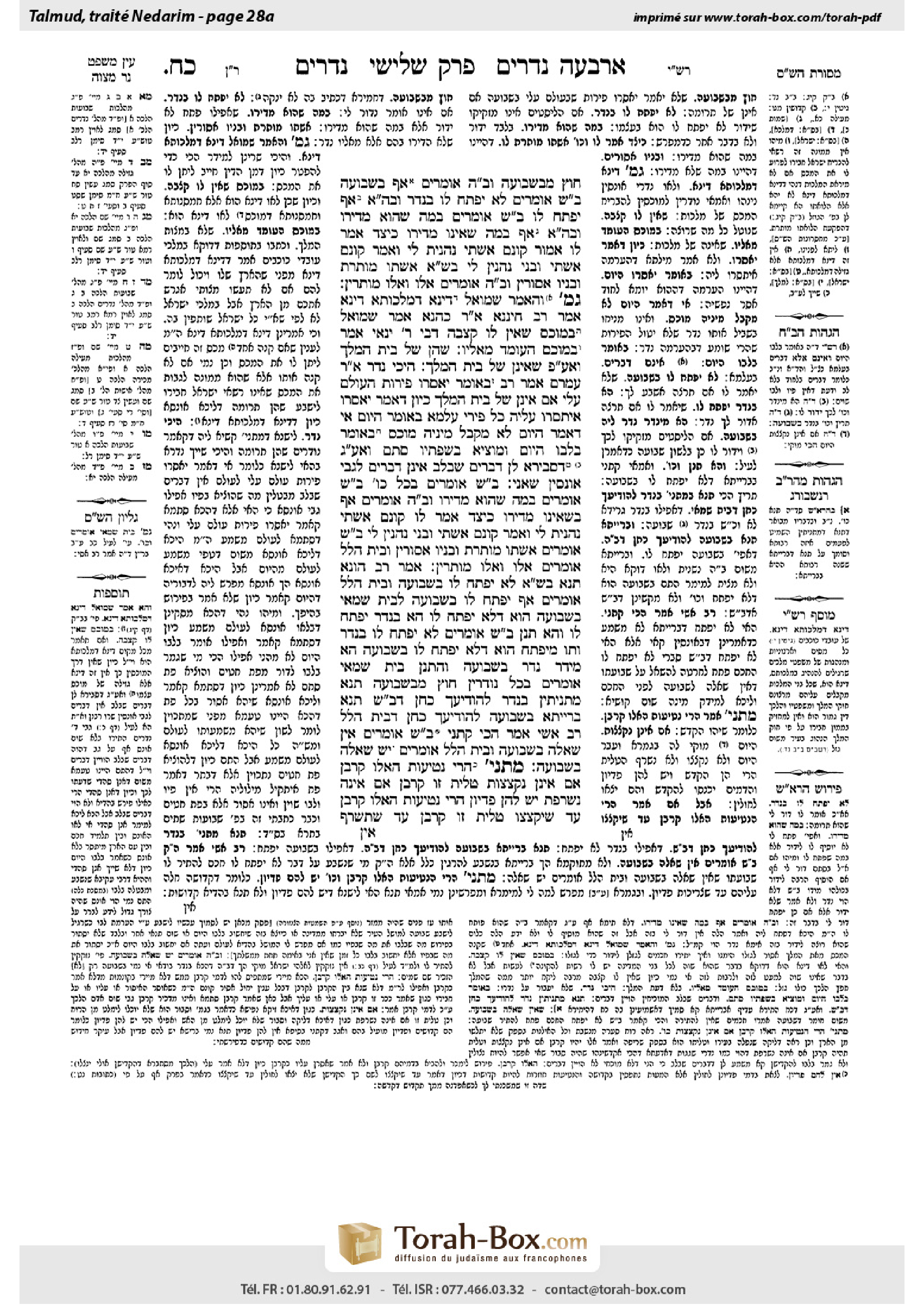
Nedarim 28a: Talmud study for Daf Yomi
Daf Yomi is the daily study of one Talmud folio. Explore 37 tractates with scans, Hebrew text, Sefaria English and AI-generated French translations where annotated.
Passage selection and English or AI-generated French translation are available where the scan has annotations. Daf Study is independent of Torah-Box and Sefaria.
Browse Nedarim · נדרים · All tractatesNedarim 28a text and translations
This page of Nedarim includes the Aramaic text, an English translation and an AI-generated French translation, alongside the scan above.
נדרים כ״ח א · Aramaic and Hebrew text
חוּץ מִבִּשְׁבוּעָה. וּבֵית הִלֵּל אוֹמְרִים: אַף בִּשְׁבוּעָה.
בֵּית שַׁמַּאי אוֹמְרִים: לֹא יִפְתַּח לוֹ בְּנֶדֶר, וּבֵית הִלֵּל אוֹמְרִים: אַף יִפְתַּח לוֹ. בֵּית שַׁמַּאי אוֹמְרִים: בַּמֶּה שֶׁהוּא מַדִּירוֹ. וּבֵית הִלֵּל אוֹמְרִים: אַף בַּמֶּה שֶׁאֵינוֹ מַדִּירוֹ.
כֵּיצַד? אָמַר לוֹ: אֱמוֹר ״קֻוֽנָּם אִשְׁתִּי נֶהֱנֵית לִי״, וְאָמַר: ״קֻוֽנָּם אִשְׁתִּי וּבָנַי נֶהֱנִין לִי״, בֵּית שַׁמַּאי אוֹמְרִים: אִשְׁתּוֹ מוּתֶּרֶת וּבָנָיו אֲסוּרִין. וּבֵית הִלֵּל אוֹמְרִים: אֵלּוּ וָאֵלּוּ מוּתָּרִין.
גְּמָ׳ וְהָאָמַר שְׁמוּאֵל: דִּינָא דְמַלְכוּתָא דִּינָא?
אָמַר רַב חִינָּנָא אָמַר רַב כָּהֲנָא אָמַר שְׁמוּאֵל: בְּמוֹכֵס שֶׁאֵין לוֹ קִצְבָה. דְּבֵי רַבִּי יַנַּאי אָמַר: בְּמוֹכֵס הָעוֹמֵד מֵאֵלָיו.
שֶׁהֵן שֶׁל בֵּית הַמֶּלֶךְ, וְאַף עַל פִּי שֶׁאֵינָן שֶׁל בֵּית הַמֶּלֶךְ. הֵיכִי נָדַר? אָמַר רַב עַמְרָם אָמַר רַב: בְּאוֹמֵר ״יֵאָסְרוּ פֵּירוֹת הָעוֹלָם עָלַי אִם אֵינָן שֶׁל בֵּית הַמֶּלֶךְ״.
כֵּיוָן דְּאָמַר ״יֵאָסְרוּ״ — אִיתְּסַרוּ עֲלֵיהּ כׇּל פֵּירֵי עָלְמָא! בְּאוֹמֵר ״הַיּוֹם״. אִי דְּאָמַר ״הַיּוֹם״ לָא מְקַבֵּל מִינֵּיהּ מוֹכֵס!
בְּאוֹמֵר בְּלִבּוֹ ״הַיּוֹם״, וּמוֹצִיא בִּשְׂפָתָיו סְתָם. וְאַף עַל גַּב דִּסְבִירָא לַן דְּבָרִים שֶׁבַּלֵּב אֵינָן דְּבָרִים — לְגַבֵּי אוֹנָסִין שָׁאנֵי.
בֵּית שַׁמַּאי אוֹמְרִים: בַּכֹּל כּוּ׳. בֵּית שַׁמַּאי אוֹמְרִים: בַּמֶּה שֶׁהוּא מַדִּירוֹ, וּבֵית הִלֵּל אוֹמְרִים: אַף בְּשֶׁאֵינוֹ מַדִּירוֹ. כֵּיצַד? אָמַר לוֹ: ״קֻוֽנָּם אִשְׁתִּי נֶהֱנֵית לִי״, וְאָמַר ״קֻוֽנָּם אִשְׁתִּי וּבָנַי נֶהֱנִין לִי״. בֵּית שַׁמַּאי אוֹמְרִים: אִשְׁתּוֹ מוּתֶּרֶת וּבָנָיו אֲסוּרִין, וּבֵית הִלֵּל אוֹמְרִים: אֵלּוּ וָאֵלּוּ מוּתָּרִין.
אָמַר רַב הוּנָא: תָּנָא, בֵּית שַׁמַּאי אוֹמְרִים: לֹא יִפְתַּח לוֹ בִּשְׁבוּעָה, וּבֵית הִלֵּל אוֹמְרִים: אַף יִפְתַּח לוֹ בִּשְׁבוּעָה. לְבֵית שַׁמַּאי בִּשְׁבוּעָה הוּא דְּלֹא יִפְתַּח לוֹ, הָא בְּנֶדֶר יִפְתַּח לוֹ. וְהָא תְּנַן, בֵּית שַׁמַּאי אוֹמְרִים: לֹא יִפְתַּח לוֹ בַּנֶּדֶר!
וְתוּ: מִיפְתָּח הוּא דְּלָא יִפְתַּח לוֹ בִּשְׁבוּעָה, הָא מִידָּר נָדַר בִּשְׁבוּעָה. וְהָתְנַן, בֵּית שַׁמַּאי אוֹמְרִים: בַּכֹּל נוֹדְרִין חוּץ מִבִּשְׁבוּעָה!
תַּנָּא מַתְנִיתִין בְּנֶדֶר, לְהוֹדִיעֲךָ כֹּחָן דְּבֵית שַׁמַּאי. תַּנָּא בָּרַיְיתָא בִּשְׁבוּעָה, לְהוֹדִיעֲךָ כֹּחָן דְּבֵית הִלֵּל.
רַב אָשֵׁי אָמַר, הָכִי קָתָנֵי, בֵּית שַׁמַּאי אוֹמְרִים: אֵין שְׁאֵלָה בִּשְׁבוּעָה, וּבֵית הִלֵּל אוֹמְרִים: יֵשׁ שְׁאֵלָה בִּשְׁבוּעָה.
מַתְנִי׳ ״הֲרֵי נְטִיעוֹת הָאֵלּוּ קׇרְבָּן אִם אֵינָן נִקְצָצוֹת״, ״טַלִּית זוֹ קׇרְבָּן אִם אֵינָהּ נִשְׂרֶפֶת״ — יֵשׁ לָהֶן פִּדְיוֹן. ״הֲרֵי נְטִיעוֹת הָאֵלּוּ קׇרְבָּן עַד שֶׁיִּקָּצְצוּ״, ״טַלִּית זוֹ קׇרְבָּן עַד שֶׁתִּשָּׂרֵף״ —
Nedarim 28a · English translation
except for by taking of an oath, due to its more stringent nature. And Beit Hillel say: One may mislead them even by taking an oath.
Beit Shammai say: When negotiating with a robber, one should not initiate by taking a vow for him unless the robber does not believe his claim, in which case he may take a vow to reinforce his words. And Beit Hillel say: He may even initiate by taking a vow to him. Beit Shammai say: One may take a vow only about that which the robber compels him to take a vow but may not add to it. And Beit Hillel say: One may take a vow even about that which he does not compel him to take a vow.
The mishna explains the previous statement: How so? If the extortionist said to him that he should say: Benefiting from me is konam for my wife if the vow is not true, and he said: Benefiting from me is konam for my wife and my children, Beit Shammai say: His wife is permitted to benefit from him, since the extortionist demanded that he take that vow, but his children, whom he added of his own accord, are prohibited from benefiting from their father. And Beit Hillel say: Both these and those are permitted to benefit from him.
GEMARA: The Gemara asks, concerning the mishna’s statement that one may take a vow to tax collectors: But didn’t Shmuel say: The law of the kingdom is the law, i.e., there is a halakhic principle that Jews must obey the laws of the state in which they live? Since one must pay the tax determined by the kingdom, how did the Sages permit one to lie in order to avoid paying?
Rav Ḥinnana said that Rav Kahana said that Shmuel said: The mishna is referring to a tax collector who has no fixed amount for collection established by the kingdom, but rather collects the tax arbitrarily. Therefore, this case is not included in the law of the kingdom. A Sage of the school of Rabbi Yannai said: The mishna is referring to a tax collector who establishes himself as such independently and was not appointed by the kingdom.
§ The mishna states: He may also take a vow to them that his produce belongs to the house of the king, although it does not belong to the house of the king. The Gemara asks: How does he take a vow in this way? Rav Amram said that Rav said: This is a case where he said: The produce of the world should be forbidden to me if this produce does not belong to the house of the king.
The Gemara asks: Since he said that the produce of the world shall be forbidden to him, shouldn’t all the produce of the world be forbidden to him, as this produce did not belong to the house of the king? The Gemara answers: This is a case where he says: They shall be forbidden to me only today. The Gemara wonders: If he says: Today, the tax collector will not accept it as a vow, since it is not difficult to avoid eating produce for one day. Therefore, he may still be suspected of lying.
The Gemara answers: This is a case where he says: Today, in his heart but verbalizes the vow in an unspecified manner. And although we hold that unspoken matters that remain in the heart are not significant matters and are not taken into consideration, with regard to circumstances beyond one’s control it is different, and he is permitted to rely on the mental stipulation that he added in order to limit the duration of the prohibition effected by the vow.
§ The mishna states: Beit Shammai say that they may take a vow in such a case using every means of vowing except for an oath, while Beit Hillel say they may take a vow even using an oath. Beit Shammai say: One may vow only about that which the extortionist compels him to take a vow but may not add to it. And Beit Hillel say: One may take a vow even about that which he does not compel him to take a vow. How so? If the extortionist said to him that he should say: Benefiting from me is konam for my wife if the vow is not true, and he said: Benefiting from me is konam for my wife and my children, Beit Shammai say: His wife is permitted to benefit from him, since the extortionist demanded that he take that vow, but his children, whom he added of his own accord, are prohibited from benefiting from their father. And Beit Hillel say: Both these and those are permitted to benefit from him.
Rav Huna said that a Sage taught: Beit Shammai say that one may not initiate by taking an oath to him unless the extortionist does not believe his claim, and Beit Hillel say: He may even initiate by taking an oath to him. The Gemara asks: A precise analysis of the wording indicates that according to Beit Shammai it is only by taking an oath to him that one may not initiate, but one may initiate by taking a vow to him. Rav Huna asks: But didn’t we learn in the mishna that Beit Shammai say: He may not initiate by taking a vow to him?
Rav Huna asks another question: And furthermore, a precise analysis of the wording indicates that he may not initiate by taking an oath to him, but he may certainly vow with an oath if the tax collector insists on it; but didn’t we learn in the mishna that Beit Shammai say: They may take a vow in such a case using every means of vowing in order to mislead them except for by taking an oath, which indicates that one may not take an oath even if he does not initiate with one?
The Gemara resolves the contradiction: The mishna taught the halakha that pertains to a vow to convey to you the far-reaching nature of the opinion of Beit Shammai, who say that one may not initiate even with a vow. However, the baraita taught the halakha that pertains to an oath to convey to you the far-reaching nature of the opinion of Beit Hillel, who maintain that initiating even with an oath is permitted. It is apparent that according to Beit Shammai one may not initiate with a vow and may not take an oath at all. Therefore, the baraita cannot be used to infer Beit Shammai’s opinion concerning oaths.
Rav Ashi said the following to resolve the contradiction: This is what it is teaching: The baraita does not refer to a vow taken in the case of robbers or tax collectors. Rather, the dispute focuses on an entirely different topic: Beit Shammai say that there is no allowance for a request for dissolution of an oath, and the statement: He may not initiate, relates to a halakhic authority who seeks an opening to dissolve an oath. And Beit Hillel say there is an allowance for a request for dissolution of an oath.
MISHNA: If one sees his property in danger of being destroyed, and takes a vow stating, for example: These saplings are like an offering if they are not cut down, or: This garment is like an offering if it is not burned, these items are consecrated if the saplings remain standing or if the garment is not burned. In addition, they are subject to the possibility of redemption just as other items consecrated for maintenance of the Temple may be redeemed. But if one said: These saplings are like an offering until they are cut down, or: This garment is like an offering until it is burned,
Nedarim 28a · Traduction française (IA)
sauf en prêtant serment, en raison de la plus grande rigueur de celui-ci. Et Beit Hillel disent : On peut les tromper même en prêtant serment.
Beit Shammaï disent : Lorsqu’on négocie avec un brigand, on ne doit pas prendre l’initiative de lui prêter serment, à moins que le brigand ne croie pas ce qu’on affirme ; dans ce cas, on peut prêter serment pour appuyer ses paroles. Et Beit Hillel disent : On peut même prendre l’initiative de lui prêter serment. Beit Shammaï disent : On ne peut prêter serment que sur ce que le brigand exige de lui, sans rien y ajouter. Et Beit Hillel disent : On peut prêter serment même sur ce que le brigand ne lui demande pas de jurer.
La Michna explique la déclaration précédente : comment cela ? Si l’extorqueur lui dit de déclarer : « Que le profit tiré de moi soit konam pour ma femme si ce que je dis n’est pas vrai », et qu’il déclare : « Que le profit tiré de moi soit konam pour ma femme et mes enfants », Beit Shammaï disent : Sa femme peut tirer profit de lui, puisque l’extorqueur lui a demandé de faire ce vœu ; mais ses enfants, qu’il a ajoutés de son propre chef, ne peuvent pas tirer profit de leur père. Et Beit Hillel disent : Ceux-ci comme ceux-là peuvent tirer profit de lui.
GUEMARA : La Guemara demande, à propos de la déclaration de la Michna selon laquelle on peut faire un vœu devant des collecteurs d’impôts : Mais Shmuel n’a-t-il pas dit : « La loi du royaume est la loi », c’est-à-dire qu’un principe halakhique impose aux Juifs d’obéir aux lois de l’État dans lequel ils vivent ? Puisqu’il faut payer l’impôt fixé par le royaume, comment les Sages ont-ils permis de mentir pour éviter de le payer ?
Rav Ḥinnana a dit au nom de Rav Kahana, qui a dit au nom de Shmuel : La Michna parle d’un collecteur d’impôts pour lequel le royaume n’a fixé aucun montant à percevoir et qui, au contraire, prélève l’impôt de façon arbitraire. Ce cas n’est donc pas visé par le principe selon lequel la loi du royaume est la loi. Un Sage de l’école de Rabbi Yannai a dit : La Michna parle d’un collecteur d’impôts qui s’est établi de sa propre initiative et n’a pas été nommé par le royaume.
§ La Michna dit : Il peut aussi leur faire un vœu en déclarant que ses produits appartiennent au palais du roi, bien que ce ne soit pas le cas. La Guemara demande : Comment peut-il faire un vœu de cette manière ? Rav Amram a dit au nom de Rav : Il s’agit d’un cas où il a dit : « Que les produits du monde me soient interdits si ces produits n’appartiennent pas au palais du roi. »
La Guemara demande : Puisqu’il a dit que les produits du monde lui seraient interdits, tous les produits du monde ne devraient-ils pas lui être interdits, puisque ces produits n’appartiennent pas au palais du roi ? La Guemara répond : Il s’agit d’un cas où il dit : « Qu’ils me soient interdits aujourd’hui seulement. » La Guemara s’étonne : S’il dit « aujourd’hui », le collecteur d’impôts n’acceptera pas ce vœu, car il n’est pas difficile de s’abstenir de manger des produits pendant une seule journée. On peut donc encore le soupçonner de mentir.
La Guemara répond : Il s’agit d’un cas où, dans son cœur, il entend limiter l’interdiction à aujourd’hui, mais formule le vœu sans précision. Et bien que nous tenions pour établi que les choses non exprimées, qui restent dans le cœur, n’ont pas de valeur et ne sont pas prises en considération, il en va autrement en cas de circonstances indépendantes de sa volonté : il est autorisé à s’appuyer sur la condition qu’il a formulée mentalement afin de limiter la durée de l’interdiction créée par le vœu.
§ La Michna dit que Beit Shammaï estiment qu’en pareil cas, on peut faire un vœu par tout moyen, sauf en prêtant serment, tandis que Beit Hillel estiment qu’on peut faire un vœu même en prêtant serment. Beit Shammaï disent : On ne peut prêter serment que sur ce que l’extorqueur exige de lui, sans rien y ajouter. Et Beit Hillel disent : On peut prêter serment même sur ce que l’extorqueur ne lui demande pas de jurer. Comment cela ? Si l’extorqueur lui dit de déclarer : « Que le profit tiré de moi soit konam pour ma femme si ce que je dis n’est pas vrai », et qu’il déclare : « Que le profit tiré de moi soit konam pour ma femme et mes enfants », Beit Shammaï disent : Sa femme peut tirer profit de lui, puisque l’extorqueur lui a demandé de faire ce vœu ; mais ses enfants, qu’il a ajoutés de son propre chef, ne peuvent pas tirer profit de leur père. Et Beit Hillel disent : Ceux-ci comme ceux-là peuvent tirer profit de lui.
Rav Houna a dit qu’un Sage a enseigné : Beit Shammaï disent qu’on ne peut pas prendre l’initiative de lui prêter serment, à moins que l’extorqueur ne croie pas ce qu’on affirme ; et Beit Hillel disent : On peut même prendre l’initiative de lui prêter serment. La Guemara demande : Une analyse précise de la formulation indique que, selon Beit Shammaï, on ne peut prendre l’initiative que de lui prêter serment, mais qu’on peut prendre l’initiative de lui faire un vœu. Rav Houna demande : Mais n’avons-nous pas appris dans la Michna que Beit Shammaï disent : On ne peut pas prendre l’initiative de lui faire un vœu ?
Rav Houna soulève une autre question : De plus, une analyse précise de la formulation indique qu’on ne peut pas prendre l’initiative de lui prêter serment, mais qu’on peut certainement prêter serment si le collecteur d’impôts l’exige. Mais n’avons-nous pas appris dans la Michna que Beit Shammaï disent : En pareil cas, on peut les tromper par tout moyen de faire un vœu, sauf en prêtant serment ? Cela indique qu’on ne peut pas prêter serment, même si l’on ne prend pas l’initiative de le faire.
La Guemara résout la contradiction : la Michna enseigne la halakha relative au vœu afin de vous faire connaître la portée extrême de l’opinion de Beit Shammaï, qui disent qu’on ne peut pas prendre l’initiative, même avec un vœu. Cependant, la baraïta enseigne la halakha relative au serment afin de vous faire connaître la portée extrême de l’opinion de Beit Hillel, qui estiment qu’il est permis de prendre l’initiative, même avec un serment. Il ressort que, selon Beit Shammaï, on ne peut pas prendre l’initiative avec un vœu et qu’on ne peut prêter serment en aucun cas. La baraïta ne permet donc pas de déduire l’opinion de Beit Shammaï concernant les serments.
Rav Ashi a donné la réponse suivante pour résoudre la contradiction : voici ce qu’enseigne le texte. La baraïta ne parle pas d’un vœu fait dans le cas de brigands ou de collecteurs d’impôts. Le désaccord porte plutôt sur un tout autre sujet : Beit Shammaï disent qu’il n’est pas permis de demander l’annulation d’un serment ; et la déclaration « il ne peut pas prendre l’initiative » concerne une autorité halakhique qui cherche un motif permettant d’annuler un serment. Et Beit Hillel disent qu’il est permis de demander l’annulation d’un serment.
MICHNA : Si quelqu’un voit ses biens menacés de destruction et fait un vœu en déclarant, par exemple : « Ces jeunes pousses sont comme une offrande si elles ne sont pas coupées », ou : « Ce vêtement est comme une offrande s’il n’est pas brûlé », ces objets sont consacrés si les jeunes pousses restent debout ou si le vêtement n’est pas brûlé. En outre, ils peuvent être rachetés, comme les autres objets consacrés à l’entretien du Temple. Mais s’il a dit : « Ces jeunes pousses sont comme une offrande jusqu’à ce qu’elles soient coupées », ou : « Ce vêtement est comme une offrande jusqu’à ce qu’il soit brûlé »,
Traduction française générée par IA à partir de l’édition anglaise de Sefaria. Vérifie toujours un passage avec le texte source.
Text from Sefaria: William Davidson Edition - Vocalized Aramaic (CC BY NC); William Davidson Edition - English (CC BY NC).