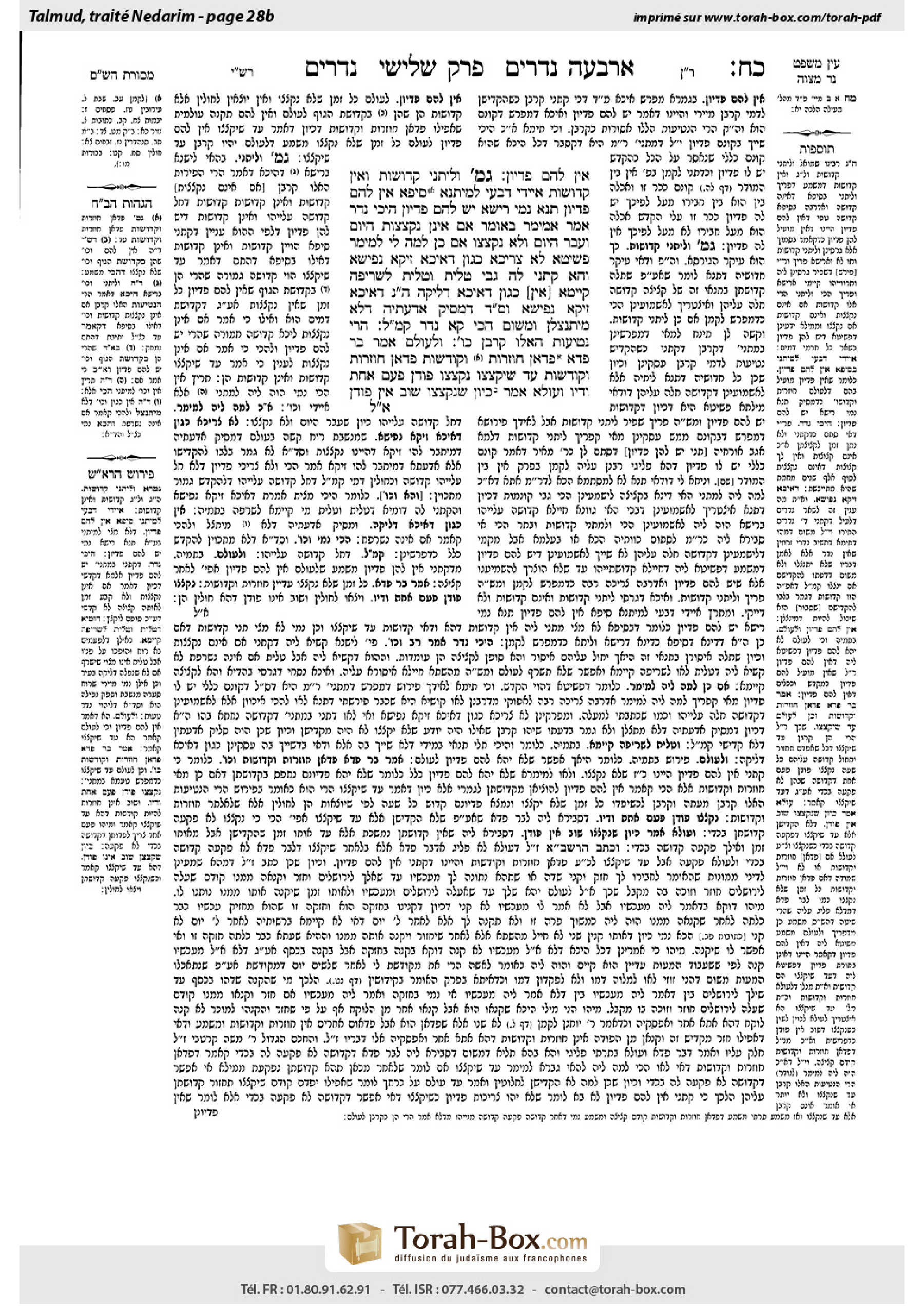
Nedarim 28b: Talmud study for Daf Yomi
Daf Yomi is the daily study of one Talmud folio. Explore 37 tractates with scans, Hebrew text, Sefaria English and AI-generated French translations where annotated.
Passage selection and English or AI-generated French translation are available where the scan has annotations. Daf Study is independent of Torah-Box and Sefaria.
Browse Nedarim · נדרים · All tractatesNedarim 28b text and translations
This page of Nedarim includes the Aramaic text, an English translation and an AI-generated French translation, alongside the scan above.
נדרים כ״ח ב · Aramaic and Hebrew text
אֵין לָהֶם פִּדְיוֹן.
גְּמָ׳ וְלִיתְנֵי ״קְדוֹשׁוֹת וְאֵין קְדוֹשׁוֹת״! אַיְּידֵי דְבָעֵי לְמִיתְנָא סֵיפָא ״אֵין לָהֶם פִּדְיוֹן״, תְּנָא נָמֵי רֵישָׁא ״יֵשׁ לָהֶם פִּדְיוֹן״.
הֵיכִי נָדַר? אָמַר אַמֵּימָר: בְּאוֹמֵר ״אִם אֵינָן נִקְצָצוֹת הַיּוֹם״, וְעָבַר הַיּוֹם וְלֹא נִקְצְצוּ. אִם כֵּן לְמָה לִי לְמֵימַר? פְּשִׁיטָא! לָא צְרִיכָא כְּגוֹן דְּאִיכָּא זִיקָא נְפִישָׁא.
וְהָא קָתָנֵי לַהּ גַּבֵּי טַלִּית, וְטַלִּית לִשְׂרֵיפָה קָיְימָא? [אִין] כְּגוֹן דְּאִיכָּא דְּלֵיקָה. הָכָא נָמֵי, דְּאִיכָּא זִיקָא נְפִישָׁא, וְסָלְקָא דַּעְתָּךְ דְּמַסֵּיק אַדַּעְתֵּיהּ דְּלָא מִיתְנַצְלָן וּמִשּׁוּם הָכִי קָא נָדַר, קָא מַשְׁמַע לַן.
הֲרֵי נְטִיעוֹת הָאֵלּוּ קׇרְבָּן כּוּ׳. וּלְעוֹלָם? אָמַר בַּר פְּדָא: פְּדָאָן — חוֹזְרוֹת וְקוֹדְשׁוֹת, פְּדָאָן — חוֹזְרוֹת וְקוֹדְשׁוֹת, עַד שֶׁיִּקָּצְצוּ. נִקְצְצוּ — פּוֹדָן פַּעַם אַחַת וְדַיּוֹ. וְעוּלָּא אָמַר: כֵּיוָן שֶׁנִּקְצְצוּ — שׁוּב אֵין פּוֹדָן.
Nedarim 28b · English translation
then they are not subject to the possibility of redemption.
GEMARA: The Gemara questions the language of the mishna: Why does the mishna utilize the wording: They have redemption and they do not have redemption? Let the mishna teach: They are consecrated and they are not consecrated, since the primary novelty is that they are consecrated, but not completely. The Gemara answers: Since it wanted to teach in the latter clause the phrase: They are not subject to the possibility of redemption, which cannot be expressed as: They are not consecrated, as they are consecrated, it taught also the first clause using the language: They are subject to the possibility of redemption.
The Gemara elaborates: How did he take a vow? What was the precise language that he used? Ameimar said: Where he says: These saplings are like an offering if they are not cut down today, and the day passed and they were not cut down. The Gemara asks: If so, why do I need to say that they are consecrated? Isn’t it obvious that his vow takes effect? The Gemara answers: No, it is necessary in a case where there is a great strong wind and he thought that they would be uprooted by the wind.
The Gemara asks: But isn’t this taught together with the case of a garment, indicating that the two are equivalent, and is a garment ready for burning, i.e., is it assumed that it will burn? The Gemara answers: Yes, in a case where there is a fire. The Gemara explains: Here also there is a great strong wind, and it enters your mind that one raised in his mind the possibility that the saplings will not be saved, and due to that reason he took a vow. Since in any event he assumes he will lose the saplings, perhaps he did not really intend to consecrate them. The mishna teaches us that in spite of this it is still considered a vow.
§ The mishna states that if he said: These saplings are like an offering until they are cut down, they are not subject to the possibility of redemption. The Gemara asks: And are they not subject to redemption forever? Bar Padda said: If he redeemed them, they become consecrated again, as they have not yet been cut down. If he redeemed them again, they become consecrated again, until they are cut down. Once they are cut down, he redeems them once and it is sufficient. And Ulla said: Once they are cut down one does not need to redeem them again because they are no longer consecrated.
Nedarim 28b · Traduction française (IA)
ils ne sont donc pas susceptibles d’être rachetés.
GUEMARA : La Guemara s’interroge sur la formulation de la Michna : pourquoi la Michna emploie-t-elle les termes « ils peuvent être rachetés » et « ils ne peuvent pas être rachetés » ? Qu’elle enseigne plutôt : « ils sont consacrés » et « ils ne sont pas consacrés », puisque la principale nouveauté est qu’ils sont consacrés, mais pas complètement. La Guemara répond : comme la Michna voulait enseigner, dans la dernière partie, l’expression « ils ne sont pas susceptibles d’être rachetés », qu’on ne peut pas exprimer par « ils ne sont pas consacrés », puisqu’ils sont consacrés, elle a également formulé la première partie en disant « ils sont susceptibles d’être rachetés ».
La Guemara précise : comment a-t-il fait son vœu ? Quelle formulation exacte a-t-il employée ? Ameimar dit : il a dit : « Ces jeunes arbres seront comme une offrande s’ils ne sont pas abattus aujourd’hui », et le jour s’est écoulé sans qu’ils soient abattus. La Guemara demande : dans ce cas, pourquoi faut-il préciser qu’ils sont consacrés ? N’est-il pas évident que son vœu prend effet ? La Guemara répond : non, cela est nécessaire dans le cas où souffle un vent très violent et où il pensait que le vent déracinerait les arbres.
La Guemara demande : mais ce cas n’est-il pas enseigné conjointement avec celui d’un vêtement, ce qui indique que les deux cas sont équivalents ? Or, un vêtement est-il prêt à brûler, c’est-à-dire suppose-t-on qu’il va brûler ? La Guemara répond : oui, dans le cas où il y a un incendie. La Guemara explique : ici aussi, il souffle un vent très violent, et tu pourrais penser qu’il a envisagé que les jeunes arbres ne seraient pas épargnés et qu’il a fait un vœu pour cette raison. Puisqu’il suppose de toute façon qu’il perdra les arbres, il est possible qu’il n’ait pas réellement eu l’intention de les consacrer. La Michna nous enseigne que, malgré cela, son vœu est bien valable.
§ La Michna enseigne que s’il a dit : « Ces jeunes arbres seront comme une offrande jusqu’à ce qu’ils soient abattus », ils ne sont pas susceptibles d’être rachetés. La Guemara demande : ne sont-ils donc pas susceptibles d’être rachetés indéfiniment ? Bar Padda dit : s’il les rachète, ils redeviennent consacrés, puisqu’ils n’ont pas encore été abattus. S’il les rachète une nouvelle fois, ils redeviennent consacrés, et ainsi de suite jusqu’à ce qu’ils soient abattus. Une fois qu’ils ont été abattus, il les rachète une seule fois et cela suffit. Et Ulla dit : une fois qu’ils ont été abattus, il n’est pas nécessaire de les racheter à nouveau, car ils ne sont plus consacrés.
Traduction française générée par IA à partir de l’édition anglaise de Sefaria. Vérifie toujours un passage avec le texte source.
Text from Sefaria: William Davidson Edition - Vocalized Aramaic (CC BY NC); William Davidson Edition - English (CC BY NC).