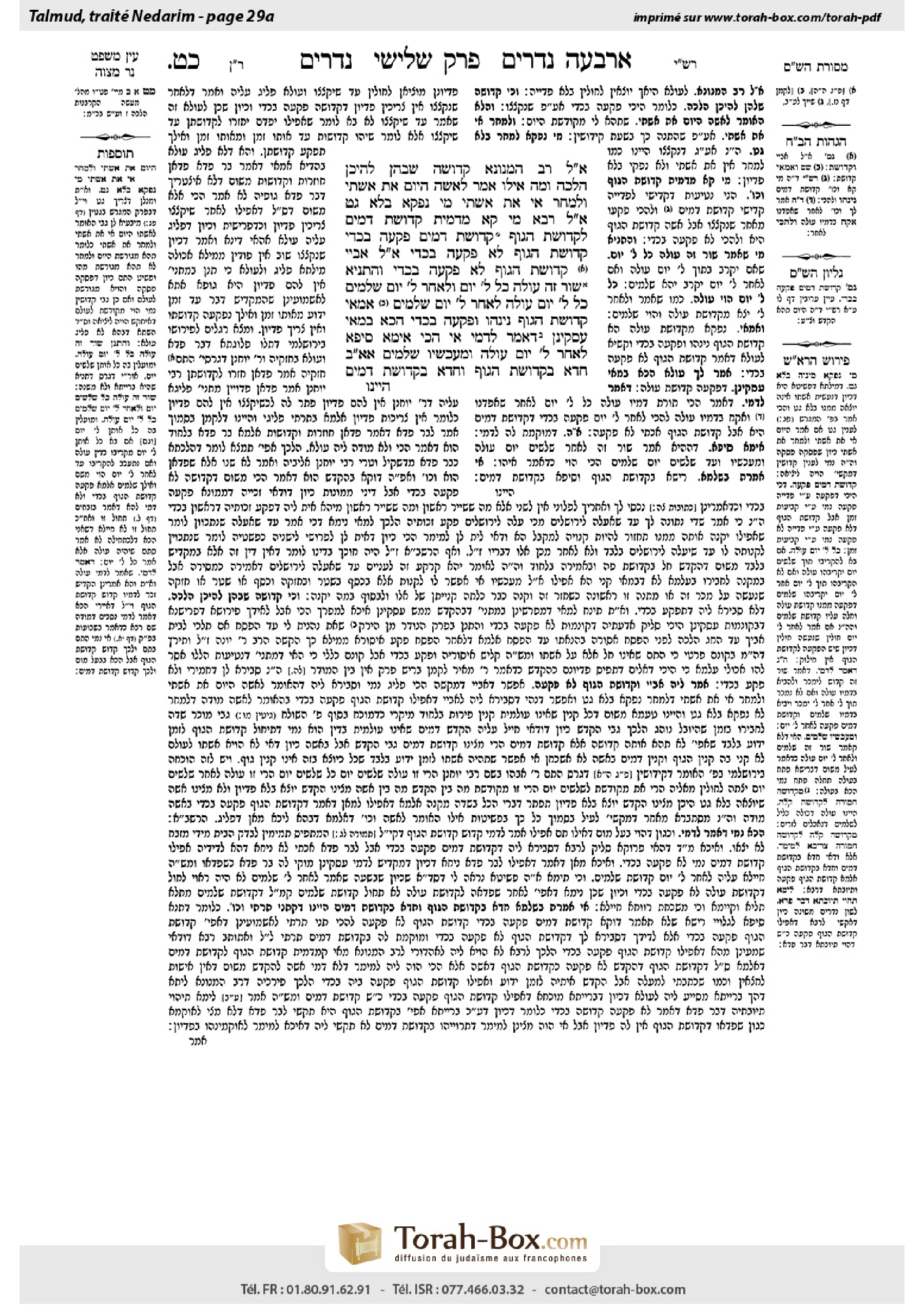
Nedarim 29a: Talmud study for Daf Yomi
Daf Yomi is the daily study of one Talmud folio. Explore 37 tractates with scans, Hebrew text, Sefaria English and AI-generated French translations where annotated.
Passage selection and English or AI-generated French translation are available where the scan has annotations. Daf Study is independent of Torah-Box and Sefaria.
Browse Nedarim · נדרים · All tractatesNedarim 29a text and translations
This page of Nedarim includes the Aramaic text, an English translation and an AI-generated French translation, alongside the scan above.
נדרים כ״ט א · Aramaic and Hebrew text
אֲמַר לֵיהּ רַב הַמְנוּנָא: קְדוּשָּׁה שֶׁבָּהֶן לְהֵיכָן הָלְכָה? וּמָה אִילּוּ אָמַר לְאִשָּׁה ״הַיּוֹם אַתְּ אִשְׁתִּי וּלְמָחָר אִי אַתְּ אִשְׁתִּי״, מִי נָפְקָא בְּלָא גֵּט?!
אֲמַר לֵיהּ רָבָא: מִי קָא מְדַמֵּית קְדוּשַּׁת דָּמִים לִקְדוּשַּׁת הַגּוּף? קְדוּשַּׁת דָּמִים פָּקְעָה בִּכְדֵי, קְדוּשַּׁת הַגּוּף לָא פָּקְעָה בִּכְדִי.
אֲמַר לֵיהּ אַבָּיֵי: קְדוּשַּׁת הַגּוּף לָא פָּקְעָה בִּכְדִי? וְהָתַנְיָא: ״שׁוֹר זֶה עוֹלָה כׇּל שְׁלֹשִׁים יוֹם, וּלְאַחַר שְׁלֹשִׁים יוֹם שְׁלָמִים״ — כׇּל שְׁלֹשִׁים יוֹם עוֹלָה, לְאַחַר שְׁלֹשִׁים יוֹם שְׁלָמִים. אַמַּאי? קְדוּשַּׁת הַגּוּף נִינְהוּ, וּפָקְעָה בִּכְדִי!
הָכָא בְּמַאי עָסְקִינַן, דְּאָמַר לִדְמֵי.
אִי הָכִי, אֵימָא סֵיפָא: ״לְאַחַר שְׁלֹשִׁים יוֹם עוֹלָה, וּמֵעַכְשָׁיו שְׁלָמִים״. אִי אָמְרַתְּ בִּשְׁלָמָא חֲדָא בִּקְדוּשַּׁת הַגּוּף, וַחֲדָא בִּקְדוּשַּׁת דָּמִים —
Nedarim 29a · English translation
Rav Hamnuna said to Ulla: Where did their sanctity go? How can the consecrated saplings become non-sacred without being redeemed? And what would happen if one said to a woman while performing betrothal: Today you are my wife and tomorrow you are not my wife? Would she exit the marriage the next day without a bill of divorce? Likewise, in the mishna, once one consecrated the saplings, how is their sanctity withdrawn without redemption?
Rava said to him: How do you compare sanctity inherent in its value to inherent sanctity? Sanctity inherent in its value departs with nothing being done, since it is conditional. When the condition is fulfilled and the saplings are cut, the sanctity is removed. However, inherent sanctity, which relates to an entity that itself is consecrated, e.g., a betrothed woman, does not depart with nothing being done. An action must be performed in order to remove it.
Abaye said to him: And does inherent sanctity not depart with nothing being done? But isn’t it taught in a baraita that if one said: This ox is a burnt-offering for all of thirty days and after thirty days it is a peace-offering, for all of thirty days it is a burnt-offering and after thirty days it is a peace-offering. One can ask: Why is this so? These offerings are examples of inherent sanctity, and it departs with nothing being done. After thirty days, it is transformed into a peace-offering without any action being taken.
The Gemara answers: With what are we dealing here? It is a case where one did not consecrate the animal as a burnt-offering or peace-offering but rather he said that he was consecrating it for its monetary value, with which to purchase a burnt-offering or peace-offering. Therefore, there was no inherent sanctity.
The Gemara asks: If so, say the latter clause: If he said that after thirty days it should be a burnt-offering, and from now until thirty days it should be a peace-offering, his words are binding. Granted, if you say that one clause is referring to inherent sanctity and one clause is referring to sanctity inherent in its value,
Nedarim 29a · Traduction française (IA)
Rav Hamnouna dit à Oulla : Où est passée leur sainteté ? Comment les jeunes arbres consacrés peuvent-ils devenir profanes sans être rachetés ? Et que se passerait-il si un homme disait à une femme, au moment de la célébration des kidouchin : « Aujourd’hui, tu es ma femme, et demain tu ne l’es plus » ? Le lendemain, sortirait-elle du mariage sans acte de divorce ? De même, dans la Michna, une fois les jeunes arbres consacrés, comment leur sainteté peut-elle disparaître sans rachat ?
Rava lui dit : Comment compares-tu une sainteté attachée à la valeur à une sainteté inhérente ? La sainteté attachée à la valeur disparaît sans qu’aucune action soit nécessaire, car elle est conditionnelle. Lorsque la condition est remplie et que les jeunes arbres sont coupés, la sainteté disparaît. En revanche, la sainteté inhérente, qui concerne une entité elle-même consacrée, comme une femme fiancée, ne disparaît pas sans qu’aucune action soit accomplie. Il faut agir pour la faire disparaître.
Abayé lui dit : Mais la sainteté inhérente ne disparaît-elle donc pas sans qu’aucune action soit nécessaire ? N’est-il pas enseigné dans une baraïta que si quelqu’un dit : « Ce taureau sera un holocauste pendant trente jours, puis, après trente jours, un sacrifice de paix », il sera un holocauste pendant trente jours et un sacrifice de paix après ces trente jours. On peut demander : pourquoi en est-il ainsi ? Ces sacrifices sont des exemples de sainteté inhérente, et celle-ci disparaît sans qu’aucune action soit nécessaire. Après trente jours, le taureau devient un sacrifice de paix sans qu’aucune action soit accomplie.
La Guemara répond : De quoi s’agit-il ici ? D’un cas où l’homme n’a pas consacré l’animal comme holocauste ou comme sacrifice de paix, mais a dit qu’il le consacrait pour sa valeur monétaire, afin d’acheter un holocauste ou un sacrifice de paix. Il n’y avait donc pas de sainteté inhérente.
La Guemara demande : Si c’est ainsi, examinons la dernière partie : s’il a dit qu’après trente jours l’animal serait un holocauste et que, d’ici là, il serait un sacrifice de paix, ses paroles sont valides. Il est certes compréhensible que, si l’on dit qu’une clause se rapporte à la sainteté inhérente et l’autre à la sainteté attachée à la valeur,
Traduction française générée par IA à partir de l’édition anglaise de Sefaria. Vérifie toujours un passage avec le texte source.
Text from Sefaria: William Davidson Edition - Vocalized Aramaic (CC BY NC); William Davidson Edition - English (CC BY NC).