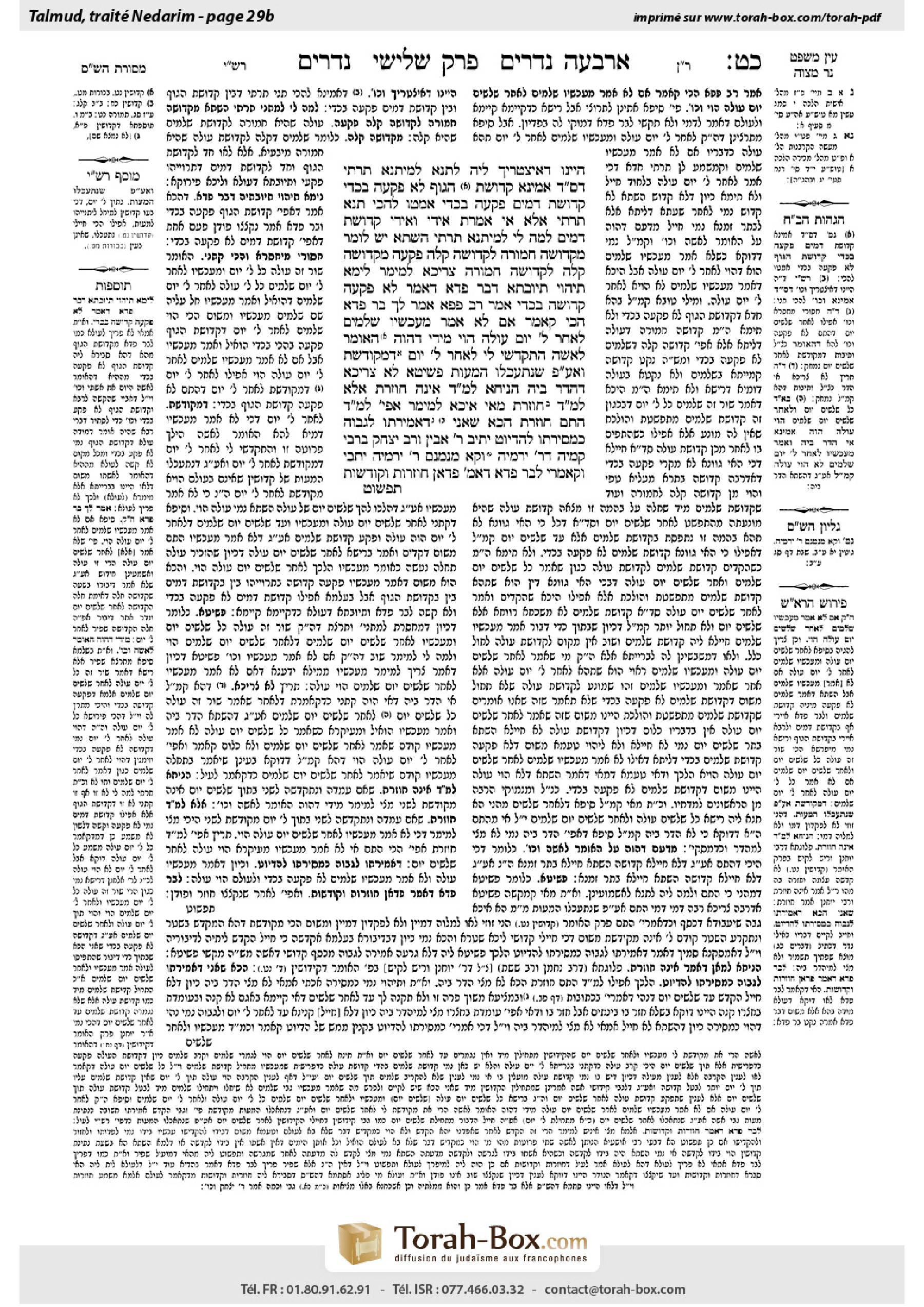
Nedarim 29b: Talmud study for Daf Yomi
Daf Yomi is the daily study of one Talmud folio. Explore 37 tractates with scans, Hebrew text, Sefaria English and AI-generated French translations where annotated.
Passage selection and English or AI-generated French translation are available where the scan has annotations. Daf Study is independent of Torah-Box and Sefaria.
Browse Nedarim · נדרים · All tractatesNedarim 29b text and translations
This page of Nedarim includes the Aramaic text, an English translation and an AI-generated French translation, alongside the scan above.
נדרים כ״ט ב · Aramaic and Hebrew text
הַיְינוּ דְּאִיצְטְרִיךְ לֵיהּ לְתַנָּא לְמִיתְנֵא תַּרְתֵּי. דְּסָלְקָא דַּעְתָּךְ אָמֵינָא: קְדוּשַּׁת הַגּוּף לָא פָּקְעָה בִּכְדִי, קְדוּשַּׁת דָּמִים פָּקְעָה בִּכְדִי, אַמְּטוּ לְהָכִי תְּנָא תַּרְתֵּי.
אֶלָּא אִי אָמְרַתְּ אִידֵּי וְאִידֵּי קְדוּשַּׁת דָּמִים, לְמָה לִי לְמִיתְנֵא תַּרְתֵּי? הַשְׁתָּא יֵשׁ לוֹמַר: מִקְּדוּשָּׁה חֲמוּרָה לִקְדוּשָּׁה קַלָּה פָּקְעָה, מִקְּדוּשָּׁה קַלָּה לִקְדוּשָּׁה חֲמוּרָה צְרִיכָא לְמֵימַר?!
לֵימָא תֶּיהְוֵי תְּיוּבְתָּא דְּבַר פְּדָא, דְּאָמַר: לָא פָּקְעָה קְדוּשָּׁה בִּכְדִי?
אָמַר רַב פָּפָּא: אָמַר לָךְ בַּר פְּדָא, הָכִי קָאָמַר: אִם לֹא אָמַר ״מֵעַכְשָׁיו שְׁלָמִים״ — לְאַחַר שְׁלֹשִׁים יוֹם עוֹלָה הָוֵי.
מִידֵּי דְּהָוֵה הָאוֹמֵר לְאִשָּׁה: ״הִתְקַדְּשִׁי לִי לְאַחַר שְׁלֹשִׁים יוֹם״, דִּמְקוּדֶּשֶׁת וְאַף עַל פִּי שֶׁנִּתְעַכְּלוּ הַמָּעוֹת.
פְּשִׁיטָא? לָא צְרִיכָא דַּהֲדַר בֵּיהּ.
הָנִיחָא לְמַאן דְּאָמַר אֵינָהּ חוֹזֶרֶת. אֶלָּא לְמַאן דְּאָמַר חוֹזֶרֶת, מַאי אִיכָּא לְמֵימַר!
אֲפִילּוּ לְמַאן דְּאָמַר הָתָם חוֹזֶרֶת, הָכָא שָׁאנֵי — דַּאֲמִירָתוֹ לְגָבוֹהַּ כִּמְסִירָתוֹ לְהֶדְיוֹט.
יְתֵיב רַבִּי אָבִין וְרַב יִצְחָק בְּרַבִּי קַמֵּיהּ דְּרַבִּי יִרְמְיָה, וְקָא מְנַמְנֵם רַבִּי יִרְמְיָה, יָתְבִי וְקָאָמְרִי: לְבַר פְּדָא דְּאָמַר פְּדָאָן חוֹזְרוֹת וְקוֹדְשׁוֹת,
Nedarim 29b · English translation
then this is the reason that it was necessary for the tanna to teach two clauses: In order to emphasize that this halakha applies in both cases, as it might enter your mind to say: Inherent sanctity does not lapse on its own, but sanctity inherent in its value departs with nothing being done. Because of this, the tanna taught two clauses, to demonstrate that there is no difference between them: Both depart with nothing being done.
But if you say that this clause and that clause refer to sanctity inherent in its value, why do I need to teach two clauses? Now, it can be said that if from the stringent sanctity of the burnt-offering to the less stringent sanctity of a peace-offering, the stringent sanctity departs and the animal becomes like a peace-offering, then from the less stringent sanctity of the peace-offering to the more stringent sanctity of the burnt-offering, need this be said?
The Gemara proposes: Let us say that this baraita should be a conclusive refutation of bar Padda, who said: Sanctity does not depart with nothing being done and the trees require redemption, while the baraita demonstrates that even inherent sanctity lapses on its own?
Rav Pappa said: Bar Padda could have said to you: This is what the baraita is saying: If one says: This ox, after thirty days, is a burnt-offering, then if he does not say: From now it is a peace-offering, then after thirty days it is a burnt-offering. But when he adds: From now it is a peace-offering, the sanctity of a peace-offering takes effect upon it and does not depart with nothing being done.
This is just as it is in the case of a man who says to a woman: Be betrothed to me after thirty days with this money that I give you, that she is betrothed after thirty days. And this is so, although the money was squandered away in the meantime and does not exist at the end of thirty days, when the betrothal takes effect. Here as well, the sanctity of a burnt-offering takes effect after thirty days.
The Gemara asks: If this is what happened, then it is obvious that it is so. Why, then, does this halakha need to be taught? The Gemara answers: No, it is necessary in a case where he retracted within these thirty days and did not want the animal to be consecrated at all. Although the sanctity did not actually take effect yet, he may not retract.
The Gemara asks: This works out well according to the one who said that a woman who is betrothed on the condition that the betrothal takes effect after thirty days may not retract even if she changed her mind within these thirty days, and the betrothal still takes effect after thirty days. But according to the one who says that she may retract, what can be said? Why should the halakha of consecration be any different than for betrothal?
The Gemara answers: Even according to the one who says that there, in the case of betrothal, the woman may retract within thirty days, here, in the case of the burnt-offering, it is different because the legal status of one’s declaration to God is equal to that of his transfer to a common person [hedyot], where the acquisition is consummated at the time of transfer. Since God is not associated with a particular location, a verbal statement is sufficient to establish sanctity immediately. But in the case of the betrothal of a woman, it can be argued that the betrothal takes effect only at the end of thirty days.
The Gemara relates: Rabbi Avin and Rav Yitzḥak, son of Rabbi, sat before Rabbi Yirmeya, and Rabbi Yirmeya was dozing [menamnem]. While he was dozing, they sat and said: According to bar Padda, who said that if he redeems them they become consecrated again,
Nedarim 29b · Traduction française (IA)
C’est donc la raison pour laquelle le tanna a dû enseigner deux clauses : pour souligner que cette halakha s’applique dans les deux cas. En effet, on aurait pu penser que la sainteté intrinsèque ne disparaît pas d’elle-même, tandis que la sainteté attachée à sa valeur disparaît sans qu’on ait rien à faire. C’est pourquoi le tanna a enseigné deux clauses, afin de montrer qu’il n’y a pas de différence entre elles : toutes deux disparaissent d’elles-mêmes.
Mais si tu dis que cette clause et l’autre portent sur la sainteté attachée à sa valeur, pourquoi faut-il enseigner deux clauses ? On pourrait alors dire que si, en passant de la sainteté plus rigoureuse de l’holocauste à la sainteté moins rigoureuse du sacrifice de paix, la sainteté plus rigoureuse disparaît et que l’animal devient comme un sacrifice de paix, à plus forte raison en est-il ainsi lorsqu’on passe de la sainteté moins rigoureuse du sacrifice de paix à la sainteté plus rigoureuse de l’holocauste ; faut-il même le préciser ?
La Guemara propose : disons que cette baraïta constitue une réfutation décisive de bar Padda, qui a dit que la sainteté ne disparaît pas d’elle-même et que les arbres doivent être rachetés, alors que la baraïta montre que même la sainteté intrinsèque disparaît d’elle-même.
Rav Pappa dit : bar Padda aurait pu te répondre que voici ce que dit la baraïta : si quelqu’un dit : « Ce bœuf sera un holocauste dans trente jours », alors, s’il ne dit pas : « Dès maintenant, il est un sacrifice de paix », au bout de trente jours, il sera un holocauste. Mais lorsqu’il ajoute : « Dès maintenant, il est un sacrifice de paix », la sainteté d’un sacrifice de paix prend effet sur lui et ne disparaît pas d’elle-même.
Il en va comme dans le cas d’un homme qui dit à une femme : « Sois-moi fiancée après trente jours avec cet argent que je te donne » : elle est fiancée au bout de trente jours. Et cela reste vrai même si, entre-temps, l’argent a été dépensé et n’existe plus au terme des trente jours, au moment où les fiançailles prennent effet. De même ici, la sainteté de l’holocauste prend effet au bout de trente jours.
La Guemara demande : si les choses se passent ainsi, cela va de soi. Pourquoi faut-il donc enseigner cette halakha ? La Guemara répond : Non, elle est nécessaire dans le cas où il revient sur sa décision au cours de ces trente jours et ne veut plus du tout consacrer l’animal. Bien que la sainteté n’ait pas encore effectivement pris effet, il ne peut pas revenir sur sa décision.
La Guemara demande : cela s’explique selon celui qui dit qu’une femme fiancée à la condition que les fiançailles prennent effet au bout de trente jours ne peut pas revenir sur sa décision, même si elle change d’avis pendant ces trente jours, et que les fiançailles prennent tout de même effet au bout de trente jours. Mais selon celui qui dit qu’elle peut revenir sur sa décision, que peut-on répondre ? Pourquoi la halakha relative à la consécration serait-elle différente de celle des fiançailles ?
La Guemara répond : même selon celui qui dit que, dans le cas des fiançailles, la femme peut revenir sur sa décision pendant les trente jours, le cas présent, celui de l’holocauste, est différent, car le statut juridique d’une déclaration faite à Dieu est le même que celui d’un transfert à un particulier [hedyot], pour lequel l’acquisition s’accomplit au moment du transfert. Puisque Dieu n’est pas associé à un lieu particulier, une déclaration verbale suffit à établir immédiatement la sainteté. En revanche, dans le cas des fiançailles d’une femme, on peut soutenir qu’elles ne prennent effet qu’au terme des trente jours.
La Guemara rapporte : Rabbi Avin et Rav Yitzḥak, fils de Rabbi, étaient assis devant Rabbi Yirmeya, qui somnolait [menamnem]. Pendant qu’il somnolait, ils discutèrent et dirent : selon bar Padda, qui a dit que si on les rachète, ils sont de nouveau consacrés,
Traduction française générée par IA à partir de l’édition anglaise de Sefaria. Vérifie toujours un passage avec le texte source.
Text from Sefaria: William Davidson Edition - Vocalized Aramaic (CC BY NC); William Davidson Edition - English (CC BY NC).