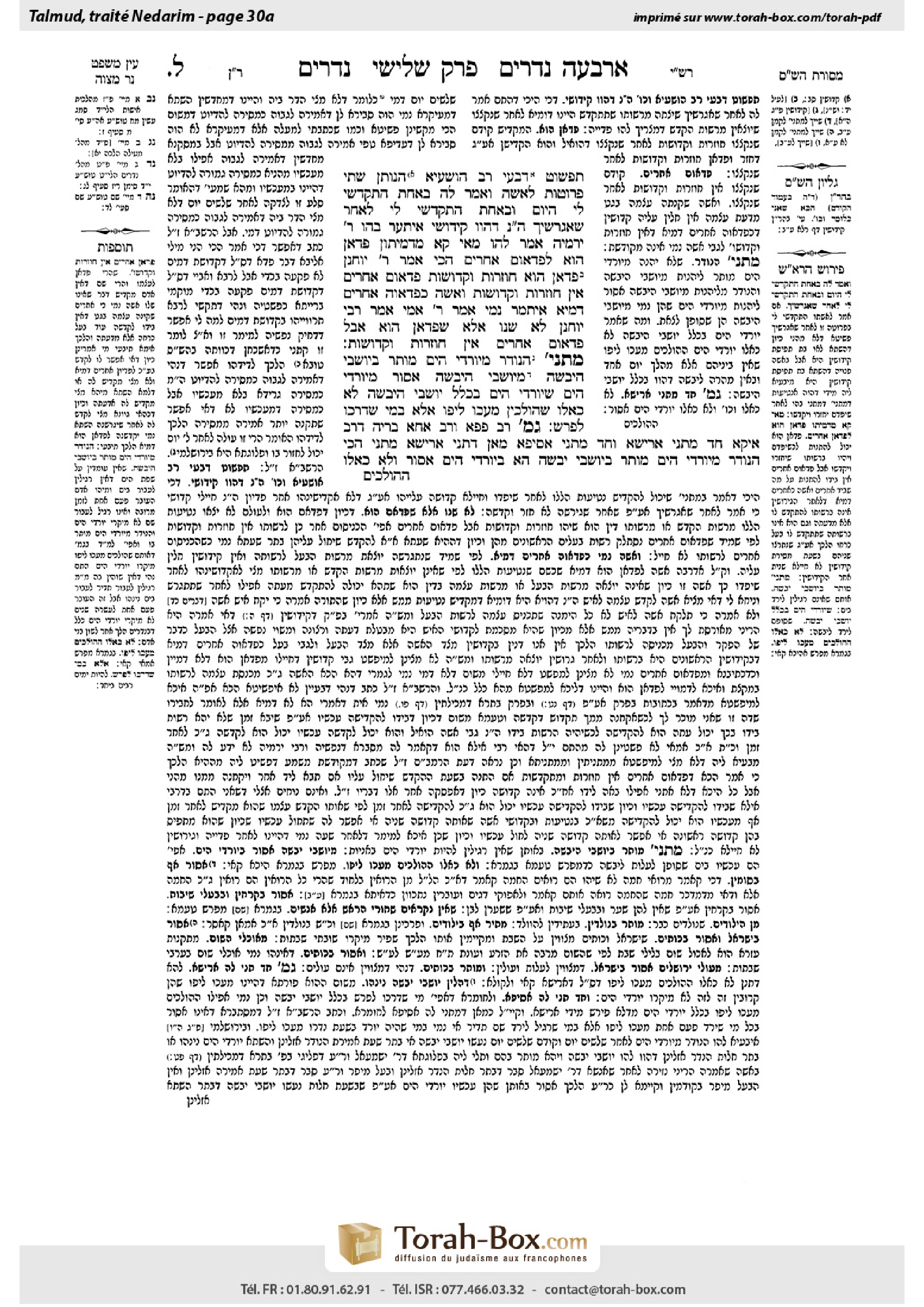
Nedarim 30a: Talmud study for Daf Yomi
Daf Yomi is the daily study of one Talmud folio. Explore 37 tractates with scans, Hebrew text, Sefaria English and AI-generated French translations where annotated.
Passage selection and English or AI-generated French translation are available where the scan has annotations. Daf Study is independent of Torah-Box and Sefaria.
Browse Nedarim · נדרים · All tractatesNedarim 30a text and translations
This page of Nedarim includes the Aramaic text, an English translation and an AI-generated French translation, alongside the scan above.
נדרים ל׳ א · Aramaic and Hebrew text
תִּפְשׁוֹט דְּבָעֵי רַב הוֹשַׁעְיָא: הַנּוֹתֵן שְׁתֵּי פְרוּטוֹת לְאִשָּׁה וְאָמַר לָהּ: ״בְּאַחַת הִתְקַדְּשִׁי לִי הַיּוֹם, וּבְאַחַת הִתְקַדְּשִׁי לִי לְאַחַר שֶׁאֲגָרְשֵׁיךְ״, הָכִי נָמֵי דְּהָווּ קִידּוּשֵׁי.
אִיתְּעַר בְּהוּ רַבִּי יִרְמְיָה, אֲמַר לְהוּ: מַאי קָא מְדַּמֵּיתוּן פְּדָאָן הוּא לִפְדָאוּם אֲחֵרִים? הָכִי אָמַר רַבִּי יוֹחָנָן: פְּדָאָן הוּא — חוֹזְרוֹת וּקְדוֹשׁוֹת, פְּדָאוּם אֲחֵרִים — אֵין חוֹזְרוֹת וּקְדוֹשׁוֹת. וְאִשָּׁה כִּפְדָאוּהָ אֲחֵרִים דָּמְיָא.
אִיתְּמַר נָמֵי, אָמַר רַבִּי אַמֵּי אָמַר רַבִּי יוֹחָנָן: לֹא שָׁנוּ אֶלָּא שֶׁפְּדָאָן הוּא, אֲבָל פְּדָאוּם אֲחֵרִים — אֵין חוֹזְרוֹת וּקְדוֹשׁוֹת.
מַתְנִי׳ הַנּוֹדֵר מִיּוֹרְדֵי הַיָּם — מוּתָּר בְּיוֹשְׁבֵי הַיַּבָּשָׁה. מִיּוֹשְׁבֵי הַיַּבָּשָׁה — אָסוּר מִיּוֹרְדֵי הַיָּם, שֶׁיּוֹרְדֵי הַיָּם בִּכְלַל יוֹשְׁבֵי הַיַּבָּשָׁה. לֹא כְּאֵלּוּ שֶׁהוֹלְכִים מֵעַכּוֹ לְיָפוֹ, אֶלָּא בְּמִי שֶׁדַּרְכּוֹ לְפָרֵשׁ.
גְּמָ׳ רַב פָּפָּא וְרַב אַחָא בְּרֵיהּ דְּרַב אִיקָא, חַד מַתְנֵי אַרֵישָׁא וְחַד מַתְנֵי אַסֵּיפָא. מַאן דְּתָנֵי אַרֵישָׁא, מַתְנֵי הָכִי: הַנּוֹדֵר מִיּוֹרְדֵי הַיָּם — מוּתָּר בְּיוֹשְׁבֵי יַבָּשָׁה, הָא בְּיוֹרְדֵי הַיָּם — אָסוּר, וְלֹא כְּאֵלּוּ
Nedarim 30a · English translation
resolve the dilemma from here, as Rav Hoshaya asked: In the case of one who gives two perutot to a woman and says to her: With one of them be betrothed to me today and with one be betrothed to me after I divorce you, what is the halakha? Rav Hoshaya was uncertain whether the second betrothal is effective after the divorce. Bar Padda holds that if he redeems the consecrated saplings, they again become consecrated. Apparently, he holds that upon the redemption, the second consecration immediately goes into effect. From bar Padda’s opinion, one could say: So too, here, after the first marriage is ended by the bill of divorce, the second betrothal that was previously performed takes effect, and it should be a valid betrothal.
Rabbi Yirmeya, who had been dozing, woke up when he heard their conversation and said to them: For what reason are you comparing where he redeemed them to where others redeemed them? The halakhot are not similar. This is what Rabbi Yoḥanan said: If he redeemed the saplings, they become consecrated again, but if others redeemed them before they were cut they do not become consecrated again, since they are not in his possession anymore, and the case of a woman given a bill of divorce from her husband is considered as if others redeemed her. This is because upon divorce she is completely independent, and the second marriage can therefore take effect only with her consent. But if she refuses, the betrothal is not valid.
It was also stated that Rabbi Ami said that Rabbi Yoḥanan said: They taught only that bar Padda holds that the saplings become consecrated again when he redeemed them himself, but when others redeemed them they do not become consecrated again for he cannot consecrate them after they have been in the possession of others, and it no longer depends on his intent.
MISHNA: In the case of one who takes a vow that he will not derive benefit from seafarers, he is permitted to benefit from those who live on dry land. But if he takes a vow not to derive benefit from those who live on dry land, he is also prohibited from deriving benefit from seafarers, because seafarers are included within the category of those who live on dry land. The mishna now defines seafarers: Not like those that travel by ship from Akko to Jaffa, which is a short trip, but rather one who customarily departs [lefaresh] to distant locations, e.g., foreign countries.
GEMARA: With regard to the mishna’s definition of seafarers, there is a dispute between Rav Pappa and Rav Aḥa, son of Rav Ika. One teaches this statement with regard to the first clause of the mishna, and one teaches it with regard to the latter clause. The Gemara explains: The one who teaches it with regard to the first clause teaches it like this: One who takes a vow not to derive benefit from seafarers is permitted to derive benefit from those who live on dry land. But he is prohibited from deriving benefit from seafarers, and seafarers are not like those
Nedarim 30a · Traduction française (IA)
Résolvons le dilemme à partir d’ici, comme l’a demandé Rav Hoshaya : dans le cas d’un homme qui donne deux peroutot à une femme et lui dit : « Avec l’une, sois ma fiancée dès aujourd’hui, et avec l’autre, sois ma fiancée après que je t’aurai répudiée », quelle est la halakha ? Rav Hoshaya se demandait si le second kiddouchin prend effet après le divorce. Bar Padda considère que, s’il rachète les jeunes plants consacrés, ceux-ci redeviennent consacrés. Apparemment, il estime qu’au moment du rachat, la seconde consécration prend immédiatement effet. On pourrait donc déduire de l’opinion de Bar Padda que, de même ici, une fois le premier mariage dissous par l’acte de divorce, le second kiddouchin, accompli auparavant, prend effet et constitue un kiddouchin valide.
Rabbi Yirmeya, qui somnolait, se réveilla en entendant leur conversation et leur dit : Pourquoi comparez-vous le cas où il les a rachetés à celui où d’autres les ont rachetés ? Ces halakhot ne sont pas analogues. Voici ce qu’a dit Rabbi Yoḥanan : s’il a lui-même racheté les jeunes plants, ceux-ci redeviennent consacrés ; mais si d’autres les ont rachetés avant qu’ils ne soient coupés, ils ne redeviennent pas consacrés, puisqu’ils ne sont plus en sa possession. De même, le cas d’une femme à laquelle son mari a remis un acte de divorce est considéré comme si d’autres l’avaient rachetée. En effet, après le divorce, elle est totalement indépendante, et le second mariage ne peut donc prendre effet qu’avec son consentement. Si elle refuse, le kiddouchin n’est pas valide.
Il a également été rapporté que Rabbi Ami a dit au nom de Rabbi Yoḥanan : ils ont enseigné que, selon Bar Padda, les jeunes plants redeviennent consacrés uniquement lorsqu’il les a lui-même rachetés ; mais si d’autres les ont rachetés, ils ne redeviennent pas consacrés, car il ne peut pas les consacrer après qu’ils ont été en la possession d’autrui, et cela ne dépend alors plus de son intention.
MICHNA : Celui qui fait le vœu de ne tirer aucun avantage des gens de mer peut tirer avantage de ceux qui vivent sur la terre ferme. Mais s’il fait le vœu de ne tirer aucun avantage des gens qui vivent sur la terre ferme, il lui est également interdit de tirer avantage des gens de mer, car ceux-ci sont inclus dans la catégorie des gens qui vivent sur la terre ferme. La Michna définit maintenant les gens de mer : il ne s’agit pas de ceux qui voyagent en bateau d’Akko à Jaffa, un trajet court, mais de celui qui a coutume de partir [lefaresh] vers des destinations lointaines, par exemple à l’étranger.
GUEMARA : Concernant la définition des gens de mer donnée par la Michna, Rav Pappa et Rav Aḥa, fils de Rav Ika, sont en désaccord. L’un rapporte cette déclaration à la première partie de la Michna, l’autre à sa dernière partie. La Guemara explique : celui qui la rapporte à la première partie l’enseigne ainsi : celui qui fait le vœu de ne tirer aucun avantage des gens de mer peut tirer avantage de ceux qui vivent sur la terre ferme. Mais il lui est interdit de tirer avantage des gens de mer, et les gens de mer ne sont pas comme ceux
Traduction française générée par IA à partir de l’édition anglaise de Sefaria. Vérifie toujours un passage avec le texte source.
Text from Sefaria: William Davidson Edition - Vocalized Aramaic (CC BY NC); William Davidson Edition - English (CC BY NC).