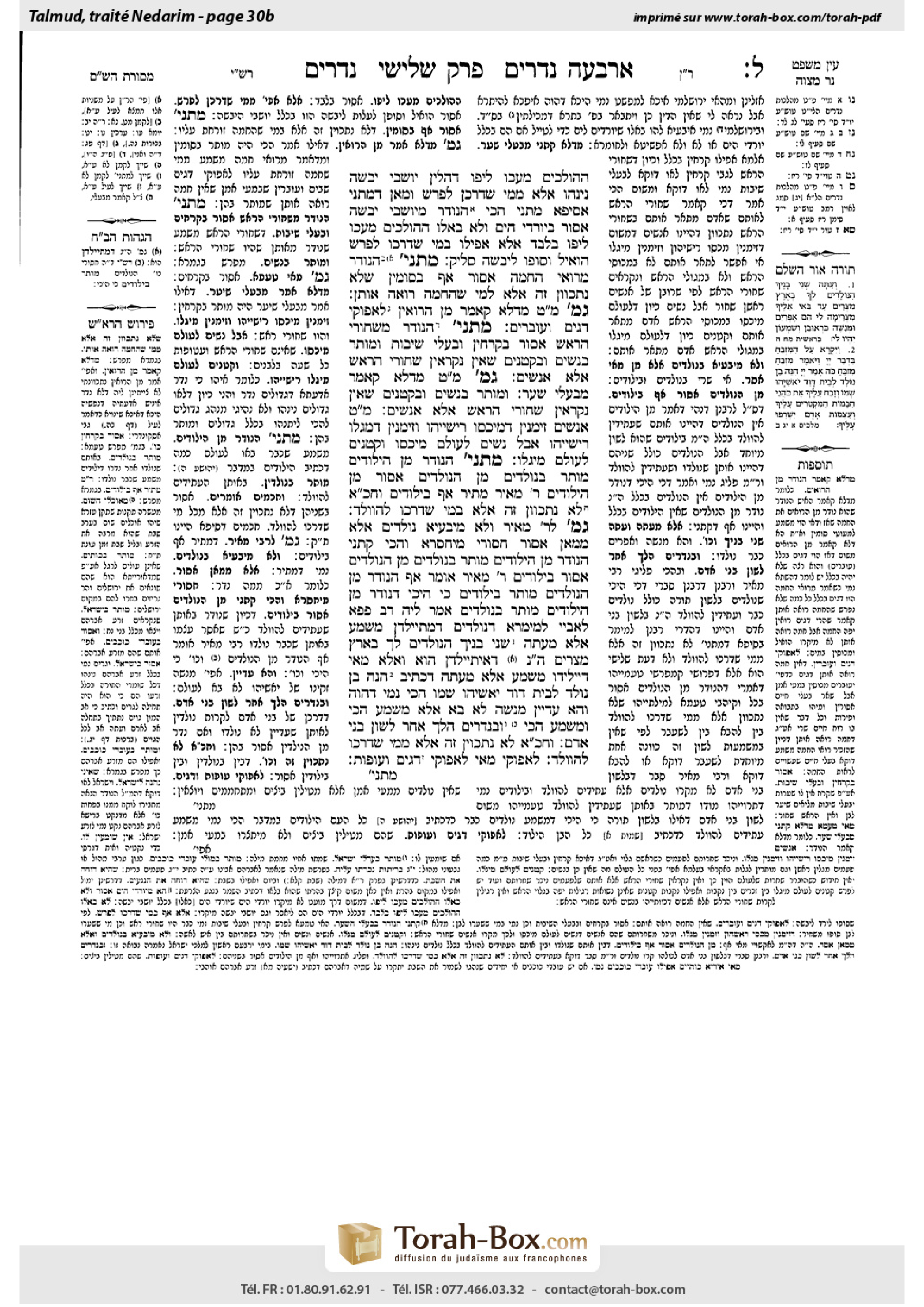
Nedarim 30b: Talmud study for Daf Yomi
Daf Yomi is the daily study of one Talmud folio. Explore 37 tractates with scans, Hebrew text, Sefaria English and AI-generated French translations where annotated.
Passage selection and English or AI-generated French translation are available where the scan has annotations. Daf Study is independent of Torah-Box and Sefaria.
Browse Nedarim · נדרים · All tractatesNedarim 30b text and translations
This page of Nedarim includes the Aramaic text, an English translation and an AI-generated French translation, alongside the scan above.
נדרים ל׳ ב · Aramaic and Hebrew text
הַהוֹלְכִים מֵעַכּוֹ לְיָפוֹ, דְּהָלֵין יוֹשְׁבֵי הַיַּבָּשָׁה נִינְהוּ, אֶלָּא מִמִּי שֶׁדַּרְכָּן לְפָרֵשׁ.
וּמַאן דְּמַתְנֵי אַסֵּיפָא, מַתְנֵי הָכִי: הַנּוֹדֵר מִיּוֹשְׁבֵי יַבָּשָׁה — אָסוּר בְּיוֹרְדֵי הַיָּם, וְלֹא בְּאֵלּוּ הַהוֹלְכִים מֵעַכּוֹ לְיָפוֹ בִּלְבַד, אֶלָּא אֲפִילּוּ בְּמִי שֶׁדַּרְכּוֹ לְפָרֵשׁ, הוֹאִיל וְסוֹפוֹ לְיַבָּשָׁה סָלֵיק.
מַתְנִי׳ הַנּוֹדֵר מֵרוֹאֵי הַחַמָּה — אָסוּר אַף בַּסּוֹמִין, שֶׁלֹּא נִתְכַּוֵּון זֶה אֶלָּא לְמִי שֶׁהַחַמָּה רוֹאָה אוֹתָן.
גְּמָ׳ מַאי טַעְמָא? מִדְּלָא קָאָמַר ״מִן הָרוֹאִין״. לְאַפּוֹקֵי דָּגִים וְעוּבָּרִים.
מַתְנִי׳ הַנּוֹדֵר מִשְּׁחוֹרֵי הָרֹאשׁ — אָסוּר בַּקֵּרְחִין, וּבַעֲלִי שֵׂיבוֹת. וּמוּתָּר בַּנָּשִׁים וּבַקְּטַנִּים, שֶׁאֵין נִקְרָאִין ״שְׁחוֹרֵי הָרֹאשׁ״ אֶלָּא אֲנָשִׁים.
גְּמָ׳ מַאי טַעְמָא — מִדְּלָא קָאָמַר ״מִבַּעְלֵי שֵׂעָר״.
וּמוּתָּר בְּנָשִׁים וּבִקְטַנִּים, שֶׁאֵין נִקְרָאִין ״שְׁחוֹרֵי הָרֹאשׁ״ אֶלָּא אֲנָשִׁים. מַאי טַעְמָא — אֲנָשִׁים זִימְנִין דְּמִיכַּסּוּ רֵישַׁיְיהוּ וְזִימְנִין דְּמִגַּלּוּ רֵישַׁיְיהוּ. אֲבָל נָשִׁים לְעוֹלָם מִיכַּסּוּ, וּקְטַנִּים לְעוֹלָם מִיגַּלּוּ.
מַתְנִי׳ הַנּוֹדֵר מִן הַיְּלוּדִים — מוּתָּר בְּנוֹלָדִים. מִן הַנּוֹלָדִים — אָסוּר מִן הַיְּלוּדִים. רַבִּי מֵאִיר מַתִּיר אַף בַּיְּלוּדִים. וַחֲכָמִים אוֹמְרִים: לֹא נִתְכַּוֵּון זֶה אֶלָּא בְּמִי שֶׁדַּרְכּוֹ לְהִוּוֹלֵד.
גְּמָ׳ לְרַבִּי מֵאִיר וְלָא מִיבַּעְיָא נוֹלָדִים. אֶלָּא מִמַּאן אָסוּר?
חַסּוֹרֵי מִיחַסְּרָא וְהָכִי קָתָנֵי: הַנּוֹדֵר מִן הַיְּלוּדִים — מוּתָּר בַּנּוֹלָדִים, מִן הַנּוֹלָדִים — אָסוּר בַּיְּלוּדִים, רַבִּי מֵאִיר אוֹמֵר: אַף הַנּוֹדֵר מִן הַנּוֹלָדִים מוּתָּר בַּיְּלוּדִים, כִּי הֵיכִי דְּנוֹדֵר מִן הַיְּלוּדִים מוּתָּר בַּנּוֹלָדִים.
אֲמַר לֵיהּ רַב פָּפָּא לְאַבָּיֵי: לְמֵימְרָא דְּ״נוֹלָדִים״ דְּמִתְיַילְּדָן מַשְׁמַע? אֶלָּא מֵעַתָּה ״שְׁנֵי בָנֶיךָ הַנּוֹלָדִים לְךָ בְּאֶרֶץ מִצְרַיִם״, הָכִי נָמֵי דְאִיתְיַילְדָן הוּא?
וְאֶלָּא מַאי דִּיילִידוּ מַשְׁמַע, אֶלָּא מֵעַתָּה דִּכְתִיב ״הִנֵּה בֵן נוֹלָד לְבֵית דָּוִד יֹאשִׁיָּהוּ שְׁמוֹ״, הָכִי נָמֵי דַּהֲוָה? וְהָא עֲדַיִין מְנַשֶּׁה לֹא בָּא? אֶלָּא מַשְׁמַע הָכִי וּמַשְׁמַע הָכִי, וּבִנְדָרִים הַלֵּךְ אַחַר לְשׁוֹן בְּנֵי אָדָם.
וַחֲכָמִים אוֹמְרִים, לֹא נִתְכַּוֵּין זֶה אֶלָּא מִמִּי שֶׁדַּרְכּוֹ לְהִוּוֹלֵד. לְאַפּוֹקֵי מַאי — לְאַפּוֹקֵי דָּגִים וְעוֹפוֹת.
Nedarim 30b · English translation
who travel from Akko to Jaffa, for they are treated like those who dwell on the land. Rather, the term seafarers means he took a vow that deriving benefit from those who customarily depart out to sea is forbidden to him.
And the one who teaches it with regard to the latter clause of the mishna teaches in this manner: One who takes a vow not to derive benefit from those who dwell on dry land is prohibited from deriving benefit from seafarers, and this is the halakha not only with regard to those who travel from Akko to Jaffa, who are certainly not considered seafarers, but even with regard to one who customarily departs to great distances. Why is such a person also considered a dweller on dry land? Since eventually he will go up onto dry land. No one lives his entire life at sea. Eventually, one will reach dry land, so all people are called dwellers on dry land.
MISHNA: One who takes a vow not to derive benefit from those who see the sun is prohibited from deriving benefit even from the blind, although they see nothing. This is because he meant only to include all those that the sun sees, i.e., shines upon with light.
GEMARA: The Gemara explains why the mishna states that blind people are included: What is the reason for this? Since he did not say: From those who see, which would exclude blind people. Instead, he employed the phrase: Those who see the sun, which comes to exclude fish and fetuses, who do not see the sun. Consequently, the vow is interpreted to refer to those who are exposed to the sun, including the blind.
MISHNA: One who takes a vow not to derive benefit from those that have dark heads [sheḥorei harosh] is prohibited from deriving benefit from those that are bald, although they have no hair at all, and from the elderly who have white hair. This is because the term is not to be understood in its simple meaning but rather in a broader manner. But he is permitted to derive benefit from women and from children, because only men are called: Those with dark heads.
GEMARA: What is the reason that the term dark heads does not exclude those that are bald? Because it does not say: From those with hair.
The mishna states: But he is permitted to derive benefit from women and from children, because only men are called: Those with dark heads. The Gemara explains: What is the reason for this? Men sometimes cover their heads and sometimes uncover their heads. They can be called dark heads since, for the most part, they have dark hair which is often uncovered. But women’s heads are always covered, and children’s heads are always uncovered, and the expression dark heads is referring to men whose hair is sometimes seen.
MISHNA: One who takes a vow not to derive benefit from those that are born [yeludim] is permitted to derive benefit from those who will be born [noladim] after the time of the vow. But if one takes a vow not to derive benefit from those who will be born, he is also prohibited from deriving benefit from those that are already born at the time of the vow. Rabbi Meir permits deriving benefit even from those that are already born at the time of the vow because he holds that the one taking the vow was precise in prohibiting only those that will be born. And the Rabbis say: He intended to include with this expression only one whose nature is to be born. Therefore, both those who will be born and those who were already born are included in the vow.
GEMARA: The Gemara comments: According to Rabbi Meir, in the case of one who takes a vow that deriving benefit from those who will be born is forbidden to him, the halakha is that he is permitted to derive benefit even from those who are already born at the time of the vow. And the mishna’s use of the term: Even, indicates that it is not necessary to say that those who will be born are permitted to him. The Gemara asks: However, if that is the case, from whom is he prohibited to derive benefit? The vow appears to have no effect.
The Gemara answers: The mishna is incomplete and is teaching like this: One who takes a vow not to derive benefit from those that are born is permitted to derive benefit from those who will be born after the time of the vow. But if one takes a vow not to derive benefit from those who will be born, he is also prohibited from deriving benefit from those that are already born at the time of the vow. Rabbi Meir says: Even one who takes a vow not to derive benefit from those who will be born is permitted to derive benefit from those who are already born, just as one who takes a vow not to derive benefit from those who are born is permitted to derive benefit from those who will be born, because Rabbi Meir claims that the one taking the vow was precise in his words.
With regard to the distinction between the terms in the mishna, Rav Pappa said to Abaye: Is this to say that the word noladim means those who will be born in the future? But if that is so, it says in the verse: “Your two sons who were born [noladim] to you in the land of Egypt” (Genesis 48:5), does it also mean those who will be born? The verse is referring to Manasseh and Ephraim, who were already alive.
The Gemara responds: But rather, what should one say; that the expression means those already born? However, if that is so, that which is written: “Behold, a son shall be born [nolad] to the house of David, Josiah by name” (I Kings 13:2), is the meaning also that he is already born? But Manasseh had not yet come into this world, and certainly not his grandson Josiah. Rather, sometimes the word means this, those already born, and sometimes means that, those who are not yet born, and with regard to vows, follow the colloquial language, in which the word noladim is used to mean those who are not yet born, so the vow is interpreted in this manner.
The mishna states: And the Rabbis say: He intended to include with this expression only one whose nature is to be born. The Gemara asks: What does this term exclude? The Gemara answers: It serves to exclude fish and birds, which are not born but are hatched from eggs, whereas the word noladim means those born from their mother’s womb.
Nedarim 30b · Traduction française (IA)
qui voyagent d’Akko à Jaffa, car ils sont considérés comme des habitants de la terre ferme. Le terme « gens de mer » désigne plutôt celui qui a fait le vœu de ne pas tirer profit de ceux qui ont l’habitude de prendre la mer.
Et celui qui enseigne la Michna en se référant à sa dernière clause l’enseigne ainsi : Celui qui fait le vœu de ne pas tirer profit des habitants de la terre ferme ne peut pas tirer profit des gens de mer. Cette halakha concerne non seulement ceux qui voyagent d’Akko à Jaffa, qui ne sont certainement pas considérés comme des gens de mer, mais aussi celui qui a l’habitude de partir pour de très longues distances. Pourquoi une telle personne est-elle également considérée comme un habitant de la terre ferme ? Parce qu’elle finira par débarquer. Personne ne vit toute sa vie en mer. Chacun finira par atteindre la terre ferme ; tous sont donc appelés habitants de la terre ferme.
MICHNA : Celui qui fait le vœu de ne pas tirer profit de ceux qui voient le soleil ne peut pas tirer profit même des aveugles, bien qu’ils ne voient rien. En effet, il entendait seulement inclure tous ceux que le soleil voit, c’est-à-dire ceux qu’il éclaire de sa lumière.
GUEMARA : La Guemara explique pourquoi la Michna précise que les aveugles sont inclus : quelle en est la raison ? Il n’a pas dit : « De ceux qui voient », ce qui aurait exclu les aveugles. Il a plutôt employé l’expression « ceux qui voient le soleil », qui vise à exclure les poissons et les fœtus, qui ne voient pas le soleil. Par conséquent, le vœu s’interprète comme visant ceux qui sont exposés au soleil, y compris les aveugles.
MICHNA : Celui qui fait le vœu de ne pas tirer profit de ceux qui ont la tête sombre [sheḥorei harosh] ne peut tirer profit ni des chauves, bien qu’ils n’aient aucun cheveu, ni des personnes âgées aux cheveux blancs. En effet, l’expression ne doit pas être comprise dans son sens littéral, mais dans un sens plus large. En revanche, il lui est permis de tirer profit des femmes et des enfants, car seuls les hommes sont appelés « ceux qui ont la tête sombre ».
GUEMARA : Pourquoi l’expression « ceux qui ont la tête sombre » n’exclut-elle pas les chauves ? Parce qu’il n’a pas dit : « De ceux qui ont des cheveux ».
La Michna enseigne : En revanche, il lui est permis de tirer profit des femmes et des enfants, car seuls les hommes sont appelés « ceux qui ont la tête sombre ». La Guemara explique : quelle en est la raison ? Les hommes se couvrent parfois la tête et la découvrent parfois. On peut les appeler « ceux qui ont la tête sombre », car ils ont généralement les cheveux foncés, qui sont souvent découverts. Mais les femmes ont toujours la tête couverte, tandis que les enfants ont toujours la tête découverte ; l’expression « ceux qui ont la tête sombre » désigne les hommes, dont les cheveux sont parfois visibles.
MICHNA : Celui qui fait le vœu de ne pas tirer profit de ceux qui sont nés [yeludim] peut tirer profit de ceux qui naîtront [noladim] après le moment où il a fait son vœu. Mais si quelqu’un fait le vœu de ne pas tirer profit de ceux qui naîtront, il ne peut pas non plus tirer profit de ceux qui sont déjà nés au moment du vœu. Rabbi Meïr permet de tirer profit même de ceux qui étaient déjà nés au moment du vœu, car il considère que celui qui a fait le vœu a choisi ses mots avec précision et n’a interdit que ceux qui naîtront. Les Sages disent, quant à eux : par cette expression, il entendait inclure uniquement ceux dont la nature est de naître. Par conséquent, le vœu inclut à la fois ceux qui naîtront et ceux qui étaient déjà nés.
GUEMARA : La Guemara fait remarquer que, selon Rabbi Meïr, lorsqu’une personne fait le vœu de ne pas tirer profit de ceux qui naîtront, elle peut tirer profit même de ceux qui étaient déjà nés au moment du vœu. L’emploi du terme « même » dans la Michna indique qu’il va de soi qu’elle peut tirer profit de ceux qui naîtront. La Guemara demande : mais si tel est le cas, de qui lui est-il interdit de tirer profit ? Il semble que le vœu n’ait aucun effet.
La Guemara répond : La Michna est incomplète et enseigne ceci : Celui qui fait le vœu de ne pas tirer profit de ceux qui sont nés peut tirer profit de ceux qui naîtront après le moment du vœu. Mais si quelqu’un fait le vœu de ne pas tirer profit de ceux qui naîtront, il ne peut pas non plus tirer profit de ceux qui étaient déjà nés au moment du vœu. Rabbi Meïr dit : Même celui qui fait le vœu de ne pas tirer profit de ceux qui naîtront peut tirer profit de ceux qui étaient déjà nés, tout comme celui qui fait le vœu de ne pas tirer profit de ceux qui sont nés peut tirer profit de ceux qui naîtront, car Rabbi Meïr affirme que celui qui a fait le vœu a choisi ses mots avec précision.
À propos de la distinction entre les termes employés dans la Michna, Rav Pappa dit à Abayé : Faut-il en conclure que le mot noladim désigne ceux qui naîtront à l’avenir ? Mais, si tel est le cas, que signifie le verset : « Tes deux fils qui te sont nés [noladim] au pays d’Égypte » (Genèse 48:5) ? Signifie-t-il lui aussi qu’ils naîtront à l’avenir ? Le verset parle de Manassé et d’Éphraïm, qui étaient déjà en vie.
La Guemara répond : Mais alors, que faudrait-il dire ? Que l’expression désigne ceux qui sont déjà nés ? Cependant, si tel est le cas, le verset qui dit : « Voici qu’un fils naîtra [nolad] à la maison de David, du nom de Josias » (I Rois 13:2) signifie-t-il lui aussi qu’il est déjà né ? Mais Manassé n’était pas encore venu au monde, et son petit-fils Josias, à plus forte raison. Le mot désigne donc parfois ceux qui sont déjà nés et parfois ceux qui ne le sont pas encore. Pour les vœux, on suit le langage courant, dans lequel le mot noladim désigne ceux qui ne sont pas encore nés ; le vœu s’interprète donc ainsi.
La Michna enseigne : Les Sages disent que, par cette expression, il entendait inclure uniquement ceux dont la nature est de naître. La Guemara demande : qu’est-ce que cette expression exclut ? Elle répond qu’elle sert à exclure les poissons et les oiseaux, qui ne naissent pas mais éclosent d’œufs, tandis que le mot noladim désigne ceux qui naissent du ventre de leur mère.
Traduction française générée par IA à partir de l’édition anglaise de Sefaria. Vérifie toujours un passage avec le texte source.
Text from Sefaria: William Davidson Edition - Vocalized Aramaic (CC BY NC); William Davidson Edition - English (CC BY NC).