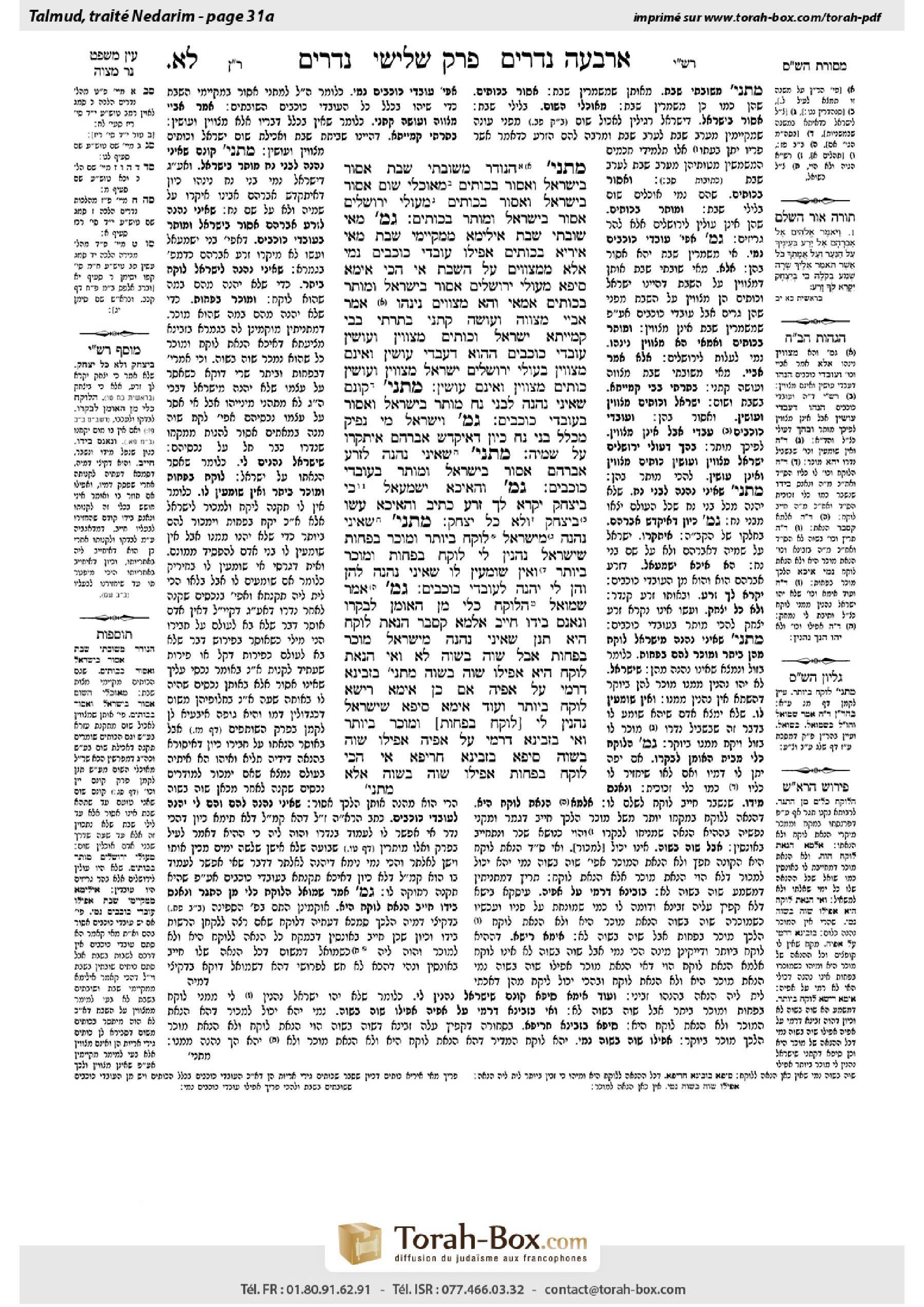
Nedarim 31a: Talmud study for Daf Yomi
Daf Yomi is the daily study of one Talmud folio. Explore 37 tractates with scans, Hebrew text, Sefaria English and AI-generated French translations where annotated.
Passage selection and English or AI-generated French translation are available where the scan has annotations. Daf Study is independent of Torah-Box and Sefaria.
Browse Nedarim · נדרים · All tractatesNedarim 31a text and translations
This page of Nedarim includes the Aramaic text, an English translation and an AI-generated French translation, alongside the scan above.
נדרים ל״א א · Aramaic and Hebrew text
מַתְנִי׳ הַנּוֹדֵר מִשּׁוֹבְתֵי שַׁבָּת — אָסוּר בְּיִשְׂרָאֵל וְאָסוּר בַּכּוּתִים. מֵאוֹכְלֵי שׁוּם — אָסוּר בְּיִשְׂרָאֵל וְאָסוּר בַּכּוּתִים. מֵעוֹלֵי יְרוּשָׁלַיִם — אָסוּר בְּיִשְׂרָאֵל וּמוּתָּר בַּכּוּתִים.
גְּמָ׳ מַאי ״שׁוֹבְתֵי שַׁבָּת״? אִילֵּימָא מִמְּקַיְּימֵי שַׁבָּת, מַאי אִירְיָא בַּכּוּתִים? אֲפִילּוּ גּוֹיִם נָמֵי! אֶלָּא מִמְּצֻוִּוים עַל הַשַּׁבָּת.
אִי הָכִי, אֵימָא סֵיפָא: ״מֵעוֹלֵי יְרוּשָׁלַיִם״ — אָסוּר בְּיִשְׂרָאֵל וּמוּתָּר בַּכּוּתִים, אַמַּאי? וְהָא מְצֻוִּוים נִינְהוּ!
אָמַר אַבָּיֵי: מְצֻוֶּוה וְעוֹשֶׂה קָתָנֵי. בְּתַרְתֵּי בָּבֵי קַמָּיָיתָא: יִשְׂרָאֵל וְכוּתִים — מְצֻוִּוין וְעוֹשִׂין, גּוֹיִם הָהוּא דְּעָבְדִי — עוֹשִׂין וְאֵינָם מְצֻוִּוין. בְּעוֹלֵי יְרוּשָׁלַיִם: יִשְׂרָאֵל — מְצֻוִּוין וְעוֹשִׂין, כּוּתִים — מְצֻוִּוין וְאֵינָם עוֹשִׂין.
מַתְנִי׳ ״קֻוֽנָּם שֶׁאֵינִי נֶהֱנֶה לִבְנֵי נֹחַ״ — מוּתָּר בְּיִשְׂרָאֵל וְאָסוּר בְּאוּמּוֹת הָעוֹלָם.
גְּמָ׳ וְיִשְׂרָאֵל מִי נָפֵיק מִכְּלָל בְּנֵי נֹחַ? כֵּיוָן דְּאִיקַּדַּשׁ אַבְרָהָם, אִיתְקְרוֹ עַל שְׁמֵיהּ.
מַתְנִי׳ ״שֶׁאֵינִי נֶהֱנֶה לְזֶרַע אַבְרָהָם״ — אָסוּר בְּיִשְׂרָאֵל וּמוּתָּר בְּאוּמּוֹת הָעוֹלָם.
גְּמָ׳ וְהָאִיכָּא יִשְׁמָעֵאל! ״כִּי בְיִצְחָק יִקָּרֵא לְךָ זָרַע״ כְּתִיב. וְהָאִיכָּא עֵשָׂו! ״בְּיִצְחָק״, וְלֹא כׇּל יִצְחָק.
מַתְנִי׳ ״שֶׁאֵינִי נֶהֱנֶה מִיִּשְׂרָאֵל״ — לוֹקֵחַ בְּיוֹתֵר וּמוֹכֵר בְּפָחוֹת. ״שֶׁיִּשְׂרָאֵל נֶהֱנִין לִי״ — לוֹקֵחַ בְּפָחוֹת וּמוֹכֵר בְּיוֹתֵר, וְאֵין שׁוֹמְעִין לוֹ. ״שֶׁאֵינִי נֶהֱנֶה לָהֶן וְהֵן לִי״ — יֵהָנֶה לְאוּמּוֹת הָעוֹלָם.
גְּמָ׳ אָמַר שְׁמוּאֵל: הַלּוֹקֵחַ כְּלִי מִן הָאוּמָּן לְבַקְּרוֹ וְנֶאֱנַס בְּיָדוֹ — חַיָּיב. אַלְמָא קָסָבַר הֲנָאַת לוֹקֵחַ הִיא.
תְּנַן: ״שֶׁאֵינִי נֶהֱנֶה מִיִּשְׂרָאֵל״ — מוֹכֵר בְּפָחוֹת, אֲבָל שָׁוֶה בְּשָׁוֶה — לָא. וְאִי הֲנָאַת לוֹקֵחַ הִיא — אֲפִילּוּ שָׁוֶה בְּשָׁוֶה! מַתְנִיתִין בִּזְבִינָא דִּרְמֵי עַל אַפֵּיהּ.
אִם כֵּן אֵימָא רֵישָׁא: לוֹקֵחַ בְּיוֹתֵר. וְעוֹד, אֵימָא סֵיפָא: ״שֶׁיִּשְׂרָאֵל נֶהֱנִין לִי״ — [לוֹקֵחַ בְּפָחוֹת] וּמוֹכֵר בְּיוֹתֵר. וְאִי בִּזְבִינָא דִּרְמֵי עַל אַפֵּיהּ — אֲפִילּוּ שָׁוֶה בְּשָׁוֶה!
סֵיפָא בִּזְבִינָא חֲרִיפָא. אִי הָכִי לוֹקֵחַ בְּפָחוֹת? אֲפִילּוּ שָׁוֶה בְּשָׁוֶה! אֶלָּא
Nedarim 31a · English translation
MISHNA: One who takes a vow that deriving benefit from those who rest on Shabbat is forbidden to him is prohibited from deriving benefit from a Jew, and he is also prohibited from deriving benefit from Samaritans [Kutim] because they are also Shabbat observers. One who takes a vow that deriving benefit from those who eat garlic on Shabbat night is forbidden to him is prohibited from deriving benefit from a Jew, and he is also prohibited from benefiting from Samaritans. However, if one takes a vow that deriving benefit from those who ascend to Jerusalem is forbidden to him, he is prohibited from deriving benefit from a Jew, but he is permitted to benefit from Samaritans because they do not ascend to Jerusalem, but rather, to Mount Gerizim.
GEMARA: The Gemara asks: What is the meaning of the expression in the mishna: Those who rest on Shabbat? If we say that the one who took the vow intended to render forbidden deriving benefit from those who uphold Shabbat, i.e., who actually observe it, why mention specifically that he is prohibited from deriving benefit from Samaritans; even benefit from other gentiles who are Shabbat observers should also be prohibited? Rather, the intention of the tanna was to refer to a case where one took a vow that deriving benefit from those who are commanded about observing Shabbat is forbidden, and this tanna holds that the Samaritans are considered true converts, commanded to observe Shabbat.
The Gemara asks: If that is so, say the latter clause of the mishna: If he takes a vow that deriving benefit from those who ascend to Jerusalem is forbidden to him, he is prohibited from deriving benefit from a Jew but permitted to derive benefit from Samaritans. Why? But aren’t Samaritans commanded to ascend just like other Jews?
Abaye said: It is teaching about those who are commanded and actually perform a mitzva, and the mishna is to be understood as follows: In the first two clauses of the mishna, which concern Shabbat observance and eating garlic, both Jews and Samaritans are included because they are commanded and actually perform the mitzva. However, with regard to gentiles, those who perform these mitzvot have the status of those who perform the mitzva but are not commanded to do so. Therefore, the one who took the vow is permitted to derive benefit from them. Concerning the case of those who ascend to Jerusalem, a Jew is commanded to keep this mitzva and performs it, while Samaritans are commanded but do not perform it, so he is permitted to derive benefit from them.
MISHNA: If one says: The property of the descendants of Noah is konam for me, and for that reason I will not benefit from it, he is permitted to derive benefit from a Jew but prohibited from deriving benefit from the nations of the world.
GEMARA: The Gemara asks: And is a Jew excluded from the category of the descendants of Noah? They are also descendants of Noah. The Gemara answers: Since Abraham was sanctified and designated to possess a unique role in the world, all his descendants are called by his name and are no longer termed the descendants of Noah.
MISHNA: If one says: The property of the offspring of Abraham is forbidden to me, and for that reason I will not benefit from it, he is prohibited from deriving benefit from a Jew but permitted to derive benefit from the nations of the world.
GEMARA: Concerning the mishna’s ruling that the one who takes such a vow is permitted to derive benefit from the nations of the world, the Gemara asks: But isn’t there Ishmael and his descendants, who are also Abraham’s offspring? Why isn’t deriving benefit from them forbidden as well? The Gemara answers: It is written with regard to Abraham: “For in Isaac shall seed be called to you” (Genesis 21:12), which demonstrates that the descendants of Ishmael are not termed the offspring of Abraham. The Gemara asks: But isn’t there Esau and his descendants; they are also offspring of Abraham, since they are descendants of Isaac? The Gemara answers that the words “in Isaac” mean that some of Isaac’s descendants, i.e., the children of Jacob, are included in the offspring of Abraham, but not all the descendants of Isaac.
MISHNA: If one says: The property of a Jew is forbidden to me, and for that reason I will not benefit from it, he may purchase items from a Jew for more than the market price and may sell items to a Jew for less than the market price, so that he does not derive benefit from the transactions. If one says: Benefit from me is forbidden to a Jew, he may purchase items from a Jew for less than the market price and may sell items to a Jew for more than the market price, so that he does not derive benefit from the transactions. But although this would be permitted, they do not listen to him, i.e., people will generally not agree to deal with him in a manner that causes them a loss in every transaction. If one says: The property of a Jew is forbidden to me, and for that reason I will not benefit from them, and my property is forbidden to a Jew and they will not benefit from me, in this case he may benefit from the nations of the world but not from a Jew, and a Jew may not benefit from him.
GEMARA: Shmuel said: In the case of one who takes a vessel from a craftsman to examine it, and an accident occurs to it while it is in his hand, e.g. it broke, the one who examined it is liable to pay for the damages. Since the one examining the item could have completed the sale at any time, he is treated like a borrower while he examines it, as all the benefit is his. The Gemara comments: Apparently, Shmuel holds that in every sale the primary benefit belongs to the buyer. The buyer benefits much more than the seller, and therefore he must pay for accidents.
The Gemara raises a difficulty with Shmuel’s statement: We learned in the mishna that if one says: The property of a Jew is forbidden to me, and for that reason I will not benefit from it, he may sell items to a Jew for less than the market price. The Gemara infers: He may sell at a lesser price, but selling the items at a price equal to the market price is not permitted. But if the primary benefit of the sale is to the buyer, then even selling the items at a price equal to the market price should be permitted. The Gemara answers: The mishna is referring to a sale that lies in his face, i.e., an item that arouses no interest among potential buyers. In that case, the seller benefits from the sale even if the item is sold at market value, and this is prohibited.
The Gemara asks: If so, say the first clause of that halakha: He may purchase items from a Jew for more than the market price. If the mishna deals with a case where the seller is glad to sell, why does the buyer need to pay more? He should be permitted to pay the market value. Furthermore, say the latter clause of the mishna: If one says: Benefit from me is forbidden to a Jew, he may purchase items from a Jew for less than the market price and may sell items to a Jew for more than the market price. But if it is referring to a sale that lies in his face, then even if he sells at the price equal to the purchase price he has more benefit than the buyer, and it should be permitted.
The Gemara answers: The latter clause is referring to the opposite case, in a keen [ḥarifa] sale, i.e., one in which the merchandise arouses keen interest among potential buyers. Therefore, the buyer benefits if he pays the market price. The Gemara asks: If that is so, that the latter clause is referring to such a case, why should the one who took the vow purchase it for less than the market price? Even at the price equal to the purchase price it should be permitted, since the merchandise is selling well and the seller derives no benefit from it. Rather,
Nedarim 31a · Traduction française (IA)
MICHNA : Celui qui fait le vœu de ne pas tirer profit de ceux qui observent le Chabbat ne peut tirer profit ni d’un Juif ni des Samaritains [Kutim], car eux aussi observent le Chabbat. Celui qui fait le vœu de ne pas tirer profit de ceux qui mangent de l’ail le soir du Chabbat ne peut tirer profit ni d’un Juif ni des Samaritains. En revanche, celui qui fait le vœu de ne pas tirer profit de ceux qui montent à Jérusalem ne peut tirer profit d’un Juif, mais peut tirer profit des Samaritains, car ils ne montent pas à Jérusalem, mais au mont Garizim.
GUEMARA : La Guemara demande : Que signifie, dans la Michna, l’expression « ceux qui observent le Chabbat » ? Si l’on dit que celui qui a fait le vœu entendait interdire de tirer profit de ceux qui observent effectivement le Chabbat, pourquoi mentionner spécifiquement qu’il ne peut tirer profit des Samaritains ? Il devrait également lui être interdit de tirer profit d’autres non-Juifs qui observent le Chabbat. Il faut plutôt comprendre que le tanna visait le cas où quelqu’un a fait le vœu de ne pas tirer profit de ceux qui ont l’obligation d’observer le Chabbat ; ce tanna considère que les Samaritains sont de véritables convertis, tenus d’observer le Chabbat.
La Guemara demande : Si tel est le cas, examinons la dernière partie de la Michna : celui qui fait le vœu de ne pas tirer profit de ceux qui montent à Jérusalem ne peut tirer profit d’un Juif, mais peut tirer profit des Samaritains. Pourquoi ? Les Samaritains n’ont-ils pas, eux aussi, l’obligation de monter à Jérusalem, comme les autres Juifs ?
Abayé dit : La Michna parle de ceux qui ont l’obligation d’accomplir une mitsva et qui l’accomplissent effectivement. Il faut donc la comprendre ainsi : dans les deux premières parties de la Michna, qui concernent l’observance du Chabbat et la consommation d’ail, les Juifs et les Samaritains sont inclus, car ils ont l’obligation d’accomplir la mitsva et l’accomplissent effectivement. En revanche, parmi les non-Juifs, ceux qui accomplissent ces mitsvot sont considérés comme accomplissant une mitsva sans en avoir l’obligation. Celui qui a fait le vœu peut donc tirer profit d’eux. Dans le cas de ceux qui montent à Jérusalem, un Juif a l’obligation d’accomplir cette mitsva et l’accomplit, tandis que les Samaritains ont cette obligation, mais ne l’accomplissent pas ; il peut donc tirer profit d’eux.
MICHNA : Si quelqu’un dit : « Les biens des descendants de Noé me sont konam », et qu’en conséquence il ne tirera pas profit d’eux, il peut tirer profit d’un Juif, mais pas des nations du monde.
GUEMARA : La Guemara demande : Un Juif est-il donc exclu de la catégorie des descendants de Noé ? Les Juifs sont eux aussi des descendants de Noé. La Guemara répond : Depuis qu’Abraham a été consacré et désigné pour jouer un rôle unique dans le monde, tous ses descendants sont appelés de son nom et ne sont plus désignés comme les descendants de Noé.
MICHNA : Si quelqu’un dit : « Les biens des descendants d’Abraham me sont interdits », et qu’en conséquence il ne tirera pas profit d’eux, il ne peut tirer profit d’un Juif, mais peut tirer profit des nations du monde.
GUEMARA : À propos de la décision de la Michna selon laquelle celui qui fait un tel vœu peut tirer profit des nations du monde, la Guemara demande : Mais Ismaël et ses descendants ne sont-ils pas eux aussi des descendants d’Abraham ? Pourquoi leur tirer profit ne lui est-il pas également interdit ? La Guemara répond : Il est écrit au sujet d’Abraham : « C’est par Isaac qu’une descendance portera ton nom » (Genèse 21,12), ce qui montre que les descendants d’Ismaël ne sont pas désignés comme les descendants d’Abraham. La Guemara demande : Mais Ésaü et ses descendants ne sont-ils pas eux aussi des descendants d’Abraham, puisqu’ils descendent d’Isaac ? La Guemara répond que les mots « par Isaac » signifient que certains descendants d’Isaac, c’est-à-dire les enfants de Jacob, sont inclus dans les descendants d’Abraham, mais pas tous les descendants d’Isaac.
MICHNA : Si quelqu’un dit : « Les biens d’un Juif me sont interdits », et qu’en conséquence il ne tirera pas profit de ces biens, il peut acheter des objets à un Juif au-dessus du prix du marché et lui en vendre au-dessous du prix du marché, afin de ne tirer aucun profit de ces transactions. Si quelqu’un dit : « Il est interdit à un Juif de tirer profit de moi », il peut acheter des objets à un Juif au-dessous du prix du marché et lui en vendre au-dessus du prix du marché, afin que le Juif ne tire aucun profit de ces transactions. Mais, bien que cela soit permis, les gens ne l’écoutent pas, c’est-à-dire qu’en général, ils n’accepteront pas de traiter avec lui d’une manière qui leur occasionne une perte à chaque transaction. Si quelqu’un dit : « Les biens d’un Juif me sont interdits », et qu’en conséquence il ne tirera pas profit des Juifs, et que ses biens sont interdits aux Juifs, qui ne tireront pas profit de lui, il peut alors tirer profit des nations du monde, mais pas d’un Juif, et un Juif ne peut pas tirer profit de lui.
GUEMARA : Chmouel dit : Si quelqu’un prend un ustensile chez un artisan pour l’examiner et qu’un accident survient alors qu’il l’a en main, par exemple s’il se brise, celui qui l’examinait est responsable des dommages. Puisqu’il aurait pu conclure la vente à tout moment pendant qu’il examinait l’objet, il est considéré comme un emprunteur durant cet examen, car il en tire seul tout le profit. La Guemara fait remarquer : Il semble donc que, selon Chmouel, dans toute vente, le principal bénéficiaire est l’acheteur. Celui-ci tire beaucoup plus profit de la vente que le vendeur et doit donc payer en cas d’accident.
La Guemara soulève une difficulté à propos de la déclaration de Chmouel : nous avons appris dans la Michna que si quelqu’un dit : « Les biens d’un Juif me sont interdits », et qu’en conséquence il ne tirera pas profit de ces biens, il peut vendre des objets à un Juif au-dessous du prix du marché. La Guemara en déduit qu’il peut les vendre à un prix inférieur, mais pas au prix du marché. Or, si le principal bénéficiaire de la vente est l’acheteur, il devrait également être permis de vendre les objets au prix du marché. La Guemara répond que la Michna parle d’un objet qui lui reste sur les bras, c’est-à-dire qui ne suscite l’intérêt d’aucun acheteur potentiel. Dans ce cas, le vendeur tire profit de la vente même si l’objet est vendu au prix du marché, ce qui est interdit.
La Guemara demande : Si tel est le cas, examinons le début de cette halakha : il peut acheter des objets à un Juif au-dessus du prix du marché. Si la Michna parle d’un cas où le vendeur est heureux de vendre, pourquoi l’acheteur doit-il payer davantage ? Il devrait être autorisé à payer le prix du marché. De plus, examinons la dernière partie de la Michna : si quelqu’un dit : « Il est interdit à un Juif de tirer profit de moi », il peut acheter des objets à un Juif au-dessous du prix du marché et lui en vendre au-dessus du prix du marché. Mais si la Michna parle d’un objet qui reste sur les bras du vendeur, alors, même s’il le vend au prix d’achat, le vendeur tire davantage profit que l’acheteur, et cela devrait être permis.
La Guemara répond : La dernière partie parle du cas inverse, d’une vente rapide [ḥarifa], c’est-à-dire d’une marchandise qui suscite un vif intérêt chez les acheteurs potentiels. L’acheteur en tire donc profit s’il la paie au prix du marché. La Guemara demande : Si tel est le cas, si la dernière partie parle d’une telle situation, pourquoi celui qui a fait le vœu devrait-il l’acheter au-dessous du prix du marché ? Il devrait être permis de l’acheter au prix d’achat, puisque la marchandise se vend bien et que le vendeur n’en tire aucun profit. Il faut plutôt,
Traduction française générée par IA à partir de l’édition anglaise de Sefaria. Vérifie toujours un passage avec le texte source.
Text from Sefaria: William Davidson Edition - Vocalized Aramaic (CC BY NC); William Davidson Edition - English (CC BY NC).