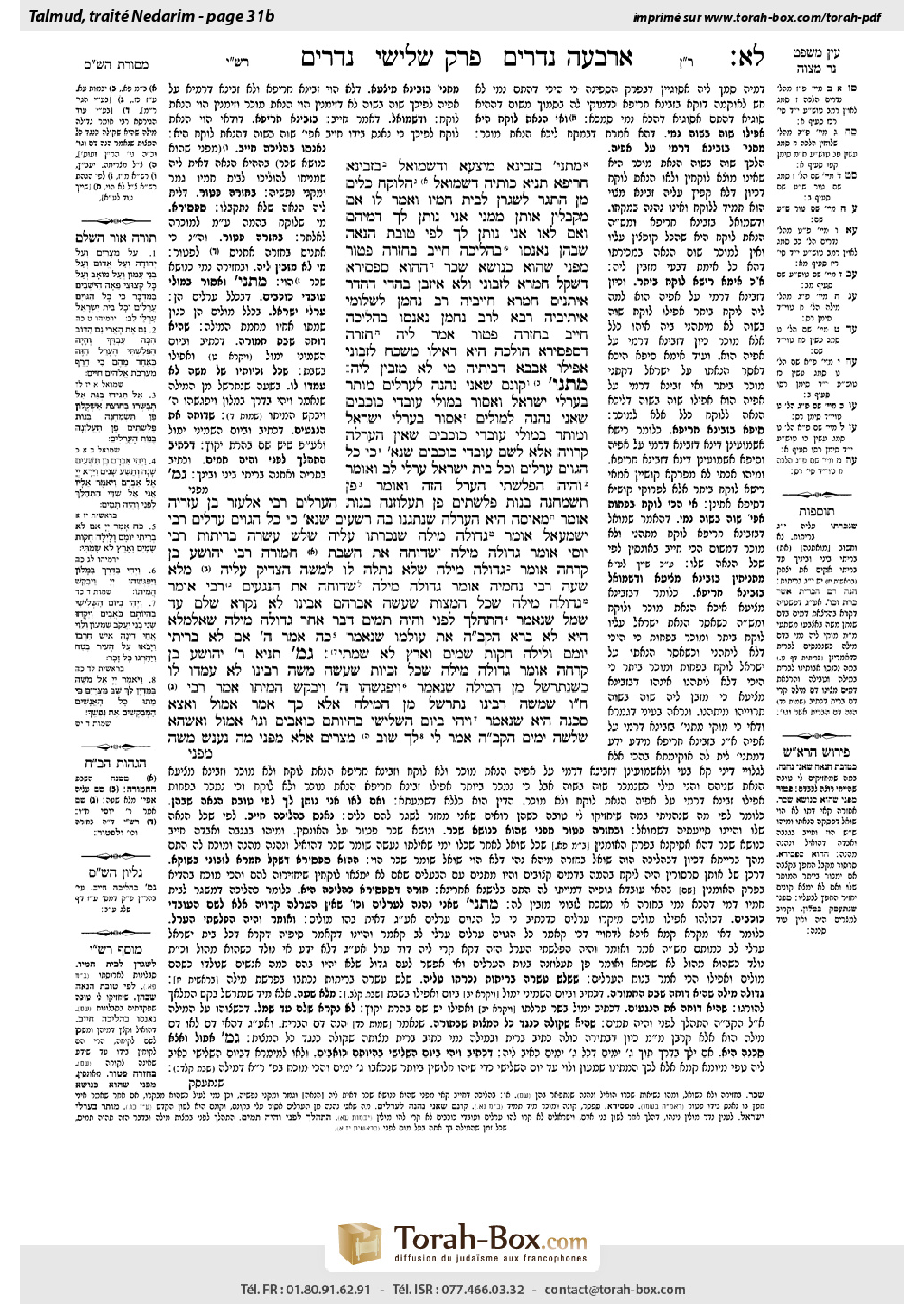
Nedarim 31b: Talmud study for Daf Yomi
Daf Yomi is the daily study of one Talmud folio. Explore 37 tractates with scans, Hebrew text, Sefaria English and AI-generated French translations where annotated.
Passage selection and English or AI-generated French translation are available where the scan has annotations. Daf Study is independent of Torah-Box and Sefaria.
Browse Nedarim · נדרים · All tractatesNedarim 31b text and translations
This page of Nedarim includes the Aramaic text, an English translation and an AI-generated French translation, alongside the scan above.
נדרים ל״א ב · Aramaic and Hebrew text
מַתְנִיתִין בִּזְבִינָא מִיצְעָא, וְדִשְׁמוּאֵל בִּזְבִינָא חֲרִיפָא.
תַּנְיָא כְּוָתֵיהּ דִּשְׁמוּאֵל: הַלּוֹקֵחַ כֵּלִים מִן הַתַּגָּר לְשַׁגְּרָן לְבֵית חָמִיו, וְאָמַר לוֹ: אִם מְקַבְּלִין אוֹתָן מִמֶּנִּי — אֲנִי נוֹתֵן לְךָ דְּמֵיהֶם, וְאִם לָאו — אֲנִי נוֹתֵן לְךָ לְפִי טוֹבַת הֲנָאָה שֶׁבָּהֶן. נֶאֶנְסוּ בַּהֲלִיכָה — חַיָּיב.
בַּחֲזָרָה — פָּטוּר, מִפְּנֵי שֶׁהוּא כְּנוֹשֵׂא שָׂכָר.
הָהוּא סַפְסִירָא דִּשְׁקַל חֲמָרָא לְזַבּוֹנֵי וְלָא אִיזַּבַּן. בַּהֲדֵי דַּהֲדַר, אִיתְּנִיס חַמְרָא, חַיְּיבֵיהּ רַב נַחְמָן לְשַׁלּוֹמֵי. אֵיתִיבֵיהּ רָבָא לְרַב נַחְמָן: נֶאֶנְסוּ בַּהֲלִיכָה חַיָּיב, בַּחֲזָרָה פָּטוּר.
אֲמַר לֵיהּ: חֲזָרָה דְסַפְסִירָא — הוֹלָכָה הִיא. דְּאִילּוּ מַשְׁכַּח לְזַבּוֹנֵי — אֲפִילּוּ אַבָּבָא דְבֵיתֵיהּ מִי לָא מְזַבֵּין לֵיהּ?
מַתְנִי׳ ״קֻוֽנָּם שֶׁאֲנִי נֶהֱנֶה לָעֲרֵלִים״ — מוּתָּר בְּעַרְלֵי יִשְׂרָאֵל, וְאָסוּר בְּמוּלֵי אוּמּוֹת הָעוֹלָם.
״שֶׁאֲנִי נֶהֱנֶה לַמּוּלִים״ — אָסוּר בְּעַרְלֵי יִשְׂרָאֵל, וּמוּתָּר בְּמוּלֵי אוּמּוֹת הָעוֹלָם. שֶׁאֵין הָעׇרְלָה קְרוּיָה אֶלָּא לְשֵׁם אוּמּוֹת הָעוֹלָם, שֶׁנֶּאֱמַר: ״כִּי כׇל הַגּוֹיִם עֲרֵלִים וְכׇל בֵּית יִשְׂרָאֵל עַרְלֵי לֵב״. וְאוֹמֵר: ״וְהָיָה הַפְּלִשְׁתִּי הֶעָרֵל הַזֶּה״. וְאוֹמֵר: ״פֶּן תִּשְׂמַחְנָה בְּנוֹת פְּלִשְׁתִּים פֶּן תַּעֲלֹזְנָה בְּנוֹת הָעֲרֵלִים״.
רַבִּי אֶלְעָזָר בֶּן עֲזַרְיָה אוֹמֵר: מְאוּסָה הִיא הָעׇרְלָה, שֶׁנִּתְגַּנּוּ בָּהּ רְשָׁעִים שֶׁנֶּאֱמַר: ״כִּי כׇל הַגּוֹיִם עֲרֵלִים״. רַבִּי יִשְׁמָעֵאל אוֹמֵר: גְּדוֹלָה מִילָה, שֶׁנִּכְרְתוּ עָלֶיהָ שְׁלֹשׁ עֶשְׂרֵה בְּרִיתוֹת.
רַבִּי יוֹסֵי אוֹמֵר: גְּדוֹלָה מִילָה שֶׁדּוֹחָה אֶת הַשַּׁבָּת חֲמוּרָה.
רַבִּי יְהוֹשֻׁעַ בֶּן קׇרְחָה אוֹמֵר: גְּדוֹלָה מִילָה — שֶׁלֹּא נִתְלָה לוֹ לְמֹשֶׁה הַצַּדִּיק עָלֶיהָ מְלֹא שָׁעָה.
רַבִּי נְחֶמְיָה אוֹמֵר: גְּדוֹלָה מִילָה — שֶׁדּוֹחָה אֶת הַנְּגָעִים. רַבִּי אוֹמֵר: גְּדוֹלָה מִילָה, שֶׁכׇּל הַמִּצְוֹת שֶׁעָשָׂה אַבְרָהָם אָבִינוּ לֹא נִקְרָא שָׁלֵם עַד שֶׁמָּל, שֶׁנֶּאֱמַר: ״הִתְהַלֵּךְ לְפָנַי וֶהְיֵה תָמִים״.
דָּבָר אַחֵר: גְּדוֹלָה מִילָה — שֶׁאִלְמָלֵא הִיא, לֹא בָּרָא הַקָּדוֹשׁ בָּרוּךְ הוּא אֶת עוֹלָמוֹ, שֶׁנֶּאֱמַר: ״כֹּה אָמַר ה׳ אִם לֹא בְרִיתִי יוֹמָם וָלָיְלָה חֻקּוֹת שָׁמַיִם וָאָרֶץ לֹא שָׂמְתִּי״.
גְּמָ׳ תַּנְיָא, רַבִּי יְהוֹשֻׁעַ בֶּן קׇרְחָה אוֹמֵר: גְּדוֹלָה מִילָה, שֶׁכׇּל זְכִיּוֹת שֶׁעָשָׂה מֹשֶׁה רַבֵּינוּ לֹא עָמְדוּ לוֹ כְּשֶׁנִּתְרַשֵּׁל מִן הַמִּילָה, שֶׁנֶּאֱמַר: ״וַיִּפְגְּשֵׁהוּ ה׳ וַיְבַקֵּשׁ הֲמִיתוֹ״.
אָמַר רַבִּי: חַס וְשָׁלוֹם שֶׁמּשֶׁה רַבֵּינוּ נִתְרַשֵּׁל מִן הַמִּילָה, אֶלָּא כָּךְ אָמַר: אָמוּל וְאֵצֵא — סַכָּנָה הִיא, שֶׁנֶּאֱמַר: ״וַיְהִי בַיּוֹם הַשְּׁלִישִׁי בִּהְיוֹתָם כֹּאֲבִים וְגוֹ׳״. אָמוּל וְאֶשְׁהֶא שְׁלֹשָׁה יָמִים, הַקָּדוֹשׁ בָּרוּךְ הוּא אָמַר לִי ״לֵךְ שֻׁב מִצְרָיִם״. אֶלָּא מִפְּנֵי מָה נֶעֱנַשׁ מֹשֶׁה —
Nedarim 31b · English translation
it must be that the mishna is dealing with an average sale, which is neither of particularly low quality and difficult to sell nor of particularly high quality and in high demand. Therefore, when it is sold at the fixed price, it cannot be said that either the buyer or seller benefits. Consequently, the one taking the vow must lower the price when selling to those forbidden by the vow and add to the price when buying from them. And by contrast, the case of Shmuel is referring to a keen sale, in which a sale at the fixed price is considered to be primarily beneficial to the buyer.
The Gemara comments: It is taught in a baraita in accordance with the opinion of Shmuel that taking an item from the seller to inspect it before purchase is considered like borrowing it. In the case of one who takes utensils from a merchant in order to send them to his father-in-law’s house as a gift and says to the merchant: If they accept them from me I will give you their value, and if they do not want them, I will give you a sum of money according to the value of the financial benefit that I received from them, i.e., I will pay something for the benefit that I received from showing my father-in-law that I want to honor him, then if an accident occurs to the utensils on the way to the house of the father-in-law and they are broken, the buyer is liable to pay because he has the status of a borrower.
But if the father-in-law did not want them and returned them to the seller, and an accident occurred on the return trip, the buyer is exempt because he is like a paid bailee. Since the father-in-law decided not to accept them, and the prospective buyer no longer benefits from them, he is not considered to be a borrower, but rather, a paid bailee of these utensils, and a paid bailee is exempt in the case of an accident.
The Gemara relates: There was a certain middleman [safseira] who took a donkey to sell but it was not sold, i.e., he was unsuccessful in finding a buyer. While he was in the midst of returning the donkey to its owner, an accident occurred to the donkey. Rav Naḥman then obligated him to pay for it. Rava raised an objection to Rav Naḥman from this baraita: If an accident occurred while on the way, he is liable to pay; if it occurred on the return trip he is exempt. Since the case involving Rav Naḥman occurred on the return trip, why did Rav Naḥman obligate him to pay?
Rav Naḥman said to him: The return trip of a middleman is like the trip there, and an item is not considered returned until he actually gives it to its owner. This is because were he to find someone to sell the donkey to even at the door of his house, would he not sell it? Therefore, he retains the status of a borrower. However, in the case of bringing a gift to a particular person who does not accept it, the sale is nullified, and the prospective buyer has only to take care of the item until it is returned to its owner, which gives him the status of a paid bailee.
MISHNA: If one says: Benefiting from those who are uncircumcised is konam for me, he is permitted to derive benefit from uncircumcised Jews because they are not regarded as uncircumcised, but he is prohibited from deriving benefit from the circumcised of the nations of the world.
Conversely, if he said: Benefiting from those who are circumcised is konam for me, he is prohibited from deriving benefit even from uncircumcised Jews and he is permitted to derive benefit from the circumcised of the nations of the world, as the term uncircumcised is used only to name the nations of the world, as it is stated: “For all the nations are uncircumcised, but all the house of Israel are uncircumcised in the heart” (Jeremiah 9:25), and it says: “And this uncircumcised Philistine shall be” (I Samuel 17:36), and it says: “Lest the daughters of the Philistines rejoice, lest the daughters of the uncircumcised triumph” (II Samuel 1:20). These verses indicate that ordinary gentiles are referred to as uncircumcised, regardless of whether they are actually circumcised.
Rabbi Elazar ben Azarya says: The foreskin is repulsive, as is evident from the fact that the wicked are disgraced through it, as it is stated: “Behold, the days come, says the Lord, that I will punish all them that are circumcised in their uncircumcision: Egypt, and Judah, and Edom, and the children of Ammon, and Moab, and all that have the corners of their hair polled, that dwell in the wilderness; for all the nations are uncircumcised, but all the house of Israel are uncircumcised in the heart” (Jeremiah 9:25), which indicates that there is an element of disgrace associated with the foreskin. Rabbi Yishmael says: So great is the mitzva of circumcision that thirteen covenants were sealed with regard to it, for the word covenant appears thirteen times in the biblical passage that discusses circumcision (Genesis, chapter 17).
Rabbi Yosei says: So great is the mitzva of circumcision that it overrides the strict halakhot of Shabbat, as circumcision is performed even if the eighth day following the birth of a son occurs on Shabbat, despite the fact that circumcision violates the prohibition of labor on Shabbat.
Rabbi Yehoshua ben Korḥa says: Great is the mitzva of circumcision, as is evident from the fact that the punishment of Moses the righteous for not circumcising his son when he was capable of doing so was not postponed for even a full hour (see Exodus 4:24–26).
Rabbi Neḥemya says: So great is the mitzva of circumcision that it overrides the prohibitions associated with leprosy. If leprosy is found on the foreskin of an infant, although it is generally prohibited to cut the afflicted area, it is permitted to do so to perform the mitzva of circumcision. Rabbi Yehuda HaNasi says: So great is the mitzva of circumcision that despite all the mitzvot that Abraham our Patriarch did, he was not called wholehearted until he circumcised himself, as it is stated at the time that the mitzva was given to him: “Walk before Me and you should be wholehearted” (Genesis 17:1).
Alternatively, so great is the mitzva of circumcision that if not for it the Holy One, Blessed be He, would not have created His world, as it is stated: “Thus says the Lord: If My covenant be not with day and night, I would not have appointed the ordinances of heaven and earth” (Jeremiah 33:25), and the covenant that exists day and night is the covenant of circumcision, as it is always found on the person’s body.
GEMARA: It is taught in a baraita that Rabbi Yehoshua ben Korḥa says: So great is the mitzva of circumcision that all the merits that Moses our teacher accrued when he performed mitzvot did not protect him when he was negligent about performing the mitzva of circumcision, as it is stated: “And the Lord met him and sought to kill him” (Exodus 4:24).
Rabbi Yehuda HaNasi said: Heaven forbid that Moses our teacher was neglectful of the mitzva of circumcision. Rather, this is what he said: If I circumcise the child now and depart to begin my journey, it is a danger for the child, as it is stated: “And it came to pass on the third day, when they were in pain” (Genesis 34:25), which indicates that the pain of circumcision lasts for several days and the child may be in danger while in pain. If I circumcise him immediately and wait three days and only then embark on the journey, this is problematic, as the Holy One, Blessed be He, said to me: “Go, return into Egypt” (Exodus 4:19), i.e., go immediately. For these reasons Moses did not circumcise the child immediately, but no neglect existed on his part. But according to this explanation, for what reason was Moses punished?
Nedarim 31b · Traduction française (IA)
Il faut donc que la Michna traite d’une vente ordinaire, portant sur un article ni particulièrement médiocre et difficile à vendre, ni particulièrement excellent et très demandé. Par conséquent, lorsqu’il est vendu au prix fixé, on ne peut pas dire que l’acheteur ou le vendeur en tire un avantage. Celui qui prononce le vœu doit donc baisser le prix lorsqu’il vend à ceux que le vœu lui interdit de fréquenter, et augmenter le prix lorsqu’il achète auprès d’eux. En revanche, le cas de Chmouel concerne une vente avantageuse, où une vente au prix fixé est considérée comme profitant principalement à l’acheteur.
La Guemara fait remarquer qu’une baraïta enseigne conformément à l’avis de Chmouel : prendre un objet au vendeur pour l’examiner avant de l’acheter est considéré comme un emprunt. Dans le cas d’un homme qui prend des ustensiles chez un marchand afin de les envoyer en cadeau chez son beau-père et qui dit au marchand : « S’ils les acceptent, je t’en paierai la valeur ; et s’ils n’en veulent pas, je te verserai une somme correspondant à la valeur de l’avantage que j’en ai tiré », c’est-à-dire qu’il paiera quelque chose pour le bénéfice qu’il a retiré du fait de montrer à son beau-père qu’il souhaite l’honorer, si un accident survient aux ustensiles en chemin vers la maison de son beau-père et qu’ils se brisent, l’acheteur est tenu de les payer, car il a le statut d’un emprunteur.
Mais si le beau-père n’en a pas voulu et les a renvoyés au vendeur, et qu’un accident survient pendant le trajet de retour, l’acheteur est quitte, car il a le statut d’un gardien rémunéré. Puisque le beau-père a décidé de ne pas les accepter et que l’acheteur potentiel n’en tire plus aucun avantage, celui-ci n’est pas considéré comme un emprunteur, mais plutôt comme le gardien rémunéré de ces ustensiles ; or un gardien rémunéré est quitte en cas d’accident.
La Guemara rapporte : un certain intermédiaire [safseira] prit un âne pour le vendre, mais ne parvint pas à trouver un acheteur. Alors qu’il était en train de ramener l’âne à son propriétaire, un accident survint à l’animal. Rav Naḥman le condamna alors à payer. Rava objecta à Rav Naḥman en citant cette baraïta : si un accident survient à l’aller, il est tenu de payer ; s’il survient au retour, il est quitte. Puisque le cas de Rav Naḥman eut lieu au retour, pourquoi Rav Naḥman l’a-t-il condamné à payer ?
Rav Naḥman lui dit : pour un intermédiaire, le trajet de retour équivaut au trajet d’aller, et l’objet n’est pas considéré comme rendu tant qu’il ne l’a pas effectivement remis à son propriétaire. En effet, s’il trouvait quelqu’un à qui vendre l’âne, ne serait-ce qu’au seuil de sa maison, ne le vendrait-il pas ? Il conserve donc le statut d’un emprunteur. En revanche, lorsqu’on apporte un cadeau à une personne déterminée qui ne l’accepte pas, la vente est annulée, et l’acheteur potentiel n’a plus qu’à veiller sur l’objet jusqu’à ce qu’il soit rendu à son propriétaire ; il a donc le statut d’un gardien rémunéré.
MICHNA : Si quelqu’un dit : « Tirer profit de ceux qui ne sont pas circoncis m’est konam », il lui est permis de tirer profit des Juifs incirconcis, car ils ne sont pas considérés comme incirconcis ; mais il lui est interdit de tirer profit des circoncis parmi les nations du monde.
À l’inverse, s’il dit : « Tirer profit de ceux qui sont circoncis m’est konam », il lui est interdit de tirer profit même des Juifs incirconcis, et il lui est permis de tirer profit des circoncis parmi les nations du monde. En effet, le terme « incirconcis » sert uniquement à désigner les nations du monde, comme il est dit : « Car toutes les nations sont incirconcises, mais toute la maison d’Israël est incirconcise de cœur » (Jérémie 9:25), et il est dit : « Et cet incirconcis de Philistin sera… » (I Samuel 17:36), et il est dit : « De peur que les filles des Philistins ne se réjouissent, de peur que les filles des incirconcis ne triomphent » (II Samuel 1:20). Ces versets indiquent que les non-Juifs en général sont appelés « incirconcis », qu’ils soient ou non effectivement circoncis.
Rabbi Elazar ben Azarya dit : le prépuce est répugnant, comme le montre le fait que les méchants sont déshonorés à cause de lui, ainsi qu’il est dit : « Voici, les jours viennent, dit le Seigneur, où je châtierai tous ceux qui sont circoncis dans leur incirconcision : l’Égypte, Juda, Édom, les fils d’Ammon, Moab et tous ceux qui se rasent les tempes, qui habitent dans le désert ; car toutes les nations sont incirconcises, mais toute la maison d’Israël est incirconcise de cœur » (Jérémie 9:25). Cela indique qu’une part de déshonneur est associée au prépuce. Rabbi Yishmaël dit : la mitsva de la circoncision est si grande que treize alliances furent conclues à son sujet, car le mot « alliance » apparaît treize fois dans le passage biblique qui traite de la circoncision (Genèse, chapitre 17).
Rabbi Yossei dit : la mitsva de la circoncision est si grande qu’elle l’emporte sur les halakhot rigoureuses du Chabbat, car la circoncision est pratiquée même lorsque le huitième jour après la naissance d’un garçon tombe un Chabbat, bien qu’elle enfreigne l’interdiction de travailler le Chabbat.
Rabbi Yehoshua ben Korḥa dit : la mitsva de la circoncision est grande, comme le montre le fait que le châtiment de Moïse le juste, pour ne pas avoir circoncis son fils alors qu’il pouvait le faire, ne fut pas différé ne serait-ce que d’une heure entière (voir Exode 4:24–26).
Rabbi Neḥemya dit : la mitsva de la circoncision est si grande qu’elle l’emporte sur les interdictions liées à la lèpre. Si la lèpre se trouve sur le prépuce d’un nourrisson, bien qu’il soit généralement interdit de couper la zone atteinte, il est permis de le faire pour accomplir la mitsva de la circoncision. Rabbi Yehouda HaNassi dit : la mitsva de la circoncision est si grande que, malgré toutes les mitsvot accomplies par Abraham notre ancêtre, il ne fut pas appelé intègre avant de s’être circoncis, ainsi qu’il est dit au moment où la mitsva lui fut donnée : « Marche devant Moi et sois intègre » (Genèse 17:1).
Autre explication : la mitsva de la circoncision est si grande que, sans elle, le Saint, béni soit-Il, n’aurait pas créé Son monde, ainsi qu’il est dit : « Ainsi parle le Seigneur : Si Mon alliance avec le jour et la nuit n’existait pas, Je n’aurais pas établi les lois du ciel et de la terre » (Jérémie 33:25). L’alliance qui existe jour et nuit est l’alliance de la circoncision, car elle se trouve constamment sur le corps de l’homme.
GUEMARA : Il est enseigné dans une baraïta que Rabbi Yehoshua ben Korḥa dit : la mitsva de la circoncision est si grande que tous les mérites acquis par Moïse notre maître en accomplissant des mitsvot ne l’ont pas protégé lorsqu’il a négligé d’accomplir la mitsva de la circoncision, ainsi qu’il est dit : « Le Seigneur le rencontra et chercha à le faire mourir » (Exode 4:24).
Rabbi Yehouda HaNassi dit : À Dieu ne plaise que Moïse notre maître ait négligé la mitsva de la circoncision. Voici plutôt ce qu’il se dit : « Si je circoncis l’enfant maintenant et que je me mette en route, l’enfant sera en danger », ainsi qu’il est dit : « Le troisième jour, alors qu’ils souffraient » (Genèse 34:25), ce qui indique que la douleur de la circoncision dure plusieurs jours et que l’enfant peut être en danger pendant qu’il souffre. « Si je le circoncis immédiatement, puis que j’attende trois jours avant de prendre la route, cela pose problème, car le Saint, béni soit-Il, m’a dit : “Va, retourne en Égypte” » (Exode 4:19), c’est-à-dire : pars immédiatement. Pour ces raisons, Moïse ne circoncit pas l’enfant sur-le-champ, mais il ne fit preuve d’aucune négligence. Mais, selon cette explication, pourquoi Moïse fut-il puni ?
Traduction française générée par IA à partir de l’édition anglaise de Sefaria. Vérifie toujours un passage avec le texte source.
Text from Sefaria: William Davidson Edition - Vocalized Aramaic (CC BY NC); William Davidson Edition - English (CC BY NC).