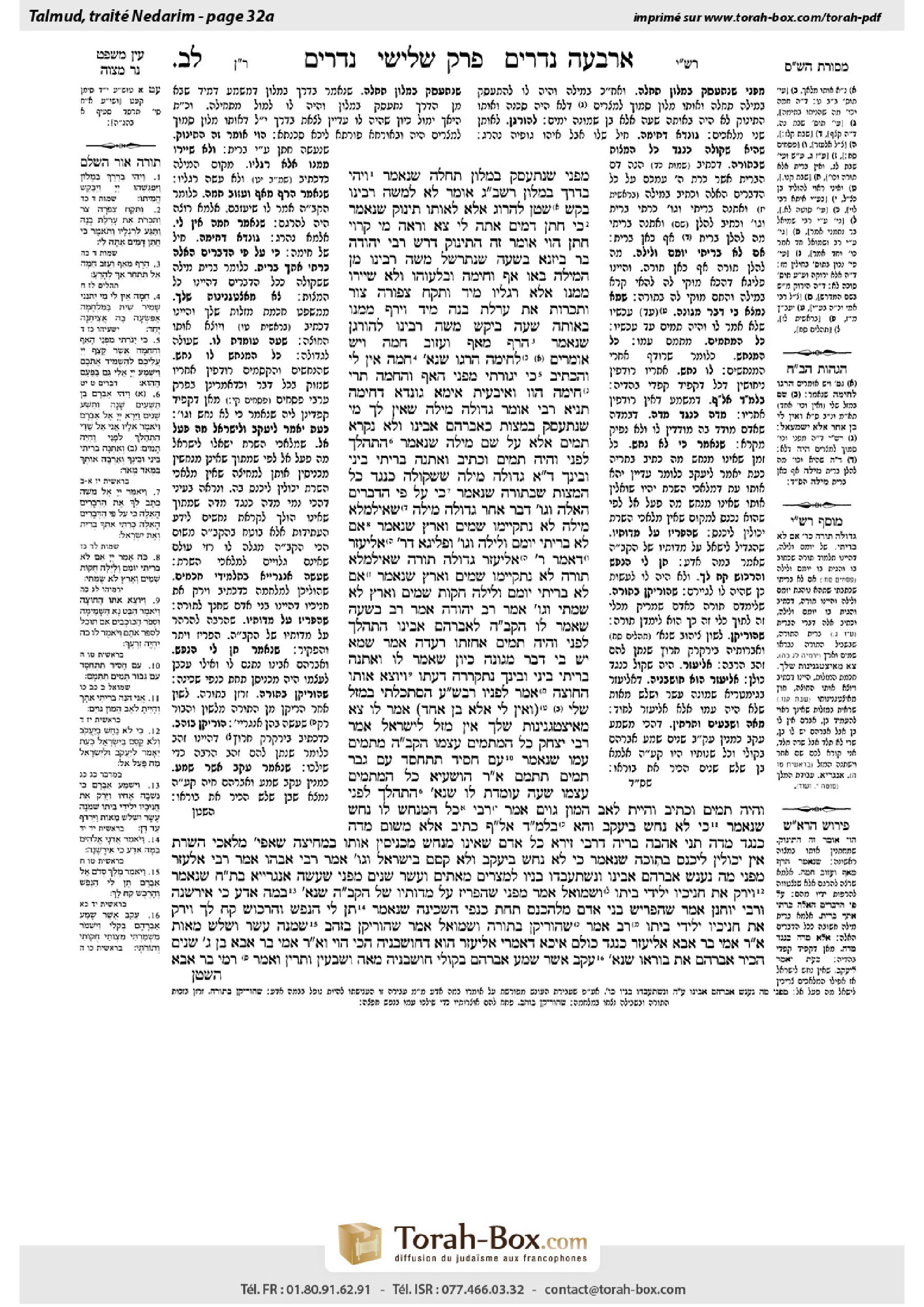
Nedarim 32a: Talmud study for Daf Yomi
Daf Yomi is the daily study of one Talmud folio. Explore 37 tractates with scans, Hebrew text, Sefaria English and AI-generated French translations where annotated.
Passage selection and English or AI-generated French translation are available where the scan has annotations. Daf Study is independent of Torah-Box and Sefaria.
Browse Nedarim · נדרים · All tractatesNedarim 32a text and translations
This page of Nedarim includes the Aramaic text, an English translation and an AI-generated French translation, alongside the scan above.
נדרים ל״ב א · Aramaic and Hebrew text
מִפְּנֵי שֶׁנִּתְעַסֵּק בַּמָּלוֹן תְּחִלָּה, שֶׁנֶּאֱמַר ״וַיְהִי בַּדֶּרֶךְ בַּמָּלוֹן״.
רַבָּן שִׁמְעוֹן בֶּן גַּמְלִיאֵל אוֹמֵר: לֹא לְמֹשֶׁה רַבֵּינוּ בִּקֵּשׁ שָׂטָן לַהֲרוֹג, אֶלָּא לְאוֹתוֹ תִּינוֹק, שֶׁנֶּאֱמַר: ״כִּי חֲתַן דָּמִים אַתָּה לִי״, צֵא וּרְאֵה מִי קָרוּי חָתָן — הֱוֵי אוֹמֵר זֶה הַתִּינוֹק.
דָּרֵשׁ רַבִּי יְהוּדָה בַּר בִּיזְנָא: בְּשָׁעָה שֶׁנִּתְרַשֵּׁל מֹשֶׁה רַבֵּינוּ מִן הַמִּילָה, בָּאוּ ״אַף״ וְ״חֵימָה״ וּבְלָעוּהוּ, וְלֹא שִׁיְּירוּ מִמֶּנּוּ אֶלָּא רַגְלָיו. מִיָּד ״וַתִּקַּח צִפֹּרָה צֹר וַתִּכְרֹת אֶת עׇרְלַת בְּנָהּ״, מִיָּד ״וַיִּרֶף מִמֶּנּוּ״.
בְּאוֹתָהּ שָׁעָה בִּיקֵּשׁ מֹשֶׁה רַבֵּינוּ לְהוֹרְגָן, שֶׁנֶּאֱמַר: ״הֶרֶף מֵאַף וַעֲזֹב חֵמָה״. וְיֵשׁ אוֹמְרִים: לְחֵימָה הֲרָגוֹ, שֶׁנֶּאֱמַר: ״חֵמָה אֵין לִי״. וְהָכְתִיב: ״כִּי יָגֹרְתִּי מִפְּנֵי הָאַף וְהַחֵמָה״! תְּרֵי חֵימָה הֲווֹ. וְאִיבָּעֵית אֵימָא: גּוּנְדָּא דְחֵימָה.
תַּנְיָא רַבִּי אוֹמֵר: גְּדוֹלָה מִילָה, שֶׁאֵין לָךְ מִי שֶׁנִּתְעַסֵּק בְּמִצְוֹת כְּאַבְרָהָם אָבִינוּ, וְלֹא נִקְרָא תָּמִים אֶלָּא עַל שֵׁם מִילָה, שֶׁנֶּאֱמַר: ״הִתְהַלֵּךְ לְפָנַי וֶהְיֵה תָמִים״, וּכְתִיב: ״וְאֶתְּנָה בְרִיתִי בֵּינִי וּבֵינֶךָ״.
דָּבָר אַחֵר: גְּדוֹלָה מִילָה, שֶׁשְּׁקוּלָה כְּנֶגֶד כׇּל הַמִּצְוֹת שֶׁבַּתּוֹרָה, שֶׁנֶּאֱמַר: ״כִּי עַל פִּי הַדְּבָרִים הָאֵלֶּה וְגוֹ׳״, דָּבָר אַחֵר: גְּדוֹלָה מִילָה, שֶׁאִילְמָלֵא מִילָה לֹא נִתְקַיְּימוּ שָׁמַיִם וָאָרֶץ, שֶׁנֶּאֱמַר: ״אִם לֹא בְּרִיתִי יוֹמָם וָלָיְלָה וְגוֹ׳״.
וּפְלִיגָא דְּרַבִּי אֱלִיעֶזֶר, דְּאָמַר רַבִּי אֱלִיעֶזֶר: גְּדוֹלָה תּוֹרָה, שֶׁאִילְמָלֵא תּוֹרָה לֹא נִתְקַיְּימוּ שָׁמַיִם וָאָרֶץ, שֶׁנֶּאֱמַר: ״אִם לֹא בְרִיתִי יוֹמָם וָלָיְלָה חֻקּוֹת שָׁמַיִם וָאָרֶץ לֹא שָׂמְתִּי וְגוֹ׳״.
אָמַר רַב יְהוּדָה אָמַר רַב: בְּשָׁעָה שֶׁאָמַר לוֹ הַקָּדוֹשׁ בָּרוּךְ הוּא לְאַבְרָהָם אָבִינוּ ״הִתְהַלֵּךְ לְפָנַי וֶהְיֵה תָמִים״ אֲחָזַתּוּ רְעָדָה. אָמַר: שֶׁמָּא יֵשׁ בִּי דָּבָר מְגוּנֶּה. כֵּיוָן שֶׁאָמַר לוֹ: ״וְאֶתְּנָה בְרִיתִי בֵּינִי וּבֵינֶךָ״, נִתְקָרְרָה דַּעְתּוֹ.
״וַיּוֹצֵא אֹתוֹ הַחוּצָה״, אָמַר לְפָנָיו: רִבּוֹנוֹ שֶׁל עוֹלָם, הִסְתַּכַּלְתִּי בַּמַּזָּל שֶׁלִּי וְאֵין לִי אֶלָּא בֵּן אֶחָד. אָמַר לוֹ: צֵא מֵאִיצְטַגְנִינוּת שֶׁלְּךָ, אֵין מַזָּל לְיִשְׂרָאֵל.
אָמַר רַבִּי יִצְחָק: כׇּל הַמְתַמֵּים עַצְמוֹ — הַקָּדוֹשׁ בָּרוּךְ הוּא מִתַּמֵּים עִמּוֹ, שֶׁנֶּאֱמַר: ״עִם חָסִיד תִּתְחַסָּד עִם גִּבּוֹר תָּמִים תִּתַּמָּם״.
אָמַר רַבִּי הוֹשַׁעְיָא: כׇּל הַמְתַמֵּים עַצְמוֹ — שָׁעָה עוֹמֶדֶת לוֹ, שֶׁנֶּאֱמַר: ״הִתְהַלֵּךְ לְפָנַי וֶהְיֵה תָמִים״, וּכְתִיב: ״וְהָיִיתָ לְאַב הֲמוֹן גּוֹיִם״.
אָמַר רַבִּי: כֹּל הַמְנַחֵשׁ — לוֹ נַחַשׁ, שֶׁנֶּאֱמַר: ״כִּי לֹא נַחַשׁ בְּיַעֲקֹב״. וְהָא בְּלָמֶד אָלֶף כְּתִיב! אֶלָּא מִשּׁוּם מִדָּה כְּנֶגֶד מִדָּה.
תָּנֵי אַהֲבָה בְּרֵיהּ דְּרַבִּי זֵירָא: כׇּל אָדָם שֶׁאֵינוֹ מְנַחֵשׁ, מַכְנִיסִין אוֹתוֹ בִּמְחִיצָה שֶׁאֲפִילּוּ מַלְאֲכֵי הַשָּׁרֵת אֵין יְכוֹלִין לִיכָּנֵס בְּתוֹכָהּ, שֶׁנֶּאֱמַר: ״כִּי לֹא נַחַשׁ בְּיַעֲקֹב וְלֹא קֶסֶם בְּיִשְׂרָאֵל וְגוֹ׳״.
אָמַר רַבִּי אֲבָהוּ אָמַר רַבִּי אֶלְעָזָר: מִפְּנֵי מָה נֶעֱנַשׁ אַבְרָהָם אָבִינוּ וְנִשְׁתַּעְבְּדוּ בָּנָיו לְמִצְרַיִם מָאתַיִם וְעֶשֶׂר שָׁנִים — מִפְּנֵי שֶׁעָשָׂה אַנְגַּרְיָיא בְּתַלְמִידֵי חֲכָמִים, שֶׁנֶּאֱמַר: ״וַיָּרֶק אֶת חֲנִיכָיו יְלִידֵי בֵיתוֹ״.
וּשְׁמוּאֵל אָמַר: מִפְּנֵי שֶׁהִפְרִיז עַל מִדּוֹתָיו שֶׁל הַקָּדוֹשׁ בָּרוּךְ הוּא, שֶׁנֶּאֱמַר: ״בַּמָּה אֵדַע כִּי אִירָשֶׁנָּה״. וְרַבִּי יוֹחָנָן אָמַר: שֶׁהִפְרִישׁ בְּנֵי אָדָם מִלְּהִכָּנֵס תַּחַת כַּנְפֵי הַשְּׁכִינָה, שֶׁנֶּאֱמַר: ״תֶּן לִי הַנֶּפֶשׁ וְהָרְכֻשׁ קַח לָךְ״.
״וַיָּרֶק אֶת חֲנִיכָיו יְלִידֵי בֵיתוֹ״, רַב אָמַר: שֶׁהוֹרִיקָן בַּתּוֹרָה. וּשְׁמוּאֵל אָמַר: שֶׁהוֹרִיקָן בְּזָהָב.
״שְׁמֹנָה עָשָׂר וּשְׁלֹשׁ מֵאוֹת״, אָמַר רַבִּי אַמֵּי בַּר אַבָּא: אֱלִיעֶזֶר כְּנֶגֶד כּוּלָּם. אִיכָּא דְּאָמְרִי: אֱלִיעֶזֶר הוּא, דְּחוּשְׁבָּנֵיהּ הָכִי הָוֵי.
וְאָמַר רַבִּי אַמֵּי בַּר אַבָּא: בֵּן שָׁלֹשׁ שָׁנִים הִכִּיר אַבְרָהָם אֶת בּוֹרְאוֹ, שֶׁנֶּאֱמַר: ״עֵקֶב אֲשֶׁר שָׁמַע אַבְרָהָם בְּקֹלִי״ — חוּשְׁבָּנֵיהּ מְאָה וְשִׁבְעִין וּתְרֵין.
וְאָמַר רָמֵי בַּר אַבָּא:
Nedarim 32a · English translation
Because he was occupied with lodging first and did not immediately perform the mitzva of circumcision, as it is stated: “And it came to pass on the way at the lodging-place” (Exodus 4:24).
Rabban Shimon ben Gamliel says: It was not Moses our teacher that Satan wanted to kill, but rather, that infant who was not circumcised, as it is stated: “Surely a bridegroom of blood are you to me” (Exodus 4:25). Go out and see: Who does it make sense would be the one that is called the bridegroom in this instance? You must say this is the infant, since he is the one who entered the covenant of Abraham by means of the circumcision.
Rabbi Yehuda bar Bizna taught: At the time that Moses our teacher was negligent about the circumcision, the destructive angels named Af, meaning anger, and Ḥeima, meaning wrath, came and swallowed him, and only his legs were left outside. Immediately, “Zipporah took a flint, and cut off the foreskin of her son” (Exodus 4:25), and immediately “He let him alone” (Exodus 4:26).
At that moment, Moses our teacher wanted to kill them, as it is stated: “Cease from anger [af ] and forsake wrath [ḥeima]” (Psalms 37:8), which indicates that he wanted to harm them. And there are those who say: He killed the angel named Ḥeima, as it is stated: “Wrath is not in me” (Isaiah 27:4). The Gemara asks: How is it possible to say that he killed Ḥeima? Isn’t it written that Moses himself said much later: “For I was in dread of the anger and wrath” (Deuteronomy 9:19)? The Gemara answers: There are two types of wrath. And if you wish, say that the army of Ḥeima remained but not the angel itself.
It is taught in a baraita: Rabbi Yehuda HaNasi says: Great is the mitzva of circumcision, for there is no one who was engaged in mitzvot like Abraham our Patriarch, and yet he was called wholehearted only due to the mitzva of circumcision, as it is stated: “Walk before Me and you should be wholehearted” (Genesis 17:1), and it is written in the next verse: “And I will make My covenant between Me and you” (Genesis 17:2), and Abraham was then commanded with regard to circumcision. This indicates that he was not called wholehearted until he performed circumcision.
Alternatively, so great is the mitzva of circumcision that it is equal to all the mitzvot of the Torah, as it is stated at the giving of the Torah: “For according to these words I have made a covenant with you and with Israel” (Exodus 34:27), and “covenant” refers to circumcision. Alternatively, so great is the mitzva of circumcision that if not for circumcision heaven and earth would not have been established, as it is stated: “If My covenant be not with day and night, I would not have appointed the ordinances of heaven and earth” (Jeremiah 33:25), and the covenant that exists day and night is the covenant of circumcision, as it is always found on the person’s body.
The Gemara comments: And this statement disagrees with the words of Rabbi Eliezer, for Rabbi Eliezer said: Great is the Torah, for if not for Torah, heaven and earth would not have been established, as it is stated: “If My covenant be not with day and night, I would not have appointed the ordinances of heaven and earth” (Jeremiah 33:25). According to Rabbi Eliezer, the covenant that exists day and night is the Torah, as it says: “You should contemplate it day and night” (Joshua 1:8).
Rav Yehuda said that Rav said: At the time that the Holy One, Blessed be He, said to Abraham our Patriarch: “Walk before Me and you should be wholehearted” (Genesis 17:1), a sensation of trembling seized him and he said: Perhaps there is something disgraceful about me due to a transgression that I committed, and therefore I cannot be called complete. When God said to him: “And I will make My covenant between Me and you” (Genesis 17:2), his mind was set at ease, since he understood that the removal of the foreskin that he was now commanded to do was the reason he had not yet achieved completion.
The Gemara expounds the verse “and He brought him outside” (Genesis 15:5): Abraham said before Him: Master of the Universe, I looked at my constellation and according to it I will have only one son, and a son has already been born to me, i.e., Ishmael. He said to him: Emerge from your astrology because there is no constellation for the Jewish people, as they are not subject to the influence of astrology.
Rabbi Yitzḥak said: Anyone who conducts himself with wholeheartedness, the Holy One, Blessed be He, treats him with wholeheartedness, as it is stated: “With the devout You act devoutly, and with the one who is strong in his wholeheartedness You act wholeheartedly” (II Samuel 22:26).
Rabbi Hoshaya said: Anyone who acts wholeheartedly, time will stand for him, i.e., he will be successful, as it is stated: “Walk before Me and you should be wholehearted” (Genesis 17:1), and it is written: “And you shall be the father of a multitude of nations” (Genesis 17:4).
Rabbi Yehuda HaNasi said: Anyone who divines, i.e., he guesses and looks for signs about the future, the sign will injure him, as it is stated: “For there is to him [lo] divination with Jacob” (Numbers 23:23). The Gemara asks: But it is written lo with the letters lamed alef, meaning “no divination,” as opposed to with the letters lamed vav, meaning “there is to him divination.” The straightforward meaning of the verse is that there is no divination with regard to Jacob. Rather, the reason that he will be injured is not based on the verse but rather due to the concept of measure for measure: Since he attempts to tell his fortune, it injures him.
Ahava, son of Rabbi Zeira, teaches: Any person who does not divine his future is brought inside a partition close to God to a place that even the ministering angels cannot enter inside, as it is stated: “For there is no divination with Jacob, neither is there any enchantment with Israel, now it is said to Jacob and Israel what has God wrought” (Numbers 23:23). In other words, matters are revealed to Israel that even the angels do not know, since Israel is closer to God than the angels.
Rabbi Abbahu said that Rabbi Elazar said: For what reason was Abraham our Patriarch punished and his children enslaved to Egypt for 210 years? Because he made a draft [angarya] of Torah scholars, as it is stated: “He led forth his trained men, born in his house” (Genesis 14:14). These trained men that he took to war were actually his disciples, who were Torah scholars.
And Shmuel said: Because he greatly examined [hifriz] the characteristics of the Holy One, Blessed be He, as it is stated: “Whereby shall I know that I shall inherit it?” (Genesis 15:8). And Rabbi Yoḥanan said: He was punished because he distanced people from entering under the wings of the Divine Presence, as it is stated that the king of Sodom said to him: “Give me the people and take the goods to yourself” (Genesis 14:21), but Abraham refused to take any goods either. If he had not listened to the king of Sodom and had allowed the people to remain with him, he would have brought the prisoners under the wings of the Divine Presence.
The Gemara returns to discuss one of the verses cited previously: “He led forth [vayyarek] his trained men, born in his house” (Genesis 14:14). Rav said: He showered them [horikan] with Torah like someone who pours from one vessel into another, and Shmuel said: He showered them [horikan] with gold and gave them an abundance of money so that they would go to war with him.
The Torah states that he took “eighteen and three hundred” (Genesis 14:14) men to war. Rabbi Ami bar Abba said: Eliezer was equivalent to all of them. There are those who say: Only Eliezer is referred to here, as the numerical value of the letters of his name is this amount, i.e., 318.
And Rabbi Ami bar Abba said: Abraham recognized his Creator at the age of three years, as it is stated: “Because [ekev] Abraham hearkened to My voice” (Genesis 26:5). The numerical value of the letters of the word ekev is 172, indicating that he observed the halakha for this many years. If Abraham lived until 175 then his first recognition of the Creator must have been at the age of three.
And Rami bar Abba said in a similar manner:
Nedarim 32a · Traduction française (IA)
Parce qu’il s’était d’abord occupé de trouver un lieu où passer la nuit et n’avait pas accompli immédiatement la mitsva de la circoncision, comme il est dit : « Or, en chemin, au lieu où l’on passa la nuit » (Exode 4:24).
Rabban Shimon ben Gamliel dit : Ce n’est pas Moïse notre maître que Satan voulait tuer, mais plutôt cet enfant qui n’avait pas été circoncis, comme il est dit : « Tu es pour moi un époux de sang » (Exode 4:25). Voyez donc : qui, dans ce cas, peut raisonnablement être celui qu’on appelle l’époux ? Il faut conclure qu’il s’agit de l’enfant, puisqu’il est celui qui est entré dans l’alliance d’Abraham par la circoncision.
Rabbi Yehuda bar Bizna enseigna : Au moment où Moïse notre maître négligea la circoncision, les anges destructeurs nommés Af, qui signifie « colère », et Ḥeima, qui signifie « fureur », vinrent et l’engloutirent, ne laissant à l’extérieur que ses jambes. Aussitôt, « Tsippora prit un silex et coupa le prépuce de son fils » (Exode 4:25), puis, aussitôt, « il le laissa tranquille » (Exode 4:26).
À cet instant, Moïse notre maître voulut les tuer, comme il est dit : « Renonce à la colère [af] et abandonne la fureur [ḥeima] » (Psaumes 37:8), ce qui indique qu’il voulait leur nuire. D’autres disent : Il tua l’ange nommé Ḥeima, comme il est dit : « Il n’y a pas de fureur en moi » (Isaïe 27:4). La Guemara demande : Comment peut-on dire qu’il tua Ḥeima ? Moïse lui-même n’a-t-il pas dit bien plus tard : « Car je redoutais la colère et la fureur » (Deutéronome 9:19) ? La Guemara répond : Il existe deux sortes de fureur. Et si tu veux, dis que l’armée de Ḥeima subsista, mais pas l’ange lui-même.
Il est enseigné dans une baraïta : Rabbi Yehuda HaNasi dit : Grande est la mitsva de la circoncision, car nul ne s’est consacré aux mitsvot autant qu’Abraham notre père, et pourtant il ne fut appelé intègre qu’en raison de la mitsva de la circoncision, comme il est dit : « Marche devant Moi et sois intègre » (Genèse 17:1), puis, au verset suivant : « J’établirai Mon alliance entre Moi et toi » (Genèse 17:2) ; Abraham reçut alors l’ordre de pratiquer la circoncision. Cela indique qu’il ne fut appelé intègre qu’après l’avoir pratiquée.
Autre explication : la mitsva de la circoncision est si grande qu’elle équivaut à toutes les mitsvot de la Torah, comme il est dit au moment du don de la Torah : « C’est selon ces paroles que J’ai conclu une alliance avec toi et avec Israël » (Exode 34:27), et le terme « alliance » désigne la circoncision. Autre explication : la mitsva de la circoncision est si grande que, sans elle, le ciel et la terre n’auraient pas été établis, comme il est dit : « Si Mon alliance n’était pas avec le jour et la nuit, Je n’aurais pas établi les lois du ciel et de la terre » (Jérémie 33:25). L’alliance qui existe jour et nuit est celle de la circoncision, puisqu’elle est toujours présente sur le corps de l’homme.
La Guemara fait remarquer que cette déclaration est en désaccord avec les paroles de Rabbi Eliezer. En effet, Rabbi Eliezer a dit : Grande est la Torah, car sans la Torah, le ciel et la terre n’auraient pas été établis, comme il est dit : « Si Mon alliance n’était pas avec le jour et la nuit, Je n’aurais pas établi les lois du ciel et de la terre » (Jérémie 33:25). Selon Rabbi Eliezer, l’alliance qui existe jour et nuit est la Torah, comme il est dit : « Tu la méditeras jour et nuit » (Josué 1:8).
Rav Yehuda dit au nom de Rav : Au moment où le Saint, béni soit-Il, dit à Abraham notre père : « Marche devant Moi et sois intègre » (Genèse 17:1), un frisson le saisit et il dit : « Peut-être y a-t-il en moi quelque chose de honteux, à cause d’une transgression que j’ai commise, et c’est pourquoi je ne peux être appelé parfait. » Lorsque Dieu lui dit : « J’établirai Mon alliance entre Moi et toi » (Genèse 17:2), son esprit s’apaisa, car il comprit que l’ablation du prépuce, qu’il recevait alors l’ordre de pratiquer, était la raison pour laquelle il n’avait pas encore atteint la perfection.
La Guemara interprète le verset « et Il le fit sortir dehors » (Genèse 15:5) : Abraham lui dit : « Maître de l’univers, j’ai observé mon horoscope et, d’après celui-ci, je n’aurai qu’un seul fils ; or un fils m’est déjà né, c’est-à-dire Ismaël. » Il lui dit : « Sors de l’astrologie, car le peuple juif n’est pas soumis à l’influence des astres. »
Rabbi Yitzḥak dit : Quiconque se conduit avec intégrité, le Saint, béni soit-Il, agit envers lui avec intégrité, comme il est dit : « Avec le fidèle, Tu agis avec fidélité, et avec celui qui est intègre, Tu agis avec intégrité » (II Samuel 22:26).
Rabbi Hoshaya dit : Quiconque agit avec intégrité verra le temps lui être favorable, c’est-à-dire qu’il réussira, comme il est dit : « Marche devant Moi et sois intègre » (Genèse 17:1), et il est écrit : « Tu seras le père d’une multitude de nations » (Genèse 17:4).
Rabbi Yehuda HaNasi dit : Quiconque pratique la divination, c’est-à-dire fait des suppositions et cherche des signes concernant l’avenir, sera lésé par le signe, comme il est dit : « Car il y a pour lui [lo] de la divination avec Jacob » (Nombres 23:23). La Guemara demande : Pourtant, le mot lo s’écrit avec les lettres lamed alef, ce qui signifie « il n’y a pas de divination », contrairement à l’orthographe avec les lettres lamed vav, qui signifie « il y a pour lui de la divination ». Le sens simple du verset est qu’il n’y a pas de divination concernant Jacob. La raison pour laquelle il sera lésé ne repose donc pas sur le verset, mais sur le principe de mesure pour mesure : puisqu’il tente de prédire son avenir, la divination lui nuit.
Ahava, fils de Rabbi Zeira, enseigne : Toute personne qui ne cherche pas à deviner son avenir est introduite derrière une cloison, près de Dieu, dans un lieu où même les anges du Service ne peuvent pénétrer, comme il est dit : « Car il n’y a pas de divination en Jacob, ni d’enchantement en Israël ; maintenant, on dit à Jacob et à Israël ce que Dieu a accompli » (Nombres 23:23). Autrement dit, des choses sont révélées à Israël que même les anges ne connaissent pas, car Israël est plus proche de Dieu que les anges.
Rabbi Abbahu dit au nom de Rabbi Elazar : Pour quelle raison Abraham notre patriarche fut-il puni et ses enfants réduits en esclavage en Égypte pendant 210 ans ? Parce qu’il réquisitionna [angarya] des érudits de Torah, comme il est dit : « Il fit sortir ses hommes entraînés, nés dans sa maison » (Genèse 14:14). Ces hommes entraînés qu’il emmena à la guerre étaient en réalité ses disciples, des érudits de Torah.
Et Shmuel dit : Parce qu’il examina de façon excessive [hifriz] les attributs du Saint, béni soit-Il, comme il est dit : « À quoi connaîtrai-je que j’en hériterai ? » (Genèse 15:8). Et Rabbi Yoḥanan dit : Il fut puni parce qu’il empêcha des gens d’entrer sous les ailes de la Présence divine, comme il est dit que le roi de Sodome lui dit : « Donne-moi les personnes et prends les biens pour toi » (Genèse 14:21), mais Abraham refusa également de prendre le moindre bien. S’il n’avait pas écouté le roi de Sodome et avait laissé les personnes rester avec lui, il aurait fait entrer les captifs sous les ailes de la Présence divine.
La Guemara revient sur l’un des versets cités précédemment : « Il fit sortir [vayyarek] ses hommes entraînés, nés dans sa maison » (Genèse 14:14). Rav dit : Il les combla [horikan] de Torah, comme quelqu’un qui transvase d’un récipient dans un autre. Shmuel dit : Il les combla [horikan] d’or et leur donna beaucoup d’argent afin qu’ils partent à la guerre avec lui.
La Torah dit qu’il emmena à la guerre « trois cent dix-huit » hommes (Genèse 14:14). Rabbi Ami bar Abba dit : Eliezer équivalait à lui seul à tous les autres. Certains disent : Seul Eliezer est désigné ici, car la valeur numérique des lettres de son nom est précisément ce nombre, c’est-à-dire 318.
Et Rabbi Ami bar Abba dit : Abraham reconnut son Créateur à l’âge de trois ans, comme il est dit : « Parce que [ekev] Abraham a écouté Ma voix » (Genèse 26:5). La valeur numérique des lettres du mot ekev est 172, ce qui indique qu’il observa la halakha pendant ce nombre d’années. Si Abraham vécut jusqu’à 175 ans, c’est donc à l’âge de trois ans qu’il reconnut pour la première fois le Créateur.
Et Rami bar Abba dit de même :
Traduction française générée par IA à partir de l’édition anglaise de Sefaria. Vérifie toujours un passage avec le texte source.
Text from Sefaria: William Davidson Edition - Vocalized Aramaic (CC BY NC); William Davidson Edition - English (CC BY NC).