Nedarim 33a: Talmud study for Daf Yomi
Daf Yomi is the daily study of one Talmud folio. Explore 37 tractates with scans, Hebrew text, Sefaria English and AI-generated French translations where annotated.
Passage selection and English or AI-generated French translation are available where the scan has annotations. Daf Study is independent of Torah-Box and Sefaria.
Browse Nedarim · נדרים · All tractatesNedarim 33a text and translations
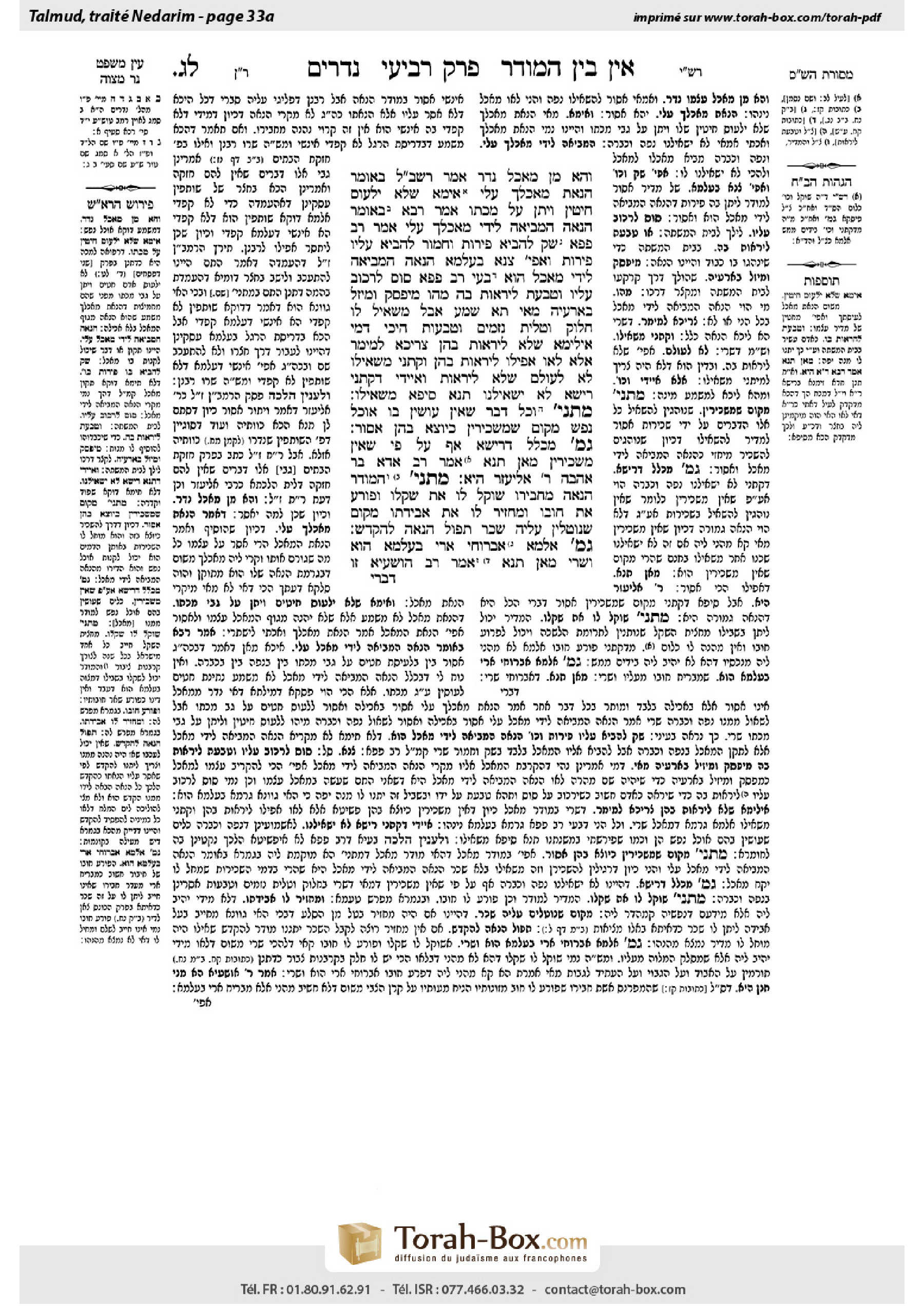
This page of Nedarim includes the Aramaic text, an English translation and an AI-generated French translation, alongside the scan above.
נדרים ל״ג א · Aramaic and Hebrew text
וְהָא מִן מַאֲכָל נָדַר! אָמַר רַבִּי שִׁמְעוֹן בֶּן לָקִישׁ: בְּאוֹמֵר ״הֲנָאַת מַאֲכָלְךָ עָלַי״.
אֵימָא שֶׁלֹּא יִלְעוֹס חִיטִּין וְיִתֵּן עַל מַכָּתוֹ! אָמַר רָבָא: בְּאוֹמֵר ״הֲנָאָה הַמְּבִיאָה לִידֵי מַאֲכָלְךָ עָלַי״.
אָמַר רַב פָּפָּא: שַׂק לְהָבִיא פֵּירוֹת, וַחֲמוֹר לְהָבִיא עָלָיו פֵּירוֹת, וַאֲפִילּוּ צַנָּא בְּעָלְמָא, הֲנָאָה הַמְּבִיאָה לִידֵי מַאֲכָל הוּא. בָּעֵי רַב פָּפָּא: סוּס לִרְכּוֹב עָלָיו וְטַבַּעַת לֵירָאוֹת בָּהּ, מַהוּ? מִיפְסַק וּמֵיזַל בְּאַרְעֵיהּ, מַאי?
תָּא שְׁמַע: אֲבָל מַשְׁאִיל לוֹ חָלוּק וְטַלִּית נְזָמִים וְטַבָּעוֹת. הֵיכִי דָמֵי? אִילֵּימָא שֶׁלֹּא לֵירָאוֹת בָּהֶן, צְרִיכָא לְמֵימַר? אֶלָּא לָאו, אֲפִילּוּ לֵירָאוֹת בָּהֶן, וְקָתָנֵי ״מַשְׁאִילוֹ״!
לָא, לְעוֹלָם שֶׁלֹּא לֵירָאוֹת, וְאַיְּידֵי דְּקָתָנֵי רֵישָׁא ״לֹא יַשְׁאִילֶנּוּ״, תְּנָא סֵיפָא ״מַשְׁאִילוֹ״.
מַתְנִי׳ וְכׇל דָּבָר שֶׁאֵין עוֹשִׂין בּוֹ אוֹכֶל נֶפֶשׁ, מָקוֹם שֶׁמַּשְׂכִּירִין כְּיוֹצֵא בָּהֶן — אָסוּר.
גְּמָ׳ מִכְּלָל דְּרֵישָׁא, אַף עַל פִּי שֶׁאֵין מַשְׂכִּירִין. מַאן תַּנָּא? אָמַר רַב אַדָּא בַּר אַהֲבָה: רַבִּי אֱלִיעֶזֶר הִיא.
מַתְנִי׳ הַמּוּדָּר הֲנָאָה מֵחֲבֵירוֹ, שׁוֹקֵל לוֹ אֶת שִׁקְלוֹ וּפוֹרֵעַ אֶת חוֹבוֹ, וּמַחֲזִיר לוֹ אֶת אֲבֵידָתוֹ. מָקוֹם שֶׁנּוֹטְלִין עָלֶיהָ שָׂכָר — תִּפּוֹל הֲנָאָה לַהֶקְדֵּשׁ.
גְּמָ׳ אַלְמָא אַבְרוֹחֵי אֲרִי בְּעָלְמָא הוּא, וּשְׁרֵי.
מַאן תַּנָּא? אָמַר רַב הוֹשַׁעְיָא: זוֹ
Nedarim 33a · English translation
The Gemara asks: But didn’t he vow that he is prohibited from partaking of food, and those items are not food items? Rabbi Shimon ben Lakish said: The mishna is referring to a case where he says: Benefit from your food is forbidden to me, which includes any benefit associated with food.
The Gemara asks: Say that the result of a vow formulated in that manner is that he may not chew wheat kernels belonging to the one from whose food benefit is forbidden and place them on his wound, as that is a benefit that results from food. However, that vow does not render items used in the preparation of food forbidden. Rava said that the mishna is referring to a case where he says: Benefit that leads to preparation of your food is forbidden to me.
Rav Pappa said: Borrowing from him a sack in which to bring produce, or a donkey upon which to bring produce, or even merely a basket, each renders benefit that leads to food, and this benefit is forbidden. Rav Pappa raised a dilemma: If he seeks to borrow a horse upon which to ride or a ring with which to be seen when attending a feast, to create the impression that he is wealthy, what is the ruling? Is it prohibited to borrow these items, since having them in one’s possession may indirectly result in his being served before others or being served higher-quality food; and therefore, borrowing those items provides benefit that leads to food? With regard to traversing and walking on his land that facilitates one’s quick return home, enabling him to eat sooner, what is the halakha?
The Gemara proposes: Come and hear a proof from the mishna: However, he may lend him a garment, and a cloak, and nose rings, and finger rings. The Gemara asks: What are the circumstances of that situation? If we say it is a case where it is not the borrower’s intent to be seen with them, and therefore there is no benefit that leads to food, does this need to be said? The vow rendered only food forbidden. Rather, isn’t this halakha stated even in a case where he borrowed those items to be seen with them, and it is taught in the mishna that he may lend it to him?
The Gemara refutes this. No, actually the mishna is referring to a case where he borrowed those items with the intention not to be seen with them. In response to the question: Is it necessary to say so, the Gemara answers that it is not necessary to teach this halakha. However, since it is taught in the first clause: He may not lend him, when listing the matters that may not be loaned, the tanna taught the latter clause of the mishna with a parallel formulation: He may lend him. Rav Pappa’s dilemma remains unresolved.
MISHNA: And with regard to any item that one does not use in the preparation of food, in a place where one rents items of that kind, that item is forbidden. Meaning, one for whom benefit from another is forbidden by vow is prohibited from borrowing this type of item from the one who vowed and imposed the prohibition. This is because one can use the money saved by borrowing the item rather than renting it to purchase food.
GEMARA: The Gemara states: By inference, one may conclude that the first clause of the mishna, which states that the one for whom benefit from another is forbidden by vow is prohibited from deriving benefit from utensils used in the preparation of food, e.g., a sieve or a strainer, applies even if they are in a place where one does not rent items of that kind but typically lends them at no cost. The Gemara asks: Who is the tanna who taught this mishna? Rav Adda bar Ahava said: It is Rabbi Eliezer, who maintains that overlooking is prohibited in the case of one for whom benefit from another is forbidden by vow.
MISHNA: With regard to one prohibited by vow from deriving benefit from another, if that other person chooses, he may contribute the half-shekel to the Temple on his behalf, and repay his debt, and return his lost item to him, and the one prohibited from benefiting is not considered to have benefited from him. In a place where one takes payment for returning a lost item, that benefit should fall into the category of consecrated Temple property.
GEMARA: The mishna allowed one who vowed and imposed the prohibition to pay the financial obligations of the one who is prohibited by vow to derive benefit from him. Based on this, the Gemara concludes: Apparently, repaying his debts is tantamount to merely driving away a lion from him, and it is permitted. He is not actually giving him anything. Rather, he is preventing potential future harm. That is not considered a benefit.
The Gemara asks: Who is the tanna who taught that in performing the actions listed in the mishna one is merely preventing harm? Rav Hoshaya said: This
Nedarim 33a · Traduction française (IA)
La Guemara demande : Mais n’a-t-il pas fait vœu de s’interdire de consommer de la nourriture, alors que ces objets ne sont pas des aliments ? Rabbi Shimon ben Lakish dit : La Michna parle d’un cas où il dit : « Tout bénéfice tiré de ta nourriture m’est interdit », ce qui inclut tout bénéfice lié à la nourriture.
La Guemara demande : On pourrait penser que la conséquence d’un vœu formulé de cette manière est qu’il ne peut pas mâcher des grains de blé appartenant à celui dont la nourriture lui est interdite, puis les appliquer sur sa plaie, car il s’agit d’un bénéfice provenant de la nourriture. Cependant, ce vœu n’interdit pas les objets utilisés pour préparer la nourriture. Rava dit que la Michna parle d’un cas où il dit : « Tout bénéfice qui contribue à la préparation de ta nourriture m’est interdit. »
Rav Pappa dit : Lui emprunter un sac pour y transporter des produits, un âne pour les transporter, ou même simplement un panier procure dans chaque cas un bénéfice qui contribue à l’obtention de nourriture, et ce bénéfice est interdit. Rav Pappa soulève une difficulté : S’il cherche à emprunter un cheval pour le monter ou une bague à porter afin d’être vu lorsqu’il assiste à un festin et de donner ainsi l’impression qu’il est riche, quelle est la halakha ? Est-il interdit d’emprunter ces objets, puisque les avoir en sa possession peut indirectement lui permettre d’être servi avant les autres ou de recevoir une nourriture de meilleure qualité, et que leur emprunt procure donc un bénéfice qui contribue à l’obtention de nourriture ? Quant au fait de traverser le terrain de l’autre et d’y marcher, ce qui permet de rentrer plus rapidement chez soi et donc de manger plus tôt, quelle est la halakha ?
La Guemara propose : Venons écouter une preuve tirée de la Michna : « Cependant, il peut lui prêter un vêtement, un manteau, des anneaux de nez et des bagues. » La Guemara demande : Dans quelles circonstances ? Si l’on dit que l’emprunteur n’a pas l’intention d’être vu avec ces objets et qu’il n’en tire donc aucun bénéfice contribuant à l’obtention de nourriture, était-il nécessaire de le préciser ? Le vœu n’interdisait que la nourriture. Ne faut-il pas plutôt comprendre que cette halakha s’applique même lorsqu’il a emprunté ces objets dans l’intention d’être vu avec eux, et que la Michna enseigne qu’il peut les lui prêter ?
La Guemara réfute cette interprétation. Non, en réalité, la Michna parle d’un cas où il a emprunté ces objets sans avoir l’intention d’être vu avec eux. À la question : « Était-il nécessaire de le préciser ? », la Guemara répond qu’il n’était pas nécessaire d’enseigner cette halakha. Toutefois, puisque la première partie de la Michna dit : « Il ne peut pas lui prêter », en énumérant les choses qu’il est interdit de prêter, le tanna a formulé la suite de la Michna de manière parallèle : « Il peut lui prêter. » La difficulté de Rav Pappa reste sans réponse.
MICHNA : Tout objet qui n’est pas utilisé pour la préparation de la nourriture est interdit dans un endroit où l’on loue ce type d’objet. Autrement dit, celui à qui il est interdit par vœu de tirer bénéfice d’autrui ne peut pas emprunter ce type d’objet à celui qui a fait le vœu et imposé l’interdiction. En effet, l’argent économisé en empruntant l’objet au lieu de le louer peut être utilisé pour acheter de la nourriture.
GUEMARA : On déduit de là que la première partie de la Michna, qui enseigne qu’il est interdit à celui à qui il est interdit par vœu de tirer bénéfice d’autrui de bénéficier d’ustensiles utilisés pour préparer la nourriture, par exemple un tamis ou une passoire, s’applique même dans un endroit où l’on ne loue pas ce type d’objet, mais où l’on a coutume de le prêter gratuitement. La Guemara demande : Quel est le tanna qui a enseigné cette Michna ? Rav Adda bar Ahava dit : C’est Rabbi Eliezer, qui soutient que fermer les yeux sur la situation est interdit à celui à qui il est interdit par vœu de tirer bénéfice d’autrui.
MICHNA : Celui à qui il est interdit par vœu de tirer bénéfice d’autrui peut, si cette autre personne le souhaite, recevoir d’elle le versement en son nom du demi-sicle destiné au Temple, le remboursement de sa dette et la restitution de l’objet qu’il a perdu ; il n’est pas considéré comme ayant bénéficié d’elle. Dans un endroit où l’on se fait payer pour restituer un objet perdu, la rémunération doit être considérée comme un bien consacré au Temple.
GUEMARA : La Michna a autorisé celui qui a fait le vœu et imposé l’interdiction à acquitter les obligations financières de celui à qui il est interdit par vœu de tirer bénéfice de lui. La Guemara en conclut : Il semble donc que rembourser ses dettes équivaut simplement à éloigner un lion de lui, et que cela est permis. En effet, on ne lui donne rien directement ; on prévient seulement un éventuel préjudice futur. Cela n’est pas considéré comme un bénéfice.
La Guemara demande : Quel est le tanna qui a enseigné qu’en accomplissant les actes énumérés dans la Michna, on ne fait que prévenir un préjudice ? Rav Hoshaya dit : C’est
Traduction française générée par IA à partir de l’édition anglaise de Sefaria. Vérifie toujours un passage avec le texte source.
Text from Sefaria: William Davidson Edition - Vocalized Aramaic (CC BY NC); William Davidson Edition - English (CC BY NC).