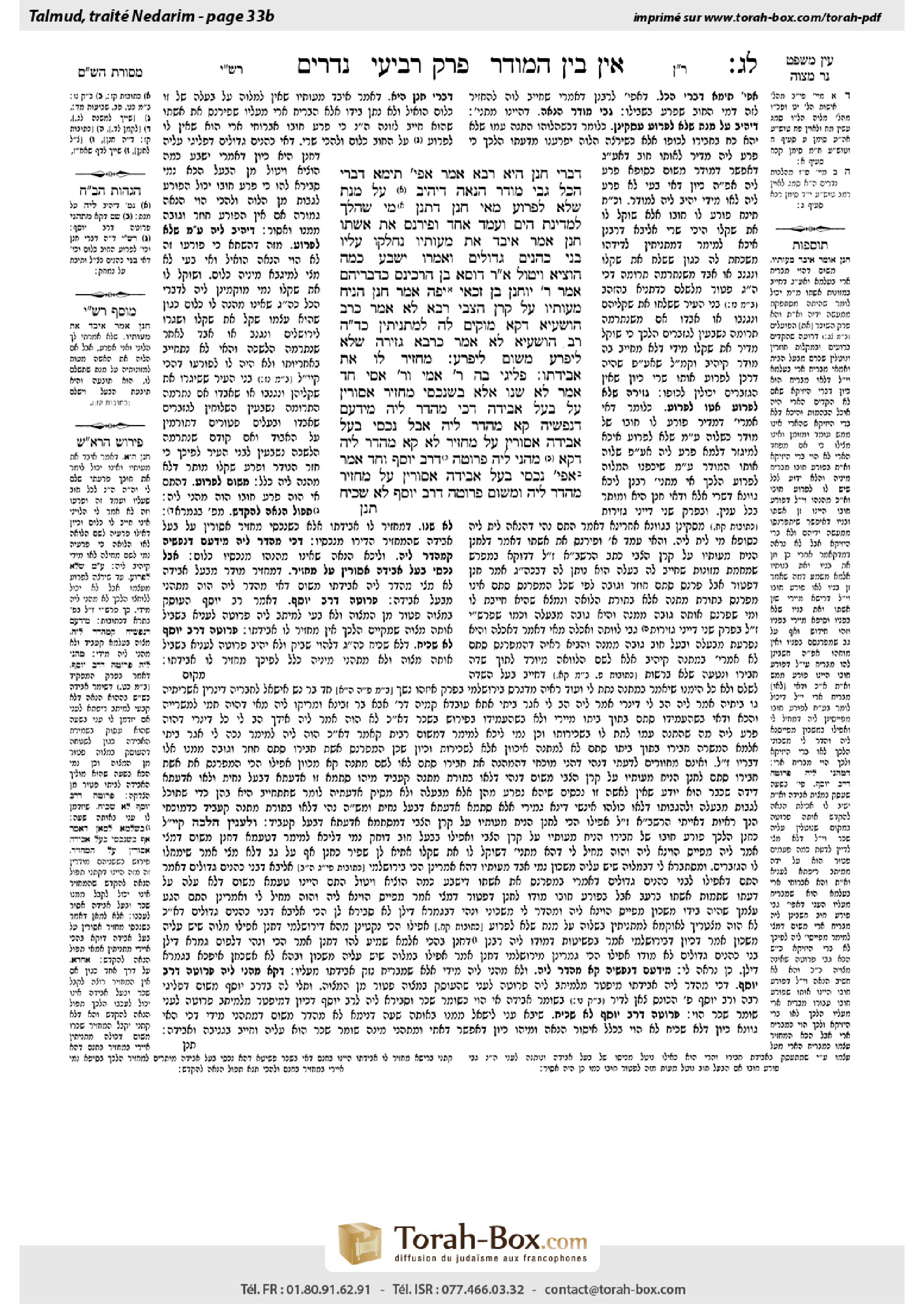
Nedarim 33b: Talmud study for Daf Yomi
Daf Yomi is the daily study of one Talmud folio. Explore 37 tractates with scans, Hebrew text, Sefaria English and AI-generated French translations where annotated.
Passage selection and English or AI-generated French translation are available where the scan has annotations. Daf Study is independent of Torah-Box and Sefaria.
Browse Nedarim · נדרים · All tractatesNedarim 33b text and translations
This page of Nedarim includes the Aramaic text, an English translation and an AI-generated French translation, alongside the scan above.
נדרים ל״ג ב · Aramaic and Hebrew text
דִּבְרֵי חָנָן הִיא.
רָבָא אָמַר: אֲפִילּוּ תֵּימָא דִּבְרֵי הַכֹּל, גַּבֵּי מוּדָּר הֲנָאָה דְּיָהֵיב עַל מְנָת שֶׁלֹּא לִפְרוֹעַ.
מַאי חָנָן? דִּתְנַן: מִי שֶׁהָלַךְ לִמְדִינַת הַיָּם, וְעָמַד אֶחָד וּפִירְנֵס אֶת אִשְׁתּוֹ. חָנָן אָמַר: אִיבֵּד אֶת מְעוֹתָיו.
נֶחְלְקוּ עָלָיו בְּנֵי כֹּהֲנִים גְּדוֹלִים, וְאָמְרוּ: יִשָּׁבַע כַּמָּה הוֹצִיא, וְיִטּוֹל. אָמַר רַבִּי דּוֹסָא בֶּן הַרְכִּינָס כְּדִבְרֵיהֶם. אָמַר רַבִּי יוֹחָנָן בֶּן זַכַּאי: יָפֶה אָמַר חָנָן, הִנִּיחַ מְעוֹתָיו עַל קֶרֶן הַצְּבִי.
רָבָא לָא אָמַר כְּרַב הוֹשַׁעְיָא, דְּקָא מוֹקֵים לָהּ לְמַתְנִיתִין כְּדִבְרֵי הַכֹּל. רַב הוֹשַׁעְיָא לָא אָמַר כְּרָבָא, גְּזֵירָה שֶׁלֹּא לִיפָּרַע מִשּׁוּם לִיפָּרַע.
מַחֲזִיר לוֹ אֶת אֲבֵידָתוֹ. פְּלִיגִי בַּהּ רַבִּי אַמֵּי וְרַבִּי אַסִּי, חַד אָמַר: לֹא שָׁנוּ אֶלָּא בְּשֶׁנִּכְסֵי מַחְזִיר אֲסוּרִין עַל בַּעַל אֲבֵידָה, דְּכִי מַהְדַּר לֵיהּ — מִידַּעַם דְּנַפְשֵׁיהּ קָא מַהְדַּר לֵיהּ. אֲבָל נִכְסֵי בַּעַל אֲבֵידָה אֲסוּרִין עַל מַחְזִיר — לָא קָא מַהְדַּר לֵיהּ, דְּקָא מְהַנֵּי לֵיהּ פְּרוּטָה דְּרַב יוֹסֵף.
וְחַד אָמַר: אֲפִילּוּ נִכְסֵי בַּעַל אֲבֵידָה אֲסוּרִין עַל מַחְזִיר מַהְדַּר לֵיהּ, וּמִשּׁוּם פְּרוּטָה דְּרַב יוֹסֵף לָא שְׁכִיחַ.
Nedarim 33b · English translation
is the statement of Ḥanan in a dispute pertaining to one who pays the debt of another. Ḥanan holds that he cannot demand to be reimbursed for that payment, since he merely prevented potential damage.
Rava said: Even if you say that everyone agrees that this is the halakha, it was stated with regard to one prohibited by vow from deriving benefit from another who borrowed money, and the creditor stipulated that it was on the condition that if he so chooses he does not need to repay the loan. In that case, by repaying the loan, one who vowed and imposed the prohibition did not actually repay his debt.
The Gemara asks: What is the opinion of Ḥanan to which the Gemara referred? The Gemara answers that it is as we learned in a mishna: In the case of a husband who went to a country overseas, and one other man arose and supported his wife on his own initiative and then demanded to be reimbursed for that support when the husband returned, Ḥanan said: The one who took the initiative to support the wife lost his money, since the husband neither asked him to do so nor committed to compensate him.
The sons of High Priests disagreed with him and said: The one who took the initiative to support his wife will take an oath as to how much he spent and take repayment from the husband. Rabbi Dosa ben Harkinas said in accordance with the statement of the sons of High Priests. Rabbi Yoḥanan ben Zakkai said: Ḥanan spoke well, as in any case of this type he placed his money on the antler of a deer, i.e., a risky venture with no guaranteed return.
The Gemara explains the dispute between Rava and Rav Hoshaya with regard to attribution of the mishna: Rava did not say that the mishna is in accordance with the opinion of Ḥanan, as did Rav Hoshaya, and he preferred a different explanation, as he establishes the mishna in accordance with the statements upon which everyone agrees, rather than attributing it to an individual tanna. Rav Hoshaya did not say that the mishna is in accordance with the opinion of all the tanna’im as did Rava, as there is basis to issue a rabbinic decree prohibiting repayment of a loan for one for whom benefit from another is forbidden by vow on the condition that he does not need to repay the loan, due to a standard loan that he is required to repay. Therefore, he prefers to establish the mishna in accordance with the opinion of Ḥanan.
§ We learned in the mishna: He returns his lost item to him. Rabbi Ami and Rabbi Asi disagree about this. One said: They taught this only in a case where the property of the one returning the lost item is forbidden to the owner of the lost item, as when he returns it to him he is returning to him something of his own and is not giving him anything new. Consequently, returning a lost item in no way violates the vow. However, in a case where the property of the owner of the lost item is forbidden to the one returning the lost item, he may not return it to him, as in that case the owner indirectly benefits the one returning the lost item by enabling him to acquire the peruta of Rav Yosef. Rav Yosef said that the legal status of one tending to the return of a lost item is like that of a paid bailee. Since one who is engaged in a mitzva is exempt from performing another mitzva, while he is tending to the lost item he is exempt from giving charity to a pauper. Since the one returning the lost item profits from engaging in the return of the lost item, it is prohibited for him to do so, as he is prohibited by vow from deriving benefit from the owner of the lost item.
And one said: Even in a case where the property of the owner of the lost item is forbidden to the one returning the lost item, he returns it to him. And with regard to the concern due to the peruta of Rav Yosef, it is not a concern because it is uncommon for a pauper to happen upon a person just when he is tending to the lost item. Therefore, it cannot be said that there is profit in the return of a lost item.
Nedarim 33b · Traduction française (IA)
C’est l’opinion de Ḥanan dans une controverse portant sur celui qui paie la dette d’autrui. Ḥanan estime qu’il ne peut pas réclamer le remboursement de cette somme, puisqu’il s’est contenté d’éviter un dommage potentiel.
Rava dit : Même si l’on affirme que tous s’accordent sur cette halakha, cela a été dit à propos d’une personne à qui un vœu interdit de tirer profit d’autrui et qui a emprunté de l’argent, le créancier ayant stipulé que l’emprunteur ne serait pas tenu de rembourser le prêt s’il le souhaitait. Dans ce cas, en remboursant le prêt, celui qui a fait le vœu et imposé l’interdiction ne s’est pas acquitté de sa propre dette.
La Guemara demande : À quelle opinion de Ḥanan la Guemara faisait-elle référence ? Elle répond qu’il s’agit de celle que nous avons apprise dans une Michna : dans le cas d’un mari parti dans un pays d’outre-mer, un autre homme prit de sa propre initiative en charge l’entretien de sa femme, puis réclama au mari le remboursement de ces dépenses à son retour. Ḥanan dit : Celui qui a pris l’initiative d’entretenir la femme a perdu son argent, puisque le mari ne le lui avait ni demandé ni promis de le dédommager.
Les fils des grands prêtres étaient en désaccord avec lui et disaient : Celui qui a pris l’initiative d’entretenir sa femme prêtera serment quant au montant dépensé et se fera rembourser par le mari. Rabbi Dosa ben Harkinas se prononça conformément à l’avis des fils des grands prêtres. Rabbi Yoḥanan ben Zakkaï dit : Ḥanan a bien parlé, car, dans une telle situation, cet homme a placé son argent sur la corne d’un cerf, c’est-à-dire qu’il s’est lancé dans une entreprise risquée sans garantie de retour.
La Guemara explique le désaccord entre Rava et Rav Hoshaya au sujet de l’attribution de la Michna : Rava n’a pas dit, comme Rav Hoshaya, que la Michna suit l’opinion de Ḥanan ; il a préféré une autre explication, établissant que la Michna suit les avis sur lesquels tous s’accordent, plutôt que de l’attribuer à un tanna en particulier. Rav Hoshaya n’a pas dit, comme Rava, que la Michna suit l’opinion de tous les tannaïm, car il y a lieu de décréter par mesure rabbinique qu’il est interdit de rembourser un prêt à une personne à qui un vœu interdit de tirer profit d’autrui, même si le prêt a été consenti à la condition qu’elle ne soit pas tenue de le rembourser, en raison des prêts ordinaires qu’elle est tenue de rembourser. Il préfère donc établir que la Michna suit l’opinion de Ḥanan.
§ Nous avons appris dans la Michna : Il lui restitue son objet perdu. Rabbi Ami et Rabbi Asi sont en désaccord à ce sujet. L’un dit : Ils n’ont enseigné cela que dans le cas où les biens de celui qui restitue l’objet perdu sont interdits au propriétaire de l’objet perdu ; en effet, en le lui restituant, il lui rend quelque chose qui lui appartient déjà et ne lui donne rien de nouveau. Par conséquent, la restitution d’un objet perdu ne transgresse en rien le vœu. En revanche, si les biens du propriétaire de l’objet perdu sont interdits à celui qui le restitue, celui-ci ne peut pas le lui rendre, car le propriétaire fait alors indirectement bénéficier celui qui restitue l’objet perdu en lui permettant d’acquérir la perouta de Rav Yosef. Rav Yosef a dit que le statut juridique de celui qui s’occupe de restituer un objet perdu est celui d’un gardien rémunéré. Comme celui qui est occupé à accomplir une mitsva est exempt d’en accomplir une autre, tant qu’il s’occupe de l’objet perdu, il est exempt de faire l’aumône à un pauvre. Puisque celui qui restitue l’objet perdu tire profit de cette activité, il lui est interdit de le faire, car un vœu lui interdit de tirer profit du propriétaire de l’objet perdu.
L’autre dit : Même si les biens du propriétaire de l’objet perdu sont interdits à celui qui le restitue, il le lui rend. Quant à la préoccupation liée à la perouta de Rav Yosef, elle n’est pas fondée, car il est rare qu’un pauvre croise quelqu’un précisément au moment où celui-ci s’occupe de l’objet perdu. On ne peut donc pas dire que la restitution d’un objet perdu procure un profit.
Traduction française générée par IA à partir de l’édition anglaise de Sefaria. Vérifie toujours un passage avec le texte source.
Text from Sefaria: William Davidson Edition - Vocalized Aramaic (CC BY NC); William Davidson Edition - English (CC BY NC).