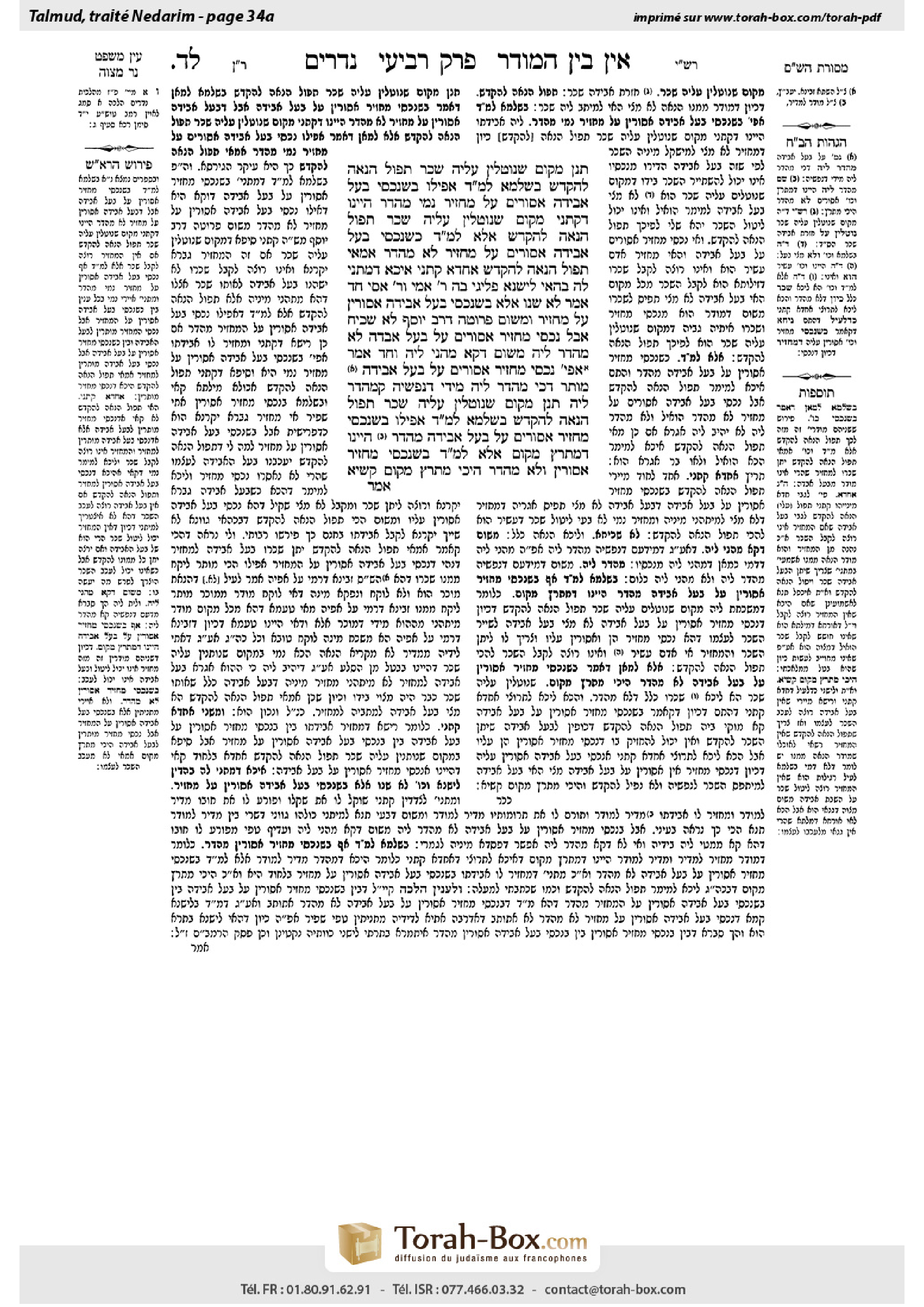
Nedarim 34a: Talmud study for Daf Yomi
Daf Yomi is the daily study of one Talmud folio. Explore 37 tractates with scans, Hebrew text, Sefaria English and AI-generated French translations where annotated.
Passage selection and English or AI-generated French translation are available where the scan has annotations. Daf Study is independent of Torah-Box and Sefaria.
Browse Nedarim · נדרים · All tractatesNedarim 34a text and translations
This page of Nedarim includes the Aramaic text, an English translation and an AI-generated French translation, alongside the scan above.
נדרים ל״ד א · Aramaic and Hebrew text
תְּנַן: מָקוֹם שֶׁנּוֹטְלִין עָלֶיהָ שָׂכָר — תִּפּוֹל הֲנָאָה לַהֶקְדֵּשׁ. בִּשְׁלָמָא לְמַאן דְּאָמַר אֲפִילּוּ בְּשֶׁנִּכְסֵי בַּעַל אֲבֵידָה אֲסוּרִים עַל מַחְזִיר נָמֵי מַהְדַּר — הַיְינוּ דְּקָתָנֵי מָקוֹם שֶׁנּוֹטְלִין עָלֶיהָ שָׂכָר תִּפּוֹל הֲנָאָה לַהֶקְדֵּשׁ.
אֶלָּא לְמַאן דְּאָמַר כְּשֶׁנִּכְסֵי בַּעַל אֲבֵידָה אֲסוּרִים עַל מַחְזִיר לָא מַהְדַּר, אַמַּאי תִּפּוֹל הֲנָאָה לַהֶקְדֵּשׁ?
אַחֲדָא קָתָנֵי.
אִיכָּא דְּמַתְנֵי לַהּ בְּהַאי לִישָּׁנָא: פְּלִיגִי בַּהּ רַבִּי אַמֵּי וְרַבִּי אַסִּי. חַד אָמַר: לֹא שָׁנוּ אֶלָּא בְּשֶׁנִּכְסֵי בַּעַל אֲבֵידָה אֲסוּרִין עַל מַחְזִיר, וּמִשּׁוּם פְּרוּטָה דְּרַב יוֹסֵף לָא שְׁכִיחַ. אֲבָל נִכְסֵי מַחְזִיר אֲסוּרִים עַל בַּעַל אֲבֵדָה — לָא מַהְדַּר לֵיהּ, מִשּׁוּם דְּקָא מְהַנֵּי לֵיהּ.
וְחַד אָמַר: אֲפִילּוּ נִכְסֵי מַחְזִיר אֲסוּרִים עַל בַּעַל אֲבֵידָה — מוּתָּר. דְּכִי מַהְדַּר לֵיהּ — מִידֵּי דְּנַפְשֵׁיהּ קָמַהְדַּר לֵיהּ.
תְּנַן: מָקוֹם שֶׁנּוֹטְלִין עָלֶיהָ שָׂכָר — תִּפּוֹל הֲנָאָה לַהֶקְדֵּשׁ. בִּשְׁלָמָא לְמַאן דְּאָמַר אֲפִילּוּ בְּשֶׁנִּכְסֵי מַחְזִיר אֲסוּרִים עַל בַּעַל אֲבֵידָה מַהְדַּר — הַיְינוּ דִּמְתָרֵץ מָקוֹם.
אֶלָּא לְמַאן דְּאָמַר בְּשֶׁנִּכְסֵי מַחְזִיר אֲסוּרִין, וְלָא מַהְדַּר, הֵיכִי מְתָרֵץ מָקוֹם? קַשְׁיָא.
Nedarim 34a · English translation
We learned in the mishna: In a place where one takes payment for returning a lost item, the benefit that he receives for returning the item should fall into the category of consecrated Temple property. The Gemara asks: Granted, according to the one who says that even in a case where the property of the owner of the lost item is forbidden to the one returning the lost item, he returns it to him. This explanation is consistent with that which the mishna teaches: In a place where one takes payment for returning a lost item, the benefit that he receives for returning the item should fall into the category of consecrated Temple property.
However, according to the one who says that in a case where the property of the owner of the lost item is forbidden to the one returning the lost item, he may not return it to him, and the mishna is referring exclusively to a case where the property of the one returning the lost object is forbidden to the owner of the lost object, why should the benefit fall into the category of consecrated Temple property? It is not prohibited for him to benefit from the property of the owner.
The Gemara answers: The tanna of the mishna teaches about only one of the cases: The property of the one returning the lost object is forbidden to the owner, and the one returning the lost object refuses to accept compensation. In that case, the owner of the lost item benefits from the one returning the lost object by allowing him to keep the compensation. Therefore, the benefit is donated to the Temple treasury.
There are those who teach the dispute in this formulation: Rabbi Ami and Rabbi Asi disagree about this. One said: They taught this only in a case where the property of the owner of the lost item is forbidden to the one returning the lost item, and the concern due to the peruta of Rav Yosef is not a concern, because it is not common. However, in a case where the property of the one returning the lost item is forbidden to the owner of the lost item, he may not return it to him, due to the fact that in doing so he benefits him.
And one said: Even if the property of the one returning the lost item is forbidden to the owner of the lost item, it is permitted to return it to him, as when he returns it, he is returning to him something of his own and is not giving him anything new.
We learned in the mishna: In a place where one takes payment for returning a lost item, the benefit that he receives for returning the item should fall into the category of consecrated Temple property. The Gemara asks: Granted, according to the one who says that even if the property of the one returning the lost item is forbidden to the owner of the lost item he returns it to him, this is the reason that it is necessary to resolve the halakha in a place where one takes payment.
However, according to the one who said that in a case where the property of the one returning the lost item is forbidden to the owner of the lost item he may not return it to him, how does he explain the halakha taught with regard to a place where one takes payment? Since the mishna is referring to a case where the property of the owner of the lost item is forbidden to the one returning the lost item, why is it prohibited for the owner of the lost item to keep the payment? It is not prohibited for him to benefit from the property of the one returning the lost item. The Gemara concludes: Indeed, it is difficult.
Nedarim 34a · Traduction française (IA)
Nous avons appris dans la Michna : dans un lieu où l’on prend une rémunération pour restituer un objet perdu, le bénéfice que l’on tire de cette restitution doit être considéré comme consacré au Temple. La Guemara demande : cela se comprend selon celui qui affirme que, même lorsque les biens du propriétaire de l’objet perdu sont interdits à celui qui le restitue, celui-ci le lui rend. Cette explication concorde avec ce qu’enseigne la Michna : dans un lieu où l’on prend une rémunération pour restituer un objet perdu, le bénéfice que l’on tire de cette restitution doit être considéré comme consacré au Temple.
Cependant, selon celui qui affirme que, lorsque les biens du propriétaire de l’objet perdu sont interdits à celui qui le restitue, celui-ci ne peut pas le lui rendre, et que la Michna ne traite que du cas où les biens de celui qui restitue l’objet sont interdits au propriétaire, pourquoi le bénéfice devrait-il être considéré comme consacré au Temple ? Il n’est pas interdit au propriétaire de tirer profit des biens de celui qui restitue l’objet.
La Guemara répond : le tanna de la Michna n’enseigne qu’un seul des cas, celui où les biens de celui qui restitue l’objet sont interdits au propriétaire et où celui qui restitue l’objet refuse d’accepter une rémunération. Dans ce cas, le propriétaire de l’objet perdu tire profit de celui qui le restitue, puisque celui-ci lui permet de conserver la rémunération. Le bénéfice est donc versé au trésor du Temple.
Certains rapportent la controverse sous cette forme : Rabbi Ami et Rabbi Asi sont en désaccord à ce sujet. L’un dit : cet enseignement ne concerne que le cas où les biens du propriétaire de l’objet perdu sont interdits à celui qui le restitue. Le risque lié à la perouta de Rav Yosef n’est pas à prendre en compte, car cela ne se produit pas souvent. En revanche, lorsque les biens de celui qui restitue l’objet perdu sont interdits au propriétaire de l’objet, il ne peut pas le lui rendre, car ce faisant, il lui procure un bénéfice.
L’autre dit : même lorsque les biens de celui qui restitue l’objet perdu sont interdits au propriétaire de l’objet, il lui est permis de le lui rendre, car, en le restituant, il lui rend quelque chose qui lui appartient et ne lui donne rien de nouveau.
Nous avons appris dans la Michna : dans un lieu où l’on prend une rémunération pour restituer un objet perdu, le bénéfice que l’on tire de cette restitution doit être considéré comme consacré au Temple. La Guemara demande : cela se comprend selon celui qui affirme que, même lorsque les biens de celui qui restitue l’objet perdu sont interdits au propriétaire de l’objet, celui-ci le lui rend ; c’est pourquoi il est nécessaire de préciser la halakha dans le cas d’un lieu où l’on prend une rémunération.
Cependant, selon celui qui affirme que, lorsque les biens de celui qui restitue l’objet perdu sont interdits au propriétaire de l’objet, celui-ci ne peut pas le lui rendre, comment explique-t-il la halakha enseignée au sujet d’un lieu où l’on prend une rémunération ? Puisque la Michna traite d’un cas où les biens du propriétaire de l’objet perdu sont interdits à celui qui le restitue, pourquoi est-il interdit au propriétaire de l’objet perdu de conserver la rémunération ? Il n’est pas interdit à celui-ci de tirer profit des biens de celui qui restitue l’objet perdu. La Guemara conclut : en effet, cela reste difficile.
Traduction française générée par IA à partir de l’édition anglaise de Sefaria. Vérifie toujours un passage avec le texte source.
Text from Sefaria: William Davidson Edition - Vocalized Aramaic (CC BY NC); William Davidson Edition - English (CC BY NC).