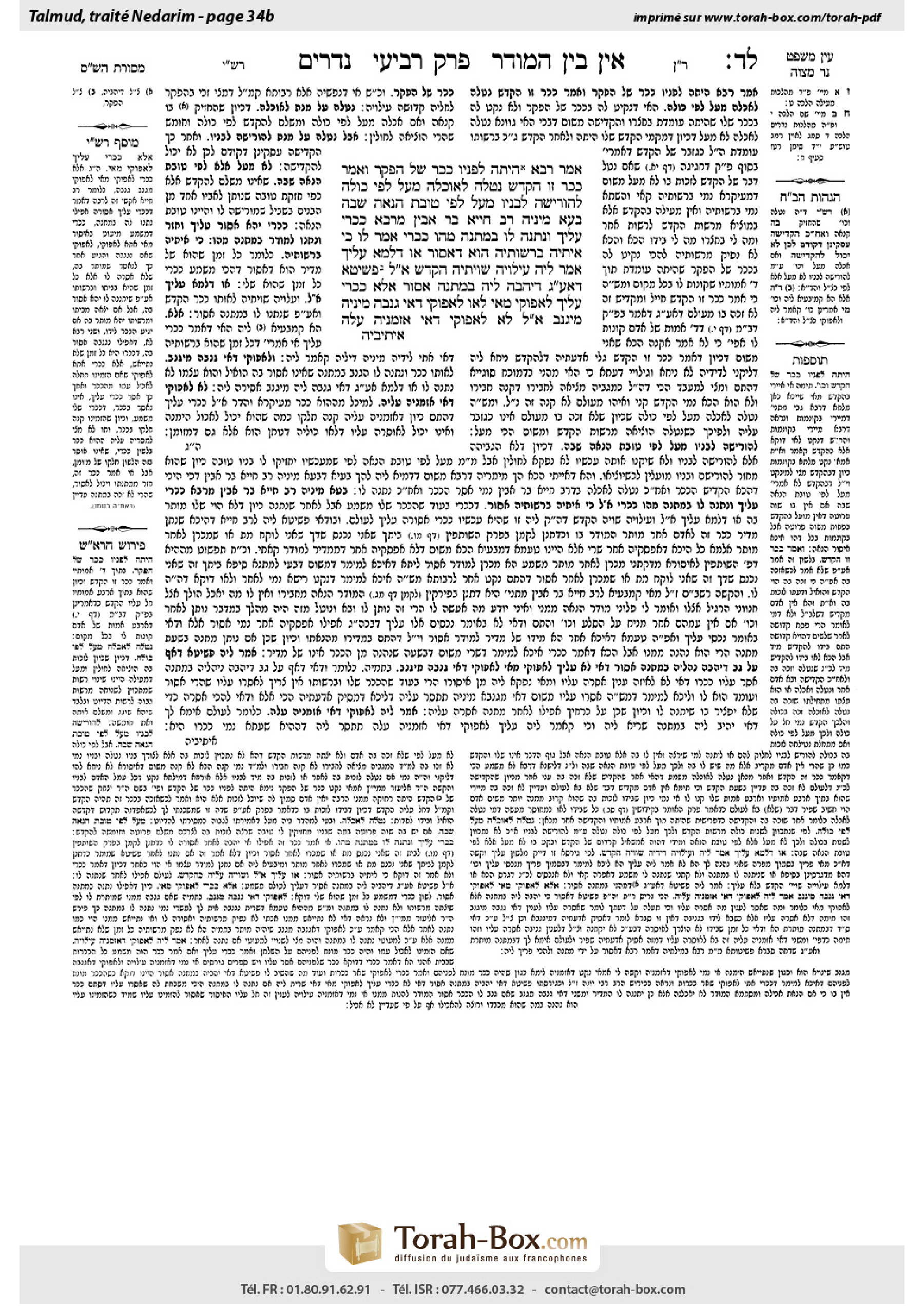
Nedarim 34b: Talmud study for Daf Yomi
Daf Yomi is the daily study of one Talmud folio. Explore 37 tractates with scans, Hebrew text, Sefaria English and AI-generated French translations where annotated.
Passage selection and English or AI-generated French translation are available where the scan has annotations. Daf Study is independent of Torah-Box and Sefaria.
Browse Nedarim · נדרים · All tractatesNedarim 34b text and translations
This page of Nedarim includes the Aramaic text, an English translation and an AI-generated French translation, alongside the scan above.
נדרים ל״ד ב · Aramaic and Hebrew text
אָמַר רָבָא: הָיְתָה לְפָנָיו כִּכָּר שֶׁל הֶפְקֵר, וְאָמַר: ״כִּכָּר זוֹ הֶקְדֵּשׁ״, נְטָלָהּ לְאוֹכְלָהּ — מָעַל לְפִי כּוּלָּהּ. לְהוֹרִישָׁה לְבָנָיו — מָעַל לְפִי טוֹבַת הֲנָאָה שֶׁבָּהּ.
בְּעָא מִינֵּיהּ רַב חִיָּיא בַּר אָבִין מֵרָבָא: ״כִּכָּרִי עָלֶיךָ״ וּנְתָנָהּ לוֹ בְּמַתָּנָה, מַהוּ? ״כִּכָּרִי״ אָמַר לוֹ, כִּי אִיתֵיהּ בִּרְשׁוּתֵיהּ הוּא דְּאָסוּר. אוֹ דִּלְמָא ״עָלֶיךָ״ אֲמַר לֵיהּ, עִילָּוֵיהּ שַׁוִּיתֵיהּ הֶקְדֵּשׁ?
אֲמַר לֵיהּ: פְּשִׁיטָא דְּאַף עַל גַּב דְּיַהֲבַהּ לֵיהּ בְּמַתָּנָה — אָסוּר. אֶלָּא ״כִּכָּרִי עָלֶיךָ״ לְאַפּוֹקֵי מַאי? לָאו לְאַפּוֹקֵי דְּאִי גַּנְבַהּ מִינֵּיהּ מִיגְנָב? אֲמַר לֵיהּ: לָא, לְאַפּוֹקֵי דְּאִי אַזְמְנֵיהּ עֲלַהּ.
Nedarim 34b · English translation
Rava said: In a case where there was a loaf of ownerless bread before a person, and he said: This loaf is consecrated, if he took the loaf to eat it, he misused consecrated property. His repayment to the Temple for that misuse is based on the loaf’s entire value. However, if his intent was not to take the loaf for himself but to bequeath it to his sons, he misused the consecrated property, and his repayment to the Temple is based on the discretionary benefit that he derived from the fact that his children are indebted to him for the bequest, as he himself derived no direct benefit from the loaf.
Rav Ḥiyya bar Avin raised a dilemma before Rava. If one said to another: My loaf is konam for you, and then he gave it to him as a gift, what is the halakha? Should one infer: My loaf is forbidden, i.e., he said to him that when the loaf is in his possession, that is when it is forbidden, but when he gives him a gift, it is no longer in his possession and it is no longer forbidden? Or, perhaps the inference is: Forbidden to you, i.e., he said to him that he rendered the loaf for him like a consecrated item that is forbidden even after the loaf is no longer in his possession.
Rava said to him: It is obvious that although he gave it to the other person as a gift, it is forbidden. Rav Ḥiyya bar Avin asked him: But if that is so, when he said: My loaf is forbidden to you, with emphasis on the word my, what does it come to exclude? Does it not come to exclude a case where he stole it from him, as in that case it is permitted? The same would be true if he gave it to him as a gift. Rava said to him: No, it comes to exclude a case where he invited him to eat from the loaf before he vowed. In that case, that part of the loaf that he invited him to eat is his, and the owner cannot render it forbidden. However, even if he invited the other person before he vowed, the entire loaf remains forbidden if he gave it to him as a gift.
Nedarim 34b · Traduction française (IA)
Rava dit : Dans le cas où une miche sans propriétaire se trouvait devant quelqu’un et où celui-ci déclara : « Cette miche est consacrée », s’il prit la miche pour la manger, il détourna un bien consacré. Le montant de son remboursement au Temple pour ce détournement est calculé d’après la valeur totale de la miche. En revanche, s’il n’avait pas l’intention de prendre la miche pour lui-même, mais de la léguer à ses fils, il détourna un bien consacré, et le montant de son remboursement au Temple est calculé d’après le bénéfice indirect qu’il a tiré du fait que ses enfants lui sont redevables du legs, puisqu’il n’a lui-même tiré aucun bénéfice direct de la miche.
Rav Ḥiyya bar Avin soumit une question à Rava : si quelqu’un dit à un autre : « Ma miche est konam pour toi », puis la lui donne en cadeau, quelle est la halakha ? Faut-il déduire de ses paroles — « Ma miche est interdite » — qu’elle n’est interdite que tant qu’elle est en sa possession, mais qu’une fois donnée en cadeau, elle n’est plus en sa possession et n’est donc plus interdite ? Ou faut-il plutôt déduire de ses paroles — « Interdite pour toi » — qu’il a rendu la miche comparable, pour lui, à un objet consacré, qui reste interdit même lorsqu’elle n’est plus en sa possession ?
Rava lui dit : Il est évident que, même s’il la donne à l’autre en cadeau, elle lui est interdite. Rav Ḥiyya bar Avin lui demanda : Mais si c’est le cas, lorsqu’il dit : « Ma miche t’est interdite », en insistant sur le mot « ma », qu’est-ce que cela vient exclure ? N’est-ce pas le cas où il l’a volée à celui qui a prononcé le vœu, auquel cas elle est permise ? Il en irait de même s’il la lui avait donnée en cadeau. Rava lui répondit : Non, cela vient exclure le cas où il l’avait invité à manger de la miche avant de prononcer son vœu. Dans ce cas, la part de la miche qu’il l’avait invité à manger lui appartient, et le propriétaire ne peut pas la lui interdire. Toutefois, même s’il avait invité l’autre personne avant de prononcer son vœu, toute la miche reste interdite s’il la lui donne en cadeau.
Traduction française générée par IA à partir de l’édition anglaise de Sefaria. Vérifie toujours un passage avec le texte source.
Text from Sefaria: William Davidson Edition - Vocalized Aramaic (CC BY NC); William Davidson Edition - English (CC BY NC).