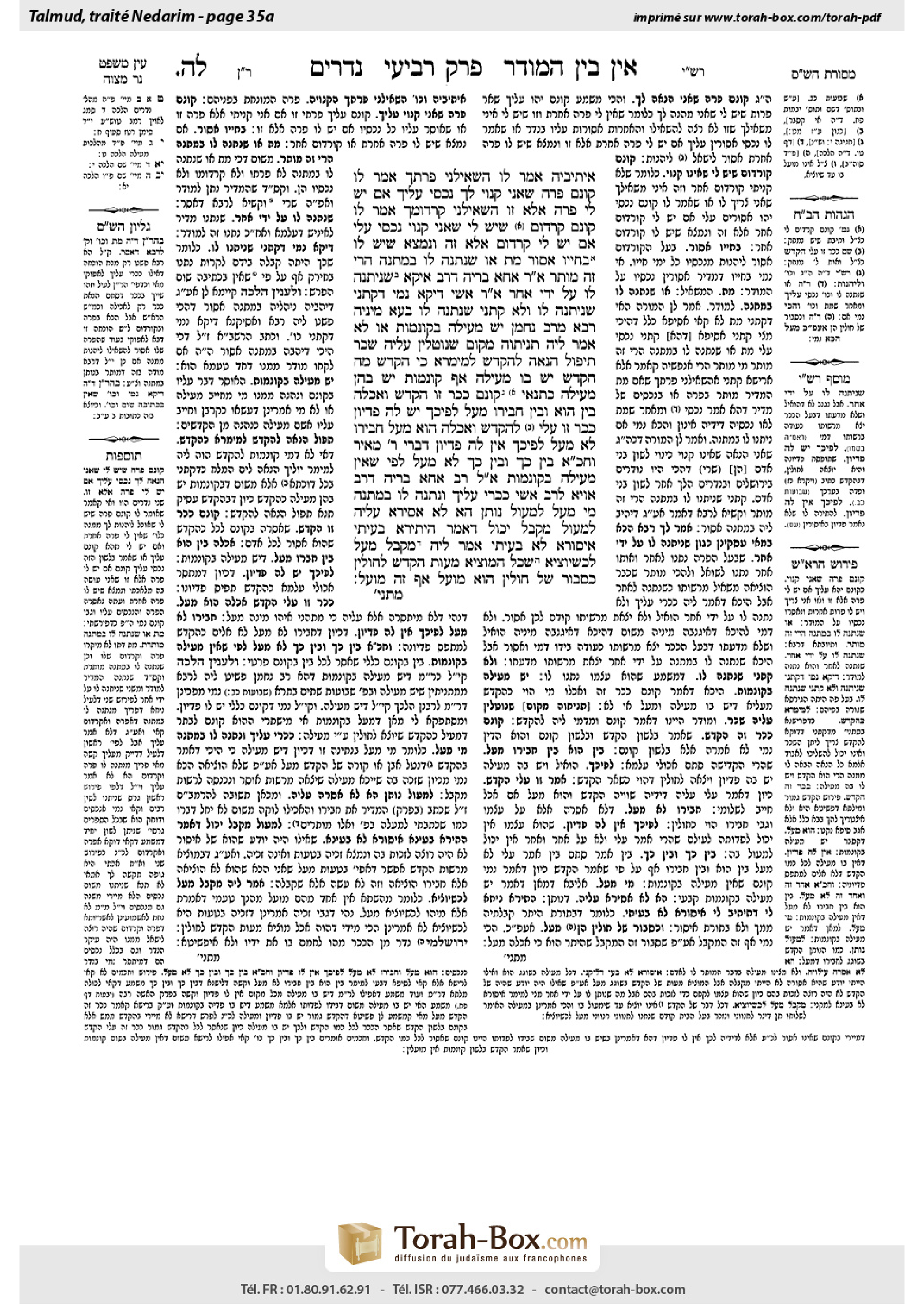
Nedarim 35a: Talmud study for Daf Yomi
Daf Yomi is the daily study of one Talmud folio. Explore 37 tractates with scans, Hebrew text, Sefaria English and AI-generated French translations where annotated.
Passage selection and English or AI-generated French translation are available where the scan has annotations. Daf Study is independent of Torah-Box and Sefaria.
Browse Nedarim · נדרים · All tractatesNedarim 35a text and translations
This page of Nedarim includes the Aramaic text, an English translation and an AI-generated French translation, alongside the scan above.
נדרים ל״ה א · Aramaic and Hebrew text
אֵיתִיבֵיהּ, אָמַר לוֹ: ״הַשְׁאִילֵנִי פָּרָתְךָ״, אָמַר לוֹ: ״קֻוֽנָּם פָּרָה שֶׁאֲנִי קָנוּי לָךְ״, ״נְכָסַי עָלֶיךָ אִם יֵשׁ לִי פָּרָה אֶלָּא זוֹ״. ״הַשְׁאִילֵנִי קַרְדּוּמְּךָ״, אָמַר לוֹ: ״קֻוֽנָּם קַרְדּוֹם שֶׁיֵּשׁ לִי שֶׁאֲנִי קָנוּי״, ״נְכָסַי עָלַי אִם יֵשׁ לִי קַרְדּוֹם אֶלָּא זֶה״, וְנִמְצָא שֶׁיֵּשׁ לוֹ — בְּחַיָּיו אָסוּר, מֵת אוֹ שֶׁנִּתְּנָה לוֹ בְּמַתָּנָה — הֲרֵי זֶה מוּתָּר.
אָמַר רַב אַחָא בְּרֵיהּ דְּרַב אִיקָא: שֶׁנִּיתְּנָה לוֹ עַל יְדֵי אַחֵר.
אָמַר רַב אָשֵׁי: דַּיְקָא נָמֵי דְּקָתָנֵי ״שֶׁנִּיתְּנָה לוֹ״, וְלָא קָתָנֵי ״שֶׁנְּתָנָהּ לוֹ״.
בְּעָא מִינֵּיהּ רָבָא מֵרַב נַחְמָן: יֵשׁ מְעִילָה בְּקוּנָּמוֹת, אוֹ לָא?
אֲמַר לֵיהּ, תְּנֵיתוּהָ: מְקוֹם שֶׁנּוֹטְלִין עָלֶיהָ שָׂכָר — תִּיפּוֹל הֲנָאָה לַהֶקְדֵּשׁ. לְמֵימְרָא כִּי הֶקְדֵּשׁ, מָה הֶקְדֵּשׁ יֵשׁ בּוֹ מְעִילָה — אַף קוּנָּמוֹת יֵשׁ בָּהֶן מְעִילָה.
כְּתַנָּאֵי: ״קֻוֽנָּם כִּכָּר זוֹ הֶקְדֵּשׁ״ וַאֲכָלָהּ, בֵּין הוּא וּבֵין חֲבֵירוֹ — מָעַל, לְפִיכָךְ יֵשׁ לָהּ פִּדְיוֹן. ״כִּכָּר זוֹ עָלַי לְהֶקְדֵּשׁ״ וַאֲכָלָהּ, הוּא — מָעַל, חֲבֵירוֹ — לֹא מָעַל. לְפִיכָךְ אֵין לָהּ פִּדְיוֹן. דִּבְרֵי רַבִּי מֵאִיר.
וַחֲכָמִים אוֹמְרִים: בֵּין כָּךְ וּבֵין כָּךְ לֹא מָעַל, לְפִי שֶׁאֵין מְעִילָה בְּקוּנָּמוֹת.
אֲמַר לֵיהּ רַב אַחָא בְּרֵיהּ דְּרַב אַוְיָא לְרַב אָשֵׁי: ״כִּכָּרִי עָלֶיךָ״ וּנְתָנָהּ לוֹ בְּמַתָּנָה, מִי מָעַל? לִמְעוֹל נוֹתֵן — הָא לָא אֲסִירָא עֲלֵיהּ! לִמְעוֹל מְקַבֵּל — יָכוֹל דְּאָמַר: הֶיתֵּירָא בְּעֵיתִי, אִיסּוּרָא לָא בְּעֵיתִי. אֲמַר לֵיהּ: מְקַבֵּל מָעַל לִכְשֶׁיּוֹצִיא, שֶׁכׇּל הַמּוֹצִיא מְעוֹת הֶקְדֵּשׁ לְחוּלִּין, כְּסָבוּר שֶׁל חוּלִּין הוּא — מוֹעֵל. אַף זֶה — מוֹעֵל.
Nedarim 35a · English translation
The Gemara raised an objection to Rava. If another person said to him: Lend me your cow, and the owner answered and said to him: Every cow that I purchased other than this one, which I need, is konam for you; or if he said: My property is forbidden to you if I have a cow other than this one, and in fact, he owns other cows; or if another said to him: Lend me your spade, and the owner of the spade said to him: Every spade that I have that I purchased is konam for you; or if he said: My property is forbidden to me if I have a spade other than this one, and it is discovered that he has another spade and the konam takes effect, then during the life of the one who vowed, the cow or the spade is forbidden to the subject of the vow. If the one who vowed died or if the cow or the spade was given to the subject of the vow as a gift, it is permitted. Apparently, the konam is in effect only as long as the property is in his possession.
Rav Aḥa, son of Rav Ika, said: It is referring to a case where it was given to the subject of the vow by another person. The one who vowed did not give him the gift directly. He sold or transferred the item to a third party, who gave it to the subject of the vow as a present. Since the property left the possession of its owner before it was given to the subject of the vow, the prohibition does not take effect upon it.
The Gemara states that Rav Ashi said: The language is also precise, as it teaches: That was given to him, and it is not taught: That he gave it to him. This indicates that this halakha applies specifically to a gift that was given to him by a third party, but not by the one who vowed.
§ Rava raised a dilemma before Rav Naḥman: Is there liability for misuse of consecrated property in cases of konamot or not? Since the legal status of an item that was rendered a konam is like that of consecrated property in that it is forbidden to the one who one vowed, is it like consecrated property in every sense, including liability for misuse of consecrated property?
Rav Naḥman said to him: You learned this halakha from a mishna (33a): In a place where one takes payment for returning a lost item, that benefit that he receives for returning the item should fall into the category of consecrated Temple property. That is to say, an item forbidden by a konam is like consecrated property. Just as with regard to consecrated property there is liability for misuse, so too with regard to konamot there is liability for misuse.
The Gemara comments on this. This dilemma is like a dispute between tanna’im. If one said: This loaf is konam to all like consecrated property, and he ate it, then, whether he ate it or whether another ate it, the one who ate it misused consecrated property. Therefore, since its status is that of consecrated property, it has the possibility of desanctification through redemption. If one said: This loaf is konam for me like consecrated property and he eats it, he misused consecrated property. If another eats it, he did not misuse consecrated property, as he said: To me. Therefore, it does not have the possibility of desanctification through redemption, since its status is not that of full-fledged consecrated property. This is the statement of Rabbi Meir.
And the Rabbis say: In the case of both vows taken in this manner and vows taken in that manner, no one misused consecrated property because there is no liability for misuse of consecrated objects in cases of konamot. Rabbi Meir disagrees and holds that there is liability for misuse in konamot.
Rav Aḥa, son of Rav Avya, said to Rav Ashi: If one said to another: My loaf is konam for you, and he then gave it to him as a gift, which of them misused consecrated property? If you say: Let the one who gives the loaf be liable for misuse, why would he be liable; the loaf is not forbidden to him? If you say: Let the one who receives the loaf be liable for misuse, he can say: I wanted to receive a permitted item; I did not want to receive a forbidden item. Since the loaf is forbidden, if I accepted it from you, it was not my intention to do so. Rav Ashi said to him: The one who receives the loaf is liable for misuse when he utilizes the loaf, as the principle with regard to misuse is that anyone who utilizes consecrated money for non-sacred purposes, when he is under the impression that it is non-sacred, misuses consecrated property. This person who received the loaf also misuses consecrated property.
Nedarim 35a · Traduction française (IA)
La Guemara soulève une objection à Rava. Si quelqu’un lui dit : « Prête-moi ta vache », et que le propriétaire lui répond : « Toute vache que j’ai achetée, hormis celle-ci dont j’ai besoin, t’est konam » ; ou s’il dit : « Que mes biens te soient interdits si j’ai une vache autre que celle-ci », alors qu’en fait il possède d’autres vaches ; ou si quelqu’un lui dit : « Prête-moi ta bêche », et que le propriétaire de la bêche lui répond : « Toute bêche que j’ai achetée et que je possède t’est konam » ; ou s’il dit : « Que mes biens me soient interdits si j’ai une bêche autre que celle-ci », et qu’on découvre qu’il en a une autre, de sorte que le konam prend effet, alors, tant que celui qui a prononcé le vœu est en vie, la vache ou la bêche est interdite au destinataire du vœu. Si celui qui a prononcé le vœu meurt, ou si la vache ou la bêche est donnée en cadeau au destinataire du vœu, elle lui est permise. Apparemment, le konam ne s’applique que tant que le bien reste en possession de son propriétaire.
Rav Aḥa, fils de Rav Ika, dit : Il s’agit d’un cas où le bien a été donné au destinataire du vœu par une autre personne. Celui qui a prononcé le vœu ne lui a pas directement fait ce cadeau. Il a vendu ou transféré l’objet à un tiers, qui l’a offert au destinataire du vœu. Puisque le bien a quitté la possession de son propriétaire avant d’être donné au destinataire du vœu, l’interdiction ne s’applique pas à lui.
La Guemara rapporte que Rav Ashi a dit : Le libellé est également précis, puisqu’il est enseigné : « qui lui a été donné », et non : « qu’il lui a donné ». Cela indique que cette halakha s’applique spécifiquement à un cadeau qui lui a été donné par un tiers, mais non par celui qui a prononcé le vœu.
§ Rava posa une question à Rav Naḥman : Y a-t-il responsabilité pour détournement de biens consacrés dans le cas des konamot, ou non ? Puisqu’un objet déclaré konam a le statut d’un bien consacré en ce qu’il est interdit à la personne visée par le vœu, a-t-il le statut d’un bien consacré à tous égards, y compris en ce qui concerne la responsabilité pour détournement de biens consacrés ?
Rav Naḥman lui dit : Tu as appris cette halakha dans une Michna (33a) : Dans un endroit où l’on reçoit une rémunération pour restituer un objet perdu, l’avantage tiré de sa restitution doit être considéré comme un bien consacré au Temple. Autrement dit, un objet interdit par un konam a le statut d’un bien consacré. De même que le détournement d’un bien consacré engage la responsabilité de celui qui l’a détourné, de même, dans le cas des konamot, le détournement engage cette responsabilité.
La Guemara commente : Cette question fait l’objet d’une controverse entre tannaïm. Si quelqu’un dit : « Cette miche est konam pour tous, comme un bien consacré », et qu’elle est mangée, alors, que ce soit par lui ou par quelqu’un d’autre, celui qui l’a mangée a détourné un bien consacré. Par conséquent, puisqu’elle a le statut d’un bien consacré, elle peut être désacralisée par rachat. Si quelqu’un dit : « Cette miche m’est konam, comme un bien consacré », et qu’il la mange, il a détourné un bien consacré. Si quelqu’un d’autre la mange, il n’a pas détourné de bien consacré, puisqu’il a dit : « pour moi ». Par conséquent, elle ne peut pas être désacralisée par rachat, car elle n’a pas le statut d’un bien consacré à part entière. Telle est la position de Rabbi Meïr.
Et les Sages disent : Dans les deux cas, que le vœu soit formulé de cette manière ou de cette autre manière, personne ne détourne de bien consacré, car il n’y a pas de responsabilité pour détournement de biens consacrés dans le cas des konamot. Rabbi Meïr est en désaccord et estime que le détournement de konamot engage cette responsabilité.
Rav Aḥa, fils de Rav Avya, dit à Rav Ashi : Si quelqu’un dit à un autre : « Ma miche t’est konam », puis la lui donne en cadeau, lequel des deux a détourné un bien consacré ? Si tu dis que celui qui donne la miche est responsable du détournement, pourquoi le serait-il ? La miche ne lui est pas interdite. Si tu dis que celui qui reçoit la miche est responsable du détournement, il peut répondre : « Je voulais recevoir un objet permis ; je ne voulais pas recevoir un objet interdit. Puisque la miche est interdite, si je l’ai acceptée de toi, ce n’était pas mon intention. » Rav Ashi lui dit : Celui qui reçoit la miche est responsable du détournement lorsqu’il l’utilise, car le principe relatif au détournement est que quiconque utilise de l’argent consacré à des fins profanes en croyant qu’il n’est pas consacré détourne un bien consacré. Celui qui a reçu la miche détourne lui aussi un bien consacré.
Traduction française générée par IA à partir de l’édition anglaise de Sefaria. Vérifie toujours un passage avec le texte source.
Text from Sefaria: William Davidson Edition - Vocalized Aramaic (CC BY NC); William Davidson Edition - English (CC BY NC).