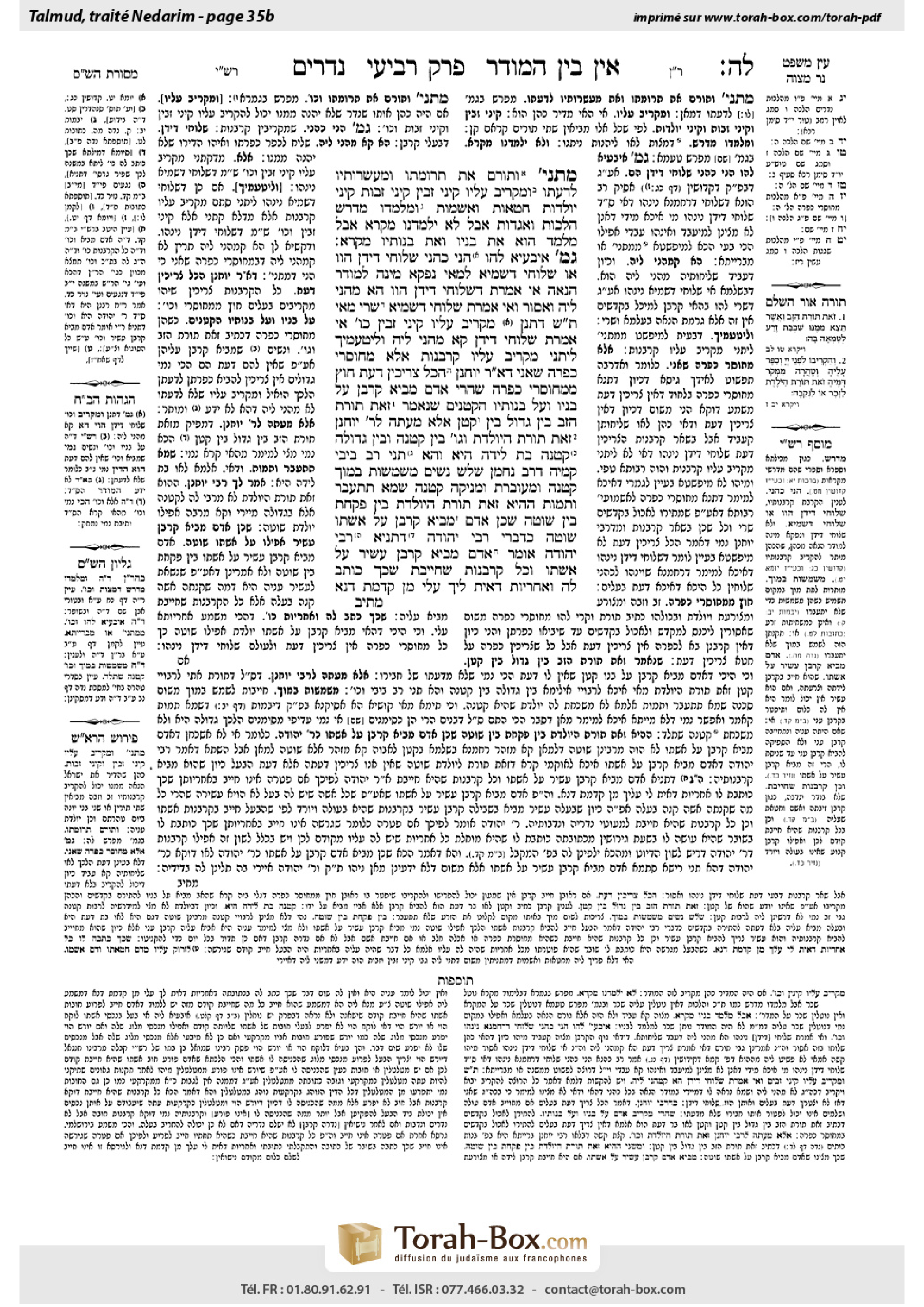
Nedarim 35b: Talmud study for Daf Yomi
Daf Yomi is the daily study of one Talmud folio. Explore 37 tractates with scans, Hebrew text, Sefaria English and AI-generated French translations where annotated.
Passage selection and English or AI-generated French translation are available where the scan has annotations. Daf Study is independent of Torah-Box and Sefaria.
Browse Nedarim · נדרים · All tractatesNedarim 35b text and translations
This page of Nedarim includes the Aramaic text, an English translation and an AI-generated French translation, alongside the scan above.
נדרים ל״ה ב · Aramaic and Hebrew text
מַתְנִי׳ וְתוֹרֵם אֶת תְּרוּמָתוֹ וּמַעְשְׂרוֹתָיו לְדַעְתּוֹ, וּמַקְרִיב עָלָיו קִינֵּי זָבִין, קִינֵּי זָבוֹת, קִינֵּי יוֹלְדוֹת, חַטָּאוֹת וַאֲשָׁמוֹת. וּמְלַמְּדוֹ מִדְרָשׁ הֲלָכוֹת וְאַגָּדוֹת, אֲבָל לֹא יְלַמְּדֶנּוּ מִקְרָא. אֲבָל מְלַמֵּד הוּא אֶת בָּנָיו וְאֶת בְּנוֹתָיו מִקְרָא.
גְּמָ׳ אִיבַּעְיָא לְהוּ: הָנֵי כָּהֲנֵי, שְׁלוּחֵי דִידַן הָווּ, אוֹ שְׁלוּחֵי דִשְׁמַיָּא? לְמַאי נָפְקָא מִינַּהּ — לְמוּדָּר הֲנָאָה. אִי אָמְרַתְּ דִּשְׁלוּחֵי דִידַן הָווּ, הָא מְהַנֵּי לֵיהּ וְאָסוּר. וְאִי אָמְרַתְּ שְׁלוּחֵי דִשְׁמַיָּא — שְׁרֵי. מַאי?
תָּא שְׁמַע, דִּתְנַן: מַקְרִיב עָלָיו קִינֵּי זָבִין כּוּ׳. אִי אָמְרַתְּ שְׁלוּחֵי דִידַן, קָא מְהַנֵּי לֵיהּ?
וְלִיטַעְמָיךְ, לִיתְנֵי: מַקְרִיב עָלָיו קׇרְבָּנוֹת! אֶלָּא, מְחוּסְּרֵי כַפָּרָה שָׁאנֵי. דְּאָמַר רַבִּי יוֹחָנָן: הַכֹּל צְרִיכִין דַּעַת, חוּץ מִמְּחוּסְּרֵי כַפָּרָה. שֶׁהֲרֵי אָדָם מֵבִיא קׇרְבָּן עַל בָּנָיו וְעַל בְּנוֹתָיו הַקְּטַנִּים, שֶׁנֶּאֱמַר: ״זֹאת תּוֹרַת הַזָּב״, בֵּין גָּדוֹל בֵּין קָטָן.
אֶלָּא מֵעַתָּה, לְרַבִּי יוֹחָנָן ״זֹאת תּוֹרַת הַיֹּלֶדֶת וְגוֹ׳״, בֵּין קְטַנָּה וּבֵין גְּדוֹלָה? קְטַנָּה בַּת לֵידָה הִיא?! וְהָא תָּנֵי רַב בִּיבִי קַמֵּיהּ דְּרַב נַחְמָן: שָׁלֹשׁ נָשִׁים מְשַׁמְּשׁוֹת בְּמוֹךְ: קְטַנָּה וּמְעוּבֶּרֶת וּמְנִיקָה. קְטַנָּה — שֶׁמָּא תִּתְעַבֵּר וְתָמוּת.
הַהִיא ״זֹאת תּוֹרַת הַיֹּלֶדֶת״, בֵּין פִּקַּחַת בֵּין שׁוֹטָה, שֶׁכֵּן אָדָם מֵבִיא קׇרְבָּן עַל אִשְׁתּוֹ שׁוֹטָה,
כְּדִבְרֵי רַבִּי יְהוּדָה. דְּתַנְיָא, רַבִּי יְהוּדָה אוֹמֵר: אָדָם מֵבִיא קׇרְבַּן עָשִׁיר עַל אִשְׁתּוֹ, וְכׇל קׇרְבָּנוֹת שֶׁחַיֶּיבֶת,
שֶׁכָּךְ כּוֹתֵב לָהּ: וְאַחְרָיוּת דְּאִית לִיךְ עֲלַי מִן קַדְמַת דְּנָא.
Nedarim 35b · English translation
MISHNA: The mishna proceeds to list other tasks that one may perform for someone who is prohibited by vow from benefiting from him. And he separates his teruma and his tithes, provided that it is with the knowledge and consent of the owner of the produce. And he sacrifices for him the bird nests, i.e., pairs of birds, pigeons and turtledoves, of zavin (see Leviticus 15:13–15); the bird nests of zavot (see Leviticus 15:28–30); the bird nests of women after childbirth (see Leviticus 12:6–8); sin-offerings; and guilt-offerings. And he teaches him midrash, halakhot, and aggadot, but he may not teach him Bible. However, he may teach his sons and daughters Bible.
GEMARA: A dilemma was raised before the Sages: Are these priests our agents or agents of Heaven when they perform the Temple service? The Gemara elaborates: What is the practical difference whether they are our agents or God’s agents? The Gemara answers: The difference is with regard to one prohibited by vow from deriving benefit from another. If you say that the priests are our agents, don’t the priests provide benefit for the one for whom benefit is forbidden by vow, and therefore, sacrificing that person’s offering is prohibited? And if you say that they are agents of Heaven, it is permitted. What is the status of priests?
Come and hear proof to resolve the dilemma, as we learned in the mishna: And he sacrifices for him the bird nests of zavin, etc. The Gemara infers: If you say that the priests are our agents, the priests would thereby provide benefit to one for whom benefit from them is forbidden. Based on the ruling in the mishna, apparently, priests are agents of Heaven.
The Gemara rejects the proof: And according to your reasoning, that the mishna holds that priests are agents of Heaven, let the mishna teach in general: He sacrifices for him offerings. Why did the mishna list these particular offerings? Rather, perforce, offerings brought by those lacking atonement are different from other offerings, as Rabbi Yoḥanan said: Everyone who brings an offering requires knowledge and intent in order to bring the offering, except for those lacking atonement, who bring the offering in order to complete their purification. This can be proven from the fact that a person brings a purification offering for his minor sons and daughters, although they lack halakhic intelligence, as it is stated: “This is the law of the zav” (Leviticus 15:32). This apparently superfluous verse comes to teach that the halakhot of the zav apply to both an adult and a minor.
The Gemara asks: However, if that is so according to Rabbi Yoḥanan, with regard to that which is written: “This is the law of a woman after childbirth” (Leviticus 12:7), would he interpret that the halakhot of a woman after childbirth apply to both an adult and a minor? Is a minor capable of giving birth? But didn’t Rav Beivai teach a baraita before Rav Naḥman: It is permitted for three women to engage in intercourse with a contraceptive resorbent: A minor, and a pregnant woman, and a nursing woman; a minor may do so lest she conceive and die. Apparently, a minor is incapable of giving birth, as she would die first.
The Gemara explains: That verse: “This is the law of a woman after childbirth,” does not come to include a minor. Rather, it comes to teach that the halakhot of a woman after childbirth apply to both a halakhically competent woman and a woman who is an imbecile, as a man brings an offering for his wife who is an imbecile.
This halakha is in accordance with the statement of Rabbi Yehuda, as it is taught in a baraita that Rabbi Yehuda says: A man brings the offering of a wealthy person for his wife, as well as all offerings that she is obligated to bring. A wealthy woman after childbirth brings a lamb as a burnt-offering and a dove or turtledove as a sin-offering. A poor woman brings two turtledoves or two pigeons, one as a burnt-offering and one as a sin-offering. Even if the woman is poor, and based on her usufruct property, she would bring the offering of the poor; if her husband is wealthy, he brings the offering of a wealthy person on her behalf. And he must bring on her behalf all the offerings for which she is obligated.
The fact that he is obligated to bring a wealthy person’s offering on her behalf is due to the fact that this is what he writes in her marriage contract: And responsibility to pay any financial obligations that you have incurred before this moment is incumbent upon me. Offerings that she is obligated to bring are included in those obligations, irrespective of her degree of halakhic competence. The offering of a woman after childbirth is one of the offerings brought by those lacking atonement. Therefore, even if priests are our agents, they may sacrifice the offering on behalf of the woman; since they may do so without her knowledge and intent, no agency is required. Therefore, there is no proof from the mishna that priests are agents of Heaven.
Nedarim 35b · Traduction française (IA)
MICHNA : La Michna énumère d’autres tâches que l’on peut accomplir pour quelqu’un à qui il est interdit, en vertu d’un vœu, de tirer profit de soi. On prélève pour lui sa terouma et ses dîmes, à condition d’agir avec la connaissance et le consentement du propriétaire des produits. On offre pour lui les nids d’oiseaux, c’est-à-dire les paires de pigeons et de tourterelles, des zavin (voir Lévitique 15, 13-15), des zavot (voir Lévitique 15, 28-30), des femmes après l’accouchement (voir Lévitique 12, 6-8), ainsi que des sacrifices expiatoires et des sacrifices de culpabilité. On lui enseigne le midrach, les halakhot et les aggadot, mais on ne peut pas lui enseigner la Bible. Toutefois, on peut enseigner la Bible à ses fils et à ses filles.
GUEMARA : Une question fut posée aux Sages : lorsque les prêtres accomplissent le service du Temple, sont-ils nos mandataires ou les mandataires du Ciel ? La Guemara précise : quelle différence pratique y a-t-il entre le fait qu’ils soient nos mandataires et celui qu’ils soient les mandataires de Dieu ? La Guemara répond : la différence concerne celui à qui il est interdit, en vertu d’un vœu, de tirer profit d’autrui. Si l’on dit que les prêtres sont nos mandataires, ne procurent-ils pas ainsi un bénéfice à celui à qui il est interdit, en vertu d’un vœu, d’en recevoir, de sorte qu’il est interdit d’offrir son sacrifice ? Mais si l’on dit qu’ils sont les mandataires du Ciel, cela est permis. Quel est le statut des prêtres ?
Viens et entends une preuve permettant de trancher la question, car nous avons appris dans la Michna : « On offre pour lui les nids d’oiseaux des zavin », etc. La Guemara en déduit : si l’on dit que les prêtres sont nos mandataires, ils procureraient ainsi un bénéfice à quelqu’un à qui il est interdit d’en recevoir de leur part. D’après la décision de la Michna, il semble donc que les prêtres soient les mandataires du Ciel.
La Guemara rejette la preuve : selon ton raisonnement, si la Michna estime que les prêtres sont les mandataires du Ciel, qu’elle dise simplement : « On offre pour lui des sacrifices. » Pourquoi la Michna énumère-t-elle ces sacrifices particuliers ? Il faut plutôt conclure que les sacrifices apportés par ceux qui doivent encore obtenir l’expiation diffèrent des autres sacrifices, comme l’a dit Rabbi Yoḥanan : quiconque apporte un sacrifice doit le faire avec connaissance et intention, à l’exception de ceux qui doivent encore obtenir l’expiation, lesquels apportent le sacrifice afin d’achever leur purification. On peut le démontrer par le fait qu’une personne apporte un sacrifice de purification pour ses fils et ses filles mineurs, alors qu’ils ne possèdent pas l’intelligence requise par la halakha, comme il est dit : « Telle est la loi du zav » (Lévitique 15, 32). Ce verset apparemment superflu vient enseigner que les halakhot du zav s’appliquent aussi bien à un adulte qu’à un mineur.
La Guemara demande : toutefois, si tel est le cas selon Rabbi Yoḥanan, interpréterait-il les mots « Telle est la loi d’une femme après l’accouchement » (Lévitique 12, 7) comme signifiant que les halakhot d’une femme après l’accouchement s’appliquent aussi bien à une adulte qu’à une mineure ? Une mineure peut-elle accoucher ? Rav Beivai n’a-t-il pas enseigné une baraïta devant Rav Naḥman : il est permis à trois femmes d’avoir des rapports en utilisant une éponge contraceptive : une mineure, une femme enceinte et une femme qui allaite. La mineure peut le faire de peur qu’elle ne conçoive et n’en meure. Il semble donc qu’une mineure soit incapable d’accoucher, puisqu’elle mourrait avant.
La Guemara explique : le verset « Telle est la loi d’une femme après l’accouchement » ne vient pas inclure une mineure. Il enseigne plutôt que les halakhot d’une femme après l’accouchement s’appliquent aussi bien à une femme douée de la capacité requise par la halakha qu’à une femme atteinte d’une déficience intellectuelle, car un homme apporte un sacrifice pour son épouse atteinte d’une déficience intellectuelle.
Cette halakha est conforme à l’opinion de Rabbi Yehuda, comme il est enseigné dans une baraïta : Rabbi Yehuda dit qu’un homme apporte pour son épouse le sacrifice d’une personne riche, ainsi que tous les sacrifices qu’elle est tenue d’apporter. Une femme riche après l’accouchement apporte un agneau en holocauste et une colombe ou une tourterelle en sacrifice expiatoire. Une femme pauvre apporte deux tourterelles ou deux pigeons, l’un en holocauste et l’autre en sacrifice expiatoire. Même si la femme est pauvre et que, compte tenu de ses biens en usufruit, elle apporterait le sacrifice d’une pauvre, si son mari est riche, il apporte pour elle le sacrifice d’une personne riche. Il doit aussi apporter pour elle tous les sacrifices qu’elle est tenue d’apporter.
Il est tenu d’apporter pour elle le sacrifice d’une personne riche parce que c’est ce qu’il écrit dans son contrat de mariage : « Et je prends à ma charge toute obligation financière que tu as contractée avant cet instant. » Les sacrifices qu’elle est tenue d’apporter sont compris dans ces obligations, quel que soit son degré de capacité au regard de la halakha. Le sacrifice d’une femme après l’accouchement est l’un des sacrifices apportés par ceux qui doivent encore obtenir l’expiation. Par conséquent, même si les prêtres sont nos mandataires, ils peuvent offrir le sacrifice pour cette femme ; puisqu’ils peuvent le faire sans sa connaissance ni son intention, aucun mandat n’est nécessaire. La Michna ne prouve donc pas que les prêtres sont les mandataires du Ciel.
Traduction française générée par IA à partir de l’édition anglaise de Sefaria. Vérifie toujours un passage avec le texte source.
Text from Sefaria: William Davidson Edition - Vocalized Aramaic (CC BY NC); William Davidson Edition - English (CC BY NC).