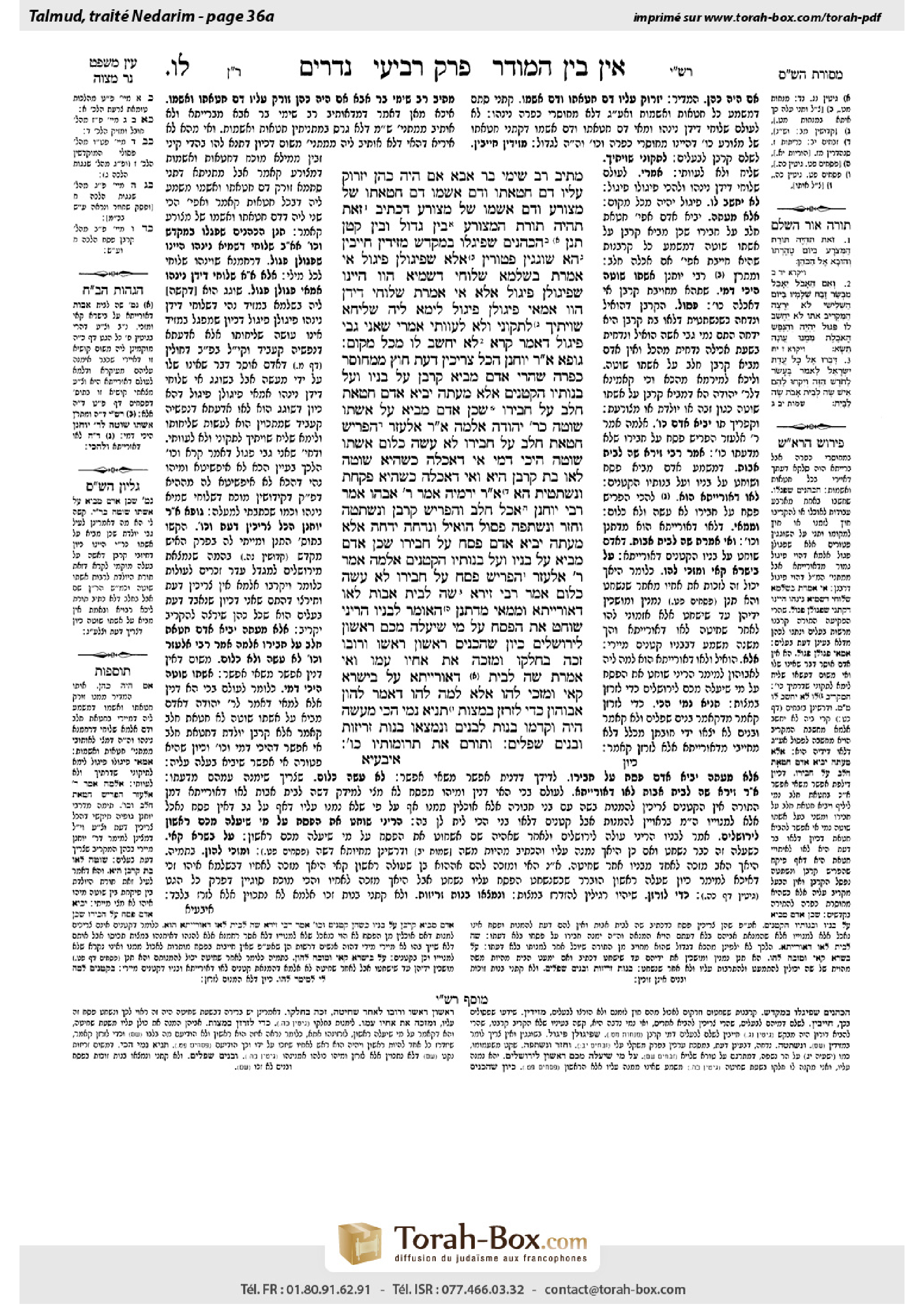
Nedarim 36a: Talmud study for Daf Yomi
Daf Yomi is the daily study of one Talmud folio. Explore 37 tractates with scans, Hebrew text, Sefaria English and AI-generated French translations where annotated.
Passage selection and English or AI-generated French translation are available where the scan has annotations. Daf Study is independent of Torah-Box and Sefaria.
Browse Nedarim · נדרים · All tractatesNedarim 36a text and translations
This page of Nedarim includes the Aramaic text, an English translation and an AI-generated French translation, alongside the scan above.
נדרים ל״ו א · Aramaic and Hebrew text
מֵתִיב רַב שִׁימִי בַּר אַבָּא: אִם הָיָה כֹּהֵן, יִזְרוֹק עָלָיו דַּם חַטָּאתוֹ וְדַם אֲשָׁמוֹ.
דַּם חַטָּאתוֹ שֶׁל מְצוֹרָע וְדַם אֲשָׁמוֹ שֶׁל מְצוֹרָע. דִּכְתִיב: ״זֹאת תִּהְיֶה תּוֹרַת הַמְּצֹרָע״, בֵּין גָּדוֹל וּבֵין קָטָן.
תְּנַן: הַכֹּהֲנִים שֶׁפִּיגְּלוּ בַּמִּקְדָּשׁ, מְזִידִין — חַיָּיבִין. הָא שׁוֹגְגִין — פְּטוּרִין, אֶלָּא שֶׁפִּיגּוּלָן פִּיגּוּל.
אִי אָמְרַתְּ בִּשְׁלָמָא שְׁלוּחֵי דִשְׁמַיָּא הָווּ, הַיְינוּ שֶׁפִּיגּוּלָן פִּיגּוּל. אֶלָּא אִי אָמְרַתְּ שְׁלוּחֵי דִידַן הָווּ, אַמַּאי פִּיגּוּלָן פִּיגּוּל? לֵימָא לֵיהּ: שְׁלִיחָא שַׁוֵּיתָיךְ לְתַקּוֹנֵי וְלָא לְעַוּוֹתֵי!
אָמְרִי: שָׁאנֵי גַּבֵּי פִּיגּוּל, דְּאָמַר קְרָא ״לֹא יֵחָשֵׁב לוֹ״, מִכׇּל מָקוֹם.
גּוּפָא, אָמַר רַבִּי יוֹחָנָן: הַכֹּל צְרִיכִין דַּעַת חוּץ מִמְּחוּסַּר כַּפָּרָה, שֶׁהֲרֵי אָדָם מֵבִיא קׇרְבָּן עַל בָּנָיו וְעַל בְּנוֹתָיו הַקְּטַנִּים. אֶלָּא מֵעַתָּה יָבִיא אָדָם חַטַּאת חֵלֶב עַל חֲבֵירוֹ, שֶׁכֵּן אָדָם מֵבִיא עַל אִשְׁתּוֹ שׁוֹטָה, כְּרַבִּי יְהוּדָה. אַלְּמָה אָמַר רַבִּי אֶלְעָזָר: הִפְרִישׁ חַטַּאת חֵלֶב עַל חֲבֵירוֹ — לֹא עָשָׂה כְּלוּם!
אִשְׁתּוֹ שׁוֹטָה הֵיכִי דָמֵי? אִי דְּאָכְלָה כְּשֶׁהִיא שׁוֹטָה — לָאו בַּת קׇרְבָּן הִיא.
וְאִי דְּאָכְלָה כְּשֶׁהִיא פִּקַּחַת, וְנִשְׁתַּטֵּית — הָא אָמַר רַבִּי יִרְמְיָה אָמַר רַבִּי אֲבָהוּ אָמַר רַבִּי יוֹחָנָן: אָכַל חֵלֶב וְהִפְרִישׁ קׇרְבָּן, וְנִשְׁתַּטָּה וְחָזַר וְנִשְׁתַּפָּה — פָּסוּל, הוֹאִיל וְנִדְחָה — יִדָּחֶה.
אֶלָּא מֵעַתָּה יָבִיא אָדָם פֶּסַח עַל חֲבֵירוֹ, שֶׁכֵּן אָדָם מֵבִיא עַל בָּנָיו וְעַל בְּנוֹתָיו הַקְּטַנִּים. אַלְּמָה אָמַר רַבִּי אֶלְעָזָר הִפְרִישׁ פֶּסַח עַל חֲבֵירוֹ לֹא עָשָׂה כְּלוּם!
אָמַר רַבִּי זֵירָא: ״שֶׂה לְבֵית אָבֹת״ לָאו דְּאוֹרָיְיתָא.
וּמִמַּאי — מִדִּתְנַן: הָאוֹמֵר לְבָנָיו: הֲרֵינִי שׁוֹחֵט אֶת הַפֶּסַח עַל מִי שֶׁיַּעֲלֶה מִכֶּם רִאשׁוֹן לִירוּשָׁלַיִם, כֵּיוָן שֶׁהִכְנִיס רִאשׁוֹן רֹאשׁוֹ וְרוּבּוֹ — זָכָה בְּחֶלְקוֹ, וּמְזַכֶּה אֶת אֶחָיו עִמּוֹ. וְאִי אָמְרַתְּ ״שֶׂה לְבֵית״ דְּאוֹרָיְיתָא, עַל בִּישְׂרָא קָאֵי וּמְזַכֵּי לְהוּ?!
אֶלָּא לְמָה לְהוּ דְּאָמַר לְהוֹן אֲבוּהוֹן? כְּדֵי לְזָרְזָן בְּמִצְוֹת. תַּנְיָא נָמֵי הָכִי: מַעֲשֶׂה הָיָה וְקָדְמוּ בָּנוֹת לַבָּנִים, וְנִמְצְאוּ בָּנוֹת זְרִיזוֹת וּבָנִים שְׁפָלִים.
וְתוֹרֵם אֶת תְּרוּמָתוֹ כּוּ׳.
Nedarim 36a · English translation
Rav Shimi bar Abba raised an objection from the Tosefta (2:7): If the one who vowed to prohibit another from benefiting from him was a priest, he may sprinkle the blood of his sin-offering and the blood of his guilt-offering on the other’s behalf. Apparently, the priest may perform all sacrificial rites for one prohibited from benefiting from him, even those that require knowledge of the one for whom the offering atones.
The Gemara answers. The reference is to blood of the sin-offering of a leper and blood of the guilt-offering of a leper. These are offerings brought by a leper who is lacking atonement, in order to complete his purification process, as it is written: “This is the law of the leper” (Leviticus 14:2). And the verse comes to teach that the halakhot of a leper apply to both an adult and a minor. This offering, too, does not require the knowledge of the one for whom the offering atones.
The Gemara cites another proof to resolve the dilemma with regard to the nature of the agency of a priest. We learned in a mishna: In the case of priests who rendered an offering piggul in the Temple, i.e., they sacrificed an offering intending to consume it after its appointed time, if they did so intentionally, i.e., with full awareness of the period during which the offering may be consumed, they are obligated to pay. The Gemara infers: If they did so unwittingly, they are exempt from payment. However, in any event, when they rendered the offering piggul, it acquired the status of piggul and is disqualified.
The Gemara asks: Granted, if you say that the priests are agents of Heaven, this is why when their actions cause piggul it is piggul; their actions are independent of the one bringing the offering. However, if you say that the priests are our agents, why when their actions cause piggul is it piggul? Let the one bringing the offering say to the priest: I designated you an agent to perform the task properly but not to perform the task improperly.
The Sages say in response: It is different with regard to piggul, as in its regard the verse states and emphasizes: “He who offered it, it will not be imputed to him” (Leviticus 7:18). This implies that it is piggul in any case, e.g., even if one’s actions cause the offering to be piggul without the consent of the owner. Therefore, there is no proof with regard to the nature of the agency of the priest.
§ With regard to the matter itself, Rabbi Yoḥanan said: Everyone who brings an offering requires knowledge, except for those offerings brought by those lacking atonement; this can be proven from the fact that a person brings a purification offering for his minor sons and daughters. The Gemara asks: However, if that is so, let a person bring a sin-offering on behalf of another who unwittingly ate forbidden fat without his knowledge, just as a man brings an offering for his wife who is an imbecile, in accordance with the opinion of Rabbi Yehuda. Why then did Rabbi Elazar say: One who separated a sin-offering on behalf of another who unwittingly ate forbidden fat has done nothing?
The Gemara refutes the analogy between the cases. What are the circumstances of the case of his wife who is an imbecile? If she ate the forbidden fat when she was an imbecile, she is not subject to liability to bring an offering, as one lacking halakhic competence is exempt from punishment and needs no atonement.
And if she ate the forbidden fat when she was halakhically competent and then became an imbecile, didn’t Rabbi Yirmeya say that Rabbi Abbahu said that Rabbi Yoḥanan said: If one ate forbidden fat unwittingly, and separated an offering, and became an imbecile, and became competent again, the offering is disqualified. Since it was disqualified when he was demented, it will be disqualified forever. It is clear, therefore, that the sin-offering that one brings for his wife who is an imbecile is not a sin-offering for eating forbidden fat, as that would require halakhic intelligence. It is merely for completion of the purification process, e.g., a woman after childbirth, for which halakhic competence is not required. Therefore, no proof may be cited from the case of one’s wife who is an imbecile to the case of bringing a sin-offering on behalf of another who ate fat.
The Gemara asks: However, if that is so, let a person bring a Paschal lamb on behalf of another without his knowledge, just as a person brings a Paschal lamb for his minor sons and daughters. Why then did Rabbi Elazar say: One who separated a Paschal lamb on behalf of another has done nothing?
Rabbi Zeira said: The verse states: “A lamb for each father’s house, a lamb for the household” (Exodus 12:3). From here it is derived that all members of a household, including minor sons and daughters, are registered to the group eating a Paschal lamb. However, this is a custom; it is not by Torah law.
And from where is this halakha learned? It is from that which we learned in a mishna (Pesaḥim 89a): With regard to one who says to his minor sons: I am hereby slaughtering the Paschal lamb on behalf of the one of you who will ascend to Jerusalem first, and he will be privileged to eat from that lamb, then once the first of his children introduces his head and most of his body into Jerusalem, he acquires his portion and acquires portions on behalf of his brothers with him. And if you say that the halakha derived from the phrase “a lamb for the household” is by Torah law, and the minors are obligated to register for the Paschal lamb, although the son who reached Jerusalem first acquired his portion based on the stipulation of his father, how can he stand over the meat of the Paschal lamb after it was slaughtered and acquire it on behalf of his brothers? Apparently, minors are not required by Torah law to register as members of the group eating the Paschal lamb.
The Gemara asks: However, why do they require that their father say to them: The one of you who will ascend to Jerusalem first will be privileged to eat from that lamb, when no actual acquisition takes place? It is in order to motivate them in the performance of mitzvot. This is also taught in a baraita: There was an incident that transpired where a father said to his sons and daughters that they should compete to see who reaches the sacrifice of the Paschal lamb first, and the daughters preceded the sons, and the daughters were found to be motivated and the sons to be lazy [shefalim]. Since the baraita did not say that the result was that daughters acquired their portion, apparently the father’s statement was merely motivational.
§ We learned in the mishna that among the tasks that one may perform for someone who is prohibited by vow from benefiting from him is: And he separates his teruma.
Nedarim 36a · Traduction française (IA)
Rav Shimi bar Abba souleva une objection à partir de la Tosefta (2:7) : Si celui qui a fait vœu d’interdire à autrui de tirer profit de lui était un prêtre, il peut asperger pour l’autre le sang de son sacrifice expiatoire et le sang de son sacrifice de culpabilité. Apparemment, le prêtre peut accomplir tous les rites sacrificiels pour quelqu’un à qui il lui est interdit de procurer un bénéfice, même ceux qui requièrent de connaître l’identité de celui pour qui le sacrifice apporte l’expiation.
La Guemara répond : Il s’agit du sang du sacrifice expiatoire d’un lépreux et du sang du sacrifice de culpabilité d’un lépreux. Ce sont des sacrifices apportés par un lépreux qui n’a pas encore reçu l’expiation, afin de compléter son processus de purification, comme il est écrit : « Telle est la loi du lépreux » (Lévitique 14:2). Le verset vient enseigner que les halakhot relatives au lépreux s’appliquent aussi bien à un adulte qu’à un mineur. Ce sacrifice, lui aussi, ne requiert pas de connaître l’identité de celui pour qui il apporte l’expiation.
La Guemara apporte une autre preuve pour trancher la question de la nature de la délégation confiée au prêtre. Nous avons appris dans une Michna : Dans le cas de prêtres qui ont rendu un sacrifice piggul dans le Temple, c’est-à-dire qui ont accompli le rite sacrificiel avec l’intention de le consommer après le délai prévu, s’ils l’ont fait intentionnellement, c’est-à-dire en connaissant pleinement la période pendant laquelle le sacrifice peut être consommé, ils sont tenus de payer. La Guemara en déduit que s’ils l’ont fait involontairement, ils sont exemptés de paiement. Quoi qu’il en soit, lorsqu’ils ont rendu le sacrifice piggul, celui-ci a acquis le statut de piggul et est invalidé.
La Guemara demande : Certes, si l’on dit que les prêtres sont les mandataires du Ciel, on comprend pourquoi le piggul résultant de leurs actes est bien piggul : leurs actes sont indépendants de celui qui apporte le sacrifice. Mais si l’on dit que les prêtres sont nos mandataires, pourquoi le sacrifice devient-il piggul du fait de leurs actes ? Que celui qui apporte le sacrifice dise au prêtre : « Je t’ai désigné comme mandataire pour accomplir correctement la tâche, mais pas pour l’accomplir incorrectement. »
Les Sages répondent : Le cas du piggul est différent, car à son sujet le verset déclare et souligne : « Celui qui l’a offert, cela ne lui sera pas imputé » (Lévitique 7:18). Cela implique que le sacrifice devient piggul dans tous les cas, par exemple même si les actes d’une personne rendent le sacrifice piggul sans le consentement de son propriétaire. Il n’y a donc pas là de preuve concernant la nature de la délégation confiée au prêtre.
§ À propos de la question elle-même, Rabbi Yoḥanan a dit : Tout sacrifice qu’une personne apporte requiert qu’elle en ait connaissance, à l’exception des sacrifices apportés par ceux qui n’ont pas encore reçu l’expiation. On peut le prouver par le fait qu’une personne apporte un sacrifice de purification pour ses fils et ses filles mineurs. La Guemara demande : Toutefois, s’il en est ainsi, qu’une personne apporte un sacrifice expiatoire au nom d’autrui qui a mangé involontairement du suif interdit, sans que celui-ci le sache, tout comme un homme apporte un sacrifice pour son épouse atteinte de déficience intellectuelle, conformément à l’opinion de Rabbi Yehuda. Pourquoi Rabbi Elazar a-t-il donc dit : « Celui qui a mis à part un sacrifice expiatoire au nom d’autrui qui a mangé involontairement du suif interdit n’a rien fait » ?
La Guemara réfute l’analogie entre les cas. Dans quelles circonstances se présente le cas de son épouse atteinte de déficience intellectuelle ? Si elle a mangé le suif interdit alors qu’elle était atteinte de déficience intellectuelle, elle n’est pas tenue d’apporter un sacrifice, car une personne dépourvue de capacité juridique selon la halakha est exemptée de sanction et n’a pas besoin d’expiation.
Et si elle a mangé le suif interdit alors qu’elle avait la capacité juridique selon la halakha, puis qu’elle est devenue atteinte de déficience intellectuelle, Rabbi Yirmeya n’a-t-il pas dit que Rabbi Abbahu a dit au nom de Rabbi Yoḥanan : « Si quelqu’un a mangé involontairement du suif interdit, a mis à part un sacrifice, est devenu atteint de déficience intellectuelle, puis a recouvré sa capacité, le sacrifice est invalidé » ? Puisqu’il a été invalidé lorsqu’il était dans cet état, il le restera à jamais. Il est donc clair que le sacrifice expiatoire qu’une personne apporte pour son épouse atteinte de déficience intellectuelle n’est pas un sacrifice expiatoire pour avoir mangé du suif interdit, car cela exigerait qu’elle ait la capacité juridique selon la halakha. Il sert uniquement à achever le processus de purification, par exemple pour une femme après un accouchement, ce qui ne requiert pas cette capacité. On ne peut donc pas invoquer le cas de l’épouse atteinte de déficience intellectuelle pour prouver qu’on peut apporter un sacrifice expiatoire au nom d’autrui qui a mangé du suif.
La Guemara demande : Toutefois, s’il en est ainsi, qu’une personne apporte un agneau pascal au nom d’autrui, sans que celui-ci le sache, tout comme une personne apporte un agneau pascal pour ses fils et ses filles mineurs. Pourquoi Rabbi Elazar a-t-il donc dit : « Celui qui a mis à part un agneau pascal au nom d’autrui n’a rien fait » ?
Rabbi Zeira a dit : Le verset déclare : « Un agneau pour chaque maison paternelle, un agneau pour chaque foyer » (Exode 12:3). On en déduit que tous les membres d’un foyer, y compris les fils et les filles mineurs, sont inscrits dans le groupe qui consomme un agneau pascal. Toutefois, il s’agit d’une coutume, et non d’une obligation selon la Torah.
Et d’où apprend-on cette halakha ? De ce que nous avons appris dans une Michna (Pesaḥim 89a) : À propos de quelqu’un qui dit à ses fils mineurs : « Je vais abattre l’agneau pascal au bénéfice de celui d’entre vous qui arrivera le premier à Jérusalem, et il aura le privilège d’en manger », dès que le premier de ses enfants introduit sa tête et la majeure partie de son corps dans Jérusalem, il acquiert sa part et acquiert également des parts pour ses frères. Or, si l’on dit que la halakha déduite de l’expression « un agneau pour chaque foyer » relève de la Torah et que les mineurs ont l’obligation de s’inscrire pour l’agneau pascal, bien que le fils arrivé le premier à Jérusalem ait acquis sa part en vertu de la condition posée par son père, comment peut-il se tenir près de la viande de l’agneau pascal après son abattage et acquérir des parts au nom de ses frères ? Apparemment, la Torah n’impose pas aux mineurs de s’inscrire comme membres du groupe qui consomme l’agneau pascal.
La Guemara demande : Toutefois, pourquoi leur père doit-il leur dire : « Celui d’entre vous qui arrivera le premier à Jérusalem aura le privilège de manger de cet agneau », alors qu’aucune acquisition réelle n’a lieu ? C’est pour les motiver à accomplir les mitsvot. Cela est également enseigné dans une baraïta : Un jour, un père dit à ses fils et à ses filles de faire la course pour voir qui arriverait le premier au sacrifice de l’agneau pascal. Les filles devancèrent les garçons, et l’on constata que les filles étaient motivées tandis que les garçons étaient paresseux [shefalim]. Puisque la baraïta ne dit pas que les filles acquièrent alors leur part, il semble que la déclaration du père visait uniquement à les motiver.
§ Nous avons appris dans la Michna que, parmi les actes qu’une personne peut accomplir pour quelqu’un à qui elle a interdit par vœu de tirer profit d’elle, figure le prélèvement de sa terouma.
Traduction française générée par IA à partir de l’édition anglaise de Sefaria. Vérifie toujours un passage avec le texte source.
Text from Sefaria: William Davidson Edition - Vocalized Aramaic (CC BY NC); William Davidson Edition - English (CC BY NC).