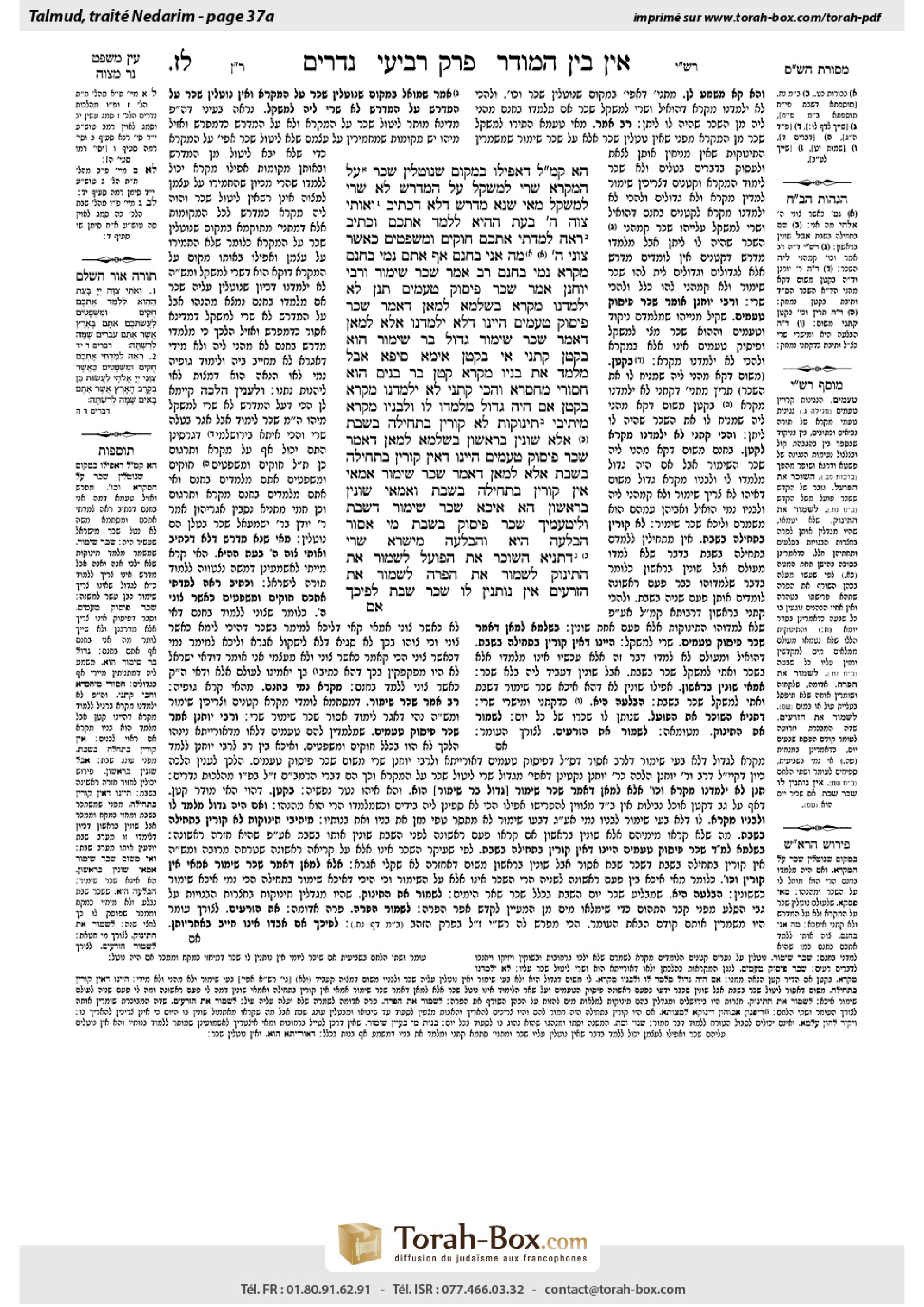
Nedarim 37a: Talmud study for Daf Yomi
Daf Yomi is the daily study of one Talmud folio. Explore 37 tractates with scans, Hebrew text, Sefaria English and AI-generated French translations where annotated.
Passage selection and English or AI-generated French translation are available where the scan has annotations. Daf Study is independent of Torah-Box and Sefaria.
Browse Nedarim · נדרים · All tractatesNedarim 37a text and translations
This page of Nedarim includes the Aramaic text, an English translation and an AI-generated French translation, alongside the scan above.
נדרים ל״ז א · Aramaic and Hebrew text
הָא קָא מַשְׁמַע לַן דַּאֲפִילּוּ בִּמְקוֹם שֶׁנּוֹטְלִין שָׂכָר, עַל הַמִּקְרָא שְׁרֵי לְמִשְׁקַל, עַל הַמִּדְרָשׁ לָא שְׁרֵי לְמִשְׁקַל.
מַאי שְׁנָא מִדְרָשׁ דְּלָא — דִּכְתִיב: ״וְאֹתִי צִוָּה ה׳ בָּעֵת הַהִיא לְלַמֵּד אֶתְכֶם״, וּכְתִיב: ״רְאֵה לִמַּדְתִּי אֶתְכֶם חֻקִּים וּמִשְׁפָּטִים כַּאֲשֶׁר צִוַּנִי ה׳״, מָה אֲנִי בְּחִנָּם — אַף אַתֶּם נָמֵי בְּחִנָּם. מִקְרָא נָמֵי בְּחִנָּם!
רַב אָמַר: שְׂכַר שִׁימּוּר. וְרַבִּי יוֹחָנָן אָמַר: שְׂכַר פִּיסּוּק טְעָמִים.
תְּנַן: לֹא יְלַמְּדֶנּוּ מִקְרָא. בִּשְׁלָמָא לְמַאן דְּאָמַר שְׂכַר פִּיסּוּק טְעָמִים — הַיְינוּ דְּלָא יְלַמְּדֶנּוּ, אֶלָּא לְמַאן דְּאָמַר שְׂכַר שִׁימּוּר — גָּדוֹל בַּר שִׁימּוּר הוּא? בְּקָטָן קָתָנֵי.
אִי בְּקָטָן, אֵימָא סֵיפָא: אֲבָל מְלַמֵּד אֶת בָּנָיו מִקְרָא, קָטָן בַּר בָּנִים הוּא?! חַסּוֹרֵי מְחַסְּרָא וְהָכִי קָתָנֵי: לֹא יְלַמְּדֶנּוּ מִקְרָא — בְּקָטָן, אִם הָיָה גָּדוֹל — מְלַמְּדוֹ לוֹ וּלְבָנָיו מִקְרָא.
מֵיתִיבִי: תִּינוֹקוֹת לֹא קוֹרִין בַּתְּחִילָּה בַּשַּׁבָּת, אֶלָּא שׁוֹנִין בָּרִאשׁוֹן. בִּשְׁלָמָא לְמַאן דְּאָמַר שְׂכַר פִּיסּוּק טְעָמִים — הַיְינוּ דְּאֵין קוֹרִין בַּתְּחִילָּה בַּשַּׁבָּת. אֶלָּא לְמַאן דְּאָמַר שְׂכַר שִׁימּוּר, אַמַּאי אֵין קוֹרִין בַּתְּחִילָּה בַּשַּׁבָּת, וְאַמַּאי שׁוֹנִין בָּרִאשׁוֹן? הָא אִיכָּא שְׂכַר שִׁימּוּר דְּשַׁבָּת!
וְלִיטַעְמָיךְ שְׂכַר פִּיסּוּק בְּשַׁבָּת מִי אָסוּר? הַבְלָעָה הִיא, וְהַבְלָעָה מִישְׁרֵא שְׁרֵי. דְּתַנְיָא: הַשּׂוֹכֵר אֶת הַפּוֹעֵל לִשְׁמוֹר אֶת הַתִּינוֹק, לִשְׁמוֹר אֶת הַפָּרָה, לִשְׁמוֹר אֶת הַזְּרָעִים — אֵין נוֹתְנִין לוֹ שְׂכַר שַׁבָּת. לְפִיכָךְ
Nedarim 37a · English translation
The Gemara answers: This teaches us that even in a place where one takes payment for teaching, for teaching Bible it is permitted to take payment, but for teaching midrash it is not permitted to take payment.
The Gemara asks: In what way is midrash different from Bible, that one may not take payment for teaching it? Based on that which is written, which Moses said to the people: “And the Lord commanded me at that time to teach you statutes and laws” (Deuteronomy 4:14), and also that which is written: “Behold, I have taught you statutes and laws, as the Lord my God commanded me, that you should do so in the midst of the land where you go in to possess it” (Deuteronomy 4:5), God said: Just as I teach you for free, without payment, so too you also shall teach for free. There should be no difference between Bible and midrash, and Bible too, like midrash, should be taught for free.
Rav said: As Bible is typically taught to children, one who teaches Bible takes payment for watching the children. And Rabbi Yoḥanan said: He takes payment for teaching punctuation of the text with cantillation notes.
We learned in the mishna that one for whom benefit from another is forbidden by a vow, that other person may not teach him Bible. Granted, according to the one who says that the payment is for teaching punctuation of the text with cantillation notes, this is the reason that he shall not teach him Bible, as teaching punctuation is a component of teaching the biblical text. However, according to the one who says it is payment for watching the students, is an adult one who requires watching, and would payment be taken for doing so? Since the teacher typically does not receive payment for teaching adults, there is no benefit when he teaches for free the one for whom benefit is forbidden; why, then, is it prohibited? The Gemara answers: The mishna is teaching about the case of a minor who requires watching and who is prohibited by a vow from deriving benefit from the teacher.
The Gemara asks: If it is the case of a minor, say the latter clause of the mishna: However, he may teach his sons Bible. Is a minor one who is capable of bearing sons? The Gemara answers: The mishna is incomplete, and this is what it is teaching: He may not teach him Bible, in the case of a minor. If the student is an adult, he may teach him and his sons Bible. He may teach him because he does not require watching, and he may teach his son because the payment is for watching his son.
The Gemara raises an objection from a baraita: Children may not read a passage in the Bible for the first time on Shabbat; however, they may review a passage that they already learned once. Granted, according to the one who says that payment for teaching Bible is for teaching punctuation of the text with cantillation notes, this is the reason that children may not read a passage in the Bible for the first time on Shabbat, as it would be necessary to pay the teacher. However, according to the one who says it is payment for watching the children, why may children not read a passage in the Bible for the first time on Shabbat? And why may children review a passage that they already learned once? Isn’t there payment for watching the children on Shabbat in both cases?
The Gemara responds: And according to your reasoning, is receiving payment for teaching punctuation prohibited on Shabbat? It is a case of incorporation of the payment for teaching on Shabbat into the teacher’s weekly salary, and incorporation is permitted, as it is taught in a baraita: One who hires a day laborer to watch a child, to watch a cow, or to guard seeds does not give him payment for Shabbat. Therefore,
Nedarim 37a · Traduction française (IA)
La Guemara répond : Cela nous enseigne que même là où l’on perçoit une rémunération pour enseigner, il est permis d’en percevoir une pour enseigner la Torah écrite, mais pas pour enseigner le midrach.
La Guemara demande : En quoi le midrach diffère-t-il de la Torah écrite, au point qu’il soit interdit de percevoir une rémunération pour l’enseigner ? Il est écrit, selon les paroles de Moïse au peuple : « Et le Seigneur m’ordonna alors de vous enseigner des statuts et des lois » (Deutéronome 4:14), ainsi que : « Voici, je vous ai enseigné des statuts et des lois, comme le Seigneur, mon Dieu, me l’a ordonné, afin que vous agissiez ainsi dans le pays où vous entrez pour en prendre possession » (Deutéronome 4:5). Dieu a dit : « De même que je vous enseigne gratuitement, sans rémunération, vous aussi, vous enseignerez gratuitement. » Il ne devrait donc y avoir aucune différence entre la Torah écrite et le midrach : la Torah écrite aussi devrait être enseignée gratuitement, comme le midrach.
Rav a dit : Comme la Torah écrite est généralement enseignée à des enfants, celui qui l’enseigne perçoit une rémunération pour surveiller les enfants. Et Rabbi Yoḥanan a dit : Il perçoit une rémunération pour enseigner la ponctuation du texte au moyen des signes de cantillation.
Nous avons appris dans la Michna que, lorsqu’une personne a fait le vœu de ne tirer aucun profit d’une autre, cette dernière ne peut pas lui enseigner la Torah écrite. Il est compréhensible que, selon celui qui dit que la rémunération est perçue pour enseigner la ponctuation du texte au moyen des signes de cantillation, ce soit la raison pour laquelle il ne doit pas lui enseigner la Torah écrite, puisque cet enseignement fait partie de celui du texte biblique. Cependant, selon celui qui dit qu’il s’agit d’une rémunération pour surveiller les élèves, un adulte a-t-il besoin d’être surveillé ? Percevrait-on une rémunération pour cela ? Puisque le maître ne reçoit généralement pas de rémunération pour enseigner à des adultes, celui qui est frappé de l’interdiction de tirer profit ne bénéficie de rien si le maître lui enseigne gratuitement. Pourquoi cela est-il alors interdit ? La Guemara répond : La Michna traite du cas d’un mineur qui a besoin d’être surveillé et à qui le vœu interdit de tirer profit du maître.
La Guemara demande : S’il s’agit d’un mineur, considérons la dernière partie de la Michna : « Toutefois, il peut enseigner la Torah écrite à ses fils. » Un mineur est-il en âge d’avoir des fils ? La Guemara répond : La Michna est incomplète, et voici ce qu’elle enseigne : Il ne peut pas lui enseigner la Torah écrite lorsqu’il s’agit d’un mineur. Si l’élève est adulte, il peut lui enseigner la Torah écrite, ainsi qu’à ses fils. Il peut l’enseigner à l’adulte, car celui-ci n’a pas besoin d’être surveillé ; et il peut l’enseigner à son fils, car la rémunération est perçue pour surveiller ce dernier.
La Guemara soulève une objection à partir d’une baraïta : Les enfants ne peuvent pas lire pour la première fois un passage de la Torah écrite pendant Chabbat ; toutefois, ils peuvent réviser un passage qu’ils ont déjà étudié une fois. Il est compréhensible que, selon celui qui dit que la rémunération pour enseigner la Torah écrite est perçue pour enseigner la ponctuation du texte au moyen des signes de cantillation, ce soit la raison pour laquelle les enfants ne peuvent pas lire un passage pour la première fois pendant Chabbat, car il faudrait rémunérer le maître. Cependant, selon celui qui dit qu’il s’agit d’une rémunération pour surveiller les enfants, pourquoi ne peuvent-ils pas lire un passage pour la première fois pendant Chabbat ? Et pourquoi peuvent-ils réviser un passage qu’ils ont déjà étudié une fois ? Dans les deux cas, le maître ne perçoit-il pas une rémunération pour surveiller les enfants pendant Chabbat ?
La Guemara répond : Mais, selon ton raisonnement, est-il interdit de percevoir une rémunération pour enseigner la ponctuation pendant Chabbat ? Il s’agit d’un cas où la rémunération de l’enseignement pendant Chabbat est incluse dans le salaire hebdomadaire du maître ; une telle inclusion est permise, comme l’enseigne une baraïta : Celui qui engage un journalier pour surveiller un enfant, surveiller une vache ou garder des semences ne lui verse pas de rémunération pour Chabbat. Par conséquent,
Traduction française générée par IA à partir de l’édition anglaise de Sefaria. Vérifie toujours un passage avec le texte source.
Text from Sefaria: William Davidson Edition - Vocalized Aramaic (CC BY NC); William Davidson Edition - English (CC BY NC).