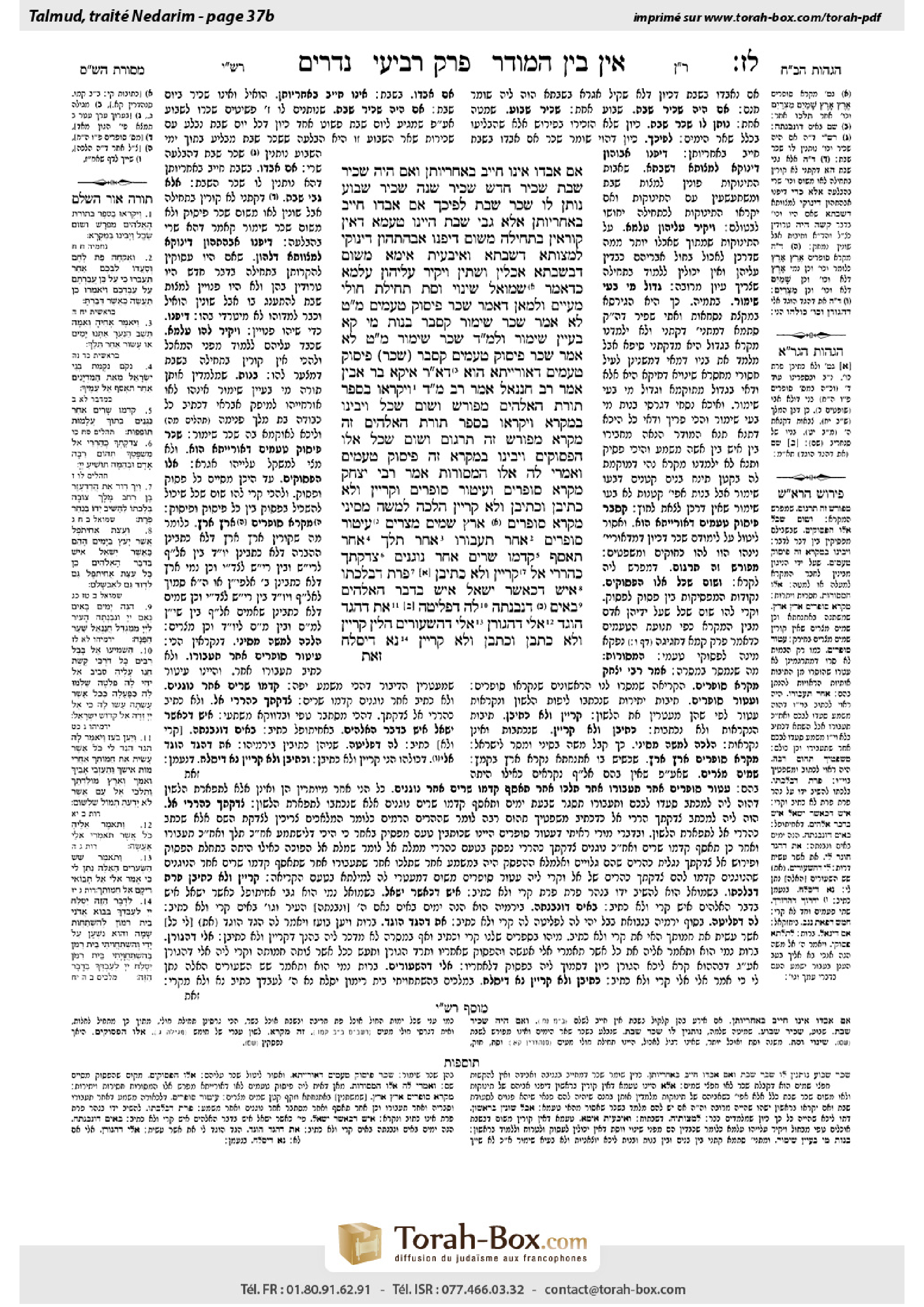
Nedarim 37b: Talmud study for Daf Yomi
Daf Yomi is the daily study of one Talmud folio. Explore 37 tractates with scans, Hebrew text, Sefaria English and AI-generated French translations where annotated.
Passage selection and English or AI-generated French translation are available where the scan has annotations. Daf Study is independent of Torah-Box and Sefaria.
Browse Nedarim · נדרים · All tractatesNedarim 37b text and translations
This page of Nedarim includes the Aramaic text, an English translation and an AI-generated French translation, alongside the scan above.
נדרים ל״ז ב · Aramaic and Hebrew text
אִם אָבְדוּ — אֵינוֹ חַיָּיב בְּאַחְרָיוּתָן. וְאִם הָיָה שְׂכִיר שַׁבָּת, שְׂכִיר חֹדֶשׁ, שְׂכִיר שָׁנָה, שְׂכִיר שָׁבוּעַ — נוֹתֵן לוֹ שְׂכַר שַׁבָּת. לְפִיכָךְ אִם אָבְדוּ — חַיָּיב בְּאַחְרָיוּתָן.
אֶלָּא: גַּבֵּי שַׁבָּת הַיְינוּ טַעְמָא דְּאֵין קוֹרְאִין בַּתְּחִילָּה — מִשּׁוּם דְּיִפְנוּ אֲבָהָתְהוֹן דְּיָנוֹקֵי לְמִצְוְתָא דְשַׁבְּתָא. וְאִיבָּעֵית אֵימָא: מִשּׁוּם דִּבְשַׁבְּתָא אָכְלִין וְשָׁתִין וְיַקִּיר עֲלֵיהוֹן עָלְמָא. כִּדְאָמַר שְׁמוּאֵל: שִׁינּוּי וֶסֶת תְּחִילַּת חוֹלִי מֵעַיִים.
וּלְמַאן דְּאָמַר שְׂכַר פִּיסּוּק טְעָמִים, מַאי טַעְמָא לָא אָמַר שְׂכַר שִׁימּוּר? קָסָבַר בָּנוֹת מִי קָא בָּעֲיָין שִׁימּוּר?
וּלְמַאן דְּאָמַר שְׂכַר שִׁימּוּר, מַאי טַעְמָא לָא אָמַר שְׂכַר פִּיסּוּק טְעָמִים? קָסָבַר (שְׂכַר) פִּיסּוּק טְעָמִים דְּאוֹרָיְיתָא הוּא.
דְּאָמַר רַב אִיקָא בַּר אָבִין אָמַר רַב חֲנַנְאֵל אָמַר רַב: מַאי דִּכְתִיב ״וַיִּקְרְאוּ בַסֵּפֶר בְּתוֹרַת הָאֱלֹהִים מְפֹרָשׁ וְשׂוֹם שֶׂכֶל וַיָּבִינוּ בַּמִּקְרָא״. ״וַיִּקְרְאוּ בַסֵּפֶר בְּתוֹרַת הָאֱלֹהִים״ — זֶה מִקְרָא, ״מְפֹרָשׁ״ — זֶה תַּרְגּוּם, ״וְשׂוֹם שֶׂכֶל״ — אֵלּוּ הַפְּסוּקִים, ״וַיָּבִינוּ בַּמִּקְרָא״ — זֶה פִּיסּוּק טְעָמִים. וְאָמְרִי לַהּ: אֵלּוּ הַמְּסוֹרוֹת.
אָמַר רַבִּי יִצְחָק: מִקְרָא סוֹפְרִים, וְעִיטּוּר סוֹפְרִים, וְקַרְיָין וְלָא כְּתִיבָן, וּכְתִיבָן וְלָא קַרְיָין — הֲלָכָה לְמֹשֶׁה מִסִּינַי.
מִקְרָא סוֹפְרִים: אָרֶץ, שָׁמָיִם, מִצְרָיִם.
עִיטּוּר סוֹפְרִים: ״אַחַר תַּעֲבֹרוּ״, ״אַחַר תֵּלֵךְ״, ״אַחַר תֵּאָסֵף״, ״קִדְּמוּ שָׁרִים אַחַר נֹגְנִים״, ״צִדְקָתְךָ כְּהַרְרֵי אֵל״.
קַרְיָין וְלָא כְּתִיבָן: ״פְּרָת״ דִּ״בְלֶכְתּוֹ״, ״אִישׁ״ דְּ״כַאֲשֶׁר יִשְׁאַל אִישׁ בִּדְבַר הָאֱלֹהִים״, ״בָּאִים״ דְּ״נִבְנְתָה״, ״לָהּ״ דִּ״פְלֵיטָה״, ״אֵת״ ״דְּהֻגֵּד הֻגַּד״, ״אֵלַי״ דְּ״הַגֹּרֶן״, ״אֵלַי״ דְּ״הַשְּׂעֹרִים״, הָלֵין קַרְיָין וְלָא כְּתִבָן.
וּכְתִבָן וְלָא קַרְיָין: ״נָא דְּ״יִסְלַח״,
Nedarim 37b · English translation
if the items that the laborer was entrusted to watch were lost on Shabbat, he does not bear financial responsibility to compensate the owners for them, since he is not a paid bailee on that day. And if he is a laborer hired for a week, hired for a month, hired for a year, or hired for seven years, the one who hired him gives him payment for labor performed on Shabbat as well. Therefore, if the items were lost on Shabbat, he bears financial responsibility to compensate the owners for them. If payment for Shabbat is incorporated within payment for a longer period, it is not prohibited to accept payment for permitted actions performed on Shabbat.
Rather, with regard to Shabbat, this is the reason that children may not read a passage in the Bible for the first time on Shabbat, so that the fathers of the children will be at leisure to fulfill the mitzva of delighting in Shabbat. Teaching new material to their children would occupy more of their fathers’ time, limiting their opportunity to fulfill that mitzva. And if you wish, say instead: Due to the fact that on Shabbat children eat and drink more than they are accustomed to eating, their world is heavy upon them, i.e., their head and their limbs are sluggish, and they are incapable of concentrating and studying well, as Shmuel said: A change in routine [veset] in eating and the like causes the onset of an intestinal ailment.
And according to the one who says that the payment for teaching Bible is payment for teaching punctuation of the text with cantillation notes, and therefore in the case of one for whom benefit from another is forbidden by vow, that other person may not teach his sons and daughters Bible, what is the reason that he did not say that it is payment for watching the children? The Gemara answers: He holds: Do girls need watching? They stay home and are not accustomed to going out.
The Gemara asks: And according to the one who says that the payment for teaching Bible is payment for watching the children, what is the reason that he did not say that it is payment for teaching punctuation of the text with cantillation notes? The Gemara answers: He holds that the punctuation of the text with cantillation notes is by Torah law; therefore, it is included in the prohibition against taking payment for teaching Torah.
This is as Rav Ika bar Avin said that Rav Ḥananel said that Rav said: What is the meaning of that which is written: “And they read in the book, in the Torah of God, distinctly; and they gave the sense, and caused them to understand the reading” (Nehemiah 8:8)? The Gemara explains: “They read in the book, in the Torah of God”; that is the Bible. “Distinctly”; that is the Aramaic translation. “And they gave the sense”; these are the division into verses. “And caused them to understand the reading”; this is punctuation of the text with cantillation notes, which facilitate the understanding of the verses. And some say: These are the traditions that determine the proper vocalization of the Bible. Rav holds that the cantillation notes are an integral part of Torah study.
On a related note, Rabbi Yitzḥak said: The vocalization of the scribes, and the ornamentation of the scribes, and the verses with words that are read but not written, and those that are written but not read are all halakha transmitted to Moses from Sinai.
The Gemara elaborates: The vocalization of the scribes is referring to words that when they appear at the end of phrases, clauses, or verses, their vocalization changes, e.g., eretz with a segol under the letter alef to aretz with a kamatz under the letter alef; shamayim with a pataḥ under the letter mem, to shamayim with a kamatz under the letter mem; and mitzrayim with a pataḥ under the letter reish, to mitzrayim with a kamatz under the letter reish.
The ornamentation of the scribes are expressions that the scribes understood in a manner that differs slightly from its plain understanding. For example: “Then [aḥar] go on” (Genesis 18:5); “then [aḥar] she will go” (Genesis 24:55); “afterward [aḥar] you will be gathered” (Numbers 31:2); “the singers go before, the minstrels follow after [aḥar]” (Psalms 68:26); “Your righteousness is like the mighty mountains” (Psalms 36:7).
Words that are read but not written are included in the halakha transmitted to Moses from Sinai. For example, the word “Euphrates” that is in the phrase “as he went to establish his control over the river Euphrates” (II Samuel 8:3) is not written in the text of the Bible. The same is true for the word “man” that is in the verse “now the counsel of Ahithophel, which he counseled in those days, was as if a man inquired of the word of God” (II Samuel 16:23); and for the word “come” that is in the verse “behold, the days come, says the Lord, that the city shall be built to the Lord from the tower of Hananel unto the gate of the corner” (Jeremiah 31:37); and for “her” that is in the phrase “let her not have escape” (Jeremiah 50:29); unto that is in the verse “it has been told me, all that you have done unto your mother-in-law” (Ruth 2:11); and for “to me” that is found in the passage “and she said unto her: All that you say to me I will do. And she went down to the threshing floor” (Ruth 3:4–5); and for “to me” that is in the verse “he gave me these six measures of barley; for he said to me” (Ruth 3:17). These words are read but not written.
And there are words that are written but not read. For example, the word “may” that is in the verse “may God forgive your servant” (II Kings 5:18) appears in the Bible text but is not vocalized.
Nedarim 37b · Traduction française (IA)
Si les objets confiés à la garde du travailleur sont perdus pendant Chabbat, il n’est pas financièrement responsable envers leurs propriétaires, puisqu’il n’est pas un gardien rémunéré ce jour-là. En revanche, s’il est engagé pour une semaine, un mois, une année ou sept années, celui qui l’a engagé lui verse également une rémunération pour le travail accompli pendant Chabbat. Par conséquent, si les objets sont perdus pendant Chabbat, il est financièrement responsable envers leurs propriétaires. Lorsque la rémunération du travail effectué pendant Chabbat est intégrée à celle d’une période plus longue, il n’est pas interdit d’accepter un paiement pour des activités permises accomplies pendant Chabbat.
Mais, en ce qui concerne Chabbat, voici pourquoi les enfants ne peuvent pas étudier pour la première fois un passage de la Bible pendant Chabbat : afin que leurs pères aient le loisir d’accomplir la mitsva de se délecter de Chabbat. Enseigner à leurs enfants une matière nouvelle prendrait davantage de temps à leurs pères et réduirait ainsi la possibilité d’accomplir cette mitsva. Et si tu le souhaites, dis plutôt que c’est parce que, pendant Chabbat, les enfants mangent et boivent davantage qu’à l’accoutumée : leur organisme s’en trouve alourdi, c’est-à-dire que leur tête et leurs membres sont engourdis, et qu’ils sont incapables de se concentrer et d’étudier correctement. En effet, comme l’a dit Chmouel : un changement d’habitude [veset], dans l’alimentation ou autre, provoque l’apparition d’une affection intestinale.
Et selon celui qui dit que la rémunération pour l’enseignement de la Bible est en réalité une rémunération pour l’enseignement de la ponctuation du texte au moyen des signes de cantillation, et que, par conséquent, dans le cas d’une personne qui a fait vœu de ne tirer aucun profit d’autrui, cette autre personne ne peut pas enseigner la Bible à ses fils et à ses filles, pourquoi ne dit-il pas que cette rémunération correspond à la garde des enfants ? La Guemara répond : il estime qu’il n’est pas nécessaire de garder les filles ; elles restent à la maison et n’ont pas l’habitude de sortir.
La Guemara demande : et selon celui qui dit que la rémunération pour l’enseignement de la Bible correspond à la garde des enfants, pourquoi ne dit-il pas qu’elle correspond à l’enseignement de la ponctuation du texte au moyen des signes de cantillation ? La Guemara répond : il estime que la ponctuation du texte au moyen des signes de cantillation relève de la Torah écrite ; elle est donc incluse dans l’interdiction de percevoir une rémunération pour enseigner la Torah.
C’est ce que Rav Ika bar Avin a dit au nom de Rav Ḥananel, qui l’a dit au nom de Rav : quel est le sens de ce qui est écrit : « Ils lisaient dans le livre, dans la Torah de Dieu, distinctement ; ils en donnaient le sens et leur faisaient comprendre la lecture » (Néhémie 8:8) ? La Guemara explique : « Ils lisaient dans le livre, dans la Torah de Dieu », c’est la Bible. « Distinctement », c’est la traduction araméenne. « Ils en donnaient le sens », ce sont les divisions en versets. « Ils leur faisaient comprendre la lecture », il s’agit de la ponctuation du texte au moyen des signes de cantillation, qui facilitent la compréhension des versets. Certains disent : il s’agit des traditions qui déterminent la vocalisation correcte de la Bible. Rav estime que les signes de cantillation font partie intégrante de l’étude de la Torah.
À ce propos, Rabbi Yits’hak a dit : la vocalisation des scribes, les ornements des scribes, les versets comportant des mots qui se lisent mais ne s’écrivent pas, ainsi que ceux comportant des mots qui s’écrivent mais ne se lisent pas, sont tous des halakhot transmises à Moïse depuis le Sinaï.
La Guemara précise : la vocalisation des scribes désigne les mots dont la vocalisation change lorsqu’ils se trouvent à la fin d’une proposition, d’une phrase ou d’un verset, par exemple eretz, avec un ségol sous la lettre alef, qui devient aretz, avec un kamats sous la lettre alef ; chamayim, avec un pata’h sous la lettre mem, qui devient chamayim, avec un kamats sous la lettre mem ; et Mitsrayim, avec un pata’h sous la lettre rech, qui devient Mitsrayim, avec un kamats sous la lettre rech.
Les ornements des scribes sont des expressions que les scribes ont comprises d’une manière qui diffère légèrement de leur sens simple. Par exemple : « Puis [aḥar], passez votre chemin » (Genèse 18:5) ; « puis [aḥar], elle partira » (Genèse 24:55) ; « ensuite [aḥar], tu seras réuni aux tiens » (Nombres 31:2) ; « Les chanteurs marchent devant, les musiciens suivent derrière [aḥar] » (Psaumes 68:26) ; « Ta justice est comme les montagnes puissantes » (Psaumes 36:7).
Les mots qui se lisent mais ne s’écrivent pas sont inclus dans la halakha transmise à Moïse depuis le Sinaï. Par exemple, le mot « Euphrate », dans l’expression « alors qu’il allait établir sa domination sur le fleuve Euphrate » (II Samuel 8:3), ne figure pas dans le texte de la Bible. Il en va de même pour le mot « homme » dans le verset « Le conseil d’Ahitophel, qu’il donnait en ces jours-là, était comme si un homme consultait la parole de Dieu » (II Samuel 16:23) ; pour le mot « viennent » dans le verset « Voici, les jours viennent, dit le Seigneur, où la ville sera bâtie pour le Seigneur, depuis la tour de Hananel jusqu’à la porte de l’Angle » (Jérémie 31:37) ; pour « elle » dans l’expression « qu’elle ne puisse pas s’échapper » (Jérémie 50:29) ; pour « à » dans le verset « On m’a rapporté tout ce que tu as fait pour ta belle-mère » (Ruth 2:11) ; pour « à moi » dans le passage « Elle lui dit : Tout ce que tu me dis, je le ferai. Elle descendit à l’aire » (Ruth 3:4–5) ; et pour « à moi » dans le verset « Il m’a donné ces six mesures d’orge, car il m’a dit » (Ruth 3:17). Ces mots se lisent mais ne s’écrivent pas.
Et il existe des mots qui s’écrivent mais ne se lisent pas. Par exemple, le mot « peut-être » dans le verset « Que le Seigneur veuille pardonner à ton serviteur » (II Rois 5:18) figure dans le texte de la Bible, mais n’est pas vocalisé.
Traduction française générée par IA à partir de l’édition anglaise de Sefaria. Vérifie toujours un passage avec le texte source.
Text from Sefaria: William Davidson Edition - Vocalized Aramaic (CC BY NC); William Davidson Edition - English (CC BY NC).